Author: Pan-African News Wire

  • Nigerian News Update: Why Yar’Adua Changed Gear on Jonathan

    Why Yar’Adua Changed Gear on Jonathan

    Meeting with Turai takes place

    Governors, PDP condemn troops deployment

    From Chuks Okocha and George Orji in Abuja, 02.27.2010

    Fresh facts have emerged as to why President Umaru Yar’Adua conceded the acting presidency to Dr. Goodluck Jonathan, which led to the clarification provided Thursday by the presidential spokesman, Olusegun Adeniyi that Jonathan remains the acting president and Commander-in-Chief of the Armed Forces.

    THISDAY learnt that following Adeniyi’s pronouncement on Wednesday in which he said the “president has directed the vice president should continue to run the affairs of the state” while he (Yar’Adua) is recuperating, the statement was said to have stirred the hornet’s nest and created uncertainty as to who was steering the ship of state.

    This prompted the governors’ caucus of the Peoples Democratic Party, the Speaker of the House of Representatives, Hon. Dimeji Bankole, and the leadership of the party to move swiftly to douse the tension the statement from the presidency had created.

    It was gathered that the governors of Bauchi State; Isa Yuguda, Kwara, Bukola Saraki; Kebbi, Ibrahim Dakingari; Katsina, Ibrahim Shema; and Gombe, Danjuma Goje, moved swiftly with the leadership of the PDP and Hon. Bankole to meet with the president’s aides to explain the implication of the divisive statement and get them to reverse it promptly.

    During the meeting which also had the president’s wife, Turai Yar’Adua in attendance, the governors and members of the party ironed out issues and counselled the president’s aides to issue a clarification so as not to exacebate the already tense atmosphere in the country.

    The governors and PDP leadership further told the president’s wife and his men that failure to reverse the statement will compel the party to issue a counter statement contradicting the president.

    Sources in the presidency explained that for the governors it was important to have the issue sorted out immediately because prior to the arrival of the president, there was an agreement reached with Yar’Adua, on the one hand, and the PDP governors’ caucus and the National Working Committee of the party, on the other, that the acting president would continue to act, while the president comes back home to recuperate fully from his illness.

    “But following the infl-ammatory statement, the PDP governor and party leadership were said to have been alarmed, and met with Turai and the president’s aides, and advised that a correction be made,” said one official.

    According to the official: “The meeting was meant to douse tension and correct the wrong impression that had been created by the statement.

    “It was imperative because the impression had been created that there was a rift in the presidency which was not the case, as both Yar’Adua and Goodluck had been elected on the same ticket.

    “So the governors of Bauchi, Kwara, Kebbi, Gombe, Katsina and the Speaker of the House of Representatives met on Wednesday night with the wife of the president, Turai and others to iron out issues.

    During the meeting with Turai and the president’s men, another issue that was brought to the fore was the deployment of troops into the streets of Abuja in the wee hours of Wednesday morning without the consent of the acting president.

    Sources allege that it may have been the Aide-de-Camp to the President, Colonel Mustapha Onoyiveta who directed the Brigade of Guards to move troops without recourse to his superiors in the army and the Acting President and Commander-in-Chief of the Armed Forces.

    The PDP leadership and the governors were said to be very concerned by the development and impressed it on the president’s handlers that by that singular action, the entire democratic institution could have been undermined because of the illegal order.

    They demanded that the close aide(s) of the president that gave the order be reprimanded, insisting that “it was unconstitutional and illegal to move out troops without the prior knowledge of the Commander-in-Chief, who is presently Dr. Goodluck Jonathan.”

    They called for an investigation into how the troops were moved without the necessary official permission.

    It was gathered that the governors also privately prevailed on Turai to set up a meeting between the president and the acting president as soon as possible.

    As at the time of this report, Jonathan and Yar’Adua were yet to have a one and one meeting.

    However, the acting president was said to have met with Turai Yar’Adua Thursday night to welcome the First Family back and pay condolences to her as a result of her ailing husband.

    Turai was said to have thanked the acting president and informed him that the president was upstairs resting from his trip but will be accessible once he is able to receive visitors.

    Prior to the Thursday night meeting, officials conversant with the meeting disclosed that only Hajia Turai, the Chief Security Officer to the President, Yusuf Tilde, and his ADC have access to the president.

    In a related development, as a sign that Jonathan is asserting his authority, he briefed presidency staff yesterday on how he intends to
    work.

    Presidency officials said “it was a meeting to harmonise the two offices, the president’s office and the VP’s office to work as one presidency.” There was no official statement after the meeting.

    Meanwhile Adeniyi yesterday shed more light on the president’s medical report said to have been sent to the acting president.
    Adeniyi stated that only one medical report was sent to Dr. Jonathan penultimate Friday, February 19 as opposed to numerous reports as was reported in the media.

    Adeniyi had on Thursday while providing clarification on the president’s directive that Jonathan remains the acting president and Commander-in-Chief, added that Jonathan had received Yar’Adua’s medical report while the latter was away in Saudi Arabia.

    Adeniyi denied newspaper reports that the acting president was receiving regular briefing on the health of the president while he was away.

    According to Adeniyi, “further to my interview with State House correspondents yesterday, I wish to clarify that only one medical report on President Umaru Musa Yar’Adua was sent to Acting President Goodluck Jonathan by the chief physician to the president, Dr Salisu Banye, through the Nigerian Ambassador to Saudi Arabia. This was on Friday, February 19, 2010.

    “The Acting President has not received any other medical report before or after that date,” he said.

  • Rebels With a Cause–And Plenty of Joy

    Rebels with a cause – and plenty of joy

    By Elisa Bray
    Friday, 26 February 2010

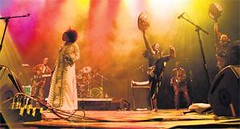
    From the soul: Sangare and her band at the Dome, Brighton

    The sixth African Soul Rebels package tour brings together three of Africa’s most radical artists, Oumou Sangare, Orchestre Poly-Rythmo and the Kalahari Surfers.

    It is the first major UK tour for Sangare, the queen of Wassoulou music and one of Mali’s biggest stars. Sangare invited the bands to join her because the three groups share a common goal in portraying African cultural richness to the rest of the world.

    For Sangare, there are other messages in her music: “My own cause is, and has always been women’s rights, and the rights of children. I want to both fight against hardship and inequalities but also show that there are strong African women with me in this struggle, and that we are making a difference.

    It’s true that when I sing it’s joyful, but in among that joy I always take the opportunity to slip in messages that educate my nation and my country (and beyond, when I go on tour). Where I come from, that’s very important. It’s true that people are happy to just listen to music, but they’re also interested in what the person is actually saying with the music.”

    It is also the first UK tour for Benin’s voodoo rockers Orchestre Poly-Rythmo – despite their 45 years as a band – and a rare sighting for Kalahari Surfers, who, since their 1984 debut album, have been censored at home in South Africa.

    On tour until 3 March

  • Algeria Probes Police Chief Murder

    Friday, February 26, 2010
    10:14 Mecca time, 07:14 GMT

    Algeria probes police chief murder

    Ali Tounsi had reportedly dismissed the police officer who shot him dead

    Algeria has opened a judicial inquiry into the killing of its national police chief, state radio reported.

    “A judicial enquiry has been opened to determine the circumstances of this distressing event,” the radio said quoting a ministry statement, without giving further details.

    The inquiry comes a day after Ali Tounsi was shot dead by one of his aides during a meeting in his office in Algiers, the capital.

    Algerian state media reported that the shooter, a retired officer, had been gripped by “madness” at the time.

    Arabic language daily El Khabar said the official, named in media reports as Chouib Woustache, opened fire after confronting Tounsi over reports the chief was planning to sack him.

    The reports were corroborated by Kamel Mansari, a journalist based in Algiers, who told Al Jazeera that the attacker – the chief commander of the police air division – had been dismissed by Tounsi a day earlier after weeks of disagreement.

    Checkpoints

    Mansari said police checkpoints had sprung up around Algiers following the incident.

    He also said rumours had been circulating in Algiers recently that Tounsi was about to be dismissed by the president.

    Several newspapers said an inquiry ordered by Tounsi into bribery allegations involving helicopter parts suppliers had implicated Woustache.

    “The perpetrator did not accept the conclusions of this inquiry,” the Arabic-language Echorouk daily said in its online edition.

    “He wasn’t ready to submit to any administrative sanction or be subjected to prosecution. He acted after getting wind that he was about to be fired.”

    The El Watan daily said on its website that the disgruntled official also fired on other colleagues present at the meeting, but there has been no official confirmation of this.

    Yazid Zerhouni, Algeria’s interior minister, paid tribute to the “fiery patriotism” of Tounsi, who took the job in 1994 when Algeria was battling anti-government Islamist fighters.

    “Tounsi gave his whole life to the service of his nation, to the anti-terrorist campaign over the past 16 years and to the modernisation of national security,” the minister said.

    Source: Al Jazeera and agencies

  • Afghanistan War Bulletin: Resistance Fighters Attack Kabul; US Plans Offensive in Kandahar

    Friday, February 26, 2010
    20:29 Mecca time, 17:29 GMT
    Taliban fighters attack Kabul

    Several suicide bombers attacked a hotel popular with foreigners in Kabul, the Afghan capital

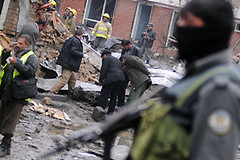
    At least 17 people were killed and 32 wounded when several suicide bombers attacked a hotel popular with foreigners and the surrounding area in the centre of Kabul.

    The Taliban have claimed responsibility for Friday’s attack, one of the deadliest on the Afghan capital in a year.

    Ten Indians, an Italian and a Frenchman were among the dead, officials said.

    Attacks on guesthouses used by foreigners have increased in recent months.

    The first blast occurred at about 06:45 local time, near the Kabul City Centre, Kabul’s largest shopping centre located in the city’s main commercial district, that includes the Safi Landmark Hotel.

    That was followed by two smaller explosions.

    Sporadic gunfire was heard in the area as ambulances raced to the scene and grey smoke billowed into the air.

    Police say at least two police officers were among those killed in the blasts.

    The Reuters news agency quoted Zabiullah Mujahid, a Taliban spokesman, as saying “holy warriors” had “managed to attack in the heart of Kabul city once again”.

    He said at least five Taliban fighters launched the attack, including two suicide bombers who detonated explosives-packed vests near the hotel and a shopping mall, Reuters reported.

    ‘Crying and shouting’

    Witnesses said people in pyjamas were led from the Park Resident hotel and taken away in ambulances.

    Friday’s attack came as US, Afghan and Nato forces push ahead with Operation Moshtarak

    Najibullah, a 25-year-old hotel worker, said he ran out of the hotel when he heard the first explosion. He said he saw two suicide bombers on the site.

    “I saw foreigners were crying and shouting,” he said.

    “It was a very bad situation inside. God helped me; otherwise I would be dead. I saw one suicide bomber blowing himself up on the first floor of the hotel.”

    The Park Residence was previously attacked in mid-2005, when a suicide bomber struck the hotel’s internet cafe.

    Dr Subodh Sanjivpaul told The Associated Press news agency that he was trapped in his bathroom for three hours inside one of the small hotels where he lived with other Indian doctors.

    “Today’s suicide attack took place in our residential complex,” he said as his wounded foot was bandaged.

    “When I was coming out, I found two or three dead bodies. When firing was going on, the first car bomb exploded and the full roof came on my head.”

    Indians ‘targeted’

    Hamid Karzai, the Afghan president, called Friday’s assault a “terrorist attack against Indian citizens” , who were working to help rebuild Afghanistan.

    S.M. Krishna, India’s foreign minister, described the attacks as “barbaric” and a matter of “deep concern”.

    “These are the handiwork of those who are desperate to undermine the friendship between India and Afghanistan,” he said in a statement.

    The Indian Embassy in Kabul has been the target of two major attacks, one in July 2008 that killed more than 60 people and another last October that killed 17 people.

    Al Jazeera’s correspondent in Kabul, Hoda Abdel-Hamid, said that the attack was a message from the Taliban that it would continue its activities despite a major offensive against it in Helmand province.

    “There is a concern that as the Nato push against the Taliban goes on, these types of attacks will increase as a result.

    “The Taliban is showing that they too are very strong-willed and that they will attack anywhere and anytime they want.

    “An attack like this one sends a message that no one is really safe, that even a city like Kabul, with heavy security, is not safe from the conflict anymore,” she said.

    She said that since Operation Moshtarakbegan 12 days ago, Kabul has been largely safe although attacks have occurred elsewherein Afghanistan.

    Nato ‘outrage’

    Anders Fogh Rasmussen, the Nato secretary-general, expressed outrage over the dawn assault.

    “I strongly condemn the terrorist attack which took place this morning in Kabul,” Rasmussen said in a statement.

    “Once again, the enemies of Afghanistan have killed innocent civilians, Afghans and international workers alike.”

    After 12 days of fighting, Brigadier General Larry Nicholson, commander of US marines in southern Afghanistan, had welcomed Thursday’s flag-hoisting in Marjahas “a new beginning” as Afghan government authority was restored.

    Afghans “believe there is a fresh start for Marjah under the government of Afghanistan”, he said as the country’s flag was hoisted by the governor of Helmand province in front of several hundred residents.

    Humanitarian groups have said residents are facing deteriorating conditions as food, medicine and other supplies run dangerously low and innumerable Taliban-planted bombs make movement in and out of Marjah perilous.

    Source: Al Jazeera and agencies

    Friday, February 26, 2010
    22:05 Mecca time, 19:05 GMT

    US ‘planning Kandahar offensive’

    Operation Moshtarak was launched to push Taliban fighters out of Marjah and surrounding areas

    The United States is planning to launch a military offensive in Afghanistan’s Kandahar city following the military operation to drive Taliban fighters out of the town of Marjah in Helmand province, a senior US official has said.

    “I think the way to look at Marjah, it’s the tactical prelude to larger, more comprehensive operations later this year in Kandahar city,” news agencies quoted the unnamed official as saying on Friday.

    Afghan troops raised their flag over Marjah as the town was symbolically handed over to the Kabul government’s control after two weeks of fighting by a joint Afghan, Nato and US Marine force.

    The senior US official told reporters that the military operation was “pretty much on track”, but cautioned that it would be several more weeks before Nato troops had cleared the area of Taliban fighters.

    The Marjah offensive was an early test of the new strategy of Barack Obama , the US president, to send an additional 30,000 troops to Afghanistanto win control of Taliban-held areas and put in a civilian administration.

    Kandahar ‘very important’

    General Stanley McChrystal, the commander of US and Nato troops in Afghanistan, said earlier this week that “Operation Moshtarak” was a “model for the future”.

    “We are going to go to where significant parts of the population are at risk and Kandahar is clearly very, very important not just to the south but to the nation,” he told Britain’s The Timesnewspaper.

    “It is not the only area though.”

    Kandahar is Afghanistan’s second biggest city and has been a centre for Taliban resistance since the movement was forced from power by the US-led invasion in 2001.

    “If the goal in Afghanistan is to reverse the momentum of the Taliban … then we think we have to get to Kandahar this year,” the US administration official was quoted as saying.

    “Bringing security, comprehensive population security to Kandahar city is the centrepiece of operations this year. Therefore, Marjah is the prelude, a sort of a preparatory action.”

    Al Jazeera’s Patty Culhane, reporting from Washington, said that the reported plans for a Kandahar offensive would fit with comments made byofficials before the Marjah operation.

    “This all fits in with Obama’s plan to surge 30,000 troops to Afghanistan and then set a timeline for withdrawal,” she said.

    “Sources were telling me this is what the plan was … They were going to focus on 80 distinct areas and they thought if they could secure those they could connect the dots and form a ‘U’ around the country.

    “The reason they want to do this is because they believe that could be the main economic artery, the main road that hits most of the population centres.

    “They are not necessary trying to secure the whole country, just the main population centres.”

    Taliban ‘confused’

    A British commander said on Friday that the Helmand offensive had left Taliban fighters “disorientated”.

    “One of the key conclusions from what the commanders on the ground have seen is the degree of dissipation and confusion the Taliban are experiencing,” Major General Gordon Messenger told reporters in London.

    “There is increasing evidence that they feel under pressure and are moving out of the area.

    “Insurgent activity across the area is levelling off and in some cases experiencing a bit of a lull.”

    However, Taliban fighters showed that they still had the ability to strike elsewhere in the country, killing at least 17 people in suicide bomb and gun attacks on a number of guesthouses in the capital Kabul on Friday.

    Source: Al Jazeera and agencies

  • Anita Baker Avoids Jail in Divorce Court Fight Over Royalties

    February 26, 2010 http://detnews.com/article/20100226/ENT05/2260428

    Anita Baker avoids jail in divorce court fight

    DOUG GUTHRIE AND SUSAN WHITALL
    The Detroit News

    Detroit –Singer-songwriter Anita Baker will not go to jail today and is negotiating to allow a judge to research how much her ex-husband is owed in music royalties.

    “I think we’ve gotten to the heart of it,” Wayne County Chief Family Court Judge Lita M. Popke said, vowing to complete the necessary documents in court today.

    Popke ordered Baker to attend a contempt of court hearing this morning after she failed Thursday to explain why she hadn’t followed orders to sign letters authorizing a court-appointed expert on music industry contracts to seek information from record companies about payments for the music she has written and performed.

    Baker got her chance to speak under oath to the judge today, expressing her anxiety about being under the threat of jail.

    “I just want to go home,” said Baker, of Grosse Pointe.

    “I want you to go home too,” Popke told the eight-time Grammy Award winner.

    Baker’s 2008 divorce from Walter Bridgforth Jr. called for an even split of royalties from two albums made during the couple’s 20-year marriage, “Giving You the Best I Got” in 1988 and “Rhythm of Love” in 1994.

    Popke on Thursday said Baker has been uncooperative in an effort to establish how much Bridgeforth is owed. Detroit entertainment attorney Howard Hertz, who represents Eminem, among other clients, was appointed by the judge as a music contract expert in an effort to settle the dispute.

    When speaking to the judge, Baker pointed out objections to language that might be interpreted as a final decision about money owed to Bridgforth.

    Although Baker signed similar letters of direction after her divorce, the new letters contain demands for “mechanical” royalties, or the inclusion of songs created during the marriage on more recent “best of” albums.

    Baker objected to the judge that this is an area that wasn’t negotiated in the divorce.

    “I think I understand Ms. Baker’s objection,” Popke said before ordering Hertz to meet today with Baker to hammer out new language in the letters to music companies.

    “Before you go into that meeting, I want you to understand it’s not under the threat of jail or contempt. I am not going to hold you in contempt,” the judge told Baker. “I don’t want you to feel coerced.”

    Baker has complained that “experts” have dominated court proceedings since her divorce began in 2007. She has said she wanted to speak directly to the judge.

    Much of the court file on Baker’s divorce, including documents that detailed the financial settlement between the couple, was ordered sealed in 2007 by Judge Bill Callahan.

    Newer documents pertaining to the fight over royalties indicate Baker in 2009 was receiving $200,000 a year from one of the several record companies with which she has held contracts.

    Bridgforth has objected to accounting that claims, after expenses, that his half of the royalties from Atlantic and Rhino records amounted to $12,000 in 2009.

    Baker’s profits also were greatly reduced by production costs. The court file doesn’t indicate what Baker has been paid by other sources, including music publishers BMI and ASCAP, and digital sales, satellite and Internet play.

    Part of the package of agreed to documents includes a protective order that will keep secret all information discovered by Hertz from everyone but the court and the lawyers involved in the case.

    Bridgforth didn’t attend the hearings on Thursday or today.

  • Nehanda Abiodun: Rap on the Run, A Political and Cultural Biography

    Rap On The Run

    Written by Ron Sharp, 2008

    Wanted by the FBI for black activism in the States, Nehanda Abiodun fled to Havana, where she became the “godmother of Cuban hip-hop”

    Outside a run-down apartment block in the eastern suburbs of Havana, a group of teenagers plays football in the street. They meet and greet each other like long-lost friends with hugs and slapped handshakes, and gesture to the top of a nearby building. If you follow their instructions to climb four flights of stairs, you can hear the sounds of local rhythms echoing down a corridor where a party is in full swing. Inside a tiny flat, a dozen people sit around a sitting room where the conversation and white rum flow freely.

    The occasion is the 58th birthday party of the apartment’s owner, Nehanda Abiodun. She cuts a fine figure, a black woman who looks younger than her age, and she’s in celebration mode today, but her happiness belies the intensity of her life’s struggle. Abiodun, who was born Cheri Dalton, is wanted by the US Federal Bureau of Investigation in connection with a string of robberies, including a 1981 hold-up of an armoured car near Nyack, in upstate New York. An exile in Havana for the past 20 years, she is now known as the “godmother” of Cuban hip-hop and founder of a Havana chapter of Black August, a seminal group that promotes hip-hop culture at the grass roots. Since the chapter’s formation it has held charitable concerts in New York and Havana featuring high-profile artists such as Erykah Badu, Mos Def, Common and Dead Prez, and until 24 August its work will be one of the highlights of this year’s Havana Hip-Hop Meeting and Festival.

    Abiodun’s life has been inextricably linked with protest, and the music of protest, since her youth. Born in 1950, graduating from Columbia University in 1972, she formed her extreme political beliefs – those of “New Afrikans”, political idealists who believed in the foundation of a black-only state within US borders – while working at an experimental drug detox programme in the South Bronx, New York. The programme operated under the banner of a militant black rights group that viewed the political radicalisation of its patients as essential.

    “I came of age during the 1960s, a time of unrest, sit-ins, student strikes, mass protests and urban rebellions,” explains Abiodun as various friends, and their relatives, sit on her knee. “The music that was being composed at that time reflected what was happening across the nation. Songs like [James Brown’s] “I’m Black and I’m Proud”, [Marvin Gaye’s] “What’s Going On” and [McFadden and Whitehead’s] “Ain’t No Stopping Us Now” were tunes not only to dance to, but which had lyrics that made you think and want to be involved in positive social and political change.

    “Hip-hop for me was a continuation of that tradition. At the beginning it was a very important contributor to community debate regarding the conditions that existed, and still persist, in US cities,” she says.

    It is alleged by the US authorities that the group Abiodun was involved with went on to form the core of “the Family”, a politically motivated, New York-based underground crime organisation. They began robbing banks, and by late 1979 were hitting armoured cars. In the 1981 attempted robbery, a guard was killed. Then, in the shoot-out that followed, two police officers were killed and a third was wounded. The FBI believes Abiodun was driving a getaway car with several Family members, all of whom escaped.

    By 1990, Abiodun had settled in Havana. “People like me are here for a reason,” she says. “I believe there is solidarity from the Cuban government with the struggles we are involved in. So even though the US might consider us criminals, it depends who you are talking to or where you are in the world. Are you a criminal or a freedom fighter? Mandela was considered a terrorist but in reality was and is still a hero.”

    She began working with Cuban rappers when she was first introduced to local hip-hop artists such as Primera Base, Doble Filo and Amenaza. “In the late Nineties a delegation of young people from the hip-hop generation [New York-based writers and “socially responsible” creatives such as Danny Hoch, Cristina Verán and Clyde Valentin] came to Cuba to participate as journalists in the island’s hip-hop festival,” she explains. “And some of the individuals were friends with people in the US who are members of the organisation I belong to [Black August]. Some of these people in Cuba asked me along to the festival and I was like, ‘I’m not going to any hip-hop concert.’ I was really disillusioned with hip-hop at that time.”

    It was the time when east coast v west coast friction was at its apotheosis, manifesting itself in the 1996 shooting of the west coast rapper Tupac Shakur and death of the east coast hip-hopper Notorious BIG the following year. Shakur’s godmother and Abiodun’s close friend, the former Black Panther Assata Shakur, is another high-profile Havana exile (in 2005 the FBI placed a $1m reward on her head for the alleged murder of a New Jersey state trooper in 1973).

    “Part of it was the kindness of young people, inviting an old lady like me,” Abiodun continues. “It was the last night of the festival and I am sitting there, and there was this song performed by Primera Base about Malcolm X and I was like, ‘Whoah!’ It kind of overwhelmed me, and all of us in that stadium. The chorus was not to my liking.” She goes on to explain that it included “the N-word”. “As a person who has struggled for the dignity of African people, I found the usage of the word offensive.” But she says she saw enough “positivity” from among the new-wave Cuban rappers to inspire her to become more involved.

    “The Cuban hip-hop community had earned my respect. To put on the festival like that, they had worked miracles with the very few material resources available. So I said I would make a commitment to the young people; that it would be nice if those of us in touch with hip-hop communities in the US would give material support to the Cuban rappers. Young people from the Havana hip-hop community started coming to me and asking about Malcolm X and various issues regarding progressive struggles in the US and other parts of the world. So we just talk all the time. It is very rewarding to me.”

    The history of Cuba’s hip-hop scene is defined by two phases. Up until the mid-1990s, it generally consisted of imports of American material, but the fall of the Soviet Union, Cuba’s main trading partner, crippled its economy, forcing more home-grown alternatives to prosper. One record epitomised this transition: Amenaza’s 1996 release “Ochavón Cruzao” – the title plays upon antiquated categories of racial classification, and the song addresses racism and Cuba’s mixed-race population. Members of Amenaza later emigrated to Europe and formed the nucleus of Orishas, a Grammy-winning group that has released four critically acclaimed albums and now has a worldwide following.

    Having initially tested the Cuban government’s tolerance for freedom of expression, the genre is now backed officially, through the Agencia Cubana de Rap (Cuban Rap Agency), which provides a state-run record label and hip-hop magazine.

    Racism is a topic still hugely relevant to the Cuban hip-hop scene. “It manifests itself as the retaining of certain ideas and language within people of a certain generation,” says Abiodun. “I am a lighter-skinned black woman. If I were to marry someone darker-skinned some people would describe me as ‘taking the race back’. If I were to marry someone who has European features I would be seen as ‘taking the race forward’. And if you do something worthwhile people might say, ‘Oh, that’s a very white thing to do.’

    “In Cuban hip-hop, most of the lyrics speak to what the artist feels she or he is confronted with daily,” she says. “I of course cannot speak for them, but I can safely say that they have been responsible for bringing to the stage topics that in the past were discussed or debated only in small intellectual circles and not made available to the public at large.”

    Now, Abiodun’s focus is back on the US, where exciting political change could spell a sea change in the lives of young black Americans. “I really hope that [the Democratic presidential hopeful] Barack Obama wins,” she says. “I’m not sure what I feel about this, because if it’s generally known that people like me support him it will be used against him. One day I hope I will go home. One never loses faith. He could bring that about if he was president. He would have the power to do that . . . though I doubt that he would.” A broad smile settles across her face, and the party continues well into the night.

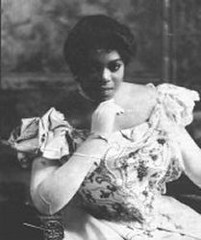
  • Pages From History: A Biography of Sissieretta Jones (1869-1933)

    Sissieretta Jones (1869-1933)

    Born Matilda Joyner in Portsmouth, Virginia, Jones moved to Providence, Rhode Island at an early age. Her father was the pastor and choir director of the Portsmouth, Virginia African Methodist Episcopal Church and her mother was a soprano in the choir. It is believed that Sissieretta Jones inherited her voice from her mother. She showed her talent as a singer as early as five years old.

    Married at age 14, she started voice training in Providence. Although it is a matter of conjecture, most sources state that she continued her studies at the New England Conservatory in Boston. She made her professional debut in Providence, which led to a tour of Europe, South America, and the West Indies with the famous Tennessee Jubilee Singers.

    James Weldon Johnson observed that she possessed “the natural voice, the physical figure, the grand air and the engaging personality,” characteristic of a great singer. The Washington Post described her voice as: “A phenomenal attraction … the upper notes of her voice are clear and bell-like…and her low notes are rich and sensuous with a tropical contralto quality…In fact, the compass and quality of her registers surpass the usual limitations and seem to combine the height and depth of both soprano and contralto.” Critics concurred that Sissieretta coerced the “musical and theatrical worlds in the United States to accept the Negro in a new image.”

    Compared to the Italian soprano at the time, Adelina Patti, Jones was pejoratively dubbed the “Black Patti”. She vehemently disapproved of the name, yet it stuck and it was used in the name of her vaudeville act. Black Patti’s Troubadours was composed of singers and dancers, featuring Sissieretta, which toured the United States and abroad for 20 years. The company’s repertoire included minstrel performances. Although Patti considered this aspect of the show demeaning, she sought to improve its overall quality and simultaneously extend her repertoire by including spirituals and arias in her finale.

    She performed for several presidents of the United States, the Prince of Wales and the Kaiser and at places like the Chicago World’s Fair and Madison Square Garden. She was barred from performing at the Metropolitan Opera in New York. Despite this, she had many successes, some of which qualify as breakthroughs. (It was not until 1955 that the color bar was lifted at the Metropolitan Opera with a performance by the contralto Marian Anderson.)

    Performing for totally white audiences who viewed her as an anomaly, she was heralded as the premier African-American singer of her time. Despite the inequities and indignities she experienced, she forced whites to see blacks as capable, dignified, and talented. She paved the way for black opera singers such as Marian Anderson, Leontyne Price, Jessye Norman, and Kathleen Battle.

    Symptomatic of black performers in the past, she had to deal with mismanagement and died penniless in 1933.

    She sang her way into history

    SISSIERETTA JONES

    Journal-Bulletin file photo

    More than a century ago, the walls of the Congdon Street Baptist Church reverberated with the “sweet, clear” voice of a young woman who went on to become a music legend.

    Madame Sissieretta Jones, who grew up in Providence, toured the world to share her “soprano voice of great richness,” considerable range and “impeccable enunciation,” one critic said. Critics credited Sissieretta with forcing the “musical and theatrical worlds in the United States to accept the Negro in a new image.”

    Jones was the first black woman to sing at Carnegie Hall, she sang for the Prince of Wales, and was invited to the White House to sing before three different presidents, including Benjamin Harrison in 1882.

    “She had most of the qualities essential in a great singer: the natural voice, the physical figure, the grand air and the engaging personality,” said James Weldon Johnson, a contemporary lyricist of the time.

    Jones was born Matilda Sissieretta Joyner in Portsmouth, Va., in 1869. She was the daughter of a Baptist minister, Jeremiah Joyner, and Henrietta Joyner, from whom Jones apparently inherited her enchanting soprano voice.

    When Jones was 7, the family moved to Providence, in search of better educational and economic opportunities.

    At 14, she began her first formal music training at the Providence Academy of Music and at music schools in Boston. The same year, she married David Richard Jones, “a gambling man” who went on to manage his wife’s career and lavishly spend their money until the couple divorced, in 1900.

    In 1892, at the age of 23, Jones sang in New York’s Madison Square Garden.

    A newspaper review of the performance compared her to famous Italian opera singer Adelina Patti, and it condescendingly tagged Jones as “the Black Patti,” a nickname she disliked but was unable to shake.

    Shortly afterward, Jones was considered to be cast in the lead role of a performance at the Metropolitan Opera House in New York, which would have fulfilled her dreams. Racial prejudice kept her from appearing on stage. The Met’s color barrier stayed in place for another 60 years, until Marian Anderson became the first black person to sing a lead role there, in 1955.

    From 1895 to 1916, Jones led a troupe of singers and musicians on a tour through the United States and abroad. Called the Black Patti Troubadours, the group performed minstrel shows and musical skits.

    While Jones initially considered the minstrel performances demeaning, she was able to expand her repertoire by singing spirituals and opera arias for the show’s finale. The show served as a training ground for hundreds of black entertainers.

    Jones was given many gifts from admirers, among them, a medal from President Hippolyte of Haiti, a bar of diamonds and emeralds from the citizens of St. Thomas, an emerald shamrock from the Irish people of Providence and a diamond tiara from the governor general of a West Indies island. She often wore her 17 medals across her chest during performances.

    After touring for about 20 years, the Troubadours disbanded, and Jones returned to her home in Providence to care for her ailing mother and grandmother.

    She lived the next 18 years at her home on Wheaton Street, taking in homeless children and selling mementos from her days of glory to pay her living expenses.

    Jones died of cancer in June 1933 in Rhode Island Hospital. She was buried in Grace Church Cemetery, Providence.

    Story by KAREN A. DAVIS

    Sources: Dictionary of American Negro Biography, edited by Rayford W. Logan and Michael R. Winston; Puritans, Pioneers and Pacesetters; eight people who shaped Rhode Island, by Marie Fontaine and Janice O’Donnell, and Providence Journal-Bulletin articles.

  • Pages From History: Hallie Quinn Brown (1849-1949): A Biography

    Hallie Quinn Brown: A Biography

    Hallie Quinn Brown was born in Pittsburgh, Pennsylvania in 1849, the daughter of two former slaves, Thomas Arthur Brown and Frances Jane Scroggins. Allowed to purchase his freedom, Thomas was the son of a Scottish woman who owned a Maryland plantation and the plantation’s black overseer.

    Frances was freed by one of her grandfathers, a white Revolutionary War officer and plantation owner. Both were well educated, her father became known as “Mr. Brown, the walking encyclopedia”, and her mother was an unofficial advisor and counselor to the students of Wilberforce University, a private, coeducational, historically black liberal arts college. Both Thomas and Frances were actively involved with the Underground Railroad. Her parents’ commitment to the cause would later influence the organizations Brown founded and participated in.

    The Brown Family moved from Pittsburgh to Ontario, Canada in 1864 and then to Wilberforce, Ohio in 1870. Brown attended Wilberforce University, and graduated from there in 1873, with a Bachelor of Science degree. After graduation, she began teaching on the Senora Plantation in Mississippi and went on to teach on several plantations during her life. Her efforts focused on improving the literacy levels of black children who had been denied the chance during slavery.

    Several years later she moved onto Columbia City Schools and then to Allen University in Columbia. Brown served as the Dean at Allen University from 1885 to 1887. From 1887 to 1891, she taught night school for African Americans in Dayton, Ohio. And in 1892 was appointed principal (Dean of Women) of Tuskegee Institutes in Alabama from 1892-1893, where she worked with Booker T. Washington. Returning to Ohio, Brown taught in the Dayton Public Schools for four years and established an adult class for migrant workers.

    In 1893, Brown was the principle promoter of the organization of the Colored Women’s League of Washington, D.C. She also founded the National Association of Colored Women (NACW) that same year. Brown began traveling in 1894 as a lecturer and public speaker for African American culture and temperance. During her travel, she spoke before Queen Victoria (Alexandria 1819-1901 Queen of Great Britain 1837-1901), the 1895 Convention of the World’s Women Christian Temperance Union in London, and the 1899 International Congress of Women, as a representative of the United States.

    In 1900, the A.M.E church elected Brown as their Secretary of Education where she became the first woman to serve as a “daughter of the church.” She also served as the President of the Ohio Federation of Colored Women’s Clubs from 1905 to 1912. In 1910, she spoke as a representative to the Woman’s Missionary Society of the African Methodist Conference, which was held in Edinburgh. Brown was also was active in Republican politics during the 1920s and addressed the party’s national convention in 1924 leading to her campaign work among African American women backed by President Coolidge.

    She became the 7th National President of the NACW from 1920 to 1924 and acted as its honorary President until her death in 1949. During the time she served as the President of the N.A.C.W., she pursued two major projects: one was dedicated to the maintenance of Fredrick Douglass’ home as a memorial in Washington, D.C., and the other was the establishment of the Hallie Q. Brown Scholarship Fund for the education of women.

    Brown died on September 16, 1949, in Wilberforce, Ohio, of coronary thrombosis. Two buildings are named in her honor: the Hallie Q. Brown Memorial Library in Wilberforce, Ohio, and our Community Center.

    In addition to her speeches, Brown authored several books and prose collections including: Bits and Odds: A Choice Selection of Recitations, published in 1880; First Lessons in Public Speaking, published in 1920; The Beautiful: A Story of Slavery, published in 1924; Tales My Father Told. Published in 1925 and Homespun Heroines and Other Women of Distinction, published in 1926. Brown’s works commonly address such topics as the importance of history and of social change, often using African American vernacular to stress these messages with the goal of helping to educate.

    Of particular note is Homespun Heroines, wherein Brown tells the life story of 60 African American women. In the introduction she states the context: “This book is presented as an evidence of appreciation and as a token of regard for the history-making women of our race.” Within it, Brown includes a description of significant events in each of the women’s lives, along with things they have accomplished. Every story begins with the birth of a distinguished woman and concludes with a statement about the life each has led.

  • A Biography of Opera Singer Lillian (Evans) Evanti (1891-1967)

    Evans, Annie/Evanti, Lillian (1891-1967)

    Lillian (Evans) Evanti, one of the first African American women to become an internationally prominent opera performer, was born in Washington D.C. in 1891. Evanti was born into a prominent Washington, D.C. family. Her father, Wilson Evans, was a medical doctor and teacher in the city. He was the founder of Armstrong Technical High School and served many years as its principal. Anne Brooks, Evanti’s mother, taught music in the public school system of Washington D.C.

    Evanti received her education from Armstrong Technical High School and graduated from Howard University in 1917 with her bachelor’s degree in music. A gifted student and performer, she was able to speak and sing in five different languages. The following year she and Roy W. Tibbs, her Howard University music professor, married and had a son, Thurlow Tibbs.

    Combining her maiden and married names into the stage name, Evanti, a lyric soprano, began singing professionally in 1918. Her career progressed slowly until she moved to France in 1925 where she became the first African American to sing with a European opera company. From France she traveled around Europe and on occasion returned to the United States to perform.

    During her travels she gave radio performances, sang in a variety of operas and in 1932 was given a chance to audition for the New York Metropolitan Opera. Evanti was not asked to join the Company and for some time blamed the decision on racial discrimination.

    Despite the setback Evanti remained popular, performing in Latin America as well as Europe. She gave a special command performance for President Franklin D. Roosevelt and his wife, Eleanor in 1934. She also performed concerts for the armed forces during World War II.

    In 1941 Evanti and Mary Cardwell Dawson created The National Negro Opera Company in Pittsburgh to provide a venue for African American performers. A series of Company performances of La Traviata, where Evanti sang the part of Violetta, was hugely successful and attracted over 12,000 people. Over her career Evanti performed in twenty four operas.

    Near the end of her life Evanti returned to Washington, D.C. where she coached and gave soprano voice lessons. Lillian Evans Evanti died on December 6, 1967 in Washington D.C.

    Sources:
    Rayford W. Logan and Michael R. Winston, eds., Dictionary of American Negro Biography (New York: W. W. Norton, 1982); Carl Van Vechten, “Lillian Evanti.” Extravagant Crowd, http://beinecke.library.yale.edu/cvvpw/gallery/evanti.html

  • Global Economic Crisis Update: Unemployment Claims Rise in US; Greece Crisis Threatens Euro Zone; Stocks Risk Another Triple-Digit Fall

    Stocks Risk Third Triple-Digit Fall This Month

    By KRISTINA PETERSON And PETER A. MCKAY
    Wall Street Journal

    NEW YORK—U.S. stocks dropped broadly as a surprise jump in jobless claims cast doubt over the economic recovery and concerns deepened over the stability of euro zone debt.

    The Dow Jones Industrial Average was recently down 161, or 1.6%, at 10209, with all of its 30 components in the red. The Dow’s worst performing component was Coca-Cola, which sank 4.2%, after agreeing to buy most of its largest bottler, Coca-Cola Enterprises, in a deal estimated to be worth between $12 billion and $13 billion.

    Industrial machinery stocks slipped as investors fled the cyclical stocks tied closest to the economy’s performance. Caterpillar dropped 2.2%, while industrial crane maker Terex, which isn’t a Dow component, fell 2.4%.

    The Dow’s financial components also sank after Federal Reserve Chairman Ben Bernanke told a U.S. Congressional Senate panel the central bank was looking into derivative transactions that U.S. banks, including Goldman Sachs Group, made with Greece, amid concerns that they might have been used to help the government hide its debt. Goldman Sachs, which isn’t a Dow component, fell 2.1%. Bank of America dropped 1.2%.

    J.P. Morgan’s slide steepened after its investment banking chief said the bank expects a return on equity of 17% this year and doesn’t expect to make changes due to regulations. Its shares fell 2.6%.

    Both the Nasdaq Composite and the Standard & Poor’s 500-share index slid 1.4%. Economically sensitive industrials and technology stocks led the tumble.

    The Dow industrials’ early losses put it on pace for its third triple-digit point decline this month and its worst one-day drop since a 268-point slide on Feb. 4 as investors registered deep fears about Greece’s heavy debt load and how it might affect Europe more broadly.

    “The focus has definitely turned back towards the problems in Greece,” said Mark Turner, head of sales trading at Instinet. “That, along with the economic data this morning, has certainly caused the selloff in the market.”

    The Labor Department said weekly jobless claims unexpectedly surged last week by 22,000 to 496,000, their highest level in over three months. Economists had expected initial claims to decrease by 13,000.

    Even the four-week average of claims, which are viewed as a more dependable barometer of the job market than volatile week-to-week readings, shook investors.

    “The fact that the moving average has turned higher is a cause for near-term concerns,” said Brian Belski, chief investment strategist at Oppenheimer Asset Management. “Investors are quite jittery, quite reactive. Many are worried that the majority of the recovery is already priced into the market,” thanks to big gains in stocks in 2009.

    The four-week average of claims rose by 6,000 in Thursday’s report, to a total of 473,750, up from the previous week’s revised average 467,750.

    A separate report from the Commerce Department showing that durable-goods demand rose 3.0%, or twice what was expected, did little to boost the market.

    Concerns over the euro zone intensified after Standard & Poor’s said Wednesday that Greece was on the verge of junk status within a month, while Moody’s said it would keep the rating unchanged if promised spending cuts by the government are enacted. Greece now plans to issue a 10-year bond next week, after the government announces a new austerity package worth between €2 billion and €2.5 billion ($2.70 billion and $3.37 billion), people familiar with the situation said.

    Among stocks in focus, Palm tumbled 14% after the company acknowledged its new smart phones aren’t selling as well as hoped, which will leave its revenue for the year “well below” what the struggling company had forecast.

    Dr Pepper Snapple Group jumped 8.1% after reporting slightly better-than-expected fourth-quarter earnings and predicted 2010 sales would rise 3 to 5%. Grocery chain Safeway slid 2.3% after swinging to a fiscal fourth-quarter loss on $1.97 billion of goodwill write-downs as the grocery-store company’s sales remained weak.

    Dynegy’s fourth-quarter loss widened on asset sales and mark-to-market losses, as the electricity generator reported a steeper-than-expected decline in revenue. Shares of Dynegy tumbled 4.2%.

    In other markets, the dollar weakened against the yen, but strengthened against the euro. Treasurys climbed, with the 10-year note up 3/8 to yield 3.648%. Crude-oil prices slid to just above $78 per barrel and gold futures also fell.

    —David Benoit contributed to this article.
    Write to Kristina Peterson at [email protected]

    Fed probes Goldman role in Greek crisis

    By Alan Rappeport in Washington
    February 25 2010 15:35

    Ben Bernanke, chairman of the Federal Reserve, said on Thursday that the US central bank was looking into Goldman Sachs’ role in creating credit default swaps for Greece.

    The remarks came in response to a question from Chris Dodd, the Democrat senator from Connecticut, in his second day of testimony before congress.

    “We are looking into a number of questions relating to Goldman Sachs and other companies and their arrangements with Greece,” Mr Bernanke said, noting that the Securities and Exchange Commission was also interested in the issue.

    Mr Bernanke called any financial instruments that destabilise a company or country “counterproductive”.

    Goldman Sachs has come under fire this month from European regulators for structuring transactions that helped Greece to trim its debt figures after it joined the European monetary union in 2001. Goldman has said that the the swaps played a minimal role in Greece’s current financial crisis. However, a senior Goldman banker said it ”could have and should have” been more transparent in the transactions.

    Copyright The Financial Times Limited 2010.

    Euro tumbles amid flight to havens

    By Jamie Chisholm, Global Markets Commentator
    February 25 2010 15:40

    Worries about the Greek debt crisis and concerns the US labour market is deteriorating saw investors flee riskier assets on Thursday.

    The FTSE World equity index tumbled 1.6 per cent, and oil led the commodity complex lower as traders pared back bets on global economic growth. The yen soared and the dollar challenged recent highs as investors sought perceived havens such as US Treasuries.

    The nervousness had its genesis in the Asian session when news that Moody’s was joining Standard and Poor’s in considering to downgrade Greek sovereign debt caused the yen to soar against the euro, pushing the single currency down against a swathe of major crosses.

    Investors have been extremely sensitive of late to moves in major currencies – particularly the euro/dollar cross, which they have used as a proxy for global risk appetite.

    “The risk-on, risk-off trade is being driven largely by euro-area specific factors, ie the volatility surrounding sovereign credit ratings. We expect these concerns to remain a weight on the euro/US dollar in the near term,” said David Forrester, currency economist at Barclays Capital.

    The Market Eye

    Amid all the worry about the euro, it is interesting to note that sterling is down 0.7 per cent today to 88.41p against the ailing single currency. It is also off 0.9 per cent at $1.5275, having broken through but then regained a technical support level seen at $1.5272. News that business investment in the UK fell in the fourth quarter of 2009 at a record annual rate of 24.1 per cent has added to the pressure on the pound, which is also at a four-month low on a trade-weighted basis.

    It had been thought that comments from Bank of England governor Mervyn King, which implied quantitative easing could be resuscitated if economic conditions don’t improve, were also weighing on sterling. However, a Reuters poll shows that only 10 per cent of economists surveyed expected the Bank to revive QE.

    This is intriguing, because the return of QE was also being used to partly explain the more than 20 basis point fall in 10-year gilt yields this week and the contraction of the spread with Bunds. Perhaps the traders are paying no attention to the economists. Surely not!

    Sentiment took a further knock after US weekly jobless claims came in much higher than expected, increasing fears that the US economy was facing a tepid, jobless recovery, at best.

    Wall Street slumped nearly 1.5 per cent as the opening bell rang, with traders also keeping a wary eye on a second day of testimony from Federal Reserve chairman Ben Bernanke and a Whitehouse healthcare summit.

    The Vix index, a gauge of expected equity market volatility, jumped 11 per cent to 22.41.

    ● The yen’s gains were broad-based as selling of the euro by Japanese exporters, and the worries over Greece, pushed the yen through stop-loss orders, exacerbating the move. Haven flows following the US data pushed the yen higher still and it breached the Y120 level, below which lurked a further batch of “stops”, said traders.

    It was later trading up 1.3 per cent at Y120.30 against the single currency and up 1.2 per cent to Y89.02 versus the dollar.

    The buck rose 0.2 per cent to $1.3508 versus the euro and climbed 0.2 per cent on a trade-weighted basis, just shy of a recent eight-month peak.

    “The euro has tried to strengthen this week, but keeps getting knocked back by deteriorating news surrounding Greece,” said strategists at Royal Bank of Scotland.

    “It is trading like the market is well short, which of course creates the risk that if something breaks positively for Greece, there will be a short-covering rally. However, it is far from clear that either Greece or the euro will catch a break any time soon”.

    ● Greek sovereign debt came under pressure, with the yield on the 10-year note rising 18 basis points to 6.67 per cent. Ten-year German Bund yields fell 1 basis point to 3.12 per cent, pushing the Greek/German yield spread to 355 basis point. Greek credit default swaps, which track the cost of protecting against a debt default, rose 4 basis points to 386 basis points.

    Supposed haven government bonds were in demand. The yield on US 10-year notes fell 5 basis points to 3.64 per cent. The Treasury will auction $32bn of seven-year notes later.

    “After a rather sluggish US 5-year Treasury sale yesterday, the question will be what concession will be needed to achieve a better result today,” asked Marc Ostwald at Monument Securities.

    ● Asian stock markets turned tail as traders saw the “haven” proxies – the yen, and on the day to a lesser extent, the dollar – start to gain ground and the US futures tumble. The FTSE Asia-Pacific index lost 0.7 per cent, with the Nikkei 225 in Tokyo off 1 per cent. The Hang Seng in Hong Kong fell 0.3 per cent but the Shanghai Composite was typically maverick and gained 1.3 per cent, a one-month closing high.

    European bourses faltered in the wake of the heightened risk aversion. The FTSE Eurofirst 300 fell 1.5 per cent and London’s FTSE 100 slipped 1.2 per cent after a bank-inspired rally dissolved and miners fell back on weakness in commodities. Turkey’s ISE National 100 fell 2.6 per cent as investors fretted about tensions between the government and the military.

    ● The stronger dollar and concerns about technical weakness saw more selling in gold. The bullion dropped 0.3 per cent to $1,094. Oil succumbed to the risk aversion sweeping bourses, slumping 2.4 per cent to $78.14.

    The Reuters-Jefferies CRB index, a commodities basket, fell 1.5 per cent.

    Copyright The Financial Times Limited 2010. Print a single copy of this article for personal use. Contact us if you wish to print more to distribute to others.

    US jobless claims show surprise rise

    By Alan Rappeport in Washington
    February 25 2010 14:10

    The number of US workers making new claims for jobless benefits recorded a surprising increase last week, offering more evidence that the labour market’s recovery will be rocky.

    Initial jobless claims rose by 22,000 to 496,000, the labour department said on Thursday. Economists were expecting jobless claims to fall during the week.

    The less volatile, four-week average of claims rose, climbing by 6,000 to 473,750 while those continuing to claim unemployment benefits also rose by 6,000 to 4.61m.

    The disappointing jobless figures follow a sharp drop in consumer confidence earlier this week, which was pulled back by growing anxiety about the labour market.

    Some relief could be in sight, however, as the US senate on Wednesday passed a $15bn jobs bill that will provide tax incentives to businesses that hire new workers. The legislation is expected to create about 250,000 jobs.

    Meanwhile, the commerce department said on Thursday that new orders for durable goods jumped last month thanks to greater demand for aircraft. The rise is another sign that the manufacturing sector will show continued strength.

    Durable goods orders rose by 3 per cent to $175.7bn. That was the biggest increase since last July and was fuelled by a 126 per cent surge in new orders for civilian aircraft.

    Excluding transportation orders, which tend to be volatile, demand for long-lasting goods was down by 0.6 per cent.

    Copyright The Financial Times Limited 2010.

    Weak investment data damp recovery hopes

    By Daniel Pimlott
    February 25 2010 11:08

    Business investment declined at an accelerated pace in the final quarter of last year and was much lower than expected, raising fresh fears over the fragility of the recovery in the UK economy.

    Investment – which ranges from spending on new machinery to IT to construction of new offices – fell by 5.8 per cent in the final three months of the year to £27bn in the quarter, compared with an expected rise of 0.1 per cent. That compares with a 1.8 per cent decline in the third quarter.
    Business investment fell in almost every sector and was down by 24.1 per cent compared with a year earlier, by far the biggest year-on-year fall in more than 40 years of data ignoring a one-off blip in 2006.

    The sharp further drop-off in investment, even as the economy appeared to leave the recession in the fourth quarter, is likely to raise concerns about the extent to which the availability of credit is hitting companies, as well as whether the recovery in the UK will prove sustainable. However, the business investment data is often subject to substantial revisions over time.

    “The substantial fall in business investment in the fourth quarter of 2009 is a horrible surprise and extremely disappointing,” said Howard Archer, economist at IHS Global Insight.

    Although the figures have no direct impact on revised fourth quarter GDP figures to be reported on Friday morning – because national income estimates rely on output figures rather than spending numbers – they do suggest an upwards revision is less likely.

    “It dilutes hopes of an upward revision on Friday to UK GDP growth of 0.1 per cent quarter-on-quarter in the fourth quarter of 2009 and even raises the spectre that this minimal growth could be revised away,” Mr Archer added.

    The figures come after other data on retail sales and mortgage lending at the start of this year have been extremely weak, albeit probably hit by the heavy snow in January.

    Manufacturing saw an 8.2 per cent fall in investment in the quarter and services investment fell by 8.4 per cent. Construction investment collapsed by a further 24.5 per cent in the quarter and has fallen by 54 per cent since the recession began in the sector at the beginning of 2008.

    Recent surveys of businesses report that plans for new investment were limited, but that companies did not expect to cut back much further.

    The Bank of England’s regional agents reported in February that “investment plans continued to be widely described as muted, with very few contacts anticipating significant growth in capital expenditure. But while the level of investment remained lower than before the recession, there were few reports of plans for a further round of sharp cuts following the previous year’s reductions.”

    The fall in investment deals a blow to the Bank’s recent argument that low interest rates could potentially help foster lower inflation by encouraging businesses to expand capacity. More importantly it threatens to undermine the supply side of the economy, reducing the ability of the economy to produce strong growth in the future and potentially boosting inflationary pressures.

    “There is still no sign of an export and investment-led recovery, which the BoE has hoped for, materialising any time soon,” said Colin Ellis, economist at Daiwa Europe.

    Copyright The Financial Times Limited 2010.

    Fiscal fears put euro under pressure

    By Peter Garnham
    February 22 2010 23:06

    The euro lost ground on Monday, trading close to a nine-month low against the dollar, as concerns over Greece’s fiscal problems, and those of other countries on the periphery of the eurozone, continued to put pressure on the single currency.

    Analysts said any relief for the euro from weekend press reports that Germany was preparing to lead a bail-out of Greece, with the European Union providing up to €25bn ($34bn) in financial assistance, was likely to prove short-lived.

    Hans Redeker at BNP Paribas said that since German banks were reported to hold about €522bn in periphery eurozone debt, a German-led bail-out for Greece should not come as a surprise if matters took a turn for the worse.

    “While such an outcome may provide some initial support for the euro, the longer term implications are likely to prove even more negative for the single currency,” he said.

    Mr Redeker said that the adjustment process in Europe would have strong deflationary pressures, suggesting that the European Central Bank would keep monetary policy much looser than the market was expecting.

    The euro was also undermined as positioning data from the Chicago Mercantile Exchange, often used as a proxy for hedge fund activity, showed bets against the euro were extended to fresh record levels.

    Late in New York, the euro, which dropped to a nine-month low of $1.3442 against the dollar on Friday, was flat at $1.3601. It had eased 0.1 per cent to £0.8785 against the pound and was down 0.4 per cent at Y124.10 against the yen.

    Meanwhile, the dollar eased back but remained close to an eight-month high on a trade-weighted basis as expectations of an early interest rate rise from the Federal Reserve receded.

    The dollar rallied sharply on Thursday after the Fed caught the market off guard with a surprise decision to raise its discount rate, the emergency rate at which it lends to banks.

    That triggered speculation that the central bank was gearing up to raise the Fed funds rate, its main lending rate, sooner than expected.

    Officials were keen to play down such a move, while a surprise fall in January core US consumer price inflation announced on Friday also damped speculation of an early US rate rise.

    The dollar index, which tracks its progress against a basket of six leading currencies, eased 0.2 per cent to 80.499, but still remained within sight of the eight-month high of 81.342 that it hit on Friday.

    The dollar also eased 0.4 per cent to Y91.18 against the yen and lost 0.1 per cent to $1.5494 against the pound.

    Copyright The Financial Times Limited 2010.

  • Greece News Update: Euro Tumbles on Concerns About Worsening Economic Crisis

    Euro Tumbles on Greece Concerns, Jobless Data

    By FABIO ALVES
    Wall Street

    NEW YORK — Revived concerns over Greece’s sovereign debt and disappointing U.S. economic data sent the euro tumbling Thursday morning, sinking to a year low against the yen, as investors fled riskier assets to seek safety in the dollar and the Japanese currency.

    The euro also slumped against the dollar, falling below the key $1.35 level, in a selloff exacerbated after Moody’s Investors Service said Thursday that Greece’s A2 debt rating may be cut if the Greek government doesn’t act forcefully to cut its ballooning deficit. That threat follows a similar warning by Standard & Poor’s, which ranks Greece’s sovereign debt at BBB+, that the country’s credit quality may be lowered to junk status.

    Demand for the dollar and yen surged in the wake of worse-than-expected U.S. weekly jobless-claims data, fueling concerns about the pace of economic recovery. The euro hit an intraday low against the yen after the data, falling more than 1.5% and falling to 119.84 yen, the lowest level since Feb. 23, 2009.

    “The jobless claims data undermines recent optimism regarding an accelerating U.S. recovery,” said Omer Esiner, senior market analyst at Travelex Global Business Payments in Washington. “Risk aversion is the primary theme of the market and [the jobless claims data] add to the already negative sentiment in the financial markets … by news of another possible downgrade of Greece’s debt ratings.”

    In recent trade, the euro was at $1.3483 from $1.3534 late Wednesday. The dollar was at 89.12 yen from 90.19 yen, while the euro was at 120.20 yen from 121.95 yen. The U.K. pound was at $1.5257 from $1.5396. The dollar was at 1.0851 Swiss francs from 1.0810 francs.

    The ICE Dollar Index, which tracks the greenback against a trade-weighted basket of currencies, was at 81.034 from 80.847.

    Investor sentiment further deteriorated overnight when Moody’s warned Greek authorities that if the country doesn’t stick to its austerity plan, its credit ratings will be cut, with the magnitude of the downgrade depending on how much the government deviates from the plan, Moody’s told Reuters.

    Write to Fabio Alves at [email protected]

    Strike-hit Greece faces EU budget test

    February 26, 2010 – 12:24AM

    European Union and IMF experts on Thursday were finalising a report on Greece’s crisis-hit finances as the embattled Socialist government digested the impact of a general strike against its austerity cuts.

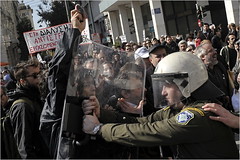
    Tens of thousands of people took to the streets of major Greek cities on Wednesday to protest tax hikes and benefit cuts in the first general strike to hit the government, which is grappling with spiralling debt levels.

    But the main question according to analysts is whether the majority of Greeks, who currently appear to accept the painful adjustment, will continue to support extra measures that are widely perceived to be imposed from Brussels.

    “The real question is whether the pro-European spirit of Greeks will falter before the flurry of orders from Brussels,” said Thomas Gerakis, head of the Marc polling company.

    For the moment, “Greeks remain convinced that the situation is very difficult. They got up from their armchairs and realised that they are on the deck of a sinking ship,” he told AFP.

    As the country with the highest public deficit in the eurozone, Greece is at the centre of a storm over spiralling debt levels in Europe that has threatened cohesion in the European single currency area. IMF stresses deficit reduction in exit strategies

    After a collapse in investor confidence, Greece faces major strains in raising new money on international markets and is under intense pressure from EU authorities to get its public finances back in order.

    The report of the three-man mission from the EU, European Central Bank and International Monetary Fund mission, which completed on Wednesday a round of talks with Greek officials, comes as a new hurdle for Athens.

    If the experts say the programme is not enough, a meeting of EU finance ministers could demand even harsher corrective action at a meeting on March 16.

    Before that meeting, the EU Financial Affairs Commissioner Olli Rehn is also due to visit Athens. EU budget enforcer to go to Greece

    The experts met Finance Minister George Papaconstantinou and Economy Minister Louka Katselli just as the country was hit by a nationwide strike, including a strike by journalists, against austerity measures.

    Also late on Wednesday, Standard & Poor’s credit rating agency warned that it could downgrade Greek sovereign debt again within a month.

    The yield on Greek ten-year bonds on Thursday rose to 6.598 percent compared to 6.496 percent a day previously.

    Under pressure from financial markets and EU institutions and partners, Greece has promised a programme to cut public spending and crimp public sector pay, to raise taxes and fight tax evasion, and to restructure its economy.

    The baseline target is to cut back an annual public deficit by four percentage points of gross domestic product to 8.7 percent this year.

    This is widely considered to be an enormous undertaking particularly since credit rating agency Moody’s has calculated that Greece will have to use 15.1 percent of its tax revenues this year to meet debt interest payments due.

    That is about twice the ratio in other debt-stricken eurozone countries Spain and Portugal.

    The last EU summit on February 11 decided to send three-way EU, ECB and IMF missions to Athens regularly under a special arrangement of exceptionally close supervision of Greek public finances.

    February 25, 2010

    Banks Bet Greece Defaults on Debt They Helped Hide

    By NELSON D. SCHWARTZ and ERIC DASH
    New York Times

    Bets by some of the same banks that helped Greece shroud its mounting debts may actually now be pushing the nation closer to the brink of financial ruin.

    Echoing the kind of trades that nearly toppled the American International Group, the increasingly popular insurance against the risk of a Greek default is making it harder for Athens to raise the money it needs to pay its bills, according to traders and money managers.

    These contracts, known as credit-default swaps, effectively let banks and hedge funds wager on the financial equivalent of a four-alarm fire: a default by a company or, in the case of Greece, an entire country. If Greece reneges on its debts, traders who own these swaps stand to profit.

    “It’s like buying fire insurance on your neighbor’s house — you create an incentive to burn down the house,” said Philip Gisdakis, head of credit strategy at UniCredit in Munich.

    As Greece’s financial condition has worsened, undermining the euro, the role of Goldman Sachs and other major banks in masking the true extent of the country’s problems has drawn criticism from European leaders. But even before that issue became apparent, a little-known company backed by Goldman, JP Morgan Chase and about a dozen other banks had created an index that enabled market players to bet on whether Greece and other European nations would go bust.

    Last September, the company, the Markit Group of London, introduced the iTraxx SovX Western Europe index, which is based on such swaps and let traders gamble on Greece shortly before the crisis. Such derivatives have assumed an outsize role in Europe’s debt crisis, as traders focus on their daily gyrations.

    A result, some traders say, is a vicious circle. As banks and others rush into these swaps, the cost of insuring Greece’s debt rises. Alarmed by that bearish signal, bond investors then shun Greek bonds, making it harder for the country to borrow. That, in turn, adds to the anxiety — and the whole thing starts over again.

    On trading desks, there is fierce debate over what exactly is behind Greece’s recent troubles. Some traders say swaps have made the problem worse, while others say Greece’s deteriorating finances are to blame.

    “This is a country that is issuing paper into a weakening market,” said Ashish Shah, co-head of credit strategy at Barclays Capital, referring to Greece’s need for continual borrowing.

    But while some European leaders have blamed financial speculators in general for worsening the crisis, the French finance minister, Christine Lagarde, last week singled out credit-default swaps. Ms. Lagarde said a few players dominated this arena, which she said needed tighter regulation.

    Trading in Markit’s sovereign credit derivative index soared this year, helping to drive up the cost of insuring Greek debt, and, in turn, what Athens must pay to borrow money. The cost of insuring $10 million of Greek bonds, for instance, rose to more than $400,000 in February, up from $282,000 in early January.

    On several days in late January and early February, as demand for swaps protection soared, investors in Greek bonds fled the market, raising doubts about whether Greece could find buyers for coming bond offerings.

    “It’s the blind leading the blind,” said Sylvain R. Raynes, an expert in structured finance at R&R Consulting in New York. “The iTraxx SovX did not create the situation, but it has exacerbated it.”

    The Markit index is made up of the 15 most heavily traded credit-default swaps in Europe and covers other troubled economies like Portugal and Spain. And as worries about those countries’ debts moved markets around the world in February, trading in the index exploded.

    In February, demand for such index contracts hit $109.3 billion, up from $52.9 billion in January. Markit collects a flat fee by licensing brokers to trade the index.

    European banks including the Swiss giants Credit Suisse and UBS, France’s Société Générale and BNP Paribas and Deutsche Bank of Germany have been among the heaviest buyers of swaps insurance, according to traders and bankers who asked for anonymity because they were not authorized to comment publicly.

    That is because those countries are the most exposed. French banks hold $75.4 billion worth of Greek debt, followed by Swiss institutions, at $64 billion, according to the Bank for International Settlements. German banks’ exposure stands at $43.2 billion.

    Trading in credit-default swaps linked only to Greek debt has also surged, but is still smaller than the country’s actual debt load of $300 billion. The overall amount of insurance on Greek debt hit $85 billion in February, up from $38 billion a year ago, according to the Depository Trust and Clearing Corporation, which tracks swaps trading.

    Markit says its index is a tool for traders, rather than a market driver.

    In a statement, Markit said its index was started to satisfy market demand, and had improved the ability of traders to hedge their risks. The index and similar products, it added, actually make it easier for buyers and sellers to gauge prices for instruments that are traded among players over the counter, rather than on exchanges.

    “These indices have helped bring transparency to the sovereign C.D.S. market,” Markit said. “Prior to their creation, there was no established benchmark index enabling investors to track the performance of segments of the sovereign C.D.S. market.”

    Some money managers say trading in Greek swaps alone, not the broader index, is the problem.

    “It’s like the tail wagging the dog,” said Markus Krygier, senior portfolio manager at Amundi Asset Management in London, which has $40 billion in global fixed-income assets. “There is a knock-on effect, as underlying positions begin to seem riskier, triggering risk models and forcing portfolio managers to sell Greek bonds.”

    If that sounds familiar, it should. Critics of these instruments contend swaps contributed to the fall of Lehman Brothers. But until recently, there was little demand for insurance on government debt. The possibility that a developed country could default on its obligations seemed remote.

    As a result, many foreign banks that held Greek bonds or entered into other financial transactions with the government did not hedge against the risk of a default. Now, they are scrambling for insurance.

    “Greece is not a small country,” said Mr. Raynes, at R&R in New York. “Credit-default swaps give the illusion of safety but actually increase systemic risk.”

  • Confusion Trails Nigerian President’s Return

    Confusion Trails Yar’Adua’s Return

    •President Fails To Attend EXCOF Meeting
    •Continue Performing State Duties, He Tells Jonathan
    •We’re Not Aware Of His Return, Say Senators
    •Yar’Adua’s Return May Fuel Uncertainty – U.S.

    By Adetutu Folasade-Koyi, Chesa Chesa, Joe Nwankwo, Otei Oham, Rotimi Akinwumi (Abuja), Paul Arhewe, Rafiu Ajakaye and Wale Igbintade (Lagos)
    Nigerian Daily Independent

    TRUE to prediction, the return of President Umaru Yar’Adua from a three-month medical treatment in Saudi Arabia is creating ripples and confusion in Aso Rock, coupled with his refusal to recognise his Deputy, Goodluck Jonathan, as Acting President.

    Yar’Adua is still indisposed and has admitted that he cannot perform the functions of his office.

    Senators said they have not been officially informed of his return, and a chorus of opinion leaders – among them the Peoples Democratic Party (PDP), the Nigerian Bar Association (NBA), the Conference of Nigerian Political Parties (CNPP), and the Save Nigeria Group (SNG) – insisted on Wednesday that Jonathan remains Acting President.

    America warned that Yar’Adua’s return while unable to carry out his duties as President could fuel uncertainty.

    Jonathan declined to preside over Wednesday’s meeting of the Executive Council of the Federation (EXCOF) and instead met in camera with Ministers in his office.

    A statement issued by Yar’Adua’s Spokesman, Olusegun Adeniyi, confirmed that Yar’Adua returned to the Villa from his hospital bed in Jeddah after being discharged by doctors.

    The statement referred to Jonathan as Vice President, not Acting President.

    However, it thanked him for “competently overseeing the affairs of state in (Yar’Adua’s) absence,” and asked him to continue to do so until Yar’Adua fully recovers.

    “(Yar’Adua) wishes to express his profound gratitude to all Nigerians for their prayers for his recovery, their exceptional generosity of spirit and their appreciation of the fact that all mortals are subject to the vagaries of ill-health,” the statement added.

    “(He) is grateful to the Vice President, Goodluck Jonathan, for competently overseeing the affairs of state in his absence.

    “(He) also wishes to thank the President of the Senate, (David Mark), the Speaker of the House of Representatives, the entire membership of the National Assembly (NASS), the Governors’ Forum, the judiciary, the Armed Forces, and other security agencies, former Heads of State and other eminent Nigerians for their roles in maintaining order and stability during his absence.

    “(Yar’Adua) wishes to reassure all Nigerians that on account of their unceasing prayers, and by the special grace of God, his health has greatly improved.

    “However, while the President completes his recuperation, Vice President Jonathan will continue to oversee the affairs of state.”

    Nevertheless, after waiting anxiously for two hours, EXCOF members who gathered at about 10 a.m. for a meeting – staying glued to their seats instead of engaging in their usual back slapping greetings – were asked to return to their offices and show up later for a special meeting with Jonathan.

    No reason was given for the cancellation, but it may be connected with the confusion in Aso Rock as Jonathan and most Ministers were not privy to the plan by Yar’Adua’s men to bring him back to the country without allowing the EXCOF delegation sent to Saudi Arabia to do so.

    Besides, it is not clear if Jonathan will be allowed to continue to sit on the Presidential seat emblazoned with the Coat of Arms in front of the national and Armed Forces flags, to preside over the EXCOF meeting, as he did in the past two weeks.

    Yar’Adua remains incommunicado as Jonathan made unsuccessful efforts to see him before the aborted EXCOF meeting.

    The meeting usually starts at 10 a.m., but at 12:10 p.m., the Secretary to the Government of the Federation (SGF), Yayale Ahmed, walked in and announced that attendance was mandatory at the special meeting scheduled for 2 p.m. with Ministers at the Vice President’s Conference Room.

    Emerging from the meeting, which lasted about 10 minutes, Information and Communications Minister, Dora Akunyili, told reporters that Jonathan briefed the cabinet on the return of Yar’Adua and that he would later in the day go over to see his wife, Turai.

    She said Jonathan acknowledged that he would continue to attend to state matters until Yar’Adua fully recovers, and that he has been briefed by the President’s aides on latest developments.

    Her words: “He (Jonathan) told us that (Yar’Adua) has returned, he has been briefed by the President’s aides and that he hopes to see (Turai) this evening, and that we meet next week, we will be briefed on the outcome of the Saudi trip by the members of Council.

    “And that when he is eventually briefed by (Yar’Adua) he will call us again.”

    However, Senators declared that they are unaware of Yar’Adua’s return, and pressed that he must follow procedure and officially inform the National Assembly (NASS) that he is back to duty.

    “I am not aware that the President is back because as a Senator I know that there are procedures and if he is back it should be announced on the floor of the Senate that he is back,” riposted Smart Adeyemi, the Chairman of the Federal Character and Inter-governmental Affairs Committee.

    Works Committee Chairman, Festus Olabode Ola, said the Senate cannot be guided by newspaper reports, and insisted that Yar’Adua must comply with the Constitution by officially writing a letter to the NASS on his return.

    Capital Market Committee Chairman, Mohammed Bello, maintained that the Senate stands by the NASS resolution of February 9 which mandated Yar’Adua to comply with Section 145 of the Constitution on his return.

    Asked if he knew of Yar’Adua’s return, States and Local Government Committee Chairman, Sahabi Ya’u, replied: “We are not aware.”

    George Sekibo, Solid Minerals Committee Chairman, insisted that, “We will not act on rumours because there have been so many rumours. Our resolution is clear.”

    But the PDP noted in a statement that Yar’Adua’s return shows that the prayers by Nigerians for his recovery have been answered by God.

    “We therefore rejoice with our fellow citizens for this unique favour done to us by the Almighty God. We wish to specially congratulate Acting President Goodluck Jonathan for successfully holding forth the ship of state while Yar’Adua was away,” the statement said.

    In his reaction, however, NBA President, Oluwarotimi Akeredolu, asked Yar’Adua to resign if he is not well enough to resume his duties as President.

    “The Acting President remains Jonathan until the President transmits a letter to the (NASS) informing it that he is back and well enough to resume his duties as President,” Akeredolu argued in a telephone interview.

    “If the President feels that he is not strong enough to continue as President, the right thing for him to do is to resign. If he is not strong enough, Nigerians should appeal to him to resign, and not to disrupt the present equilibrium.”

    Akeredolu also maintained at a press conference in Abuja that Jonathan is still in charge of the government until Yar’adua physically presents himself to the nation and formally informs the NASS of his return.

    “We have seen from reports in the press that (Yar’Adua) came back under the cover of darkness with all the lights at the airport turned off, and soldiers taking over the entire environment.

    “We have not seen him, and I heard that not even journalists who were there were allowed to see him.”

    CNPP National Publicity Secretary, Osita Okechukwu, also decried the way Yar’Adua was flown back to the country, saying the secrecy demonstrates that he is incapable of ruling.

    Okechukwu reiterated that, “We are yet to see any photograph of Yar’Adua in any news media, whether local or foreign, since his return. How come that the media were cordoned off from the precincts of his arrival? We demand to see our President.

    “The CNPP calls on (his) handlers to allow us to see our dear President, and join us in appealing to him to honourably resign and save the country from divided government and its attendant instability.”

    The SNG asked the cabinet to declare Yar’Adua incapacitated, as stipulated in Section 144 of the Constitution, and dismissed as primitive the manner he was smuggled back into the country on Wednesday morning.

    It said in a statement that it welcomes Yar’Adua back, but he should address a joint session of the NASS, broadcast live on television, to enable Nigerians determine whether he is fit enough to govern.

    “As citizens of Nigeria, we deplore in the strongest terms the way Yar’Adua was smuggled into the country like a piece of contraband in the dead of the night and through mafia tactics by his kidnappers,” the statement added.

    “The reported parking of the aircraft that brought him in a bush path further showed that the cabal has no respect for Yar’Adua and would not give him the amount of care a sick dog deserves from the owner for as long as they use his sick body to feather their nests.

    A statement issued by the United States Assistant Secretary of State,Johnnie Carson, expressed hope that Yar’Adua’s health “is sufficient to enable him to fully resume his official duties” because “Nigeria needs a strong, healthy, and effective leader to ensure the stability of the country and to manage Nigeria’s many political, economic, and security challenges.”

    Carson said reports continue to suggest that Yar’Adua’s health remains fragile and that he may still be unable to fulfill the demands of his office.

    “We hope that (his) return to Nigeria is not an effort by his senior advisers to upset Nigeria’s stability and create renewed uncertainty in the democratic process.

    “Nigeria is an extraordinarily important country to its friends and partners, and all of those in positions of responsibility should put (Yar’Adua’s) health and the best interests of the country and people of Nigeria above personal ambition or gain.

    “As a nation of 150 million people, Nigeria’s democracy and its continued adherence to constitutional rule should be the highest priority.”

    In any case, the Senate on Wednesday concluded the amendment of Sections 145 and 190 of the Constitution, a legislative record and a first since 1999.

    More than the required two thirds passed the changes, which make it mandatory for the President to inform the NASS in writing whenever he is going on vacation.

    Should he fail to do so within two weeks of his vacation, the NASS would empower the Vice President to become Acting President by a simple majority.

    Likewise, a Governor has to inform the state House of Assembly of his vacation, and failure to do so within 14 days, the Assembly would empower the Deputy Governor to act as Governor by a simple majority.

    The amendments would be transmitted to the state Assemblies for approval after the concurrence from the House of Representatives.

    Two-thirds or 24 of the 36 state Assemblies are required to pass the amendments.

  • Nigerian Vice-President to Stay in Charge

    Wednesday, February 24, 2010
    17:58 Mecca time, 14:58 GMT

    Nigerian VP to stay in charge

    An ambulance, thought to be carrying Yar’Adua, left the airport under police escort

    Nigeria’s vice-president will continue to lead the nation while the ailing president recuperates, a presidential adviser has said.

    In a statement issued on Wednesday, Olusegun Adeniyi, a presidential spokesman, said Goodluck Jonathan would continue to serve as acting president.

    “After being discharged by the team of medical experts overseeing his treatment in… Saudi Arabia, President Umaru Musa Yar’Adua returned to the presidential villa, Abuja early this morning,” Adeniyi said.

    “While the president completes his recuperation, Vice-President Jonathan will continue to oversee the affairs of state,” he said.

    The announcement comes after Yar’Adua returned to Nigeria early on Wednesday morning after more than three months abroad at a Saudi Arabian hospital.

    Two aeroplanes arrived at the presidential wing of Abuja’s Nnamdi Azikiwe international airport where one of them was met by an ambulance, the Reuters news agency, citing a witness, reported.

    The ambulance later left under a heavy police escort. There was no immediate word on Yar’Adua’s condition.

    Constitutional concerns

    Following a power vacuum because of Yar’Adua’s long absence from the country, Nigeria’s parliament installed Jonathan as the acting head of state early this month.

    Yvonne Ndege, Al Jazeera’s West Africa correspondent, said that while Jonathan had established himself as a leader, constitutionally power still lay with Yar’Adua.

    “There is potential, let’s say, for Goodluck Jonathan to try to consolidate his position and become the substantive president of Nigeria,” she said.

    “But my sense is that that will have to come with the blessing of President Yar’Adua because if the constitution is followed to the letter of the law President Yar’Adua will be back in the seat of power.”

    Nigeria’s constitution says the president must make a written declaration that he is on vacation or unable to carry out his duties before a transfer of power can take place.

    Yar’Adua had not officially given his consent to the transfer of power, but parliament said it based its decision on an interview that he gave the BBC last month, saying that he would return to work once his doctors gave him the go-ahead.

    Health problems

    Despite general government support, some critics have described the move to have Jonathan assume presidential powers as illegal.

    Yar’Adua left Nigeria on November 23 to receive medical treatment at a clinic in Jeddah for pericarditis, an inflammation of the membrane surrounding the heart that can restrict normal beating.

    He is also known to suffer from a chronic kidney condition and has long been criticised for not being able to work more than five or six hours a day.

    Aside from the near constitutional crisis, Yar’Adua’s long absence had prompted street protests by thousands across the country, demanding his resignation.

    It also threatened to paralyse the government until parliament installed Jonathan as acting head of state on February 9.

    Balancing act

    A delegation of Nigerian ministers had travelled to Saudi Arabia on Monday to ascertain Yar’Adua’s health, expecting to report back to a weekly cabinet meeting, but it appeared they had not managed to see him.

    Instead they were told that he was on his way back to Abuja.

    Nii Akuetteh, the former executive director of Africa Action, said that could have been a deliberate move to avoid further conflict.

    “My impression is now that the delegation that went to Jeddah [was] a small portion of the cabinet,” he told Al Jazeera.

    “Now the entire cabinet, if they want to assess the president’s health, will have him there to do that instead of depending on a few people who went to Jeddah and can come back with conflicting reports.”

    The Nigerian presidency reflects a regional balancing act between the Muslim north and the Christian south, with the role traditionally switching between the two sides with every election.

    Yar’Adua is from the Muslim north and Jonathan from the Christian south.

    While many activists in the south would be pleased to see a southerner in the presidency, others from the north would like their candidate to serve a full term.

    “A lot of this was precipitated by people from the south – activists – who actually went to court to say that he [Yar’Adua] has been away for too long,” Akuetteh said.

    Source: Al Jazeera and agencies

  • ZANU-PF Politburo Approves Empowerment

    Politburo okays empowerment

    Herald Reporter

    ZANU-PF’S Politburo yesterday endor-sed the Indigenisation and Economic Empowerment Regulations whose main objective is to achieve 51 percent Zimbabwean shareholding in existing businesses.

    The endorsement followed a detailed explanation by Zanu-PF secretary for indigenisation and economic empowerment Cde Saviour Kasukuwere on the regulations.

    “(The) Politburo has endorsed the Empowerment Regulations,” Zanu-PF secretary for information Cde Rugare Gumbo said after the 230th Ordinary Session of the Politburo.

    “The Secretary for Indigenisation and Economic Empowerment has just explained the whole process.

    “It would appear everyone is very happy. There was clarity on the regulations,” he said.

    Cde Gumbo said the regulations were not a new phenomenon in Sadc as other countries in the region had embarked on similar empowerment drives.

    “There is nothing new with the regulations as far as we are concerned. MDC-T is complaining, but it is nothing new in the region,” he said.

    Prime Minister Morgan Tsvangirai has opposed the regulations.

    The main objective of the regulations is to have 51 percent indigenous shareholding in existing businesses with the owners given a five-year period to comply.

    The regulations require that all existing businesses with a threshold of US$500 000 should within 45 days —from March 1, 2010 — declare their shareholding status to the Indigenisation and Economic Empowerment Minister through a prescribed form.

    New businesses will be required to comply within 60 days.

    Businesses that do not meet the 51 percent indigenisation requirement will be expected to submit a plan on how they intend to meet the requirements within 45 days from March 1.

    Those with acceptable reasons will be afforded an extension not exceeding 30 days to furnish the authorities with their indigenisation implementation plans.

    Cde Gumbo said President Mugabe yesterday explained to new Politburo members how the organ operates and what was expected of them.

    “The President explained to new members of the Politburo that they are joining a special club and should make contributions if they are to have impact.

    “He also encouraged the old guard to work harder,” he said.

    New Politburo members include Cdes Kudakwashe Bhasikiti, Patrick Zhuwao, Samuel Mugande and Edison Chakanyuka.

    Cde Gumbo said the Politburo discussed the Global Political Agreement and the constitution-making process, which they said they wanted to see succeed.

    The Politburo also discussed the 21st February Movement celebrations this weekend, that coincide with celebrations to mark President Mugabe’s 86th birthday.

    “All of us are going to Bulawayo for the actual celebrations,” Cde Gumbo said.

    There was a carnival atmosphere at Zanu-PF’s headquarters as both the party’s staff and Politburo members congratulated President Mugabe on turning 86 last Sunday.

    Politburo members Cdes Emmerson Mnangagwa and Nathan Shamuyarira described the President as a principled, straightforward and honest leader.

    President Mugabe thanked the party saying: “Tinotenda kubatana kwatinoramba tinako nokutsigira zvikuru musangano. Nyika kuuya kwayakaita uku kuzvipira kwakaitwa.”

  • Detroit Demonstration on March 4: Fund Education, Not Banks & The War Machine

    FUND EDUCATION, NOT BANKS & THE WAR MACHINE

    Students, youth, educational workers and community activists are all
    joining together to participate in the National Day of Action to Defend
    Education on Thursday, March 4 2010. The politicians and administrators say that there is no money for education and social services. They contend that there is no alternative to the massive layoffs of teachers, clerical workers, custodians, social workers and counselors.

    However, everyone knows that there is plenty of money and resources for wars, bank bailouts, mass incarceration of people of color and the poor. We must take a stand to demand that local, state and federal governments fund education, not military occupations and wealthy financiers.

    We must demand the end to privatization of public education and the
    usurpation of local control and self-determination. Education is a
    fundamental human right, not a privilege for the rich and powerful.

    Join us on March 4 for a march and rally from Wayne State University to the New Center area.

    Please note: The people of Michigan will pay $18.7 billion for Total
    Defense Spending in FY2010. For the same amount of money, the following could have been provided:

    –1,924,702 Scholarships for University Students for One Year OR

    –7,037,020 People with Health Care for One Year OR

    –338,748 Music and Arts Teachers for One Year OR

    –3,372,216 Students receiving Pell Grants of $5550 OR

    –150,871 Affordable Housing Units OR

    –264,394 Elementary School Teachers for One Year

    See http://www.nationalpriorities.org/
    for
    more ways that your money is wasted on war.

    Rally at Gullen Mall on the Wayne State University Campus in Detroit, MI — 4 p.m.
    March to Cadillac Plaza and Detroit Public Schools Headquarters —
    4:30 p.m.
    Picket and Rally Outside Cadillac Plaza and the Fisher Building (Grand Blvd. & 2nd Ave.) — 5 p.m.

    Join us on March 4 for a march and rally from Wayne State University to the New Center area where we will demand:

    — Full funding of public k-12 education and the restoration of music,
    arts and sports programs;
    –The reduction of class sizes to 16 students in all schools;
    — A halt to all tuition hikes in higher education and the rolling back
    of recent tuition increases;
    — Increased funding for breakfast and lunch programs in all K-12
    educational institutions;
    — Stop the privatization and charterization of public schools;
    — Restore state funding for the Michigan Promise Scholarship, not a
    phony tax credit;
    — Increase funding for state universities and community colleges and university workers;
    — Stop layoffs of secondary school, community college and university
    workers;
    — Rehire all workers laid off in the current crisis;
    — Hands off unions and student organizations;
    — Fire the DPS Emergency Financial Manager; restore local control to Detroit Schools;
    — Increase African-American, Latin@, Middle Eastern and Native American enrollment in higher education

    Sponsored by FIST Detroit, the Michigan Emergency Committee Against War & Injustice (MECAWI) and the Moratorium NOW! Coalition To Stop Foreclosures, Evictions & Utility Shutoffs. Endorsement list in formation.

    For more more information:
    313-671-3715;
    313-559-7074; 248-990-0275;
    email: [email protected] ;
    or see: www.defendeducation.org

  • Over 5,300 Official US Military Deaths in Iraq and Afghanistan Occupations

    Death toll in Afghan war nears 1,000

    By Craig Whitlock, Greg Jaffe and Julie Tate
    Washington Post Staff Writers
    Wednesday, February 24, 2010; A01

    More than eight years after the Taliban was toppled from power, the number of U.S. military fatalities in the war in Afghanistan is nearing 1,000, a grim milestone in a resurgent conflict that is claiming the lives of an increasing number of troops who had survived previous combat tours in Iraq.

    As of Tuesday, 996 U.S. military personnel had died while serving in Operation Enduring Freedom. The roll call of the fallen began on Oct. 10, 2001, when Air Force Master Sgt. Evander E. Andrews was killed in a forklift accident in Qatar while building an airstrip in preparation for the invasion of Afghanistan. The latest confirmed addition came Sunday, when Army Pfc. J.R. Salvacion, 27, of Ewa Beach, Hawaii, died of wounds suffered when insurgents attacked his unit near Kandahar.

    The number of dead is small in comparison with U.S. casualties in Iraq, where 4,366 uniformed personnel have died since 2003. But as operations intensify in Afghanistan, the war is killing more and more service members who came home safely after serving in Iraq, only to return to the battlefield in another theater.

    Since Dec. 1, at least 30 percent of the American military personnel who have died in Afghanistan have been veterans of the Iraq war, according to a Washington Post analysis.

    Among them: Marine Staff Sgt. Chris Eckard, 30, who was killed Saturday in Helmand province, the site of a major NATO offensive targeting Taliban-held territory. Eckard, an explosives specialist from Hickory, N.C., had disarmed hundreds of makeshift bombs during four tours in Iraq. It was his first assignment to Afghanistan. He leaves behind a wife and two sons, ages 4 and 18 months.

    “Chris loved the Marines. He was all about the Marines,” said his sister-in-law, Chastity Eckard. “This was going to be his last tour.”

    The impending milestone of 1,000 deaths hasn’t drawn much notice in the United States or in Afghanistan, despite the Obama administration’s focus on the war and the launch this month of the largest U.S.-NATO military operation in the country since 2001.

    When the United States crossed the threshold of 1,000 deaths in the Iraq war in September 2004, there was widespread concern in Washington that public support for the conflict would collapse. To some, the relatively quiet approach of the new benchmark is a sign that the country has grown more sober-minded in the way it perceives the war. “We’ve learned that the public doesn’t react reflexively to the tote board of [war deaths],” said Peter Feaver, who served in George W. Bush’s administration and teaches political science at Duke University.

    Others see a fundamental change in American foreign policy after almost nine years of combat. “The American people and the governing class have accepted that war has become a permanent condition,” said retired Army Col. Andrew Bacevich, a history professor at Boston University whose son was killed in Iraq in 2007. “Protracted war has become a widely accepted part of our politics.” Even before his son’s death, Bacevich spoke out forcefully against the wars.

    More than 600 troops from NATO allies and other countries have died in Afghanistan since 2001. Thousands of Afghan civilians, soldiers and police officers have also died in the war, although the precise number is unknown.
    Back to the front, again

    For many Americans, what is most striking is that so many Marines and soldiers have died during their second or third combat tours. Of the 73 U.S. troops killed in Afghanistan since Dec. 1, at least 23 had previously served in Iraq, according to The Post’s analysis.

    “It affirms what we already knew, which is that the burden of this very long war is being borne by a small percentage of the population,” Bacevich said.

    Both the Obama and Bush administrations have wrestled with how to highlight the sacrifices of the troops and, to the extent possible, share the burden with the rest of the country. During the debate last year over the Afghanistan strategy, President Obama made high-profile visits to Arlington National Cemetery and Dover Air Force Base to witness the return of fallen U.S. troops. Lawmakers, meanwhile, have repeatedly boosted pay and benefits for service members, sometimes to the consternation of the Pentagon, which has become concerned that the surging personnel costs are squeezing out money for new weapons.

    But the White House, Congress and the military seem broadly comfortable with the notion that a relatively small number of professional soldiers and Marines should be expected to fight multiple tours in Afghanistan and Iraq.

    “There are enormous and disturbing moral implications in the tacit agreement we have made to have such a small percentage of our population bear so great a burden,” Bacevich said. “But there is no recognition of it or desire to raise questions about it.”
    For families, questions

    White House officials said they do not want to draw special attention to what they described as an arbitrary figure. “We mourn the loss of each and every serviceman and woman,” said National Security Council spokesman Mike Hammer. “The nation is indebted to them and their families for making the ultimate sacrifice in defense of our country.”

    But as the casualty count rises, so does the number of grieving relatives who can’t help question why their sons and daughters, or their spouses or parents, had to keep returning to the battlefield, tempting fate again and again.

    Adam K. Ginett, a 29-year-old Air Force tech sergeant from eastern North Carolina, told his family that he felt compelled by a sense of public service to serve two tours in Iraq, followed by two more in Afghanistan. An explosives and ordinance disposal specialist, he had extensive experience in the highly risky job of defusing makeshift bombs, the insurgents’ weapon of choice in both war zones.

    When Ginett was a teenager, “I told him he’d be safer going into the Air Force, that at least he’d get a clean bed to sleep in every night,” said his grandfather James Haslam, 80, a former Marine. “But he chose perhaps the most dangerous job in the military.”

    When he was last home in July, visiting his parents in tiny Coats, N.C., Ginett was gently challenged by his mother, who wanted to know: Why do you keep volunteering to go back to the war? “It just seemed like he was always going,” said his mother, Christina Kazakavage. “He said: ‘Mom, it’s just my turn. I gotta go.’ “

    As he departed for the airport to return to Afghanistan, he left behind a book for his mother. Titled “Final Salute: A Story of Unfinished Lives,” it tells the story of a Marine major assigned to knock on the doors of military spouses and parents and deliver the tragic news that their loved ones had sacrificed their lives for their country.

    “After I read that book, I looked at my husband and said, ‘He’s not going to come home.’ After reading that book, I just knew,” Kazakavage said. “I think it was just Adam’s way of preparing me.”

    Staff writer Karen DeYoung contributed to this report.

  • Latin American and Caribbean States Plan to Establish Regional Organization Without the U.S. and Canada

    New US-free Americas bloc planned

    Latin American and Caribbean nations have agreed to set up a new regional body without the US and Canada.

    The new bloc would be an alternative to the Organisation of American States (OAS), the main forum for regional affairs in the past 50 years.

    Mexico has been hosting a regional summit in the beach resort of Cancun.

    The OAS has been dogged by rifts between some members and the US over economic policy and trade, and criticised for promoting US interests.

    ‘Regional integration’

    The proposed new grouping was one of the main issues on the agenda of the two-day summit, which ended on Tuesday.

    It “must as a priority push for regional integration… and promote the regional agenda in global meetings”, Mexican President Felipe Calderon told the summit, which includes leaders and representatives from 32 countries.

    Cuban President Raul Castro was quick to applaud Mr Calderon’s announcement as a historic move toward “the constitution of a purely Latin American and Caribbean regional organisation”.

    Cuba was suspended from the OAS in 1962 because of its socialist political system. In 2009, the OAS voted to lift Cuba’s suspension but the country has declined to rejoin.

    Venezuelan President Hugo Chavez earlier expressed his support for the proposal, citing it as a move away from US “colonising” of the region.

    A US State Department official, Arturo Valenzuela, said he did not see the new body as a problem.

    “This should not be an effort that would replace the OAS, ” he said.

    The terms of the new bloc and whether it would replace the Rio Group of Latin American countries has not been clarified.

    “It’s very important that we don’t try to replace the OAS,” said Chile’s President-elect Sebastian Pinera. “The OAS is a permanent organisation that has its own functions.”

    On Monday, Bolivian President Evo Morales proposed that it begin operating in July 2011 with a summit hosted by Venezuela.

    Falklands row

    The Cancun summit has also unanimously backed Argentina’s claim over the British-owned Falklands.

    Argentina is angered that a UK firm has begun drilling for oil off the Falkland Islands, which lie about 450km (280 miles) off the Argentine coast.

    Argentina and Britain went to war over the South Atlantic islands, which Argentina calls the Malvinas, in 1982, after Buenos Aires invaded them.

    The leaders at Cancun also discussed whether to recognise Porfirio Lobo as the legitimate president of Honduras after he was elected president under interim authorities following a 28 June coup that ousted Manuel Zelaya.

    A long-term plan to help Haiti recover from the devastating January earthquake was also on the agenda.

    Story from BBC NEWS:
    http://news.bbc.co.uk/go/pr/fr/-/2/hi/americas/8531266.stm
    Published: 2010/02/24 01:04:45 GMT

  • Cuban Medical Personnel Treat Over 95,000 Haitians

    In Haiti: More than 95,000 patients treated

    Leticia Martínez Hernández

    PORT-AU-PRINCE, Haiti.— More than 95,000 patients have been treated here to date here by the Cuban medical brigade since the January 12 earthquake, and 4,500 operations have been performed. However, as brigade coordinator Carlos Alberto García says, in looking toward the country’s future, the most important part begins today with the transfer of equipment and medical personnel to two new hospitals in the provinces.

    Dr. García explained that one hospital will be set up in the Port Salut commune and another in Corail, both at a considerable distance from the capital.

    “The new centers will be in places which have bee lacking the conditions for health care because of a shortage of doctors, equipment, running water and electricity. These institutions will be open not only during the post-earthquake national emergency situation, but also will continue to provide services on an ongoing basis.

    “With the two new hospitals and the seven Comprehensive Diagnostics Centers in various departments, we are taking the first steps toward improving the health system in Haiti,” the coordinator stated.

    A total of 1,439 Cuban doctors trained on the island are currently working in Haiti, 637 of them graduates from the Latin American School of Medicine. The Cuban medical brigade is providing services in 134 of the country’s 140 communes.

    Translated by Granma International

    Cuban-trained doctors vaccinate the Haitian population

    A group of doctors trained in the Latin American School of Medicine in Cuba (ELAM) have joined the vaccination campaign organized by Cuban medical personnel in devastated Haiti.

    Cuban-trained doctors vaccinate the Haitian populationThe young doctors, from various Latin American countries, began their work in one of the largest improvised camps for victims of the earthquake, assisted by Cuban medical personnel who are providing services in Haiti.

    There has been no vaccination campaign to date at the camp, located in the Saint Louis Gonzaga secondary school, despite requests to nongovernmental organizations and other institutions, according to the camp’s coordinator, Elvire Constant.

    Latin American and Cuban doctors, assisted by nurses from the island, immunized the population with vaccines for diphtheria, tetanus and whooping cough, placing a priority on children and women.

    Translated by Granma International

    Cuba in the heart of every Haitian

    Haitian government reiterates its gratitude to the Cuban people. Esteban Lazo concludes visit to Haiti

    PORT-AU-PRINCE, Haiti.— Shortly before leaving for Cuba after two working days in Haiti, Vice President Esteban Lazo Hernández was received by Haitian Prime Minister Jean-Max Bellerive who, on behalf of the Haitian government, reiterated his people’s gratitude to Cuba.

    “I have to thank you for the help provided by Cuba since long before the earthquake. It is fantastic, free, unconditional, and it is in the heart of every Haitian man and woman,” Bellerive said. He went on to note two fundamental aspects: “first that that the Cuban cooperation is going to continue. It is important for Haiti to know that the programs will continue and moreover, outside of the capital, outside of the area where the earthquake occurred.”

    “The second issue is that you didn’t come to talk about building a hospital or a healthcare center. You are talking about helping us to build a healthcare system and that is more important. A system that is going to allow us to improve Haitians’ health has never been within the framework of cooperation. Because many people come and say that they want to build a hospital but not an integral system that will help attain more health, greater levels of hygiene. With that cooperation we can raise the level of health of our people, which they deserve.”

    The prime minister acknowledged the attitude assumed by the Haitians after the tragedy, when many of them rushed into the streets to help save thousands of people. “Up until now, I think that they have dealt with the situation very calmly and intelligently and have not let themselves get caught up in violence, a situation which can occur after a disaster like this.”

    For his part Lazo informed him of the Cuban delegation’s activities in Haiti, which included visits to the Croix des Bouquets and Leoganne field hospitals, the Mirebalais Comprehensive Diagnostics Center, the La Paz and La Renaissance hospitals, and the Venezuelan Simón Bolívar Camp. Lazo told Bellerive that the Commander in Chief Fidel Castro had called him several times out of concern for the situation in Haiti.

    “It has been an intense working visit. It was not possible to come immediately after the earthquake but our hearts have always been here.” Laze reiterated that the idea was to concentrate aid on recovery and the creation of a national healthcare system in Haiti. “At this point, it has to be at that level, above all in something as significant as the population’s health. We would like everyone who wants to do so, to help, without exception. But Haiti will be the principal player in the development of the program,” Lazo stated.

    Translated by Granma International

    Haitians describe landing of yanki Marines as occupation

    PORT-AU-PRINCE, January 19.— Hundreds of Haitians watched with a mixture of resignation and anger on Tuesday as several helicopters landed U.S. troops in the grounds of the Presidential Palace, an act considered by many Haitians as a loss of sovereignty, the AFP reported.

    “I haven’t seen them distributing food downtown, where the people urgently need water, food and medicine. This looks more like an occupation,” said Wilson Guillaume, a 25-year-old student.

    At least four helicopters brought 100 U.S. soldiers from the 82nd Airborne Division to the grounds, as hundreds of Haitians looked on stunned. Having lost their homes in the earthquake, they are living as refugees in the Palace gardens.

    As the U.S. troops left the Palace to guard Haiti’s general hospital, overflowing with injured people, many people yelled “Go home!” and “Don’t occupy us!”

    A fleet of amphibious craft also reached the coast of Haiti, transporting some 800 Marines expected to go ashore in the next few days to join the 2,000-plus soldiers already stationed in Haiti.

    Also today, the UN Security Council today unanimously approved increasing the number of international military and police forces in Haiti by 3,500 to reinforce security.

    Meanwhile, thousands of earthquake victims are trying to get onto buses to flee the hunger and violence of the destroyed capital, with the hope of finding food more easily in the countryside, AP reports.

    (Translated by Granma International)

  • IRS Worker’s Widow Sues Texas Suicide Pilot’s Wife

    IRS worker’s widow sues Texas suicide pilot’s wife

    The Associated Press
    Tuesday, February 23, 2010; 9:05 PM

    AUSTIN, Texas — The widow of the Internal Revenue Service employee killed when a Texas man crashed his plane into the agency’s Austin office is suing the pilot’s widow.

    Attorney Daniel Ross says the lawsuit against Sheryl Stack seeks to determine if the pilot left behind insurance policies or other assets.

    Ross represents Valerie Hunter, whose 68-year-old husband Vernon Hunter was killed last week when authorities say Joseph Stack deliberately crashed his single-engine plane into the IRS office.

    Joseph Stack left behind a lengthy anti-government Internet posting blaming the IRS for personal problems spanning decades.

    The lawsuit filed Monday says Sheryl Stack should have warned others about her husband.

    A message seeking comment was left Tuesday with a family spokesman for Sheryl Stack.

  • Nigeria News Bulletin: President Yar’Adua Returns From Saudi Arabia

    Yar’Adua Arrives

    From Paul Ibe and George Oji in Abuja, 02.24.2010
    Nigeria ThisDay

    Exactly three months after he left Nigeria for medical treatment in Saudi Arabia, President Umaru Musa Yar’Adua, in a most dramatic twist, returned to the country in the early hours of today.

    THISDAY learnt that the President, whose prolonged absence had generated considerable heat in the polity, left Jeddah, Saudi Arabia, at 8.22pm Nigerian time last night and arrived at 1.46am today.

    About 30 minutes to his arrival, the source of power supply to the airport was switched from public to generator.

    After the first, small aircraft arrived, another one, a bigger aircraft, landed a few minutes later. Both were unusually parked on the runway – virtually in the bush – instead of the parking area, for a very long time. It was not clear which of the two aircraft carried the President as the entire area was covered in darkness.

    An ambulance was seen moving towards the two aircraft shortly after the arrival of the second one. A bus also moved in a few minutes later.

    At the airport to receive Yar’Adua were Governors Isa Yuguda (Bauchi), Ibrahim Shema (Katsina) and Namadi Sambo (Kaduna). They had earlier met with the Speaker of the House of Representatives, Rt Hon Dimeji Bankole, at his residence in Abuja.
    Soldiers were deployed on the route from the airport to the Presidential Villa. They all took strategic positions, fully armed. The trucks that conveyed them bore the sign of Brigade of Guards.

    THISDAY learnt that all the soldiers, who came in two companies, were asked to drop their phones, thereby rendering them incommunicado.

    Airport staff were also ordered out of the presidential wing as soldiers took over the place. The only thing that could be gleaned from the aircraft was the flashing beacons.

    At 2.56 am, the ambulance left while a convoy of about eight cars drove towards the aircraft. After 3am, the cars left the airport. They drove at moderate speed on the way to Aso Rock. There were about 16 cars in the convoy that headed for town.

    The presidential jet eventually moved to park at its usual place at 3.20am while the unmarked smaller aircraft, presumed to be an air ambulance, also parked at 3.25am.

    Yar’Adua returned to the country in company with his wife, Turai; his Chief Security Officer, Yusufu Tilde; and Aide-de-Camp, Col. Mustapha Onoedieva.

    The President’s return came as a complete surprise as the public had no prior notice or indication to that effect. The six-man ministerial team set up by the Executive Council of the Federation (EXCOF) to pay him a visit only left for Saudi Arabia Monday night.

    A source said yesterday that the ministers flew directly to Riyadh, the capital city of Saudi Arabia, and met with a representative of the King, Abdullah Bin Abdul Aziz, to “express deep appreciation for the excellent and generous attention the government and people of Saudi have given to the President”.

    However, before the team could move to Jeddah – about one and a half hours by flight from Riyadh – the President had begun his journey back to Nigeria.

    There were unconfirmed reports, however, that Yar’Adua flew in an air ambulance provided by the King of Saudi Arabia.

    The presidential jet that flew him out of the country on November 23, 2009, was still at the Jeddah International Airport after he left, but it was believed to have taken off shortly after.

    The air ambulance had been on standby for the past five days to bring the President back, THISDAY learnt, and airport authorities in Nigeria had been put on alert in the last two days to prepare for his return.

    Members of the ministerial team, namely the Secretary to the Government of the Federation, Alhaji Yayale Ahmed; Minister of Health, Professor Babatunde Osotimehin; Minister of Petroleum Resources, Dr. Rilwanu Lukman; Attorney-General and Minister of Justice, Adetokunbo Kayode (SAN); Agriculture Minister, Dr. Abba Ruma; and Foreign Affairs Minister, Chief Ojo Maduekwe, are expected to return to Nigeria this morning straight from Riyadh.

    Nigeria’s ambassador to Saudi Arabia, Mr. Abdullah Garba Aminchi, had said on Monday that doctors were preventing visitors from having access to Yar’Adua.

    Aminchi said he himself had visited Yar’Adua on Saturday and that the condition of the president was improving after treatment for a heart ailment.

    “I saw him the day before yesterday… He’s really feeling better now,” Aminchi had told AFP

    Yar’adua is back

    Written by Theophilus Abbah & Nasir L. Abubakar
    Nigerian Daily Trust
    Wednesday, 24 February 2010 03:12

    President Umaru Musa Yar’adua’s long medical sojourn in Saudi Arabia ended early this morning when two planes landed at the Nnamdi Azikiwe Airport, Abuja. While the first plane, an air ambulance, landed at 1.47am, a second one, the presidential aircraft, landed at 1.54am. As soon as the first plane landed, the small convoy of cars already waiting at the Presidential Lounge drove to the tarmac and came to a stop near it. There were about five cars, one of which was a Ford ambulance recently acquired by the State House.

    Soon after the two planes landed, Daily Trust learnt that a large group of security agents and Foreign Ministry protocol officials who moved towards them were chased away by presidential bodyguards. Only a handful of bodyguards and the planes’ crew members were allowed near the planes as the president alighted, so it was not clear whether he walked into the waiting cars or was helped into them. The scene was also dark, but the ambulance was seen moving towards the parked planes.

    Yar’adua had been away from the country for 90 days. He had earlier departed Jeddah, Saudi Arabia at 9pm Nigerian time [11pm local Saudi time] last night in a convoy of three different aircraft.

    Indications that Yar’adua was about to depart the Saudi Kingdom first became manifest yesterday when a long convoy of royal cars and police escort vehicles were seen at the Royal Guest House in Jeddah, where he had been recuperating for several weeks since he left the King Faisal Hospital in December. At around 7pm Nigerian time yesterday, the convoy drove out to the airport, and two hours later the president’s plane departed for Nigeria.

    Signs of his return however became more visible as the night wore on, and our reporters saw columns of soldiers with armoured personnel carriers taking positions at Wuse, at the intersection between the Airport Road and Olusegun Obasanjo Way. Our reporters also saw a small convoy of cars sweeping into the airport’s presidential wing at about 11pm. It included a Ford ambulance.

    Yar’adua’s return plans were a tightly-kept secret, as several government officials said last night that they were unaware of the president’s impending return. However, there were indications that Acting President Goodluck Jonathan’s office got wind of them, because some items on his itinerary for today were hastily cancelled. Jonathan’s office had earlier invited media chiefs from all over the country to dine with him in Abuja tonight, but late in the afternoon yesterday, officials called and cancelled the dinner without advancing any reasons. Earlier yesterday, Jonathan held a long meeting with Niger Delta community leaders and state governors, following which he suspended the on-going Niger River dredging project.

    Daily Trust also learnt that the 6-man delegation of Federal Ministers that arrived in Jeddah early in the morning yesterday delivered the Nigerian government’s letter of thanks to the Saudi Foreign Minister, Prince Saud al-Faisal. The letter, addressed to Saudi King Abdullah bin Abdul-Aziz, thanked him for his generous hospitality to Yar’adua while the treatment lasted.

    However, the ministers’ plans to fly on to Jeddah to see Yar’adua were aborted when they heard that the ailing president was already on his way to the airport, on his way home. The ministers then quickly changed their plans and are expected to return to the country this morning, in time for today’s meeting of the Federal Executive Council, likely to be chaired by Yar’adua himself.

    The ministerial delegation, led by Foreign Affairs Minister Chief Ojo Maduekwe, comprised Secretary to the Government of the Federation Mahmud Yayale Ahmed, Health Minister Professor Babatunde Osotimehin, Petroleum Minister Dr. Rilwanu Lukman, Agriculture Minister Dr. Abba Sayyadi Ruma as well as Attorney General and Minister of Justice Adetokunbo Kayode, SAN. Their trip was at the behest of the FEC, which directed them on Wednesday last week to undertake the trip, officially billed to thank the Saudi King and to see Yar’adua. Many observers however saw it as the first step in invoking Section 144 of the Constitution to declare Yar’adua permanently incapacitated from holding his office.

    Yar’adua had been out of the country since November 23, last year when he left for Jeddah to treat an ailment later described as pericarditis, or inflammation of the heart’s linings. The president also has a long history of kidney disease. Two weeks ago, when Yar’adua failed to transmit a letter of medical vacation, the National Assembly unanimously passed a resolution recognising Vice President Goodluck Jonathan as Acting President. He is expected to relinquish the role today with Yar’adua’s return.

    Yar’Adua Returns Home

    By Sunny Igboanugo and Rafiu Ajakaye, Lagos
    Nigeria Daily Independent

    President Umaru Yar’Adua flew out of Jeddah on Tuesday night to return to the saddle in Nigeria, against all expectations, and with mum still the word from his close associates in the saga of three months that has kept Nigeria on edge.

    The plane conveying Yar’Adua, who left the country on November 23 last year for medical treatment, touched down at the the Nnamdi Azikiwe International Airport in Abuja at about 3 a.m.

    The jet left Jeddah International Airport with him and his entourage at about 11 p.m. (Saudi time), two hours ahead of Nigeria for the six-hour flight.

    He shunned his own Presidential aircraft that took him out of the country for one provided by the King of Saudi Arabia, Abdallah bin Abdul Aziz, with his family members and security details.

    He left ahead of the six members of the Executive Council of the Federation (EXCOF) team which travelled out of Nigeria on Monday to visit him at the King Faisal Specialist Hospital in Jeddah.

    The Ministerial team was said to have first gone to Riyadh to meet with Aziz, but was met instead by the Saudi Foreign Affairs Minister because protocol stipulates five days’ notice to meet him.

    The team, according to sources, had no choice but to deliver a letter from Acting President Goodluck Jonathan to the Minister for onward transmission to Aziz before it went on to Jeddah to meet with Yar’Adua.

    The letter thanked Aziz for his hospitality and generosity, and for taking good care of Yar’Adua, but also explained the concern of the Nigerian Government and the people over their inability to reach their President in the last three months, and therefore asked the Saudi Government to provide them access to him.

    The Ministerial team was expected to also leave the country at midnight (Saudi time) back home to enable the members attend today’s EXCOF meeting in order to brief the cabinet and Jonathan on the true health situation of Yar’Adua.

    Daily Independent reliably gathered that the team did not meet Yar’Adua, who was already airborne when it arrived Jeddah.

    Events before and after the President’s trip had been steeped in controversy and drama that left the country totally nonplussed, bruised and in clear danger following agitations from several quartres.

    In the weeks before November 23, 2009, attention was completely turned to the National Assembly where a superiority contest was taking place – a debate on which Chamber should host the President to present the 2010 Appropriation Bill.

    That left the President himself almost completely out of national gaze.

    Yar’Adua then gave the lawmakers an ultimatum to resolve their rift or have the Bill sent to them, without the honour of having him laying it before them, as has been the convention for the few years of democracy since Independence in 1960.

    Lawyers and laymen alike disagreed on the legality of the President not appearing in person to read the budget, but most legal minds quickly dismissed the debate as unnecessary and blamed the disruption (of the convention) on the bickering of lawmakers. The President’s Adviser on National Assembly Matters, Muhammed Abba-Aji, laid the bill before each arm of the parliament.

    But the jetting out of Yar’Adua to Saudi Arabia on Monday, November 23, promptly brought out a theory that the superiority contest must have been provoked to achieve a purpose: shielding the consistently worsening health condition of Yar’Adua from public gaze. Budget presentation, a ritual that may last well over an hour, could have confirmed the long-held rumour that Yar’Adua was so weak and lean he could no longer stand for more than 30 minutes.

    The Presidential Spokesman, Segun Adeniyi, merely issued a statement announcing Yar’Adua was going on a medical vacation, again provoking a debate and pressure on the government to say exactly the state of Mr. President’s health. This debate was followed by a rumour about 78 hours later that the President had died in a Saudi hospital.

    This rumour prompted Adeniyi to, on November 25, issue a statement announcing that the President is suffering from Acute Pericarditis”, an inflammatory condition of the coverings of the heart, but is fast recuperating. He lamented the death rumour. Adeniyi was reading to reporters a statement from Yar’Adua’s Personal Physician, Dr. Salisu Banye. And so Rock confirmed for the first time since the uproar that the President was at the King Faisal Specialist Hospital and Research Centre in Jeddah, Saudi Arabia.

    With doctors acknowledging how grave the President’s condition is, Nigerians called on him to write the National Assembly empowering his deputy, Goodluck Jonathan, to be Acting President.

    But if the secrecy with which the issue has been handled angered most Nigerians, quite a number of pressing issues worsened the anger.

    The gradual collapse of the amnesty deal in the Niger Delta, the budget impasse, and the December 25 attempted bombing of a Detroit-bound aircraft by a 23-year-old Nigerian and the subsequent listing of Nigeria among “countries of interest” by the United States brought to the fore the need for an active President, strong enough to steer the ship of Nigeria.

    With the Executive Council of the Federation (EXCOF) turning down calls to declare the President unfit and clear the way for Jonathan to take charge, Nigerians of varied background came under different umbrellas to ratchet up the pressure. This took various forms, including street protests and press conferences, all directed at getting Yar’Adua to hand over power. The country has since recorded a chain of events, including court declarations and National Assembly resolutions. They are as follows:

    On January 5, the Nigerian Bar Association (NBA) took the Federal Government to court, and prayed the latter to compel the EXCOF to act appropriately

    On January 12, Yar’Adua broke his silence in a two-minute interview with the British Broadcatsing Corpoiration (BBC), during which he thanked Nigerians for their prayers, urged on the Super Eagles then at the Nations Cup, but sidestepped the issue of the listing of Nigeria among terrorist countries and its impacts on her citizens worldwide

    On January 13, a Federal High Court in Abuja declared that Goodluck is empowered by the Constitution to exercise, in the absence of Yar’Adua, all the powers vested in him, including signing of sensitive documents, so far such powers are delegated to him. The presiding high court judge, Justice Dan Abutu, made the pronouncement while interpreting the meanings and intendments of sections 5(1) and 148 (1) of the 1999 constitution in a suit brought by a lawyer, Mr. Christopher Onwuekwe.

    Also on January 13, the House of Representatives resolved to send a delegation to Saudi Arabia to see the President. The team returned without seeing him

    On January 28, the same court ruled that Jonathan can carry out presidential duties, as delegated by Yar’Adua, but can’t be Acting President until conditions precedent are satisfied, that is Yar’Adua must transmit letter.

    On January 21, the same Justice Abutu ordered the EXCOF to investigate the state of health of President Umaru Yar’Adua and pass a resolution within 14 days. He gave the verdict in a suit filed by former House of Representatives Minority Leader, Farouk Aliyu, and Jigawa State Nigerian Bar Association (NBA), Chairman, Sani Gabbas. He, however, held that: “The Court certainly has no power to declare the president permanently incapacitated as the body vested with such powers in line with Section 144, is the Executive Council of the Federation. The Court cannot usurp the power of the Executive Council of the Federation.”

    On January 22, former President Olusegun Obasanjo denied imposing Yar’Adua on the country and called on the ailing President to stand down – a call greeted by criticism from the PDP and opposition which accused the former President of deceit

    On January 27, the Senate urged Yar’Adua to transmit letter announcing his medical vacation

    January 29, former President Shehu Shagari and other elder statesmen urged Yar’Adua to transmit letter and asked the lawmakers to save the country

    On February 3, Information Minister, Dora Akunyili, submitted a memo to EXCOF urging it to pass a resolution making Jonathan the Acting President – a step that drew nationwide applause and polarised the federal cabinet

    On February 4, following claims and counter claims that Yar’Adua may have written a letter announcing his vacation and directing that Jonathan be made Acting President, Abba-Aji denied possession of such letter

    On February 8, the ruling PDP sent a delegation to Saudi Arabia to ascertain the state of the President’s health. It returned without seeing Yar’Adua

    On February 9, the National Assembly passed separate resolutions empowering Jonathan to be Acting President

    On February 10, the EXCOF said it was in full support of the National Assembly resolution and pledged support for the Acting President

    Also on February 10, Jonathan made a slight cabinet reshuffle removing Michael Aondoakaa as the AGF/Justice Minister and redeployed him to Special Duties Ministry.

    On February 17, the EXCOF set up a six-man committee to visit Yar’Adua, probably setting the ground for the setting up of a medical panel to ascertain the true state of his health.

    Reps raise alarm over economy

    ABIODDUN ADELAJA and ADEKUNLE ADESUJI, Abuja
    Nigeria Daily Champion

    The House of Representatives yesterday rejected claims by the executive that the 2009 budget can not be fully implemented on account of inadequate funding arising from dwindling oil revenue due to militants attacks in the Niger Delta.

    It raised alarm that the country’s economy would suffer if the country continues to depend solely on crude oil.

    The lawmakers’ stand was contained in a report jointly signed by the chairmen of House committees on appropriation and that of finance, Ayo Adesanya and John Enoh respectively, which was made available to the Daily Champion at the weekend.

    Eziuche Ubani who briefed newsmen on the activities of the committees said the country might be in trouble if we continue to depend on crude oil because America that imports 25 per cent of our crude oil is looking for other sources of energy generation. He said other countries of Western Europe may emulate the United States (US).

    “Therefore, we should begin to look for other sources to make money apart from crude oil, it is high time we stop depending on oil money if we want to be serious,” he said.

    Ubani also implored President Umaru Yar’Adua to pay much attention to climate change saying, “we are the one that climate change will affect because of the problem of poverty we face in our continent. It is very necessary to pay much attention to it because other developed countries do it”.

    He urged the Speaker to write to the president on the need to pay much attention to it adding that we need comprehensive climate change bill in Nigeria.

    “We want to drive this thing from the highest corridor of power,” he stated.

    In another development the Chairman House Committee on Constituency Outreach, Hon. Muhammed Bawa said the Federal Government has provided N30 million for the consistency project in 2009.

    He said money will not be given to members even-though they will choose areas in which they want the project to be done in their various consistencies.

    He however said they have not embarked on 2009 project as at present because the 2008 project was still on course, saying about N2.9billion has been released to about 1068 contractors to start working but some can do it due to logistic problem and we have decided to give the contract to capable contractors.

    Ailing president returns

    By Terfa Tilley-Gyado
    Nigeria Next
    February 24, 2010 05:30AM

    Three months after leaving Nigeria to receive medical treatment for a heart condition, President Umaru Yar’Adua shocked the nation by returning home in the early hours of today. A patient at the King Faisal hospital in Jeddah for 92 days, Mr. Yar’Adua was finally removed from his bed on Tuesday and taken aboard an Abuja bound flight at about 2100 Saudi time.

    Two planes, one of them an air ambulance, landed in the presidential wing of the Nnamdi Azikiwe Airport in Abuja within ten minutes of each other and it is believed that the president was on board the first one which landed at 0145 hours.

    A presidential convoy, including the Ford intensive care ambulance, was at the airport waiting to meet him. It is doubtful if the president has recovered from his illness and sources at the airport were unable to confirm what kind of condition he was in when he landed. Soldiers prevented journalists from going anywhere near the aircraft and the homecoming was without ceremony.

    An airport employee who works as a ground staff said quite unusually, the planes disembarked at a secluded part of the runway.

    “That is not where they normally land even when it is a presidential flight,“ he said. “The place they landed is as if they don’t want anybody to see them at all.”

    The floodlights on the tarmac were also dimmed in the section the planes landed which made it difficult to make out the figures that alighted from the planes. It appeared though that Mr. Yar’Adua was moved directly into the ambulance.

    There had been some signs that the president was returning to the country. Two of Mr. Yar’Adua’s daughters, Aisha Yar’Adua and Mariam Badamasi Kabir, both returned to Nigeria last weekend and this fuelled speculation that the president would soon be coming back. Both daughters had spent the most of the past three months in Jeddah with their ailing father.

    Sources within the state house in Aso Rock also revealed that the past two days had seen some increased activity in the presidential quarters. On Tuesday, there was a high level of military presence at both the airport and within the federal capital territory.

    Nigerian president ‘returns home’

    Ailing Nigerian President Umaru Yar’Adua has returned home secretly after three months’ medical treatment in Saudi Arabia, reports say.

    A plane landed from Jeddah at the presidential wing of Abuja airport in the middle of the night, where an ambulance was waiting on the tarmac.

    Earlier this month, Vice-President Goodluck Jonathan became acting leader as fears mounted of a power vacuum.

    Mr Yar’Adua had been suffering from a heart condition and kidney problems.

    There has been no official confirmation of his return, although Reuters news agency quoted an unnamed government source as saying: “He just landed at Abuja airport on a Saudi plane escorted by the presidential plane. He is on his way to the [presidential] villa now.”

    His state of health is unclear, and it is not known whether he wants to return to his post.

    Soldiers were reported to be lining the main road from the airport to the city.

    A delegation of Nigerian ministers had travelled to Saudi Arabia on Monday for an update on Mr Yar’Adua’s health.

    They had been expected to report back to a weekly cabinet meeting on Wednesday, and reports suggest they arrived back on another plane shortly after that thought to be carrying the ailing leader.

    The BBC’s Ahmed Idris in Abuja says the next three or four hours will be crucial, as Nigerians wait to see whether the president himself turns up to the cabinet meeting.

    If he does not appear, questions will be asked as to whether Mr Yar’Adua is fit enough to resume his duties.

    Story from BBC NEWS:
    http://news.bbc.co.uk/go/pr/fr/-/2/hi/africa/8533380.stm
    Published: 2010/02/24 04:14:57 GMT