Author: Pan-African News Wire

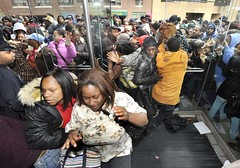
  • The New Poor: Millions of Unemployed Face Years Without Jobs

    February 21, 2010

    The New Poor: Millions of Unemployed Face Years Without Jobs

    By PETER S. GOODMAN
    New York Times

    BUENA PARK, Calif. — Even as the American economy shows tentative signs of a rebound, the human toll of the recession continues to mount, with millions of Americans remaining out of work, out of savings and nearing the end of their unemployment benefits.

    Economists fear that the nascent recovery will leave more people behind than in past recessions, failing to create jobs in sufficient numbers to absorb the record-setting ranks of the long-term unemployed.

    Call them the new poor: people long accustomed to the comforts of middle-class life who are now relying on public assistance for the first time in their lives — potentially for years to come.

    Yet the social safety net is already showing severe strains. Roughly 2.7 million jobless people will lose their unemployment check before the end of April unless Congress approves the Obama administration’s proposal to extend the payments, according to the Labor Department.

    Here in Southern California, Jean Eisen has been without work since she lost her job selling beauty salon equipment more than two years ago. In the several months she has endured with neither a paycheck nor an unemployment check, she has relied on local food banks for her groceries.

    She has learned to live without the prescription medications she is supposed to take for high blood pressure and cholesterol. She has become effusively religious — an unexpected turn for this onetime standup comic with X-rated material — finding in Christianity her only form of health insurance.

    “I pray for healing,” says Ms. Eisen, 57. “When you’ve got nothing, you’ve got to go with what you know.”

    Warm, outgoing and prone to the positive, Ms. Eisen has worked much of her life. Now, she is one of 6.3 million Americans who have been unemployed for six months or longer, the largest number since the government began keeping track in 1948. That is more than double the toll in the next-worst period, in the early 1980s.

    Men have suffered the largest numbers of job losses in this recession. But Ms. Eisen has the unfortunate distinction of being among a group — women from 45 to 64 years of age — whose long-term unemployment rate has grown rapidly.

    In 1983, after a deep recession, women in that range made up only 7 percent of those who had been out of work for six months or longer, according to the Labor Department. Last year, they made up 14 percent.

    Twice, Ms. Eisen exhausted her unemployment benefits before her check was restored by a federal extension. Last week, her check ran out again. She and her husband now settle their bills with only his $1,595 monthly disability check. The rent on their apartment is $1,380.

    “We’re looking at the very real possibility of being homeless,” she said.

    Every downturn pushes some people out of the middle class before the economy resumes expanding. Most recover. Many prosper. But some economists worry that this time could be different. An unusual constellation of forces — some embedded in the modern-day economy, others unique to this wrenching recession — might make it especially difficult for those out of work to find their way back to their middle-class lives.

    Labor experts say the economy needs 100,000 new jobs a month just to absorb entrants to the labor force. With more than 15 million people officially jobless, even a vigorous recovery is likely to leave an enormous number out of work for years.

    Some labor experts note that severe economic downturns are generally followed by powerful expansions, suggesting that aggressive hiring will soon resume. But doubts remain about whether such hiring can last long enough to absorb anywhere close to the millions of unemployed.

    A New Scarcity of Jobs

    Some labor experts say the basic functioning of the American economy has changed in ways that make jobs scarce — particularly for older, less-educated people like Ms. Eisen, who has only a high school diploma.

    Large companies are increasingly owned by institutional investors who crave swift profits, a feat often achieved by cutting payroll. The declining influence of unions has made it easier for employers to shift work to part-time and temporary employees. Factory work and even white-collar jobs have moved in recent years to low-cost countries in Asia and Latin America. Automation has helped manufacturing cut 5.6 million jobs since 2000 — the sort of jobs that once provided lower-skilled workers with middle-class paychecks.

    “American business is about maximizing shareholder value,” said Allen Sinai, chief global economist at the research firm Decision Economics. “You basically don’t want workers. You hire less, and you try to find capital equipment to replace them.”

    During periods of American economic expansion in the 1950s, ’60s and ’70s, the number of private-sector jobs increased about 3.5 percent a year, according to an analysis of Labor Department data by Lakshman Achuthan, managing director of the Economic Cycle Research Institute, a research firm. During expansions in the 1980s and ’90s, jobs grew just 2.4 percent annually. And during the last decade, job growth fell to 0.9 percent annually.

    “The pace of job growth has been getting weaker in each expansion,” Mr. Achuthan said. “There is no indication that this pattern is about to change.”

    Before 1990, it took an average of 21 months for the economy to regain the jobs shed during a recession, according to an analysis of Labor Department data by the National Employment Law Project and the Economic Policy Institute, a labor-oriented research group in Washington.

    After the recessions in 1990 and in 2001, 31 and 46 months passed before employment returned to its previous peaks. The economy was growing, but companies remained conservative in their hiring.

    Some 34 million people were hired into new and existing private-sector jobs in 2000, at the tail end of an expansion, according to Labor Department data. A year later, in the midst of recession, hiring had fallen off to 31.6 million. And as late as 2003, with the economy again growing, hiring in the private sector continued to slip, to 29.8 million.

    It was a jobless recovery: Business was picking up, but it simply did not translate into more work. This time, hiring may be especially subdued, labor economists say.

    Traditionally, three sectors have led the way out of recession: automobiles, home building and banking. But auto companies have been shrinking because strapped households have less buying power. Home building is limited by fears about a glut of foreclosed properties. Banking is expanding, but this seems largely a function of government support that is being withdrawn.

    At the same time, the continued bite of the financial crisis has crimped the flow of money to small businesses and new ventures, which tend to be major sources of new jobs.

    All of which helps explain why Ms. Eisen — who has never before struggled to find work — feels a familiar pain each time she scans job listings on her computer: There are positions in health care, most requiring experience she lacks. Office jobs demand familiarity with software she has never used. Jobs at fast food restaurants are mostly secured by young people and immigrants.

    If, as Mr. Sinai expects, the economy again expands without adding many jobs, millions of people like Ms. Eisen will be dependent on an unemployment insurance already being severely tested.

    “The system was ill prepared for the reality of long-term unemployment,” said Maurice Emsellem, a policy director for the National Employment Law Project. “Now, you add a severe recession, and you have created a crisis of historic proportions.”

    Fewer Protections

    Some poverty experts say the broader social safety net is not up to cushioning the impact of the worst downturn since the Great Depression. Social services are less extensive than during the last period of double-digit unemployment, in the early 1980s.

    On average, only two-thirds of unemployed people received state-provided unemployment checks last year, according to the Labor Department. The rest either exhausted their benefits, fell short of requirements or did not apply.

    “You have very large sets of people who have no social protections,” said Randy Albelda, an economist at the University of Massachusetts in Boston. “They are landing in this netherworld.”

    When Ms. Eisen and her husband, Jeff, applied for food stamps, they were turned away for having too much monthly income. The cutoff was $1,570 a month — $25 less than her husband’s disability check.

    Reforms in the mid-1990s imposed time limits on cash assistance for poor single mothers, a change predicated on the assumption that women would trade welfare checks for paychecks.

    Yet as jobs have become harder to get, so has welfare: as of 2006, 44 states cut off anyone with a household income totaling 75 percent of the poverty level — then limited to $1,383 a month for a family of three — according to an analysis by Ms. Albelda.

    “We have a work-based safety net without any work,” said Timothy M. Smeeding, director of the Institute for Research on Poverty at the University of Wisconsin, Madison. “People with more education and skills will probably figure something out once the economy picks up. It’s the ones with less education and skills: that’s the new poor.”

    Here in Orange County, the expanse of suburbia stretching south from Los Angeles, long-term unemployment reaches even those who once had six-figure salaries. A center of the national mortgage industry, the area prospered in the real estate boom and suffered with the bust.

    Until she was laid off two years ago, Janine Booth, 41, brought home roughly $10,000 a month in commissions from her job selling electronics to retailers. A single mother of three, she has been living lately on $2,000 a month in child support and about $450 a week in unemployment insurance — a stream of checks that ran out last week.

    For Ms. Booth, work has been a constant since her teenage years, when she cleaned houses under pressure from her mother to earn pocket money. Today, Ms. Booth pays her $1,500 monthly mortgage with help from her mother, who is herself living off savings after being laid off.

    “I don’t want to take money from her,” Ms. Booth said. “I just want to find a job.”

    Ms. Booth, with a résumé full of well-paid sales jobs, seems the sort of person who would have little difficulty getting work. Yet two years of looking have yielded little but anxiety.

    She sends out dozens of résumés a week and rarely hears back. She responds to online ads, only to learn they are seeking operators for telephone sex lines or people willing to send mysterious packages from their homes.

    She spends weekdays in a classroom in Anaheim, in a state-financed training program that is supposed to land her a job in medical administration. Even if she does find a job, she will be lucky if it pays $15 an hour.

    “What is going to happen?” she asked plaintively. “I worry about my kids. I just don’t want them to think I’m a failure.”

    On a recent weekend, she was running errands with her 18-year-old son when they stopped at an A.T.M. and he saw her checking account balance: $50.

    “He says, ‘Is that all you have?’ ” she recalled. “ ‘Are we going to be O.K.?’ ”

    Yes, she replied — and not only for his benefit.

    “I have to keep telling myself it’s going to be O.K.,” she said. “Otherwise, I’d go into a deep depression.”

    Last week, she made up fliers advertising her eagerness to clean houses — the same activity that provided her with spending money in high school, and now the only way she sees fit to provide for her kids. She plans to place the fliers on porches in some other neighborhood.

    “I don’t want to clean my neighbors’ houses,” she said. “I know I’m going to come out of this. There’s no way I’m going to be homeless and poverty-stricken. But I am scared. I have a lot of sleepless nights.”

    For the Eisens, poverty is already here. In the two years Ms. Eisen has been without work, they have exhausted their savings of about $24,000. Their credit card balances have grown to $15,000.

    “I don’t know how we’re still indoors,” she said.

    Her 1994 Dodge Caravan broke down in January, leaving her to ask for rides to an employment center.

    She does not have the money to move to a cheaper apartment.

    “You have to have money for first and last month’s rent, and to open utility accounts,” she said.

    What she has is personality and presence — two traits that used to seem enough. She narrates her life in a stream of self-deprecating wisecracks, her punch lines tinged with desperation.

    “See that,” she said, spotting a man dressed as the Statue of Liberty. Standing on a sidewalk, he waved at passing cars with a sign advertising a tax preparation business. “That will be me next week. Do you think this guy ever thought he’d be doing this?”

    And yet, she would gladly do this. She would do nearly anything.

    “There are no bad jobs now,” she says. “Any job is a good job.”

    She has applied everywhere she can think of — at offices, at gas stations. Nothing.

    “I’m being seen as a person who is no longer viable,” she said. “I’m chalking it up to my age and my weight. Blame it on your most prominent insecurity.”

    Two Incomes, Then None

    Ms. Eisen grew up poor, in Flatbush in Brooklyn. Her father was in maintenance. Her mother worked part time at a company that made window blinds.

    She married Jeff when she was 19, and they soon moved to California, where he had grown up. He worked in sales for a chemical company. They rented an apartment in Buena Park, a growing spread of houses filling out former orange groves. She stayed home and took care of their daughter.

    “I never asked him how much he earned,” Ms. Eisen said. “I was of the mentality that the husband took care of everything. But we never wanted.”

    By the early 1980s, gas and rent strained their finances. So she took a job as a quality assurance clerk at a factory that made aircraft parts. It paid $13.50 an hour and had health insurance.

    When the company moved to Mexico in the early 1990s, Ms. Eisen quickly found a job at a travel agency. When online booking killed that business, she got the job at the beauty salon equipment company. It paid $13.25 an hour, with an annual bonus — enough for presents under the Christmas tree.

    But six years ago, her husband took a fall at work and then succumbed to various ailments — diabetes, liver disease, high blood pressure — leaving him confined to the couch. Not until 2008 did he secure his disability check.

    And now they find themselves in this desert of joblessness, her paycheck replaced by a $702 unemployment check every other week. She received 14 weeks of benefits after she lost her job, and then a seven-week extension.

    For most of October through December 2008, she received nothing, as she waited for another extension. The checks came again, then ran out in September 2009. They were restored by an extension right before Christmas.

    Their daughter has back problems and is living on disability checks, making the church their ultimate safety net.

    “I never thought I’d be in the position where I had to go to a food bank,” Ms. Eisen said. But there she is, standing in the parking lot of the Calvary Chapel church, chatting with a half-dozen women, all waiting to enter the Bread of Life Food Pantry.

    When her name is called, she steps into a windowless alcove, where a smiling woman hands her three bags of groceries: carrots, potatoes, bread, cheese and a hunk of frozen meat.

    “Haven’t we got a lot to be thankful for?” Ms. Eisen asks.

    For one thing, no pinto beans.

    “I’ve got 10 bags of pinto beans,” she says. “And I have no clue how to cook a pinto bean.”

    Local job listings are just as mysterious. On a bulletin board at the county-financed ProPath Business and Career Services Center, many are written in jargon hinting of accounting or computers.

    “Nothing I’m qualified for,” Ms. Eisen says. “When you can’t define what it is, that’s a pretty good indication.”

    Her counselor has a couple of possibilities — a cashier at a supermarket and a night desk job at a motel.

    “I’ll e-mail them,” Ms. Eisen promises. “I’ll tell them what a shining example of humanity I am.”

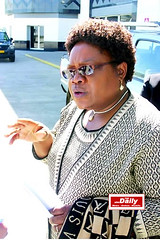
  • Rosalyn Brock was appointed the Chair of the Board for the N.A.A.C.P. She has worked as a healthcare executive. Brock is pictured here with President Ben Jealous (center) and outgoing Chair Julian Bond.

    February 21, 2010

    Health Executive to Lead N.A.A.C.P.

    By IAN URBINA
    New York Times

    The National Association for the Advancement of Colored People on Saturday announced the selection of its first new board leader in more than a decade.

    Roslyn M. Brock, 44, the board’s current vice chairwoman, will become chairwoman of the board, taking the reins from Julian Bond, who last year, on the eve of the organization’s centennial celebration, announced his decision to step down. The 64-member board is the policymaking arm of the organization.

    In being named vice chairwoman of the N.A.A.C.P. board at 35, Ms. Brock was the first woman and the youngest person to hold the position.

    Previously she worked in health care administration and policy. In her current job as a vice president of Bon Secours Health Care, Ms. Brock serves as the chief spokeswoman on government relations, advocacy and public policy.

    “This is the time for renewal,” said Mr. Bond, 70, who took over the chairmanship in 1998. “We have dynamic new leadership. Roslyn understands firsthand how important youth are to the success of the N.A.A.C.P. She was introduced to the N.A.A.C.P. 25 years ago when she served the N.A.A.C.P. as a youth board member and Youth and College Division State Conference president.”

    The most recognized organization in the civil rights establishment, the association was founded in 1909. One of its main missions was to fight the lynchings of blacks.

    The organization has played an important role in virtually every major civil rights issue of the last century, including the landmark 1954 Brown v. Board of Education desegregation case, the 1964 Civil Rights Act and the 1965 Voting Rights Act.

    It has struggled in recent years, however, with declining membership, financial and political problems and questions of how best to move forward. The group’s reputation was tarnished in the mid-1990s when it fired its president for using organization money to settle a sexual harassment claim against him. In 2007, it laid off more than a third of its staff because of a budget shortfall.

    In 2008, the board selected Benjamin T. Jealous, an activist and former news executive, as its youngest president, breaking with a tradition of picking ministers and political leaders and rebuffing criticisms that it was out of touch with the concerns of younger African-Americans.

    “We’re looking at a generational shift in our communities,” Ms. Brock said. “We have a 48-year-old president in the White House, an N.A.A.C.P. president who was 35 at the time of his election and a 44-year-old board chair. The wisdom of those who stood the test of time got us to this point, and the youth are who will ensure the future legacy of this organization.”

  • History That Liberates: Africa’s Urgent Need

    History that liberates: Africa’s urgent need

    By Dr Kwaku Person-Lynn

    SUPPRESSING African world history is top priority in the intellectual world. It contains stories that will forever transform world history.

    The greatest area of change and correction is revealing that world civilisation evolved from African civilisation.

    It was ancient before Europeans started the struggle of creating civilisation. Africans were the only people with experience and the capacity to teach from its universities. Europeans (ancient Greeks and Romans) had no great learning centres. The Nile Valley was the intellectual, spiritual, educational, industrial centre for the ancient world.

    The areas of science, medicine, mathematics, engineering, parenting, architecture, philosophy, religion, public works projects, distribution, preparing food and so many other human activity areas were created there and were distributed throughout the world by various conquerors and travellers.

    This revelation changes the entire complexion of all we were taught. Once this is realised, there will be no accurate history books published outside of a few exceptions: John G. Jackson’s Introduction To Civilisations and Chancellor Williams’ Destruction Of Black Civilisation, the various volumes of The Journal Of Civilisations, edited by Ivan Van Sertima, along with some other rare literature. These works are closer to accuracy than the large majority of books published on the subject.

    What is missing is a current book, incorporating the vast amount of incredible new information, adding a new component, DNA studies.

    This new literary effort can only be legitimate from an African point of view. Writers of European descent have written the majority of books on African history. This is not to say Europeans cannot write history. They are better at writing their own history than any one else. It is more the concept of starting from within, rather than without. Beginning with the primary, rather than the traditional method of analysing and interpreting from the secondary.

    Europeans have written volumes on African history. A mammoth amount is colonial or slave history, written from that perspective. To have a holistic approach to history, one must examine as many perspectives as possible.

    A view that has been alive for a few years is that one must start with the origin of humanity.

    There is such a lack of respect for Ernest E. Just, an American African biologist who worked at Howard University, early 1900s, who through his fertilisation and cell separation research brought us DNA. Thanks to his efforts, the origin of humanity work is almost at its conclusion.

    All of the present evidence leads straight to Africa more specifically, Ethiopia.

    The African influence in world civilisations is so massive it may take a few decades to document all that it means.

    Unfortunately, there are strenuous efforts to obstruct this information from public consumption and dissemination. There are people afraid of change. There are innate beliefs that people of African descent do not have the intellectual capacity to do serious scholarship. And there are those who suffer from the mental illness of colour prejudice.

    Lack of knowledge can be one cause of negative conduct.

    The bulk of immoral behaviour by people of African descent, particularly the youth, today is acquired from birth, several generations, learning and acting someone else’s habits, customs, behaviour, principles, culture, almost totally abandoning everything their ancestors taught.

    Cursory examination of things projected in Western culture indicates that it does not put much value in truth and moral character. That can be devastating and self destructive to young people being born and raised in that kind of environment. It will make people with little resources prey on each other. Understanding that this is arranged by purposeful design is the beginning of developing counter measures.

    One of many reasons why it is mandatory information of African world history be researched, written, distributed, read and analysed. In one sense, it is liberating. It frees a person from seeing the world from one perspective; primarily that people of European descent created all the great things. As self-serving as that has been for the perpetrators of that type of thinking, much of it is based on gross inaccuracies and omissions.

    Western intellectuals are fearful their authoritative scholarship and public trust may not prove as precise and accepted as it once was.

    This could cause a great dilemma among Western scholars as students, faculty and the general public become aware of this.

    Their next statement may be, “Since most of our teachers and books did not give us all of the information or withheld information, maybe we should look elsewhere.” The foremost concern is where that elsewhere may be.

    –Dr Kwaku Person-Lynn, Ph.D. is the author of On My Journey Now – The Narrative and Works of Dr John Henrik Clarke, The Knowledge Revolutionary. First Word: Black Scholars, Thinkers, Warriors, Knowledge, Wisdom, Mental Liberation. He can be reached on [email protected].

    This article is reproduced from the African Executive.

  • US Liberals Get War President of Their Own

    Liberals get war president of their own

    Zimbabwe Herald

    SUDDENLY and surprisingly, we have a Bush-like Obama Doctrine. To the applause of liberal hawks and formerly critical neo-cons, the president declared in his Nobel Peace Prize speech that the US will continue to wage war — though naturally, only “just” war — anywhere and against anyone it chooses in a never-ending struggle against the forces of evil.

    His antiwar supporters can take seats on the sidelines. It’s all-reminiscent of John F. Kennedy and the prescient George Ball, and afterward Ball and Lyndon Johnson.

    In the early ’60s, JFK—reluctantly, we are told by his admirers—decided to send 16 000 “trainers” to Vietnam to teach the South Vietnamese how to play soldier and to stop the Communists from sweeping over Southeast Asia.

    Vast quantities of money and assorted advisers were shipped without accountability to the corrupt gang of thugs running and ruining that country.

    Ball, the one dissenter in Kennedy’s entourage, pleaded with JFK to recall France’s devastating defeat in 1954 at Dien Bien Phu and throughout Indochina. “Within five years we’ll have 300 000 men in the paddies and jungles and never find them again,” he warned the liberal icon in the White House. But JFK thought he knew better, caustically answering, “George, you’re crazier than hell.

    That just isn’t going to happen.” Ball would also press Lyndon Johnson to stand down in Vietnam before he destroyed his presidency, domestic agenda, and more importantly the lives of tens of thousands of American soldiers and their families, not to mention a few million Southeast Asians.

    But LBJ wasn’t going to be the first president to lose a war and be blasted by pugnacious home-front warriors. Failing to stop the North Vietnamese would sooner or later have us fighting them on Waikiki Beach, or so the Cold War line went.

    Ever since then, we have continued to hear about regional menaces that supposedly, if left unchecked, will threaten vital US interests or even Americans at home. Ronald Reagan employed that rationale in defending the proxy war in Central America waged by US-backed Contras.

    George H.W. Bush and Bill Clinton extended the tradition of intervention, sending troops to theatres of combat as far-flung as Panama, Kuwait, and the Balkans, while the second Bush launched invasions of Iraq and Afghanistan. They have all been war presidents.

    But Barack Obama was going to be different, or so my fellow antiwar liberals — and a few antiwar conservatives — hoped. He was to herald the end of that uncompromising and unilateral era of preventive war.

    The hundreds of thousands who joyously greeted the president-elect in Grant Park or the 1,5 million at his inauguration were ecstatic with anticipation. Left-wing pundits wrote excitedly about FDR’s 100 Days and projected great plans onto the new Man from Illinois.

    In countless articles, Republicans were declared brain dead, and the Bush-Cheney policies that got us into Iraq, Afghanistan, and the torture business were buried.

    One year after those celebrations, it’s the neocons cheering, seeing in Obama’s policies a vindication of the late administration.

    Who would have dreamed that following Obama’s West Point speech announcing 30 000 more troops destined for Afghanistan, William Kristol would laud Obama in the pages of the Washington Post, writing, “the rationale for this surge is identical to Bush’s,” and praise the Democratic president for having “embraced the use of military force as a key instrument of national power”?

    War makes strange bedfellows. Michèle Flournoy, Obama’s under secretary of defence for policy, has been invited to speak about the president’s hopes for a new Afghanistan on a panel led by Frederick W. Kagan at the American Enterprise Institute, the heart of neo-conservatism. Why did Obama buy what the hawks sold him?

    What if he had levelled with the nation and acknowledged that, however obnoxious and cruel the Taliban may be, they pose no danger to the United States?

    What if he had vowed that we would not dispatch tens of thousands of additional troops to a civil war in an agrarian, impoverished, largely illiterate country divided by tribal loyalties?

    It was not to be. Instead, as New York Times columnist David Brooks stated approvingly, “With his two surges, Obama will more than double the number of American troops in Afghanistan.” Charles Krauthammer was direct and sharp: “most supporters of the Afghanistan war were satisfied.

    They got the policy; the liberals got the speech”—and no say in the construction of that policy.

    After West Point and Oslo, neo-cons saw Obama as a more coherent Bush, an electrifying orator who had dazzled antiwar Democrats and independents and then promptly dumped them.

    When the New York Times printed a photo of the men and women who helped Obama reach his decision to escalate, not one dove was present.

    Were there no alternatives? In this huge country, could he not find a handful of realists, whether Left or Right, to supply some workable ideas for eliminating third and fourth tours for our overextended troops and the resulting suicides, amputations, epidemics of post-traumatic stress disorder, and legions of weeping relatives at gravesides? Hold on, Obama’s loyal liberal defenders counter, shuddering at the memory of Bush.

    Why blame him for the miserable decisions he has to make based on impossible situations he did not create?

    They would prefer not to explain why they and their allies in the think tanks and Congress have so little influence. Granted, some of Obama’s base reacted negatively.

    In December, MoveOn .org sent its millions of members a scorching email denouncing Obama’s troop escalation for “deepen (ing) our involvement in a quagmire.”

    Anti-Vietnam War rebel Tom Hayden removed the Obama sticker from his car. United for Peace and Justice, the main organiser of mass peace rallies around the country, announced, “It’s Obama’s War, and We Will Stop it.”

    The widely read liberal TomDispatch.com dubbed its former champion the “Commanded-in- Chief” for giving way to the hardball pressures exerted by the generals.

    Matthew Rothschild of The Progressive, founded by the fabled anti-militarist Robert M. LaFollette Sr. in 1909, compared Bush and Obama’s rhetoric and wrote an article called “Obama Steals Bush’s Speechwriters.”

    But these protests notwithstanding, we remain — and will throughout Obama’s presidency — an empire of military colonisation, the goal for decades of neoconservatives and assorted liberal hawks.

    In anthropologist Hugh Gusterson’s wonderfully evocative words, “The US is to military bases as Heinz is to ketchup.” American forces are stationed at approximately 1 000 military bases in 120 countries at a cost topping $100 billion annually.

    Diego Garcia, a remote island in the Indian Ocean midway between Africa and Indonesia, is apparently so essential a base that 5000 locals were thrown out of their homes so the US could have yet another top-secret facility from which to conduct its perpetual wars.

    Far from being a consensus-seeking peacenik, Obama would not even sign the Landmine Ban Treaty, which Bush also refused to endorse, thus leaving the US the only NATO nation unwilling to participate.

    Said Steve Goose of Human Rights Watch’s Arms Division, “they have simply decided to allow the Pentagon to dictate terms.”

    A shocked Bill Moyers pointed out that 5000 people died from mine explosions in 2008, noting the disconnect between Obama’s refusal to enlist the support of the government he leads and the Oslo speech in which he maintained, “I am convinced that adhering to standards, international standards, strengthens those who do and isolates and weakens those who don’t.”

    In another instance of history repeating, the first Obama defence budget has been virtually the same as Bush’s military appropriations.

    Obama has reduced spending on Cold War weapons such as the F-22 fighter, but he reportedly plans to ask Congress for an extra $33 billion for the ongoing wars in the Middle East and Central Asia.

    To his credit, the president is trying to negotiate a new nuclear-arms reduction pact with Russia and close a few of the CIA’s clandestine prisons.

    But in many other vital areas of defence and national security, like warrantless wiretaps and renewal of much of the Patriot Act, he persists in activities that violate fundamental freedoms.

    He has also refused to hold anyone from the Bush-Cheney era accountable. There’s more: his administration has just signed an accord with Colombia granting the US 10 -year right to use seven of its bases, including the centrepiece of the agreement, Palanquero AFB.

    Take heed, any leftist South American government that dares defy Uncle Sam. At the same time, Obama blinked at the coup d’état in Honduras. “They really thought he was different,” said Julia Sweig of the Council on Foreign Relations, referring to Latin America’s opinion of Obama.

    “But those hopes were dashed over the course of the summer.” So what happened? Barack Obama happened. More eloquence than substance happened. More time-honoured political caution than audacity or hope.

    Liberal and conservative Cold Warriors as key advisers. A reluctance to cross wartime profiteers.

    A recognition by his poll-counters that, with future elections in mind, it was best to govern from some ill-defined centre, acting tough abroad to keep the neocons off his back while throwing an occasional bone to his left.

    That strategy may buy him a second term as fruitless as his first — or it could render him indistinguishable from his deservedly maligned predecessor and cost him re-election in 2012.

    The Left howls now, but from the very start, Obama signalled his lack of interest in McGovernite ideas of change in foreign policy. There was a time when he talked about pressing Israel to dismantle its settlements.

    But thus far he has been cowed by Netanyahu and his American backers, betraying any hope for a genuinely independent Palestinian state. There was that stirring speech in Cairo and then silence. There was talk about closing Guantanamo but no mention of the much larger Bagram prison in Afghanistan.

    The sad truth is everything we are seeing we have already seen. Despite presidents who come and go, permanent war is a hallowed American institution.

    Start if you will with the War of 1812, the invasion of Mexico, and the carnage of a Civil War. Move to the mass murder of Native Americans and theft of their property, the killing, torture, and prison camps in the Philippines, then the blood-drenched 20th century.

    The 21st likewise dawns red. It never changes. Doves protest, hawks rule, ordinary people pay the penalty. All wars are “just.” As surely as the bloodletting persists, so does the opposition.

    The old chestnut that liberals have always stood for peace and conservatives for war is historically false. In fact, our past is rich with anti-militarist heroes of surprisingly varied political colours.

    Daniel Webster opposed the War Hawks and the draft they proposed in 1812.

    Abolitionist Theodore Parker denounced the Mexican War and called on his fellow Bostonians in 1847 “to protest against this most infamous war.”

    Henry Van Dyke, a Presbyterian minister and ardent foe of the annexation of the Philippines, told his congregation in 1898, “If we enter the course of foreign conquest, the day is not far distant when we must spend in annual preparation for wars more than the US$180 000 000 that we now spend every year in the education of our children for peace.”

    Socialist and labour leader Eugene Debs received a 10-year prison sentence for daring to tell potential draftees in 1918 that it was “the working class who fight all the battles, the working class who make the supreme sacrifices, the working class who freely shed their blood and furnish the corpses.”

    Against US entry into World War I, Republican Sen. George Norris of Nebraska asked, “To whom does this war bring prosperity? Not to the soldier . . . not to the broken-hearted widow . . . not to the mother who weeps at the death of her baby boy . . . War brings no prosperity to the great mass of common and patriotic citizens . . . War brings prosperity to the stock gambler on Wall Street.” Rep. Barbara Lee (D-Calif.), the only member of Congress in 2001 who voted against George W. Bush’s decision to invade Afghanistan, warned her colleagues to be “careful not to embark on an open-ended war with neither an exit strategy nor a focused target.”

    Conservative Russell Kirk laid out a post-World War II programme for conservatives by reminding them, “A handful of individuals, some of them quite unused to moral responsibilities on such a scale, made it their business to extirpate the populations of Nagasaki and Hiroshima; we must make it our business to curtail the possibility of such snap decisions.”

    Anti-militarism is very much an American tradition, but it has never been a majority position. Who now reads Finley Peter Dunne, the Chicago newspaperman who invented the brogish bartender Mr Dooley speaking to his customer, Mr Hennessey, while deriding American excesses and the national passion for imperial expansion?

    He wondered why many leaders and everyday Americans passively embraced, without much knowledge, our devotion to world hegemony — specifically in his time, the decision to invade and occupy the Philippines.

    “’Tis not more than two months,” he told his pro-annexation readers, “ye larned whether they were islands or canned goods.”

    Yet just as certain as opposition to foreign adventuring arises, again it goes unheeded. As we begin President Obama’s second year in office, of this we can be certain: in global affairs, but for a few crumbs here and there, antiwar views will rarely be welcomed by this White House. And when these marginalised voters complain all the president’s men will remind them that they were told Afghanistan was a “necessary war” and “national security” is everything.

    I can imagine Obama’s advisers confidently telling him that however many troops he ships to these and future wars, however much money he spends on military hardware, his anguished allies have no place else to go. Plus ça change. — www.trinicenter.com

  • Zimbabwe News Update: Vice-President Mujuru Hands Over Tractors, Urges Farmers to Be Productive

    VP Mujuru hands over tractors, urges farmers to be productive

    From George Maponga in CHIREDZI
    Zimbabwe Herald

    Zimbabwe has the capacity to neutralise the effects of the illegal sanctions imposed by the West if the citizenry unites and contributes positively towards resuscitating the agricultural sector, Vice President Mujuru said yesterday.

    She said sanctions could be rendered useless if Zimbabweans worked together to consolidate the gains of the land reforms that saw Government acquiring formerly white-owned commercial farms to resettle 300 000 landless black families.

    VP Mujuru was speaking at Gibbo Stadium in Chiredzi where she handed over 36 tractors to resettled sugarcane farmers.

    The farmers are from the lowveld Hippo Valley, Triangle and Mkwasine sugar estates.

    The VP said, “It is imperative for every Zimbabwean to make a positive contribution towards the revival of the agricultural sector since it is the backbone and mainstay of our economy.

    “If we optimally utilise our land and vast agricultural potential the illegal sanctions imposed by the West will become negligible.

    “Zimbabweans should put their differences aside and work together in unison to shame the West, who up to this day maintained the illegal economic sanctions against our country,” she said.

    She said Government was cognisant of the challenges facing the cane industry.

    VP Mujuru challenged Zimbabweans to take advantage of Government’s indigenisation drive and take controlling stakes in various industries.

    The chairperson of the Commercial Sugarcane Farmers’ Association of Zimbabwe Mr Edmore Hwarare appealed to the Government to establish a cane mill to circumvent acts of sabotage by elitist millers.

    ‘New sanctions will motivate nation’

    Herald Reporter

    Zimbabweans should remain dedicated and united against the onslaught by the West after the renewal of sanctions by the European Union.

    Addressing troops at a command handover ceremony of 2.3 Infantry Batallion in Magunje yesterday, incoming commander Lieutenant-Colonel Don Chidavanyika said the extension of the illegal sanctions should motivate rather than demoralise the nation.

    “Being someone who fears God, I am reminded of Jesus’ words when he said ‘Upon this rock I will build my church and the gates of hell cannot prevail against it’.

    “Similarly, against Zimbabwe — the house of stone through unity of purpose — the gates of sanctions and neo-colonialism cannot prevail. This country needs committed and dedicated people who jealously guard the country’s abundant resources and wealth. We have stood the test of the times in the past decade, so what can stop us now.

    “We will overcome the adversaries we are facing and the injustice that the Western countries continue to impose on us,” he said.

    On his plans for the battalion, Lt-Col Chidavanyika said: “What I will simply do is to further tighten the screws and cut the loose ends.

    “I do not demand much from you. All I ask for is simple; a high standard of discipline, teamwork, loyalty, dedication and professionalism, which are the core values of the Zimbabwe National Army.

    “The courage and confidence you displayed over the past decade should continue to inspire us into the future,” he said.

    Lt-Col Chidavanyika is the unit’s 18th commanding officer since its formation at Independence.

    Outgoing commander Lt-Col Clifford Muchono said his tenure had moulded him and the troops into a hard-working and hard-hitting force.

    The commander of 2 Brigade Brigadier-General Douglas Nyikayaramba was the witnessing officer and guest of honour.

    Sanctions no threat to GPA, says President

    By Sydney Kawadza
    Zimbabwe Herald

    President Mugabe says the illegal Western sanctions will not achieve their intended objective of dividing the inclusive Government.

    He said the European Union’s decision this week to extend the embargo was designed to offset unity between Zimbabwe’s political parties.

    In an interview with ZTV ahead of his 86th birthday tomorrow, President Mugabe said the inclusive Government had achieved more and it would be “foolish” for the parties to break it over issues outside of the Global Political Agreement.

    “Why should they impose sanctions, take a negative step where we have taken a very positive step? They want to negate and obviously undermine the GPA.

    “They want to undermine the unity of the people of Zimbabwe. They would want to see us fight each other much more.”

    President Mugabe said the people of Zimbabwe decided that quarrelling would hinder development.

    He said only a handful of the 27 members of the EU were maintaining the sanctions.

    “It’s Britain and perhaps France, Germa-ny, Italy and a few others . . . together with the United States.

    “But we belong to the Third World and we say, in spite of their sanctions, we will continue to look East where there is greater friendship,” he said.

    On the issue of national unity, he said: “The getting together of political parties that yesterday were fighting each other and that today they are working together is worth celebrating over.

    “Just that phenomenon of unity and under that unity or using that phenomenon of unity comes the fact of the arrangement that is within the global agreement; the leaders must work together in accordance with the apportionment of functions and which meant, of course, that each party was given a number of posts, ministerial posts.

    “This Government comes from the various parties which were quarrelling yesterday and have ceased to quarrel now and are pursuing the various functions as per the global agreement.

    “I think just that arrangement, the fact of that arrangement is worth celebrating. But, of course, we would want to celebrate more when we look at the functions, the performance now of the Government as a whole.”

    The Head of State and Government and Commander-in-Chief of the Zimbabwe Defence Forces said the inclusive Government should acknowledge its inadequacies.

    He said the Government, given enough resources, would perform much better this year.

    On negotiations on the full implementation of the GPA, President Mugabe said everything had been fulfilled as per the agreement.

    “We are negotiating about nothing. It is the nothings that are holding us back. All that was important is enshrined in the global agreement and there is hardly anything we are now discussing which falls within the global agreement.

    “All the matters that have to do with Tomana and so on and so forth don’t come into the global agreement. There is no mention of Tomana, there is no mention of the Governor of the Reserve Bank, there is no mention of Bennett.

    “There is a need for a post of deputy minister of agriculture, which needs to be filled by a candidate from the MDC-T not necessarily by Bennett, by anyone else.”

    He said the only pending issue was for the parties to call for the lifting of sanctions.

    “And that one, naturally, needs greater attention, much greater attention and one wonders whether we all are at one in regards to it.

    However, President Mugabe said even a deadlock on the issue of sanctions would not break the inclusive Government.

    “We won’t breach the agreement because of that. I mean, from our point of view, it would be stupid for us to do so.

    “I mean, we have gained much more by way of working together than what we might lose by way of our failure to perform in respect of what we are expected to perform at the moment,” he said.

    President Mugabe defended the Indigenisation and Economic Empowerment Act.

    “This issue of indigenisation is an on-going process. We indeginised land, it was in the hands of outsiders — European farmers, some British, some South African, some German — and we decided, we had agreed with Britain that there would be a land redistribution programme and we proceeded accordingly.

    “We are still proceeding in respect with the land acquisition programme. But we are now, after the land, dealing with our ownership of resources in other areas with regard to mining, with regards to raw materials that we want to turn into finished goods, the manufacturing sector . . .”

    Touching on the land audit, he said: “I think it’s necessary for us to have the audit.

    “Varimi chaivo ngavaregere kuvhunduka, vasiri varimi ngavavhunduke. Vasiri varimi, ndiri kuzvitaura, nekuti pane vamwe vasiri varimi iye zvino kune mirwi yevanhu, perhaps it’s an exaggeration, asi kune vazhinji vasina kurima vakandoshevedza mabhunhu zvakare kuti huyai murime. Mabhunhu achiti tokupayi 10 percent or 15 percent of value of the harvest.

    “Vamwe vachitokoka, inviting them. Vakadaro ndivo vatisingade. Tinovatorera. Hatimbomira! And I happen to know quite several kunana Mash West and Mash Central,” he said.

    ZBC will broadcast the full interview tonight at 8.30

    Strike temporarily shelved

    Herald Reporter

    Unions representing civil servants yesterday said they will temporarily abandon their strike and instead embark on a sit-in for the next two weeks so as to avoid salary cuts.

    The Public Service Commission last week declared the strike illegal, ordering the state employees to return to work.

    The Public Service Act stipulates that any State employee who absents him/herself from work for 14 days will not get paid.

    Unionists yesterday urged civil servants to report for duty on Monday but said they should not do any work until they get an increment from their employer.

    Public Service Minister Eliphas Mukonoweshuro did not pick his phone when contacted to comment on this development and its legal implications.

    Addressing civil servants at a rally in Harare yesterday, Zimbabwe Teachers Association president Mrs Tendai Chikowore said: “After a careful scan of the current action and forecasting the future we have decided to change the course and tactics and thus we have adopted the form of a sit in.”

    The unionists said the sit–in would end on March 5 and another rally would be convened to map the way forward.

    Hundreds of civil servants marched through the City Centre to Parliament Building and the Public Service and Finance Ministries with petitions.

  • 5 Killed in Ivory Coast Anti-Government Protests

    5 killed in Ivory Coast anti-government protests

    By MARCO CHOWN OVED Associated Press Writer © 2010 The Associated Press
    Feb. 19, 2010, 5:21PM

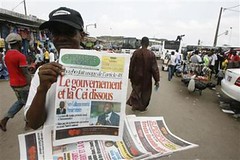
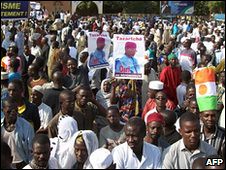
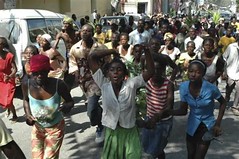
    ABIDJAN, Ivory Coast — Police fired on demonstrators at an anti-government rally Friday, killing five people and wounding a dozen others in Ivory Coast’s latest protest since the president dissolved the government a week ago, the opposition said.

    Demonstrations spread to at least eight cities in the West African nation on Friday. Moussa Dembele of the opposition RDR party said the deadly protest took place in Gagnoa, about 125 miles (200 kilometers) northwest of the economic capital, Abidjan.

    President Laurent Gbagbo had set a Friday deadline to form a new government but the prime minister on Thursday evening asked for a 48-hour extension.

    Dembele said late Wednesday that the death toll had increased to five people, from three earlier in the day.

    “The police were aiming directly at the protesters,” he said. “These weren’t stray bullets.”

    Augustin Gehoum, a spokesman for Gbagbo’s party, said the deaths were “regrettable,” but said police were not to blame. He also said the protests were part of an opposition strategy to destabilize the country after Gbagbo’s decision to dissolve the government.

    “Now they are crying ‘dictatorship,’” he said. “It’s nothing of the sort. Mr. Gbagbo dissolved a body that had lost the confidence of the Ivorian people.”

    The dissolution of the government has thrown into doubt the political reconciliation process in Ivory Coast, which was about to hold elections. Five years after the president’s term ended, Ivory Coast has yet to hold a ballot to replace him.

    The now-defunct government was the fruit of a peace agreement signed by Gbagbo’s government and the New Forces rebels in 2007 following a civil war that had split the world’s No. 1 cocoa producer into a rebel-held north and a government-controlled south. The unity government was composed of 33 ministers from all political parties and rebel factions.

    At the heart of the impasse that has delayed elections for five years is the question of who is really Ivorian. Before its brief civil war, Ivory Coast was one of Africa’s economic stars boasting a modern, cosmopolitan capital which lured tens of thousands of immigrants from poorer neighboring nations. At least a quarter of the nation’s 20 million people have been disqualified from voting based on the electoral law’s convoluted definition for determining eligibility, stoking tension.

    U.N. Secretary-General Ban Ki-moon expressed “grave concern” at the Ivorian political situation, according to U.N. deputy spokeswoman Marie Okabe.

    “The secretary-general is concerned about the clashes that occurred today in Gagnoa, which resulted in a number of deaths and injured people and are a reminder of the volatility of the situation,” Okabe said.

    “The secretary-general urges the Ivorian people to remain calm and the Ivorian political actors, authorities and the media to refrain from any action and rhetoric that could result in more violence,” she said.

  • Sudanese Government to Sign Formal Peace Deal With Darfur Rebels

    Sudanese government to sign formal peace deal with Darfur rebels

    From Jennifer Z. Deaton, CNN

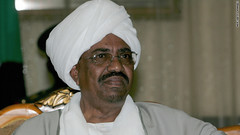
    (CNN) — Sudanese President Omar al-Bashir’s government will formally sign next week a framework agreement for a cease-fire with rebels in Sudan’s volatile Darfur region, a rebel representative and state media said Saturday.

    Dr. Tahir al-Fati, chairman of the rebel group Justice and Equality Movement’s legislative assembly, told CNN that a preliminary document for the framework agreement was signed Saturday in Chad between representatives of the two sides.

    He said the framework agreement will be formally signed Tuesday in Doha, Qatar.

    Al-Bashir said Saturday that it will be signed within two days, Sudan’s state news agency, SUNA, reported. The president also called off death sentences against members of the rebel group who were convicted after clashes in the Khartoum suburb of Omdurman.

    Mahamat Hisseine, spokesman for the government of Chad, told CNN that the document to be signed on Tuesday will “be an agreement as a cease-fire between the government of Sudan and the Justice and Equality Movement [JEM].”

    He added, “All these details would be part of a general cease-fire agreement that is still being finalized.”

    A permanent cease-fire will be a final step, al-Fati said.

    Last year, Sudan’s government and the JEM rebels signed a confidence-building agreement in Qatar, a step toward ending a six-year conflict that has killed hundreds of thousands.

    Qatar has been mediating talks between the two sides in the Darfur conflict, which erupted in 2003 after rebels began an uprising against the Khartoum government.

    The government launched a brutal counter-insurgency campaign, aided by government-backed Arab militias that went from village to village in Darfur, killing, torturing and raping residents, according to the United Nations, Western governments and human rights organizations.

    Al-Bashir is under pressure to end the fighting, particularly because he was charged with genocide by the International Criminal Court last year for the government’s campaign of violence in Darfur.

    In the past seven years, more than 300,000 people have been killed through direct combat, disease or malnutrition, the United Nations says. An additional 2.7 million people fled their homes because of fighting among rebels, government forces and allied militias.

    Links referenced within this article

    International Criminal Court
    http://topics.edition.cnn.com/topics/International_Criminal_Court
    Omar al-Bashir
    http://topics.edition.cnn.com/topics/Omar_al_Bashir
    Sudan
    http://topics.edition.cnn.com/topics/Sudan
    Darfur
    http://topics.edition.cnn.com/topics/Darfur

  • Niger Military Coup Leaders Face Condemnation From the AU and ECOWAS

    Friday, February 19, 2010
    17:14 Mecca time, 14:14 GMT

    Niger coup leaders face criticism

    Mamadou Tandja, the ousted presdient, is reportedly being held in a military building

    The African Union, France, and ECOWAS, a West African economic bloc, have condemned a military coup in Niger, a day after dissident soldiers seized the president and dissolved the constitution.

    Jean Ping, the head of the African Union, on Friday criticised the coup leaders, saying he was following developments “with concern”, while France called for dialogue to resolve the political crisis in its former colony.

    “France calls on all players including the armed forces to find, through dialogue, and as soon as possible, a solution to the constitutional crisis,” Bernard Valero, a French foreign ministry spokesman, told reporters.

    Niamey, Niger’s capital, was calm on Friday, with businesses and schools opening as usual, although armoured vehicles were seen stationed outside key government offices, including the presidential palace.

    An Al Jazeera contact in Niger, who cannot be named due to security reasons, said life had returned to normal in Niamey with people resuming their daily activities.

    “This morning we toured the city and found out that the military that took power have left their tanks and vehicles in some strategic points of the city. This is normal following a coup d’état, in order to secure these areas” he added.

    New ruler

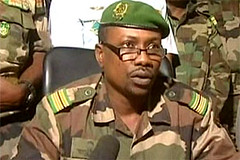
    After carrying out the coup, soldiers calling themselves the Supreme Council for the Restoration of Democracy (CSRD), announced that Salou Djibo, their squadron leader, was the country’s new ruler.

    They said in a statement that Niger’s current ministers would continue to run the government for the moment, and that they intended to turn Niger “an example of democracy and of good governance”.

    The statement also said that Mamadou Tandja, the ousted president, had been seen by a doctor and the 71-year-old was “doing very well”. Tandja is reportedly being held in an army building in Niamey.

    Soldiers stormed the presidential palace on Thursday, seizing Tandja and some of his aides after a four-hour gun battle. At least three people were reported to have been killed in the gunfight.

    Tensions had been high in Niger since President Tandja dissolved parliament last year and changed the constitution to extend his rule following a referendum – a move that drew widespread criticism at home and led to international sanctions.

    ‘Expected action’

    Marie-Roger Biloa, founding editor of the Africa International magazine, said some sort of action had been expected.

    “Nigeriens are very proud of their democratic process,” she told Al Jazeera from Paris, where she is based.

    “They [Nigeriens] have been really trying to put a democratic institution in place, and everybody was expecting something to happen after President Tandja decided not to play by the rules.”

    Last June, Tandja dissolved the constitutional court that had ruled against him and assumed the power to rule by decree, brushing aside international criticism of the move, saying he was answerable only to the people of Niger.

    He was supposed to step down in December following two five-year terms in a row, but his so-called reforms removed most checks on his authority, abolished term limits and gave him an initial three more years in power without an election, an extension he said he needed to complete large-scale investment projects.

    Source: Al Jazeera and agencies

  • Austin Man Crashes Private Plane Into IRS Office

    February 19, 2010

    Man Crashes Plane Into Texas I.R.S. Office

    By MICHAEL BRICK
    New York Times

    AUSTIN, Tex. — Leaving behind a rant against the government, big business and particularly the tax system, a computer engineer smashed a small aircraft into an office building where nearly 200 employees of the Internal Revenue Service were starting their workday Thursday morning, the authorities said.

    The pilot, identified as Andrew Joseph Stack III, 53, of north Austin, apparently died in the crash, and one other person was unaccounted for. Late Thursday, two bodies were pulled from the site, though the authorities would not discuss the identities of those found, The Associated Press reported. Two serious injuries were also reported in the crash and subsequent fire, which initially inspired fears of a terrorist attack and drew nationwide attention.

    But in place of the typical portrait of a terrorist driven by ideology, Mr. Stack was described as generally easygoing, a talented amateur musician with marital troubles and a maddening grudge against the tax authorities.

    “I knew Joe had a hang-up with the I.R.S. on account of them breaking him, taking his savings away,” said Jack Cook, the stepfather of Mr. Stack’s wife, in a telephone interview from his home in Oklahoma. “And that’s undoubtedly the reason he flew the airplane against that building. Not to kill people, but just to damage the I.R.S.”

    Within hours of the crash, before the death or even the identity of the pilot had been confirmed, officials ruled out any connection to terrorist groups or causes.

    “The main thing I want to put out there is that this is an isolated incident here; there is no cause for alarm,” said the Austin police chief, Art Acevedo, in a televised news conference at midday. Asked how he could be sure, Mr. Acevedo said, “You have to take my word at it, don’t you?”

    As the Department of Homeland Security opened an investigation and President Obama received a briefing from his counterterrorism adviser, John O. Brennan, federal officials emphasized the same message, describing the case as a criminal inquiry.

    Since the attacks of Sept. 11, 2001, the notion of terrorists using small airplanes to crash into buildings has raised a special sort of public anxiety. That was the initial reaction in 2006, when a New York Yankees pitcher and his flight instructor died in a crash in Manhattan. On Thursday the North American Aerospace Defense Command sent two F-16 aircraft to patrol the area before it was determined that the crash was the work of one man.

    Mr. Stack’s aircraft, a single-engine fixed-wing Piper PA-28-236 registered in California, took off from Georgetown Municipal Airport, about 25 miles north of Austin, at 9:40 a.m., the Federal Aviation Administration said.

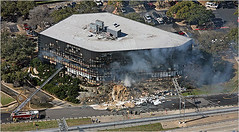
    At 9:56, the plane tore through a seven-story office building at 9430 Research Boulevard, about seven miles northwest of the State Capitol, local authorities said. Flames and smoke engulfed the building, sending big black burned panels to the ground. Emergency medical officials said two men were injured, both in the fire. One was transported to a burn unit in San Antonio. A third office worker was described only as unaccounted for.

    Aside from the I.R.S., private organizations including an education center affiliated with St. Edward’s University maintain offices in the building, according to address records. The local office of the Federal Bureau of Investigation is in a separate part of the complex.

    “We can confirm that the building that the plane hit this morning includes I.R.S. offices,” said Terry L. Lemons, a spokesman for the agency. “We have about 190 employees that work at those offices. We’re still in the process of accounting for everyone.”

    In a six-page statement signed “Joe Stack (1956-2010)” and posted on a Web site connected to Mr. Stack’s wife, the author singled out the tax agency as a source of suicidal rage, concluding, “Well, Mr. Big Brother I.R.S. man, let’s try something different, take my pound of flesh and sleep well.”

    Though profane at points, the statement articulated grievances with specific sections of the tax code, corporations, politicians and a local accountant. It appeared to have been written with some deliberation. At one point, the verbs “left” and “abandoned” appear side by side, seemingly an editing choice never settled.

    From relatives, friends and neighbors, a portrait emerged of Mr. Stack as a man pushed over the brink by retirement dreams deferred by a long series of financial setbacks.

    By the account of Mr. Cook, Mr. Stack was raised in an orphanage in Hershey, Pa., with a brother and sister, leaving the orphanage after high school to attend college. He worked as a software engineer in California, learned to fly and played guitar and piano for recreation. He moved to Austin, playing with a band and at informal gatherings.

    Mr. Stack met Mr. Cook’s stepdaughter, the former Sheryl Housh, through musician friends in Austin. After eight months of friendship, they dated and married about three years ago. Both had been previously married.

    Mrs. Stack, 50, listed in records at the University of Texas as a graduate student in music performance, brought her own back story to the marriage, having spent several years in the sway of a religious cult before her parents orchestrated a rescue.

    On visits to Oklahoma, Mr. Stack took his new in-laws up in his plane. He never spoke of his troubles with the I.R.S., though his wife related them. The family assembled in Austin at Christmas, and Mr. Stack seemed fine, Mr. Cook said.

    But in recent weeks Mrs. Stack complained to her parents of an increasingly frightening anger in her husband, straining the marriage, Mr. Cook said. On Wednesday night, Mrs. Stack took her 12-year-old daughter, Margaux, to a hotel to get away from her husband.

    They returned on Thursday morning to find their house ablaze, their belongings destroyed. Officials said the house fire was deliberately set, casting Mr. Stack as the primary suspect. But by that point he was gone, airborne.

    “This is a shock to me that he would do something like this,” Mr. Cook said. “But you get your anger up, you do it.”

    Sewell Chan contributed reporting from Washington.

    Anger wasn’t obvious to friends, they say

    By Steven Kreytak
    AMERICAN-STATESMAN STAFF
    Updated: 12:08 a.m. Friday, Feb. 19, 2010
    Published: 10:24 p.m. Thursday, Feb. 18, 2010

    Roughly three decades of anger and bitterness, much of it aimed at the U.S. tax system, were laid bare in an online diatribe linked to Andrew Joseph Stack III, the Austin man who is believed to have set his house on fire and then flown his airplane into an Austin office building Thursday.

    Violence, the note says, was the only answer.

    “Nothing changes unless there’s a body count,” the note says. “By not adding my body to the count, I insure nothing will change.”

    Posted on EmbeddedArts.com, a Web site registered to Stack and once used for his software and firmware engineering business, the note, six pages when printed, ends like an obituary: “Joe Stack (1956-2010).”

    Authorities declined to confirm its authenticity.

    Stack wrote: “If you’re reading this, you’re no doubt asking yourself, `Why did this have to happen?’”

    What follows in the note is a series of stories apparently meant to explain Stack’s actions Thursday, when his Piper Cherokee airplane hit an office building on Research Boulevard that houses about 200 Internal Revenue Service employees, including criminal investigators and auditors.

    Web site coding shows the note was created Tuesday, edited 27 times, the final time early Thursday morning. In 2,676 words, Stack also rails against large corporations, the Roman Catholic Church, former President George W. Bush and a 1986 tax law that redefined the status of some technology industry contract workers.

    Friends and neighbors said they had never heard any of these gripes from the 53-year-old software engineer and former bass player in a local alt-country band.

    “We didn’t know that he had frustrations and troubles,” said Pam Parker of Austin, who had known Stack and his wife, Sheryl, for several years and last spoke to him a few weeks ago. “He always was very easygoing. … He was just a pleasant friendly guy.”

    Stack graduated from Milton Hershey School in Hershey, Pa. The school was founded and endowed by the candy magnate more than 90 years ago as a home and school for orphaned boys. Stack attended Harrisburg Area Community College from 1975 to 1977 but did not graduate, school spokesman Patrick M. Early said.

    Stack later married, moved to California and had a daughter who grew up to marry a Norwegian pilot. Parker said Stack went to Norway to visit her and his one or two grandchildren each year.

    In his online note, Stack said that in the early 1980s in California, he began participating in “tax code readings and discussions” that focused on tax exemptions, such as ones that “make institutions like the vulgar, corrupt Catholic Church so incredibly wealthy. We carefully studied the law (with the help of some of the `best’, high-paid, experienced tax lawyers in the business), and then began to do exactly what the `big boys’ were doing,” he wrote in the note.

    “That little lesson in patriotism cost me $40,000+, 10 years of my life, and set my retirement plans back to 0,” Stack wrote, without elaboration. “It made me realize for the first time that I live in a country with an ideology that is based on a total and complete lie.”

    After Stack began working as an engineer in the 1980s, the note says, the 1986 tax law change essentially “declared me a criminal and non-citizen slave.”

    In the note, Stack wrote about 100-hour workweeks in Los Angeles in the early 1990s, his divorce and the dot-com bust. After the Sept. 11, 2001, terrorist attacks, he wrote, “our leaders decided that all aircraft were grounded for what seemed like an eternity.” Security alerts “made access to my customers prohibitively expensive,” he wrote.

    “Ironically, after what they had done the government came to the aid of the airlines with billions of our tax dollars … as usual they left me to rot and die while they bailed out their rich, incompetent cronies WITH MY MONEY!” the note said.

    According to previous versions of his Web site recovered online, Stack came to Austin around 2004 and continued seeking work as an engineer.

    What he found, according to the note, was “a place with a highly inflated sense of self-importance.”

    Work was hard to come by, and the rates were a third of what he had earned in past years, the note says. Stack claimed in the note that the Justice Department turns a blind eye while a few large companies in Austin collude and drive down wages.

    Like Parker, other friends and neighbors said they had no indication that Stack was so frustrated. He married in 2007 and lived in a 2,500-square-foot house in far North Austin, near Metric Boulevard and Parmer Lane, with his wife Sheryl and her daughter, who is about 12.

    There his wife taught piano lessons, neighbors said. Parker said Stack’s wife is a pianist in the graduate music program at the University of Texas. With Stack playing bass, the couple would put on house concerts for friends, Parker said.

    “You wouldn’t have pegged him to do anything crazy let alone a big spectacular crazy thing,” she said.

    Stack also played for a time in the Billy Eli Band with Parker’s husband.

    Jim Hemphill, also a member of the band, said he flew in Stack’s plane once to play a wedding in Conroe.

    Referring to the anger revealed in the note, Hemphill said: “I never saw anything like this in Joe.”

    According to his online note, Stack relied on savings and retirement accounts to survive in Austin. One year he had no income so was not required to file a tax return, the note says.

    “The sleazy government … disagreed. But they didn’t notify me in time … to launch a legal objection. … Bend over for another $10,000 helping of justice.”

    Stack wrote that he recently sought tax assistance from an accountant. After he was audited, that accountant neglected to report some of “Sheryl’s unreported income,” the note says.

    “That left me … trying to defend transactions that have no relationship to anything tax related,” the note says. “The end result is… well, just look around. I saw it written once that the definition of insanity is repeating the same process over and over and expecting the outcome to suddenly be different,” the note says. “I am finally ready to stop this insanity. Well, Mr. Big Brother IRS man, let’s try something different; take my pound of flesh and sleep well.”

    [email protected]; 912-2946

    Additional material from The Associated Press and staff writer Patrick Beach.

    Stunned workers find way out of burning building

    By Kevin Robbins
    AMERICAN-STATESMAN STAFF
    Published: 10:27 p.m. Thursday, Feb. 18, 2010

    William Winnie glanced to the north. His eyes locked on an airplane drawing near.

    An airplane? Winnie thought.

    Here?

    He watched the doomed Piper Cherokee through the tinted window of an office building on Research Boulevard called Echelon 1. Winnie noticed the wings: level. It was flying very fast.

    “It looked like it was coming right in,” he said.

    Winnie and three of his colleagues at the Internal Revenue Service had gathered Tuesday morning in a small third-floor room for a recertification program to operate an automated external defibrillator. The colleagues, all revenue agents with the federal agency responsible for tax collection and tax-law enforcement, wore casual clothes and white identification badges around their necks.

    On the floor above and the floor below, IRS field agents, information technology specialists and criminal investigators went about the morning as a man authorities believe was Andrew Joseph Stack III banked the Cherokee south from an airport in Georgetown and aimed the nose toward Austin.

    Winnie, 56, with thin white hair pulled into a short ponytail, was standing when he saw the plane. He said he had no time to hide or shout a warning.

    The Cherokee dipped slightly below the third floor and to the left. The building shook, Winnie said. Glass splintered, and particles from the ceiling spiraled to the floor like snow.

    As the Cherokee approached, Rene Sadlier sat unaware at his desk on the first floor of Echelon I, sipping coffee.

    “It was 9:51 or 9:52,” he said.

    The national account representative for ATR International said he felt a concussion. He thought a transformer had exploded.

    “I just jumped under my desk,” he said.

    The drop ceiling fell around him. The desk collapsed. Sadlier fumbled his way outside. He left his car keys.

    He called his wife.

    “The building just blew up,” he told her.

    Hundreds of people worked in Echelon I. Few actually saw the Cherokee plunge into their workplace.

    But many motorists and bystanders watched the small, single-engine plane dive into the dark-windowed building from a springlike blue sky.

    Gerry Cullen walked through the parking lot at Marie Callender’s, a restaurant on the north side of U.S. 183 . He heard an unmistakable sound.

    “It scared the hell out of me,” he said.

    A 66-year-old flight instructor, Cullen recognized the noise as well as he would his own voice. He said he’d spent about 400 hours in the cockpit of a Cherokee, teaching slow-speed takeoffs and stability in the air.

    The Cherokee he saw Tuesday knifed through the sky — its four-cylinder engine at full whine, its wing flaps positioned for pure speed, its throttle shoved up against the instrument panel.

    Cullen estimated that the plane was flying at 150 miles an hour, and so low the fixed-wheel landing gear appeared to brush the light poles in the parking lot. The Cherokee’s typical cruising speed is 115, he said.

    Any faster, he said, and “you have to fight them. They don’t want to dive. They don’t want to go fast.”

    Cullen said he entertained that very thought as he watched the white underside of the fuselage pass overhead and vaporize against the building in a swell of fire.

    Dr. Todd Nash saw the Cherokee through the window of his Dodge Ram pickup. He knew that silhouette.

    The 39-year-old chief of the emergency department at Seton Northwest Hospital has flown a similar small plane. Flying is his hobby, and he paid attention to detail.

    Driving north on Mopac Boulevard (Loop 1) toward U.S. 183, Nash realized that the Cherokee had “violently started to descend.” The scene riveted Nash. He wondered whether the pilot were trying to land on Loop 360 or in the woods nearby.

    “I thought he lost control of the aircraft,” Nash said.

    The Cherokee dipped under the horizon. “And there was a big puff of smoke,” Nash said.

    The physician called Dr. Christopher Ziebell, chief of emergency medicine at University Medical Center Brackenridge, the city’s only Level 1 trauma center for adults. Nash warned his counterpart to get ready for a busy morning.

    Chris Messer, who turned 27 on Thursday, said the Cherokee flew right in front of his car on the flyover between Mopac Boulevard and U.S. 183.

    He felt the plane’s impact through his steering wheel.

    “The heat came through my air vents,” he said.

    Lyric Olivarez worked in Echelon IV, a building that shared a parking lot with Echelon I.

    A woman ran in, Olivarez said.

    There’s been a bomb.

    Olivarez, 22, rushed to the fire escape. Once outside, she heard voices in distress.

    “People were screaming and crying for us to help them,” she said.

    Up on the third floor of Echelon I, Dawn Goldberg sat at a computer terminal. She heard a loud, muffled sound that reminded her of nothing she had ever heard.

    “The building shook violently,” said Goldberg, an IRS revenue agent based in Houston.

    “There were things falling off of the ceiling.”

    Goldberg joined the other IRS employees in a stairwell so dark they had to feel for the handrail. The evacuation was calm, she said. Her Austin colleagues clearly had been drilled.

    She found her way to the corner office where she’d left her purse. She opened the door. The room was burning. Goldberg located her purse. She picked it up. It was on fire. It burned a finger on her right hand.

    She saw an IRS employee being led to an ambulance.

    He was wearing no shirt. His back was burned.

    Goldberg forgot about her finger.

    “He’s going to be OK,” she said.

    “He was talking.”

    William Winnie, the revenue agent training on the third floor, said the concussion made the building move, like the ground had shifted under his shoes.

    “I didn’t lose my footing,” he said. “But it was enough to knock people who were sitting to the floor.”

    Winnie and his colleagues remembered the evacuation plan. They assembled at the middle stairwell and filed down the risers. The lights were out. People were calm.

    “There was very little panic,” Winnie said.

    He heard the unsettling klaxon of the fire alarm in Echelon I. He followed his colleagues to daylight, careful to step around the glass.

    They left the building through the doors opposite the dark windows facing U.S. 183.

    With every step, the IRS employees got farther from the destroyed Cherokee and the damage it caused.

    They walked quickly through the shady parking lot, through the pleasant morning air under a sky growing dark with soot, and across the street, where firetrucks and ambulances began to block their view of the smoke and fire inside Echelon 1.

    [email protected]; 445-3602

    Additional material from Mary Ann Roser, Melissa Taboada, Chuck Lindell and Barry Harrell.

    Stunned workers find way out of burning building

    By Kevin Robbins
    AMERICAN-STATESMAN STAFF
    Published: 10:27 p.m. Thursday, Feb. 18, 2010

    William Winnie glanced to the north. His eyes locked on an airplane drawing near.

    An airplane? Winnie thought.

    Here?

    He watched the doomed Piper Cherokee through the tinted window of an office building on Research Boulevard called Echelon 1. Winnie noticed the wings: level. It was flying very fast.

    “It looked like it was coming right in,” he said.

    Winnie and three of his colleagues at the Internal Revenue Service had gathered Tuesday morning in a small third-floor room for a recertification program to operate an automated external defibrillator. The colleagues, all revenue agents with the federal agency responsible for tax collection and tax-law enforcement, wore casual clothes and white identification badges around their necks.

    On the floor above and the floor below, IRS field agents, information technology specialists and criminal investigators went about the morning as a man authorities believe was Andrew Joseph Stack III banked the Cherokee south from an airport in Georgetown and aimed the nose toward Austin.

    Winnie, 56, with thin white hair pulled into a short ponytail, was standing when he saw the plane. He said he had no time to hide or shout a warning.

    The Cherokee dipped slightly below the third floor and to the left. The building shook, Winnie said. Glass splintered, and particles from the ceiling spiraled to the floor like snow.

    As the Cherokee approached, Rene Sadlier sat unaware at his desk on the first floor of Echelon I, sipping coffee.

    “It was 9:51 or 9:52,” he said.

    The national account representative for ATR International said he felt a concussion. He thought a transformer had exploded.

    “I just jumped under my desk,” he said.

    The drop ceiling fell around him. The desk collapsed. Sadlier fumbled his way outside. He left his car keys.

    He called his wife.

    “The building just blew up,” he told her.

    Hundreds of people worked in Echelon I. Few actually saw the Cherokee plunge into their workplace.

    But many motorists and bystanders watched the small, single-engine plane dive into the dark-windowed building from a springlike blue sky.

    Gerry Cullen walked through the parking lot at Marie Callender’s, a restaurant on the north side of U.S. 183 . He heard an unmistakable sound.

    “It scared the hell out of me,” he said.

    A 66-year-old flight instructor, Cullen recognized the noise as well as he would his own voice. He said he’d spent about 400 hours in the cockpit of a Cherokee, teaching slow-speed takeoffs and stability in the air.

    The Cherokee he saw Tuesday knifed through the sky — its four-cylinder engine at full whine, its wing flaps positioned for pure speed, its throttle shoved up against the instrument panel.

    Cullen estimated that the plane was flying at 150 miles an hour, and so low the fixed-wheel landing gear appeared to brush the light poles in the parking lot. The Cherokee’s typical cruising speed is 115, he said.

    Any faster, he said, and “you have to fight them. They don’t want to dive. They don’t want to go fast.”

    Cullen said he entertained that very thought as he watched the white underside of the fuselage pass overhead and vaporize against the building in a swell of fire.

    Dr. Todd Nash saw the Cherokee through the window of his Dodge Ram pickup. He knew that silhouette.

    The 39-year-old chief of the emergency department at Seton Northwest Hospital has flown a similar small plane. Flying is his hobby, and he paid attention to detail.

    Driving north on Mopac Boulevard (Loop 1) toward U.S. 183, Nash realized that the Cherokee had “violently started to descend.” The scene riveted Nash. He wondered whether the pilot were trying to land on Loop 360 or in the woods nearby.

    “I thought he lost control of the aircraft,” Nash said.

    The Cherokee dipped under the horizon. “And there was a big puff of smoke,” Nash said.

    The physician called Dr. Christopher Ziebell, chief of emergency medicine at University Medical Center Brackenridge, the city’s only Level 1 trauma center for adults. Nash warned his counterpart to get ready for a busy morning.

    Chris Messer, who turned 27 on Thursday, said the Cherokee flew right in front of his car on the flyover between Mopac Boulevard and U.S. 183.

    He felt the plane’s impact through his steering wheel.

    “The heat came through my air vents,” he said.

    Lyric Olivarez worked in Echelon IV, a building that shared a parking lot with Echelon I.

    A woman ran in, Olivarez said.

    There’s been a bomb.

    Olivarez, 22, rushed to the fire escape. Once outside, she heard voices in distress.

    “People were screaming and crying for us to help them,” she said.

    Up on the third floor of Echelon I, Dawn Goldberg sat at a computer terminal. She heard a loud, muffled sound that reminded her of nothing she had ever heard.

    “The building shook violently,” said Goldberg, an IRS revenue agent based in Houston.

    “There were things falling off of the ceiling.”

    Goldberg joined the other IRS employees in a stairwell so dark they had to feel for the handrail. The evacuation was calm, she said. Her Austin colleagues clearly had been drilled.

    She found her way to the corner office where she’d left her purse. She opened the door. The room was burning. Goldberg located her purse. She picked it up. It was on fire. It burned a finger on her right hand.

    She saw an IRS employee being led to an ambulance.

    He was wearing no shirt. His back was burned.

    Goldberg forgot about her finger.

    “He’s going to be OK,” she said.

    “He was talking.”

    William Winnie, the revenue agent training on the third floor, said the concussion made the building move, like the ground had shifted under his shoes.

    “I didn’t lose my footing,” he said. “But it was enough to knock people who were sitting to the floor.”

    Winnie and his colleagues remembered the evacuation plan. They assembled at the middle stairwell and filed down the risers. The lights were out. People were calm.

    “There was very little panic,” Winnie said.

    He heard the unsettling klaxon of the fire alarm in Echelon I. He followed his colleagues to daylight, careful to step around the glass.

    They left the building through the doors opposite the dark windows facing U.S. 183.

    With every step, the IRS employees got farther from the destroyed Cherokee and the damage it caused.

    They walked quickly through the shady parking lot, through the pleasant morning air under a sky growing dark with soot, and across the street, where firetrucks and ambulances began to block their view of the smoke and fire inside Echelon 1.

    [email protected]; 445-3602

    Additional material from Mary Ann Roser, Melissa Taboada, Chuck Lindell and Barry Harrell.

  • Israeli Intelligence Assassinates Palestinian Leader in Dubai

    Thursday, February 18, 2010
    21:18 Mecca time, 18:18 GMT

    Interpol alert over Dubai suspects

    Dubai police named 11 people suspected of involvement in the killing of a Hamas official

    Interpol, the international police agency, has placed 11 members of an alleged hit squad suspected of assassinating Mahmoud al-Mabhouh, a senior Hamas commander, at a luxury Dubai hotel last month, on its most-wanted list.

    Interpol issued the red notices, its highest-level alert, on Thursday on the request of Dubai authorities.

    Interpol said it had reason to believe the suspects had stolen the identities of real people, using them as aliases to commit the murder.

    Interpol’s “red notices” are not international arrest warrants but are put out after national authorities issue a warrant to help with finding suspects so they can be arrested or extradited.

    ‘Israeli role’

    In this case, the red notices were requested by Dubai police and Interpol’s bureau in Abu Dhabi, the international police organisation said on its website www.interpol.int.

    Earlier on Thursday, Dahi Khalfan Tamim, Dubai’s police chief, said he believed Israeli agents, using British, French, German and Irish passports, were behind the killing on January 19.

    The National, an Abu Dhabi government-owned newspaper, quoted Tamim as saying that the investigation into the killing “reveal[s] that Mossad [Israel’s security service] is involved in the murder”.

    Tamim told the publication’s website on Thursday that he “is 99 per cent, if not 100 per cent, that Mossad is standing behind the murder”.

    Police in Dubai have already released closed-circuit television footage of 11 individuals believed to have been involved in the killing of al-Mabhouh at the Al-Bustan hotel.

    Tamim told Al-Bayan, another UAE newspaper based in Dubai, that “Dubai police has more evidence, apart from the tapes and photos that were revealed earlier”.

    “The coming days will carry more surprises which will leave no room for doubt,” he said.

    UK ‘outrage’

    Israeli silence on the killing was broken on Wednesday by Avigdor Lieberman, the country’s foreign minister, who said that “there is no reason to think that it was the Israeli Mossad, and not some other intelligence service or country up to some mischief”.

    However, he also said that Israel maintains a “policy of ambiguity” on intelligence matters.

    London, Paris and Dublin have all demanded explanations from Israel as to why passport details of their citizens had been used by the suspected hit squad.

    Britain summoned Ron Prosor, the Israeli ambassador to London, for a meeting with Peter Ricketts, who heads its diplomatic service, to explain how several UK citizens living in Israel found their passport details had been used by the alleged killers.

    David Miliband, the British foreign minister, described the use of six British passports as an “outrage”.

    Miliband said Ricketts had made clear “how seriously we take any suggestion of fraudulent use of British passports” and sought Israeli assistance.

    “We hope and expect they will co-operate fully with the investigation that has been launched by the prime minister [Gordon Brown],” said Miliband, adding that he hoped to discuss the issue further with Lieberman, when both men meet in Brussels on Monday.

    Britain’s Serious Organised Crime Agency is to lead an investigation into the matter in close co-operation with the Emirati authorities.

    Paris also demanded that Israel explain how an apparently forged French passport had been used by the suspected assassins.

    “We are asking for explanations from Israel’s embassy in France over the circumstances of the use of a fake French passport in the assassination of a Hamas member in Dubai,” said the country’s foreign ministry.

    Dublin followed suit, calling in the Israeli ambassador to grill him about how the suspects had used passport details of three Irish citizens, one of whom has never visited Israel.

    Hamas accusations

    Sources within Hamas, which has already blamed Israel for being behind the killing, have also accused members of a rival Palestinian faction of helping Israel to kill al-Mabhouh.

    The sources accused members of Fatah party, headed by Palestinian president Mahmoud Abbas, of aiding the murder.

    In the Gaza Strip, the Palestinian territory run by Hamas, anger spilled onto the streets on Wednesday with thousands of people gathering at a rally vowing to avengethe death of al-Mabhouh.

    Al-Mabhouh was a senior commander and one of the founders of the Ezzedine al-Qassam Brigades, Hamas’armed wing.

    Khaled Meshaal, Hamas’ leader and himself a victim of an attempted Israeli assassination, pointed the finger of blame squarely at Mossad.

    “The time for promises and talk of revenge is done. Now is the time for action,” he said, addressing the Gaza rally via video from Damascus, where he is based.

    Israeli media has seen mixed reactions, with some praising al-Mabhouh’s death, and others criticising a sloppy operation.

    A front-page commentary in the daily newspaper Haaretz called for Meir Dagan, the head of Mossad, to be removed from office.

    But a source close to Dagan told the Reuters news agency that the intelligence chief has no intention to resignbefore the end of his term later this year.

    For Dagan to resign on the heels of a political row over al-Mabhouh’s death would be to admit having had a role in it, the source said.

    Source: Al Jazeera and agencies

    Last update – 20:26 18/02/2010

    Germany, France also request Israeli answers on Dubai fake passports

    By Barak Ravid, Danna Harman and Jack Khoury, Haaretz Correspondents, and Agencies

    Report: Suspected killers of Hamas commander in Dubai used U.S.-issued credit cards during operation.

    Germany joined France, Britain, and Ireland on Thursday in demanding Israel to provide any information it had which might help explain the circumstances surrounding the death of a top Hamas official in Dubai.

    The request was made by the Foreign Ministry’s Middle East envoy, Andreas Michaelis, during a meeting with Emmanuel Nahshon, counselor at the Israeli embassy in Berlin.

    The meeting came after authorities in Dubai said they were nearly certain Israel’s intelligence agency, Mossad, was behind the death of Mahmoud al-Mabhouh in a luxury hotel in the city-state on January 20. One French and one German passport were used by the suspected assailants.

    “In view of the information available so far, I believe it is imperative to explain the circumstances surrounding the death of Mahmoud al-Mabhouh, German Foreign Minister Guido Westerwelle said.

    “Germany will do everything it can to contribute to resolving the matter,” he added.

    Germany’s announcement came after France asked earlier that Israel explain how a forged French passport came to be used by the alleged assassins.

    “We are asking for explanations from Israel’s embassy in France over the circumstances of the use of a fake French passport in the assassination of a Hamas member in Dubai,” the Foreign Ministry said in an electronic news briefing.

    Meanwhile, the web of countries allegedly involved in the January assassination of Hamas strongman Mahmoud al-Mabhouh continues to grow as the Wall Street Journal reported Thursday that Dubai authorities are looking into five U.S.-issued credit card accounts suspected to have been used by the alleged assassins.

    The cards, according to the Wall Street Journal report, issued by U.S. banks, were used by the suspected assassins to buy plane tickets connected to the operation, as well as other travel related items.

    Earlier Thursday, British Foreign Secretary David Miliband demanded Israel’s full cooperation in investigating of the fraudulent use of U.K. passport by the killers of a Hamas official in Dubai.

    Israel’s ambassador to Britain, Ron Prosor, met with Sir Peter Ricketts, head of the British diplomatic service, on Thursday after London asked him to clarify what it called an “identity theft” in which the passports of six British Israelis were used by assassins.

    “The permanent secretary (Ricketts) said we wanted to give Israel every opportunity to share with us what it knows about this incident,” Miliband told British television.

    “We hope and expect they will cooperate fully with the investigation that has been launched by the prime minister [Gordon Brown],” he said.

    He said he hoped to discuss the issue further with Israeli Foreign Minister Avigdor Lieberman when both men were in Brussels on Monday.

    A hit squad that killed senior Hamas official Mahmoud al-Mabhouh in a Dubai hotel room in January apparently forged travel documents bearing the names of the Britons, who all live in Israel.

    “Following an invitation yesterday evening, I met today with Sir Peter Ricketts, Permanent Under Secretary of the Foreign and Commonwealth Office,” Prosor said following the lunchtime meeting.

    “Whilst of course happy to cooperate with Sir Peter’s request, I was unable to shed any further light on the events in question,” Prosor continued.

    “In keeping with standard diplomatic practice, it would be improper to disclose the content of such bilateral discussions between our countries.”

    Prosor added: “In accordance with accepted diplomatic protocol, it would be unfitting to reveal the content of the talks conducted between the countries.”

    Although Jerusalem has not taken responsibility for the January 20 hit on Mabhouh, the incident seems to have spawned a serious diplomatic rift between Israel and the United Kingdom.

    Israel’s ambassador to the Republic of Ireland, Zion Evroni, said Wednesday that he too had received a summons from the country’s Department of Foreign Affairs and would be meet Minister Michael Martin on Thursday.

    In Jerusalem, Foreign Ministry officials declined to comment on the matter, but an Israeli diplomat said on condition of anonymity that the government has decided to withhold a public statement until the British message is received, and would then choose how to respond.

    Israeli officials expressed concern Wednesday that the affair could seriously harm ties between Jerusalem and London. They said the British and Irish summonses could lead to similar steps on the part of France and Germany, other countries whose passports the assailants carried in Dubai.

    One Israeli official said the Irish government had already contacted Britain, Germany and France to recommend they conduct a joint investigation into the incident.

    British Prime Minister Gordon Brown promised Wednesday that his government would launch an inquiry into the use of the British passports in the operation, but did not cast blame over the alleged forgeries.

    “The defrauding of British passports is a very serious issue,” a statement from the Foreign Office released Wednesday read. “The government will continue to take all the action that is necessary to protect British nationals from identity fraud.”

    “The government is involved in a number of strands of ongoing activity in relation to this specific case,” the statement said. It cited three specific areas of activity: offering bureaucratic assistance to the affected British citizens living in Israel, investigating the matter fully and summoning the Israeli ambassador for clarification.

    “The Serious Organised Crime Agency will lead this investigation, in close cooperation with the Emirati authorities,” the Foreign Office said.

    Ireland’s Department of Foreign Affairs released a statement indicating, “the identities of the persons recorded on the forged passports do not correspond to those recorded on the valid passports carrying the same numbers.”

    Emirati police said the team left Dubai several hours after the operation – some individually and others in pairs – for destinations in Europe, Asia and Africa.

    At a memorial rally for Mabhouh in Gaza Wednesday, leaders of Hamas’ armed wing said the group “will never rest until they reach his killers”.

    Hamas politburo chief Khaled Meshal addressed the rally of several thousand by video link from Damascus.

    “We call on European countries to punish Israel’s leaders for violating laws,” he said. “Israel deserves to be placed on the terror list.”

    Last update – 02:29 19/02/2010

    Israel believes Dubai passport row won’t cause major crisis

    By Avi Issacharoff, Barak Ravid, Danna Harman, Fadi Eyadat

    Government officials estimate affair will pass unless new evidence emerges implicating Israel.

    Israel’s government believes that a row over forged French, British, German and Irish passports used by the suspected assassins of Hamas official Mahmoud al-Mabhouh in Dubai is not likely to develop into a major diplomatic crisis.

    Mabhouh was found dead in a Dubai hotel room in January, and the tiny emirate has named 11 people it believes carried out the killing. Charges that Israel’s Mossad spy agency was behind the assassination have been strengthened in recent days by revelations that seven of the suspects entered Dubai on British passports bearing the names of British-born Israelis.

    “At this stage, there is no evidence linking Israel to the incident, and if that continues, the affair will subside quickly,” one senior Israeli official predicted. Nevertheless, he added, Israeli diplomats and intelligence personnel will hold additional conversations about the case with their British counterparts over the next few days.

    Dubai police have accused Mossad of being behind the assassination, which Foreign Minister Avigdor Lieberman has declined to confirm or deny, citing Israel’s policy of ambiguity on such matters.

    Meanwhile, the Wall Street Journal, citing sources in the United Arab Emirates, has reported that five of the suspects used credit cards issued by an American bank to buy plane tickets, among other outlays. However, the U.S. State Department has not yet demanded any clarifications from Israel, unlike the four European countries whose passports were forged by the assassins.

    The Foreign Ministry in Jerusalem is trying to cope with the diplomatic fallout. But though the Israeli ambassadors in both London and Dublin were summoned for clarification meetings Thursday, and France and Germany have also asked Israel for any information it has about who was behind the forged passports.

    The Israeli citizens who identities were stolen are also still trying to deal with the fallout. One of them, Melvyn Adam Mildiner of Beit Shemesh, has been hiding at home since the news broke, and his wife said that their children are feeling very pressured, bewildered by the sudden interest in their father.

    Another, Paul Keeley, decided to leave his home on Kibbutz Nachsholim for a few days and visit relatives in the center of the country in order to escape the journalists who have been besieging him for the past two days.

    On Thursday, when one journalist entered the kibbutz and asked for Keeley’s house, an angry resident responded, “leave him alone. Give the poor man a little quiet.”

    A friend said that Keeley’s father still lives in England, and that is how he found out that his identity had been used – when his father read it in the paper.

    “I understand that he [Paul] is now afraid to leave the country,” the friend added.

    “I’ve heard that Paul is planning to sue the state, and rightly so,” said another kibbutz member. “How can it be that a person sits at home, lives only to support his family, and they accuse him of an assassination overseas? We on the kibbutz all laughed over it, but for Paul, it’s a nightmare.

  • World Bank Vows to Speed Up Spending on South Sudan

    World Bank vows to speed spending on South Sudan

    Fri Feb 19, 2010 5:58am GMT
    By Lesley Wroughton

    WASHINGTON (Reuters) – The World Bank acknowledged on Thursday it needs to speed up funding for rebuilding war-torn South Sudan but said it also had to ensure the aid was not wasted through corruption or mismanagement.

    Western donors criticized the institution on Thursday for being too slow to disburse the funds from the World Bank Multi Donor Trust Fund (MDTF), one of the main ways for donors to funnel cash into the region. For details click

    Obiageli Ezekwesili, vice-president for the World Bank’s Africa Department, said the institution was working with donors and the government to speed up implementation of rebuilding programs. It had a high-level mission on the ground looking at the issue, she said.

    “We need to move much faster, while still ensuring the proper use of funds, and we continue to look for ways to speed up the program’s effectiveness, including channeling money through faster mechanisms,” she said.

    She admitted shortcomings in the trust fund, saying it had “not met our standards achieved by other trust funds we administer in similar countries.”

    “It is important to remember that this is donor money that has been entrusted to the World Bank, and we are expected to ensure the highest fiduciary standards to see that resources go to the poor and not the powerful,” she added.

    Donors said the funds had been tied up by red tape and only $188.1 million of the $524.1 million of funds given to the trust fund had been disbursed since Sudan ended more than two decades of north-south civil war in 2005.

    Much of the south is still in ruins and the U.N. said this month that almost half the population in South Sudan faced food shortages because of conflict and drought.

    ANTI-CORRUPTION EFFORTS

    World Bank figures show that of the $594 million committed by donors to the trust fund, some $213 million had been disbursed. The Bank has targeted another $100 million for projects in the current fiscal year which ends in July.

    In addition, 12 projects worth $326 million have been approved over the next several years.

    The Bank has long been pressured by donors, especially the United States, to ensure that money for development is well spent and not lost through corruption. In recent years it has stepped up its anti-corruption efforts and barred companies that have abused its funding.

    Ezekwesili said that despite the criticism there had also been progress in South Sudan, including the rehabilitation of the main hospital in the southern capital Juba and half of the city’s water supply. Financing has also providing basic materials for health care and education, and supported agricultural projects and ensured government ministries are set up with offices.

    “Nevertheless, we need to move faster,” Ezekwesili added.

    She said the Bank had nearly doubled the number of staff on the ground over the past two years, with many living in tents, and assigned two international procurement specialists to its team and added experts in the finance ministry to handle funds.

    It also simplified requirements for small business contractors and increased the threshold for the number of contracts that can be locally approved.

    “The development issue in Sudan is urgent and in addressing that urgency we must ensure that limited resources that are available are effectively and efficiently used,” she said.

    “That has meant we would have to comply with at least the possible minimum level that ensures us effectiveness of use of resources in such a challenging and complex environment,” Ezekwesili added.

  • ECOWAS Summit Addresses Issues in Guinea, Niger, Among Regional Concerns

    Liberia Government (Monrovia)

    West Africa: Ecowas Summit Addresses Issues of Guinea, Niger, among Regional Concerns

    17 February 2010

    The 37th Ordinary Session of the Economic Community of West African States (ECOWAS) Authority of Heads of State and Government opened in the Nigeria capital, Abuja, on Tuesday, February 16th.

    The opening session was addressed by the Acting President of Nigeria, Dr. Goodluck Jonathan, who is also serving as Chairman of the ECOWAS Authority of Heads of State and Government; the President of the ECOWAS Commission, Dr. Mohamed Ibn Chambas; and the Special Representative of the United Nations Secretary-General for West Africa, Ambassador Said Djinnit, who delivered a special message on behalf of Secretary-General Ban Ki-moon.

    The leaders expressed concern over the increasing wave of trafficking and organized crime in the sub-region. Beyond the political crisis, they observed, the region is confronted with transnational organized crime such as trafficking of humans, small arms and light weapons, terrorism and drugs. The President of the ECOWAS Commission, Dr. Chambas, made specific reference to drug trafficking, which he said is “steadily permeating our societies, threatening the very moral fabric of our community and undermining efforts at enthroning democracy and good governance.”

    ECOWAS, Dr. Chambas said, is confronting the challenges squarely with the support of its development partners, and expressed confidence that the body would overcome the challenges.

    “For this to happen quickly, we need to sustain the solidarity of the region in the face of threats to the regional peace and security by continuing to remain faithful to the high standards you have set around the constitutional convergence principles of good governance and zero tolerance for power obtained or maintained by unconstitutional means,” the ECOWAS Commission President maintained.

    The political situation in Guinea and the constitutional crisis in Niger were also highlighted, with an assurance by the United Nations to continue to work closely with the Mediator, President Blaise Compaore, ECOWAS, and the African Union, as well as all the other international stakeholders to ensure that “the current opportunity be fully seized by the Guineans to restore democratic rule and build their nation.”

    Dr. Chambas commended the efforts of ECOWAS mediators, including Liberian President Ellen Johnson Sirleaf, for their mediatory role in the situation in Guinea. “To all of your esteemed Heads of State and Government of the region, no sacrifice, no price, and no personal effort have been too demanding in our pursuit of peace and security, democracy and economic development of our region,” the outgoing ECOWAS Commission President noted in his remarks.

    The meeting went into closed session Tuesday afternoon to review a number of reports, including the Annual Report of the ECOWAS Commission President; the Report of the 63rd Session of the ECOWAS Council of Ministers; and the Report on Regional Transport and Energy Infrastructure. Reports of the Mediation and Security Council and the ECOWAS Mediation in Guinea and Niger are also expected to be presented during the closed-door session which also features the appointment of the Chairman of the Authority.

    The regional leaders will also sign supplementary acts and decisions to improve the areas of telecommunications and information, communication and technology (ICT), as well as facilitate the creation of a regional copyright observatory.
    A final communiqué is expected to be issued later following deliberations by the Heads of State and Government.

  • Pages From History—Remembering James W. Ford: African-American Fighter and VIce-Presidential Candidate

    Remembering James W. Ford

    by: Tony Pecinovsky
    February 16 2010

    In honor of African American History Month, the sixth article in our series on the Communist Party’s 90th anniversary will survey a document written by James W. Ford, one of the most recognized African American leaders in the party during the 1930’s, 40’s and early 50’s.

    James W. Ford, who ran for vice president on the Communist Party ticket in 1932, ’36 and ’40, was the first African American to run for a presidential ticket in U.S. history. Ford served in the military during WWI; after the war he was an active trade unionist in the American Postal Workers’ Union. In 1925, he became active in the American Negro Labor Congress, a mass organization of black workers founded and led by the Party.

    The following year, Ford officially joined the CP. Ford quickly became a respected leader in the CP and in 1928 he was sent to the Soviet Union to the 4th World Congress of the Red International of Labor unions. Also in 1928, Ford attended the 6th World Congress of the Communist International, where he served on the Comintern’s Negro Commission, and the 2nd Congress of the League Against Imperialism. In 1930, Ford helped organize the Comintern sponsored 1st International Conference of Negro Workers. In1932, Ford returned to the U.S. where he was elected vice president of the League of Struggle for Negro Rights, and to the Political Bureau of the CPUSA. In 1933, Ford was put in charge of the Party work in Harlem.

    Again in 1935, Ford was sent to the 7th World Congress of the Communist International, and then as fascism was on the rise, he went to Spain to support the Republican forces in the Spanish Civil War. During the late 1930s, Ford was instrumental in founding the National Negro Congress. After WWII, the dissolution of the Communist Party by Earl Browder, and it’s re-founding, Ford continued to play an active role in the Communist Party, African American rights, peace and socialism. Ford died in 1957.

    The document that we will survey comes from the January 1943 issue of “The Communist,” a monthly magazine published by the CPUSA; the article is titled “Mobilize Negro Manpower For Victory.”

    During most of World War II African Americans were segregated in the Armed Forces and in most war-related industries. Additionally, despite the the Roosevelt administration’s stance on the issue, the government bodies established by to oversee war-time production needs remained largely opposed to desegregation.

    It is in this context that Ford writes, “The armed forces of the United States are engaged far and wide in this people’s war for the survival of our nation…The armed forces are drawing heavily upon the national manpower. It is required that all Americans, regardless of race or religion, be fitted into the production program for a total war economy, to supply the armed forces and the civilian war needs.”

    While Ford viewed the newly established Manpower Commission as a positive step forward, he also criticized it for not going far enough. First he criticized it for not including provisions that insure representation from labor and farmer’s organizations. Second, he wrote, “the absence of a mandatory provision for representatives of Negro organizations” is a major shortcoming of the commission that weakens war production.

    With these caveats, Ford wrote, the “Manpower Commission can transform the entire nation in moral and in working efficiency; it can make the people a living part of the nation’s industrial machinery…it can unite the people as never before and make them assume a sense of national civic responsibility…”

    Ford continues, “Discrimination is a political problem and is eating at the vitals of mobilization of the total war effort.”

    As is apparent, Ford is arguing that all-out mobilization in war production is necessary to defeat fascism, however war production is hampered by racism, therefore the federal government must do more to challenge racism in war-related industries in order to win the war.

    Additionally, Ford argues, “It [discrimination] is eating at the heart of the Negro people and aggravating their attitude and morale towards the war effort…The Negro people,” he continues, “are fully justified in their resentment and struggle against abuses that have meant their rejection as a part of national unity.”

    Ford is making a very important point here. He is arguing for the broadest possible national unity within the context of the struggle for African American equality. Rather than being a compromise, Ford’s analysis suggests that African American equality can be fought for more fully by winning the full participation of African Americans in the war effort.

    Ford then goes on to highlight the work of the United Automobile Workers union, the National Maritime Union and the United Electrical Workers’ Union in breaking down racist barriers in their respective union jurisdictions. Ford called these unions “outstanding examples.”

    For example, Ford writes, “The U.E.W.A changed the place of its national convention because hotels discriminated against its Negro delegates. In New Jersey a local of that union forced the employers to include 20 percent Negro workers in its training program for 25,000 workers. [And] The U.A.W.A…took prompt steps to end a local wildcat strike of white workers of that union because Negro workers had been assigned to skilled jobs.”

    However, he noted, “There are…many bottlenecks of discrimination that operate against the full integration of Negroes in war industries.” In fact, “many state employment services refuse to hire Negroes,” especially in the South, and many unions refused to follow the lead of the CIO-led unions mentioned above.

    To this Ford responded, “Discrimination by unions against Negro workers is a problem that the entire labor movement must tackle in the spirit of the CIO, which brands discrimination as characteristic of our Nazi enemies.”

    James W. Ford fought tirelessly for full equality, while fighting for total war mobilization against fascism. He saw the struggle to win democracy abroad as being connected to the struggle to win democracy here at home.

    His strategic and tactical insight contributed to the struggle to win African American equality in a period of equal rights struggle usually given very little attention in history books. As part of the 90th anniversary of the Communist Party let us celebrate James W. Ford and the countless other communists who fought so tirelessly for equality here at home, while working to defeat fascism abroad.

  • African-American History & The Struggle For Socialism: Detroit Forum Saturday, Feb. 20, 5:00-8:00pm

    African-American History Month Program
    Saturday, Feb. 20, 2010, 5:00-8:00pm
    5920 Second Avenue at Antoinette (WSU area)
    Sponsor: Workers World Party and the Harriet Tubman School
    Contact: 313.671.3715 or 887.4344
    E-mail: [email protected]
    Dinner: African-American Cuisine Served

    African American History & The Struggle for Socialism

    Even though it is hidden in the official accounts of U.S. history,
    African-Americans have played a pivotal role in the struggles against
    national oppression, capitalism and imperialism. During slavery Africans revolted and fled from bondage. Many fought in the civil war and afterwards for freedom and self-determination.

    African-American workers and youth have been on the ground level in the formation of trade unions and student organizations. Thousands joined left movements between World War I and the Great Depression. In the 1960s and 1970s, the Black Panther Party and the League of Revolutionary Black Workers advanced socialism as a political goal.

    Today African-Americans and women are on the frontlines of the struggle against the economic crisis for jobs, housing, health care and quality education. Join us on Feb. 20 for this groundbreaking discussion.

    Speakers Include:

    Debbie Johnson, Meeting Chair: Member of Workers World Detroit Branch

    Sandra Hines, Moratorium NOW! Coalition Organizer: Presents “A Tribute to Langston Hughes”

    Andrea Egypt, MECAWI/Moratorium NOW! Coalition Member:
    “Report on the Legacy of Claudia Jones and the Role of African-American Women in the Fight for Socialism”

    Kevin Carey, People’s Task Force: Report on “The Cold War, COINTELPRO & The Black Left”

    Abayomi Azikiwe, Editor, Pan-African News Wire: Report on “Socialism and the Right of Oppressed Nations to Self-Determination”

  • Niger News Bulletin: President Mamadou Tandja Reportedly Held in Military Coup Attempt

    Niger leader ‘held by soldiers’

    Niger President Mamadou Tandja and his cabinet are being held by
    soldiers after gun battles in the capital, a government source has
    told the BBC.

    Gunfire broke out around the presidential palace at about 1300 (1200
    GMT) and continued for 30 minutes, says the BBC’s Idy Baraou in
    Niamey.

    Our correspondent says tanks are on the streets and witnesses report seeing injured people being taken to hospital.

    An unnamed senior French official told AFP a coup attempt was under way.

    “All I can say is that it would appear that Tandja is not in a good
    position,” he told the news agency on condition of anonymity.

    Long-term tensions

    Soldiers captured Mr Tandja while he was chairing his weekly cabinet meeting, the government source said.

    The exchange of gunfire has been between soldiers but it is confusing and one cannot tell one side from another. I saw tanks being fired and soldiers on the streets using machine guns.

    The area near the presidential palace is where the business of
    government takes place and at least four military barracks are based
    there.

    People have fled the area and some civil servants have locked
    themselves inside their offices.

    Earlier, smoke could be seen from the roof of the office where
    President Mamadou Tandja was holding his cabinet meeting.

    But Reuters news agency spoke to other people inside the palace who said things were “all right”.

    “We can hear gunshots from time to time but… the president is in his
    office,” a security source told Reuters by telephone.

    Our correspondent says sporadic shooting can still be heard.

    A witness told AFP that the bodies of three soldiers had been taken to a military mortuary.

    But the situation in Niamey remains unclear, with radio stations
    continuing their programmes as normal and apparently there has been no large-scale deployment of military personnel.

    Political tensions have been growing in the West African nation since
    Mr Tandja changed the constitution last year to allow him to stand for
    a third term.

    The government and opposition have been holding on-off talks –
    mediated by the regional body Ecowas – to try to resolve the country’s
    political crisis.

    Mr Tandja, a former army officer, was first voted into office in 1999
    and was returned to power in an election in 2004.

    Niger has experienced long periods of military rule since independence from France in 1960.

    Story from BBC NEWS:
    http://news.bbc.co.uk/go/pr/fr/-/2/hi/africa/8522227.stm
    Published: 2010/02/18 16:09:26 GMT

    Armed soldiers storm Niger presidential palace

    (AP) NIAMEY, Niger — Witnesses say armed soldiers have stormed the presidential palace with guns blazing and left with the president,
    whose whereabouts are unknown.

    Moussa Mounkaila, a palace chauffeur, told The Associated Press that the gunmen showed up as a meeting of government ministers was taking place at the place.

    A local journalist who was working at the palace, Traore Amadou, says President Mamadou Tandja was taken by the commandos Thursday and his whereabouts are unknown. Only months ago, a referendum allowed Tandja to extend his rule for years past the constitutional limit in the uranium-rich West African nation.

    Government officials could not be reached for comment. National radio did not mention the developments in an afternoon report.

    THIS IS A BREAKING NEWS UPDATE. Check back soon for further
    information. AP’s earlier story is below.

    NIAMEY, Niger (AP) — Gunfire broke out Thursday afternoon near the
    presidential palace in the uranium-rich West African desert nation of
    Niger as government ministers gathered there for a meeting.

    The violence comes just months after a referendum was passed allowing President Mamadou Tandja to extend his rule for years past the constitutional limit in the West African nation.

    An Associated Press correspondent heard gunshots for about 20 minutes and said frightened residents fled the downtown area of the capital. The gunfire then stopped but the downtown commercial area remained deserted.

    There was no immediate comment from Niger’s president, and government officials could not be reached for comment following the gunfire. National radio did not mention the developments in an afternoon report.

    The opposition had protested the August 2009 referendum, saying it
    granted Tandja near-totalitarian powers. Tandja claimed he was only
    pushing to stay in power because his people had demanded it.

    After three coups hit Niger between 1974 and 1999, Tandja twice won votes deemed fair. But in the waning months of his final term, he has gone down the path of many long-serving African despots, breaking a promise he had frequently made to step down when his term expired in December.

    Troubles began in late May, when he dissolved parliament because it opposed his referendum plan. The move was legal, but in June, he
    invoked extraordinary powers to rule by decree. The constitution,
    however, says he could only do so if the nation is facing a dire
    threat and parliament is in place to monitor abuse.

    Days later, the constitutional court ruled his referendum call
    illegal. Tandja responded by issuing a decree replacing the court with another, whose members he chose.

    Niger is ranked fifth from last on the U.N.’s worldwide human
    development index and has an astounding 70 percent illiteracy rate.
    The nation on the Sahara’s southern edge has been perpetually battered by drought and desertification. And these days, it has the world’s highest population growth rate.

    ECOWAS makes Senegal’s Wade Niger crisis mediator

    Thu Feb 18, 2010 6:03am GMT

    DAKAR (Reuters) – African regional bloc the Economic Community of West African States (ECOWAS) has appointed Senegalese President Abdoulaye Wade as mediator in Niger’s political crisis, Senegal said on Wednesday.

    Niger’s President Mamadou Tandja drew widespread criticism and
    international sanctions last year after dissolving parliament and
    orchestrating a constitutional reform that gave him extra powers and
    extended his term beyond his second five-year mandate, which expired in December.

    “(President Wade) will work on that (Niger) case with the former
    mediator, General Abdusalami Abubakar and a representative of the
    African Union,” a spokesman for Wade said in a statement.

    Wade successfully mediated in a political crisis in Mauritania but
    some of his domestic opponents say he should deal with a long-running conflict in the southern Senegalese province of Casamance.

    On Monday, two soldiers were killed by suspected separatists there.

    More than 10,000 anti-government protesters gathered in Niger’s
    capital Niamey on Sunday, demanding Tandja reverse last year’s changes to the constitution.

    Heightened tensions in the uranium exporting central African country
    come amid stalled negotiations between Tandja’s government and ECOWAS, which suspended the country’s membership last year.

    Despite political turmoil and occasional Tuareg rebellions, Niger has
    attracted billions of dollars in investment from major international
    firms seeking to tap its mineral wealth, including France’s Areva and
    Canada’s Cameco.

    ECOWAS this week held a summit meeting in Abuja, capital of Nigeria.

    Niger: As Country Faces Severe Food Shortages, UN and Partners Appeal for Aid

    10 February 2010
    ——————————————————————————–
    With 7.8 million people in Niger – or three fifths of the population –
    facing Niger talks suspended again

    afrol News, 12 February – Niger talks have hit yet another hard rock
    after the opposition accused government of refusing to adhere to
    suggestions by mediator and former Nigerian President General
    Abdusalami Abubaka.

    A leading member of Niger’s opposition coalition, Bazoum Mohammed, said President Mamadou Tandja’s government is to blame for the breakdown of negotiations to resolve an ongoing political crisis.

    The dialogue, which began last year on 21 December and has been
    interrupted several times, failed again after two conflicting sides
    could not reach an understanding on the new draft agreement submitted by Abdulsalami Abubakar, the mediator of the Economic Community of West African States (ECOWAS).

    The draft accord proposes that President Mamadou Tandja remains in office during the period of transition. It also envisages an
    opposition prime minister, a new constitution and fresh general
    elections.

    President Tandja dissolved parliament in May last year and extended
    his term by way of a referendum on 4 August, which was boycotted by
    the opposition.

    Political observers have suggested that the West African regional bloc might consider stiffer sanctions against President Tandja’s government over the breakdown of negotiations.

    With moderate to severe food insecurity, the United Nations and its
    non-governmental organization (NGO) partners today appealed for
    international aid to help the Government of the impoverished West
    African country overcome imminent shortages.

    “It is imperative to support the Government in its efforts to mobilize
    the resources to satisfy the food needs of the most vulnerable,”
    resident UN Humanitarian Coordinator Khardiata Lo N’Diaye said.

    She noted that a national food security assessment completed in
    December showed that 2.7 million people suffered faced severe food
    insecurity, and another 5.1 million faced moderate food insecurity,
    with more than half the total population having less than two months”
    food stocks until the next harvest, not expected until October.

    “The United Nations and their partners in close cooperation with the
    national authorities to respond rapidly to identified priorities,” the
    Coordinator said.

    An irregular, spottily distributed and prematurely shortened rainy
    season in 2009 led to insufficient cereal and fodder production for
    people and livestock, and the Government is currently evaluating how
    much more funding is needed.

    “There is good reason to fear that this situation seriously threatens
    food security in the short term and undermines efforts made so far,”
    Ms. Lo N’Diaye said.

    “We must act at once, and together.”

    In 2005, when Niger faced severe food shortages because of drought, the UN launched a variety of initiatives, including funding appeals, to stave off potential famine that threatened nearly 3 million people and had already killed thousands of children.

    Niger talks suspended again

    afrol News, 12 February – Niger talks have hit yet another hard rock
    after the opposition accused government of refusing to adhere to
    suggestions by mediator and former Nigerian President General
    Abdusalami Abubaka.

    A leading member of Niger’s opposition coalition, Bazoum Mohammed,said President Mamadou Tandja’s government is to blame for the breakdown of negotiations to resolve an ongoing political crisis.

    The dialogue, which began last year on 21 December and has been
    interrupted several times, failed again after two conflicting sides
    could not reach an understanding on the new draft agreement submitted by Abdulsalami Abubakar, the mediator of the Economic Community of West African States (ECOWAS).

    The draft accord proposes that President Mamadou Tandja remains in office during the period of transition. It also envisages an
    opposition prime minister, a new constitution and fresh general
    elections.

    President Tandja dissolved parliament in May last year and extended
    his term by way of a referendum on 4 August, which was boycotted by
    the opposition.

    Political observers have suggested that the West African regional bloc might consider stiffer sanctions against President Tandja’s government over the breakdown of negotiations.

    Niger: French Nuclear Power Fed by Uranium From Country
    Khadija Sharife

    14 January 2010
    ——————————————————————————–
    Opinion

    It is known as the ‘uranium highway,’ a network of major roads
    connecting the Niger’s primary urban mining centres such as Arlit,
    Agadez and Niamey.

    Developed in the 1970s and 1980s, the north-south highway acts as the primary vein facilitating carriage of liquidated uranium resources.
    The network itself forms part of the Trans-Sahara route, an ancient
    system used since time immemorial by inhabitants of the ‘Tinariwen’ – or Desert of Many, as the Sahara was known to its native sons and daughters, including the Hausa and Tuareg.

    Despite the nip and tuck of territories by former colonialists,
    conveniently stitching together concessional nation-states (the better
    to divide, conquer and exploit), the Trans-Sahara route continued to
    survive by innovatively moving around border closures. Central to this
    route is the landlocked Niger, the bridge between North and
    sub-Saharan Africa, a land bordered by seven countries.

    The Sahara, spanning 11 countries, composes 80 per cent of the Niger’s land mass – a country generally characterised by poverty, famine, droughts and dictatorships. Over 60 per cent of the population live on the poverty belt, deprived of access to food, water and waste sanitation, infrastructure and education. Life expectancy is pegged at 43 years, and most citizens, including 71 percent of females, are illiterate – just three per cent of the state budget is redistributed toward education.

    Instead, at the turn of the millennium, over 50 per cent of
    development finance was used to service odious debt. Debt
    cancellation, following Niger’s qualification in 2000 for the IMF’s
    Heavily Indebted Poor Countries (HIPC) initiative, required mass
    privatisation of the Niger’s state- owned enterprises and provided
    partial relief. Nonetheless, in 2004, IMF directors would conclude
    that the country’s debt burden remained high in spite of ‘structural
    adjustment’ medicine.

    The Niger, exporting 7.7 per cent of the world’s uranium, consistently
    ranks in the top five alongside Canada, Australia, Kazakhstan, and
    produces on par with Russia. The town of Arlit alone largely supplies
    the country’s former colonial landlord, France, with the uranium
    required to power up the latter’s nuclear programme and power stations – generating almost 80 per cent of France’s electricity via an
    estimated 59 nuclear plants.

    Uranium was initially discovered in Niger in 1957 by the Bureau Minier de la France d’Outre-Mer, one year prior to the creation of Republic of the Niger. This followed in the footsteps of extensive surveys conducted by France’s Commissariat à l’Energie Atomique (CEA), which started in 1956 and resulted in several discoveries on the eve of independence in 1960. France’s successful decolonisation in Africa was realised through secretive military and resource agreements and special monetary zones.

    These agreements interlocked the interests of France with those of
    handpicked ‘native governors,’ such as Gabon and Togo’s Gnassingbé Eyadéma and Omar Bongo – both lifetime leaders from selective political liberation until death – and Cote d’Ivoire’s Felix
    Houphout-Boigny.

    As a result, France was not only granted preferential priority access to strategic resources, but the presence of French military bases in former colonies was legitimised, simultaneously sustaining the rule of dictators while keeping them in line. From the 1960s onwards, 27 agreements were signed by former colonies, including
    the Niger.

    French interests on the continent were realised through France’s
    postcolonial Africa policy, known as Françafrique, extending to the
    diplomatic and political echelons of the Elysée from the days of de
    Gaulle. The policy comprised corporate and intelligence lobbies,
    multinationals intimately connected to the State such as Elf and
    Areva, French-backed dictators, and shadow networks named in honour of its masterminds such as Jacques Foccart, de Gaulle’s chief Africa advisor who was called out of retirement at age 81 by French President Jacque Chirac to resume activities. Chirac himself would declare in the early 1990s that the continent ‘was not yet ready for democracy.’

    When asked to describe the role of Françafrique’s Foccart, de Gaulle’s Deputy Prime Minister Louis Joxe declared, ‘Nurse-maiding presidents and making sure that African civil servants are paid at the end of the month.’

    Uranium deposits, found in the Congo, Gabon and the Niger, have
    enabled France to circumvent flammable geopolitical landmines
    associated with uranium mined in Uzbekistan, Kazakhstan, Canada and Australia, regions that were perceived as leaning towards, or managed by, the US – France’s rival in Africa and globally.

    Resource-hungry China, with a rapidly expanding footprint in Africa –
    extending over US$24 billion in loans since 2003, chiefly backed by
    resources – is also considered a threat to French interests.

    Presently, France maintains 10,000 specialised soldiers on the
    continent, many of them based in Libreville, Gabon, also known as
    ‘Foccartland.’ From 1997 to 2002, France militarily intervened 36
    times; 24 of these incidents were conducted outside the umbrella of
    the UN. The Françafrique policy has continued under Nicholas Sarkozy, with French soldiers still intervening in domestic disputes.

    Since the days of flag independence, the Niger’s Diori Hamani and his political party, the Parti Progressiste Nigérien (PPP), indirectly
    handpicked by France, ruled the country aided by various covert and
    overt interventions beginning in 1963. Thanks to a secretive defence
    agreement, French soldiers based in Niamey collaborated with Hamani to obliterate and exile the opposition, such as Union Nigerienne Democratique.

    Hamani ran unopposed in 1965 and 1970, but made the fatal error of
    requesting the removal of French troops in the early 1970s. France
    duly removed the troops. Not surprisingly, thereafter a military coup
    brought Colonel Seyni Kountche to power. In 1987 Kountche was killed and succeeded by Colonel Ali Saibou.

    Fast-forward to the Niger’s electoral authoritarianism under dictator
    Tandja Mamadou. Currently, the Niger’s 12,000 armed forces are guided by 15 French military advisors, with Nigerien personnel largely trained, armed and financed by France, protecting five critical
    defence zones – namely geostrategic routes and mines. The Niger’s two key mines are controlled by Areva, the world’s leading nuclear entity, controlled by the Elysée via the company’s majority shareholder, France’s state-owned CEA.

    With a presence in 43 countries, extending to every aspect in the
    commodity chain from extraction to enrichment, propulsion, recycling
    and dismantling, and 16 billion in sales revenue, Areva’s powerful
    mobile economy dwarfs that of many ‘developing nations.’ The Niger’s mines (underground and open pit mines) are operated by Areva subsidiaries COMINAK and SOMAIR, accounting for 75-90 per cent of the country’s export earnings. A contract between Areva and Mamadou’s government, signed in January 2009, to exploit Imouraren’s uranium reserves, is estimated to produce 5,000 tons per annum, with a life of 40 years.

    Production is slated to begin in 2012, with an investment of 1.2
    billion. COMINAK and SOMAIRE currently produce almost 5,000 tons. ‘The subject of uranium and the agreements that are linked with uranium are highly strategic in nature, placed at the level of relations between states,’ stated Publish What You Pay’s (PWYP) National Coordinator Idriss Ali.

    ‘These agreements took the form of a neo-colonial framework that led to the signing of mining agreements establishing the functioning of the SOMAIR (1968) and the COMINAK (1975), which are nothing other than a bias contract, making available the uranium in Niger to France. Under these conditions, the choice is of the buyers of the product; setting its price in the international market is the prerogative of the former colonial power,’ he stated.

    Since 2007, the Niger government, in an attempt to diversify the
    uranium industry, awarded 122 exploration licences to multinationals
    from France, in addition to companies from the US, South Africa,
    China, Canada and Australia.

    China’s state-owned uranium firm, SINO-U, will invest US$300 million to exploit deposits at the Somina mine, near Agadez, producing 700 tons per annum from 2010. Meanwhile, the US’s Exelon Corporation signed agreements with the government to access 300 tons each year for a period of 10 years.

    But the government has also further diversified the type of
    commodities exploited, including oil (the subject of a US$5 billion
    deal with China’s National Petroleum Corporation) and gold (already
    the third largest primary commodity exported, accounting for 13 per
    cent of resource rent). But France remains both the single largest
    source of investment and the primary force effecting geostrategic
    control over, and exploiting, the Niger’s uranium resources.

    According to Areva, by 2006, the company had reached the threshold of 100,000 tons of extracted uranium. The Niger government received 300 billion CFA francs of a total 2,300 billion CFA francs in sales revenue. Mining activities, largely centred on uranium, generate
    between 2.4 per cent and 4 per cent of the Niger’s GDP.

    Areva also remains the largest employer in the country, following the government, with 1,850 people on the direct payroll and more than 4,000 indirect jobs through subcontractors and general supply services. ‘Our sustainable investments in water and health represent a contribution of more than 3 million CFA francs annually,’ stated the company.

    Yet it is precisely Areva’s environmental investment claims that have
    resulted in the country being up in arms, especially on the subject of
    the use of non-renewable water sources for COMINAK’s underground mine and the leakages of radioactive matter, including the contamination of water, air and soil; the use of lethal radioactive scrap metal for sale in markets; radioactive ore used to build roads; and dumped radioactive tailings (pulverised uranium rock). ‘When we visited the Niger, we were told by officials, ‘Here in Niger, you are in France.’

    If there is a problem in Niger, the problem goes back to France, to
    Areva,’ said Bruno Chareyron, a physicist and laboratory manager with French NGO CRIIRAD (the Commission for Independent Research and Information about Radioactivity), who produced a damning report.

    CRIIRAD’s reports documented various findings, including 20 million
    tons of carcinogenic radioactive tailings stored in open air;
    radioactive materials from the company disposed of and sold in markets through scrap merchants; discharge of toxic gasses from COMINAK’s mines as well as exploitation of finite water sources underground; contamination of water sources; and violation of international radioprotection standards, among others.

    ‘When we released the results to the press, Areva organised a press
    trip to the Niger and paid for a plane to take a team of 30
    journalists to the country – but there was no Geiger counter, no real
    or tangible way to discern the levels of radiation. They could have
    been standing on radioactive rocks built into the street and not known
    differently,’ said Chareyron. He also revealed that a laboratory
    contracted by the multinational to monitor radiation disproved the
    company’s claims. Areva claimed that the Niger government was solely responsible for regulation systems.

    Meanwhile, the government of the Niger itself appears to exhibit the
    same lack of concern as the corporation. The country’s official
    institution monitoring ionising radiation, the National Centre for
    Radiation Protection (CNRP), when inspected by CRIIRAD was found to be idle. Explained CRIIRAD’s Chareyron, ‘CNRP could not carry out analysis due to the fact that their only Gamma spectrometer was broken – a wire had been out of place since the machine was initially delivered to them.’

    But citizens in the Niger have not been idle. The Niger Movement for
    Justice, active since 2007, led by a former official from the Niger
    Armed Forces, has demanded a greater share of uranium revenue,
    protection from ecological degradation and access to constitutional
    rights such as water and waste sanitation, education and electricity.
    The government has dismissed the armed civil society movement as
    anti-democratic ‘drug smugglers.’

    It goes without saying that the Niger cannot actually access any of
    the uranium mined within its borders: 100 per cent of electricity (225
    million kWh) is derived from fossil fuels and imported largely from
    neighbouring Nigeria. France, though, is well aware of the situation.
    ‘Until now, it is impossible for French citizens and civil society to
    obtain the content of such ‘secret agreements’ concerning access and control of resources – it is confidential,’ stated Sebastian Alzerreca of Survie, a French-based NGO. But, he cautioned, ‘If diplomacy fails, they can still send the gunman in.’ No doubt, the uranium highway will come in handy.

    Khadija Sharife is a freelance journalist and writer. She is currently
    a Visiting Scholar at the Centre for Civil Society (CCS) and a
    researcher with the Tax Justice Network.

  • Judge Releases Eight Americans Jailed for Child Trafficking in Haiti

    February 18, 2010

    Judge Releases Eight Americans Jailed in Haiti

    By SIMON ROMERO and IAN URBINA
    New York Times

    PORT-AU-PRINCE, Haiti — A Haitian judge on Wednesday ordered the release of 8 of the 10 Americans arrested here on child abduction charges but decided that two members of the group, including its leader, would remain in jail for additional questioning.

    The judge, Bernard Saint-Vil, told lawyers for the Americans that he freed the members of the group, five of whom were from a Baptist congregation in Idaho, after parents of some of the 33 children with the Americans testified that they had voluntarily handed over their children to them. The Americans said they were planning to house the children in an orphanage across the border in the Dominican Republic.

    The eight Americans emerged from a jail here on Wednesday looking exhausted and were accompanied by American diplomats to the airport. The group flew out on an Air Force plane, Reuters reported, and landed Thursday morning in Miami.

    The arrests of the Americans touched a raw nerve here, highlighting fears that criminal networks would take advantage of the post-earthquake chaos to engage in child trafficking. Some of the children are not orphans, and it soon emerged that a Dominican adviser to the group was wanted in El Salvador on sex-trafficking charges and in the United States on charges of smuggling illegal immigrants into the country.

    While Judge Saint-Vil’s ruling allows eight of the Americans to leave Haiti on the condition that they return to the country to answer further questions in the case, it requires that Laura Silsby, the Idaho businesswoman who led the group, and her live-in nanny, Charisa Coulter, remain in jail to answer questions about traveling to Haiti before the Jan. 12 earthquake.

    Some of the freed Americans had already contended this month that they were misled by Ms. Silsby, who had faced more than a dozen legal complaints connected to her online shopping business before she persuaded fellow Baptists from Idaho to assist her in setting up an orphanage for Haitian children.

    “We are disappointed that all in the group are not being released,” said Terry Michaelson, a lawyer for Central Valley Baptist Church in Meridian, Idaho, where five of the detainees, including Ms. Silsby and Ms. Coulter, attended church.

    The church mission’s lawyer had put forward about $7,000 to help pay for the first month’s rent for the orphanage that Ms. Silsby planned to establish in the Dominican Republic.

    “Laura had this dream to help, and when the earthquake occurred she recruited some fellow church folks,” Mr. Michaelson said. “The church had absolutely no reason to believe that her activities were anything other than purely altruistic, and we just hope her and Charisa come home soon.”

    Earlier on Wednesday, Ms. Coulter, who is diabetic, was briefly taken to a field hospital here for treatment but was taken back to jail soon after. Months before the earthquake, Ms. Silsby and Ms. Coulter began working on their idea to create an orphanage on nine acres in the Dominican Republic, relatives of the two women said.

    The two women visited Haiti and the Dominican Republic last summer to finish their plans, and Ms. Coulter kept a photo album online of her August 2009 trip to an area in the Dominican Republic near the Haiti border.

    Ms. Silsby’s group’s mission plan posted online states that at the time of the earthquake she was “in the process of buying land and building an orphanage in Magante on the Northern Coast of the Dominican Republic.” Public documents indicate that on Jan. 8, an organization called The Dominican New Life Children’s Home was registered in the Dominican Republic to Ms. Silsby and a real estate broker who had helped locate the land.

    While the group acknowledged trying to take the children out of Haiti without the proper documentation, Aviol Fleurant, a lawyer for the Americans, said in an interview that all members of the group were not guilty of child abduction charges. Still, he acknowledged that the emergence of the group’s Dominican adviser, Jorge Puello, had made things more complicated. Mr. Fleurant said that he had been paid only $10,000 of his $40,000 fee, and that Mr. Puello had disappeared with the rest of the money.

    “Puello presented himself as a man of God, and now look what happened,” said Mr. Fleurant, adding that he was told by Ms. Silsby that Mr. Puello had offered his services to the group after they were arrested. “I’m looking for my money, and Laura Silsby is still in jail.”

    Simon Romero reported from Port-au-Prince, and Ian Urbina from Washington.

  • A Single Act, a Punished People: Nigerians Face Backlash

    A single act, a punished people: Nigerians face backlash

    Funmi Feyide-John
    2010-02-10, Issue 469
    http://pambazuka.org/en/category/features/62186

    Ordinary Nigerians, Funmi Feyide-John observes, are experiencing a backlash of discrimination worldwide as a result of the attempted suicide bombing on an American flight by Nigerian Umar Farouk Abdulmutallab. Following the event, Nigeria has been listed as a ‘terror prone’ country. Feyide-John goes on to reveal that despite most Nigerians having denounced Abdulmutallab’s actions and terrorism, the US is denying Nigerian students their visas, Nigerian travellers are subjected to special ‘rules’ and Nigerian community initiatives in the US are being shunned. He notes that Nigerians are receiving no support from the Nigerian government to overcome these problems. Furthermore, Nigeria’s unstable political backdrop at the moment is one that encourages separation. What is needed, Feyide-John concludes, however, is unity.

    The last few weeks have been unprecedented for Nigerians. As a people, they are accustomed to the negative stereotypes and press that come with being known for online princes duping the greedy and unsuspecting, ineptly corrupt government officials, or sporadic outbursts of political and tribal violence and much more. The last few weeks, however, have offered incredible surprises, the first of which was the revelation that a privileged Nigerian attempted a suicide attack on a plane headed to the United States (US). Then, there was Nigeria’s surprising inclusion on a ‘terror prone’ list putting the country in the company of state sponsors of terrorism like Iran and Syria. But despite these unexpected incidents, it is the treatment of Nigerian citizens and those of Nigerian heritage that has been the most shocking. Innocent Nigerians and their families have been subjected to embarrassment and sheer discrimination across the world with little support or solace from the Nigerian government, which has a president who has not been seen for months, other authorities that have ineffectively responded to the growing diplomatic crisis, and a senate that chose to wait until it returned from its vacation to address the growing concerns and issues faced by citizens.

    THE CHRISTMAS DAY ATTEMPT

    On 24 December 2009, Umar Farouk Abdulmutallab boarded a KLM flight in Accra, Ghana, that took him to Lagos, Nigeria and then on to Amsterdam, where he caught a connecting flight to Detroit, Michigan in the US. The 23 year old, the son of an well respected banker and former Minister, has been indicted with attempting to explode a device over the US. His father warned the US government of his son’s radicalisation and that he might be a threat. In addition to this warning, Abdulmutallab was on a British ‘watch list’ and was refused entry into the United Kingdom (UK). Additionally, American intelligence had information about a Nigerian visiting Yemen for terrorist purposes, and according to President Obama, ‘[t]he U.S. government had sufficient information to have uncovered this plot and potentially disrupt the Christmas Day attack’, but failed to do so. And, crucially, the alleged masterminds of the attack were actually former Guantanamo prison inmates who were released by the Bush administration to return to Yemen.

    On 3 January 2009, Nigeria was included in a list of ‘terror prone’ countries by the Transportation Security Administration (TSA), which specified that all travellers flying into the US from a Nigerian airport, regardless of their nationality, would experience additional screening and searches.

    THE NIGERIAN REACTION

    Before the full extent of Abdulmutallab’s objectives were known, some snickered that he was a ‘silly little boy trying to light Christmas fireworks on a plane’ and dismissed the news story as a soon-to-be-cleared-up mistake. However, as more details were revealed, it became clear that Abdulmutallab became a radicalised Muslim while schooling in the UK and spent considerable time preparing to be a suicide bomber in Yemen. There, he apparently met a controversial cleric who is tied to the recent Fort Hood attack (where a US soldier killed fellow soldiers). Abdulmutallab also spent time in Dubai in 2009.

    A Nigerian official announced that full body scanners would be introduced at Nigerian international airports, once it was revealed that Abdulmutallab might have been caught in Nigeria’s Murtala Mohammed Airport if the device had been used. Embarrassingly, a New York Times report disclosed that Nigeria’s four main international airports are already outfitted with body scanners, which were not used on a frequent basis. Nigeria’s government issued an official statement reacting to the incident, specifying: ‘The Federal Government of Nigeria received with dismay the news of attempted terrorist attack on a U.S. airline. We state very clearly that as a nation, we abhor all forms of terrorism. The Vice-President of the Federal Republic of Nigeria, Dr Goodluck Ebele Jonathan, has directed Nigerian security agencies to commence full investigation of the incident. [O]ur security agencies will cooperate fully with the American authorities in the on-going investigations. Nigerian government will be providing updates as more information becomes available.’ [sic]

    Nigerians around the world expressed their outrage that a fellow citizen would make such a murderous attempt. Many spoke out against Abdulmutallab in the media, such as a group of Nigerian Muslims based in Detroit, where the fateful plane was headed. In no time, others used the social networking site Facebook to create a group condemning the terrorist attempt. Various Nigerian organisations in America issued similar statements in reaction to the incident, such as the Nigerians in the Diaspora Organization and even the militants of the Movement for the Emancipation of the Niger Delta (MEND).

    BACKLASH AGAINST THOSE OF NIGERIAN HERITAGE

    Immediately after the terrorist attempt, Nigerians in the US expressed their worries of a possible backlash. Nigerian immigrants in Chicago feared that their American neighbours would ‘rush into judgment, criminalizing all Nigerians’ and many Nigerians in the Washington DC metropolitan region also discussed with a local news station their fears of a backlash.

    And those fears appear to have been justified as disturbing information on the treatment of those of Nigerian heritage is beginning to emerge. At airports, some Nigerian Americans have been asked to enter special lines for additional scrutiny when travelling to Nigeria, despite their American passports. Delta Airlines officially declared that passengers flying to Nigeria could not check in more than 2 pieces of luggage, even if they are willing to pay for the excess baggage (confirmed via telephone as of 12 January). This is despite the fact that the company’s website states that all travellers heading to Nigeria can pay for excess luggage. A Nigerian professor^, travelling from South Africa to the US on the weekend of 9 January, was searched at least seven times. Furthermore, visas for Nigerian students, seeking to come to the US to start Master’s programmes, were recently denied. As of 19 January, a sign was placed outside the US embassy in Abuja notifying that student visas were not being processed at the time.

    In communities with large numbers of Nigerian immigrants, there is increasing pressure. Nigerian communities in the Detroit town of Southfield have been ‘encouraged’ to ‘deter acts of terrorism’ despite the fact that Abdulmutallab was radicalised in the UK and Yemen. That city’s mayor is now being advised by city officials to withdraw his support for the Nigerian community, its many organisations and activities. Interviews with those^ involved in this evolving situation reveal the worry that the hard work that the Nigerian community has put into entrenching itself into Southfield has been erased by the single act of one misled individual.

    And the profiling of Nigerians and those of Nigerian heritage increases in the US. Individuals of Nigerian heritage seeking US government clearance are receiving phone calls from American authorities. They are asked ubiquitous questions about their ties to Nigeria. In one specific case, the individual was of Nigerian descent^, born in America to Nigerian parents, and thus a US citizen via birth not naturalisation. Apparently, that reality did not deter the authorities from impinging on this individual’s rights by profiling on the basis of national heritage.

    UNITY IS CRUCIAL

    It is situations like this – and the many more that may never come to light – that make it imperative for Nigeria-related organisations to take the initiative to stem the backlash that all Nigerians – individuals and businesses – experience. Although Abdulmutallab acted without consulting the greater Nigerian public, it is that same public and those in the diaspora that seemingly suffer for his actions. Consequently, the advice given to Nigerian groups in the Southfield area of Detroit is wise – do as much as possible to publicly convince those around you that you are not just against terrorism, but will not harbour the thought. That does not mean disowning Abdulmutallab, it means taking the time to think about the specifically Nigerian issues that might have contributed to his ‘creation’. There is no mistake that Nigeria, despite its natural wealth, suffers from ever increasing poverty, an underperforming educational system that forces families to send their children to school anywhere other than in Nigeria, health indicators for women and children that are disappointing, and a government that cannot figure out whether it is run by a president in Saudi Arabia for over two months or someone else. Nigeria’s problems clearly encourage separation not unity. Yet, it is unity that is needed more than ever in light of Abdulmutallab and the backlash that some Nigerians are experiencing in the US and around the world. Unity is the balm which Nigerians need – regardless of where they live – in order to tackle both the tough issues at home and the international crisis that the nation must unburden itself of.

    BROUGHT OT YOU BY PAMBAZUKA NEWS

    * The individuals in this article marked ^ have asked that the writer maintain their anonymity.
    * Funmi Feyide-John is a Nigerian lawyer and writer living in Washington DC.
    * Please send comments to [email protected] or comment online at Pambazuka News.

  • European Union Extends Sanctions Against Zimbabwe

    EU extends sanctions

    Herald Reporters

    THE European Union yesterday extended its illegal economic sanctions on Zimbabwe by another year, citing what it called “lack of progress in the implementation” of the Global Political Agreement.

    The sanctions were first imposed in 2002 and have been renewed annually since then with the bloc gradually increasing the number of individuals and companies on the sanctions list.

    In their official journal yesterday, the bloc said: “In view of the situation in Zimbabwe, in particular the lack of progress in the implementation of the Global Political Agreement signed in September 2008, the restrictive measures . . . should be extended for a further period of 12 months.”

    AFP reported that six individuals and nine companies had been removed from the sanctions list.

    The individuals include late national heroes Cdes Vitalis Zvinavashe and Richard Hove.

    Others are ex-Home Affairs Minister Dr Dumiso Dabengwa and Omani businessman Thamer ben al-Shanfari, who heads the Oryx Natural Resources company, which was also struck off the list.

    Also removed was police Chief Superintendent Thomsen Jangara.

    The renewed sanctions, which include an arms ban and restrictions on trade, will run until February 20, 2011.

    AFP quoted Lutz Guellner, the spokesman for EU foreign affairs chief Catherine Ashton, as saying they would review their action “if the current political situation improves”.

    The decision was made through a formal announcement in the EU’s official journal before the sanctions expired.

    Internet news reports said EU foreign ministers would discuss the issue more fully in Brussels, Belgium, next week.

    Government is expected to officially respond to the extension today.

    The extension of the widely discredited sanctions is despite repeated calls for their removal by Sadc, the Pan African Parliament, the Non-Aligned Movement, Comesa and most recently the African Union passed its second such summit resolution.

    Sadc has also issued two summit communiqués — in Tanzania in March 2007 and exactly two years later to the day in Swaziland in 2009 — urging the removal of the illegal sanctions.

    Last month, the AU Summit in Addis Ababa, Ethiopia, called for an end to the embargo that has suffocated the economy and caused untold suffering to ordinary citizens.

    The EU and some private media organisations have tried to claim the sanctions are targeted at specific individuals while ignoring the fact that they have hindered Zimbabwe’s access to trade opportunities.

    The EU has also opposed IMF extension of financial assistance to Zimbabwe and has instead opted to give food aid-related packages that do not benefit the national economy.

    Companies are also barred from trading with their counterparts in the EU bloc.

    A raft of undeclared sanctions have accompanied the illegal embargo and these have seen Germany refusing to supply Zimbabwe with banknote paper in breach of a standing contract and farmers failing to sell their produce in some EU markets because they are farming on land “stolen” from whites.

    A 2006 EU study on the implementation of the Cotonou Partnership Agreement admitted sanctions were a political tool to manipulate the outcome of the 2002 Presidential election and punish Zimbabwe for embarking on the revolutionary land reform programme two years earlier.

    The study, commissioned to evaluate the coherence, co-ordination and complementarity of Article 96 of the Cotonou Agreement, admitted the body precluded dialogue with Zimbabwe in a rush to impose sanctions.

    Article 96 of the agreement, which brings together the EU and the Africa-Caribbean-Pacific bloc, outlines procedures to be followed should a country be deemed in violation of certain governance, rule of law and human rights requirements as defined in Article 8.

    However, the EU flouted its own procedures so that they could sanction Zimbabwe.

    The study also accepts that the so-called targeted sanctions have adversely affected the economy.

    British Foreign Secretary David Miliband recently told the UK House of Commons that they would wait for advice from MDC-T on how to proceed on the sanctions issue.

    The United States has also imposed its own set of sanctions through what it calls the Zimbabwe Democracy and Economic Recovery Act.

    ZDERA bars US citizens on boards of multilateral financial institutions from supporting the extension of any money to Zimbabwe.

    In fact, ZDERA indicates that sanctions will only be lifted if Zimbabwe reverts to pre-1998 tenure patterns when some 6 000 whites held land that was subsequently allocated to nearly 300 000 black families.

  • Muslim Suspect Faces Trial in the Murder of US Soldier at Little Rock Recruiting Office

    February 17, 2010

    A Muslim Son, a Murder Trial and Many Questions

    By JAMES DAO
    New York Times

    MEMPHIS — When Monica Bledsoe spoke to her younger brother late last May, he seemed his old upbeat self. He had just led his first sightseeing tour of Little Rock, Ark., for their father’s new tour bus company and all went well. The tips had flowed.

    A week later, her brother, Abdulhakim Mujahid Muhammad, opened fire with a semiautomatic rifle on a military recruiting center in Little Rock, killing one soldier and wounding another.

    Ms. Bledsoe was stunned. “I would never have thought this could happen,” she said.

    Eight months after the shooting, Mr. Muhammad’s family is still sorting through the confusing pieces of his shattered life. A gentle, happy-go-lucky teenager, he had become a deeply observant Muslim in college, shunning gatherings where alcohol was served. He traveled to Yemen to study Arabic, married a Yemeni woman, was imprisoned and then deported for overstaying his visa. After returning to Memphis last year, he stewed with anger about the wars in Iraq and Afghanistan.

    Recently, Mr. Muhammad, 24, thrust himself back into the news by claiming in a note to an Arkansas judge that he was a member of Al Qaeda in the Arabian Peninsula, a terrorist group based in Yemen. He asked that he be allowed to plead guilty to capital murder, a request that will probably be denied.

    The note has renewed questions about his case, which had been nearly forgotten in the wake of subsequent attacks, most notably the shooting rampage in November at Fort Hood, Tex., and the attempted bombing of an airplane on Christmas Day. Like both of those cases, Mr. Muhammad’s involved a Yemeni connection and the failure by the authorities to anticipate an attack, despite having clues.

    In Mr. Muhammad’s case, the same F.B.I. agent interviewed him twice before the shootings: once while he was in prison in Yemen and then again in Nashville soon after he returned. But the Federal Bureau of Investigation did not place Mr. Muhammad under surveillance, law enforcement officials have said, apparently believing that he did not pose a threat.

    In January, Senator Frank R. Lautenberg, Democrat of New Jersey, sent a letter to Attorney General Eric H. Holder Jr. requesting information about the F.B.I.’s interviews with Mr. Muhammad before the shootings, raising questions about why someone possibly suspected of extremist ties was allowed to buy a firearm.

    But no one is more vocal about shining light on Mr. Muhammad’s radicalization than his father, Melvin Bledsoe. Though he has hired a lawyer for his son, visits him in his cell in Little Rock on weekends and contributes to his defense, Mr. Bledsoe, 54, says he has no illusions about his son’s guilt.

    “My heart bleeds for the families of the victims,” he said.

    What he wants, Mr. Bledsoe says, is to understand how “evildoers” brainwashed his son, as he puts it. And he wants the F.B.I. held accountable for what he considers its negligence in preventing the attack.

    “They didn’t pull the trigger, but they allowed this to happen,” Mr. Bledsoe said. “It is owed to the American people to know what happened. If it can happen to my son, it can happen to anyone’s son.”

    The F.B.I. said it could not discuss Mr. Muhammad on orders from the judge.

    It also appears that Mr. Muhammad’s trial, set for June, will answer few questions about his radicalization. Prosecutors say that they consider it a straightforward murder case and that they intend to try it without delving into Mr. Muhammad’s religious conversion, political beliefs or possible ties to terrorists.

    “If you strip away what he says, self-serving or not, it’s just an awful killing,” said Larry Jegley, the lead prosecutor for Pulaski County, which includes Little Rock. “It’s like a lot of other killings we have.”

    Pvt. William A. Long of Conway, Ark., was killed in the shooting, and Pvt. Quinton Ezeagwula of Jacksonville, Ark., was wounded.

    Despite Mr. Muhammad’s claim to be a Qaeda soldier, Mr. Jegley said “it looks to me like he was acting alone,” a view supported by some law enforcement experts. Those experts, and Mr. Bledsoe, also say there is no evidence that Mr. Muhammad was ever in contact with Anwar al-Awlaki, a radical Yemeni-American cleric who exchanged e-mail messages with the accused Fort Hood gunman, Maj. Nidal Malik Hasan.

    Why Mr. Muhammad might fabricate links to Al Qaeda is a subject of debate. Mr. Bledsoe suggests that his son may be trying to fulfill a sense of martyrdom; some experts say it may be a form of self-aggrandizement.

    But whether Mr. Muhammad is a lone-wolf jihadist or a Qaeda soldier, his case underscores the immense challenges of identifying homegrown extremists, experts say.

    Mr. Muhammad was born Carlos Bledsoe in 1985. Raised a Baptist, he was by all accounts a sunny child who loved playing basketball and telling jokes. After graduating from high school in 2003, he went to Tennessee State University in Nashville to study business, saying he wanted to take over his father’s company someday.

    In his freshman year, he was arrested for possessing an illegal weapon. Though the charge was later expunged, the incident caused him to explore religion more deeply, his father said. He considered Judaism, attended a speech by Louis Farrakhan, the Nation of Islam leader, and then, to his parents’ dismay, decided to become a Sunni Muslim.

    He dropped out of college at the end of his sophomore year and began working odd jobs in Nashville hotels and restaurants. He was also becoming more religiously devout, spending time in Nashville’s Somali community, praying regularly at the Islamic Center of Nashville, wearing Arab-style clothing, forswearing alcohol and changing his name.

    In 2007, wanting to learn Arabic and visit Mecca, he decided to move to Yemen and signed a contract to teach English for $300 a month in the southern port city of Aden, records show.

    Before he left, he told his sister that he hoped to marry in Yemen and move to Saudi Arabia. When she expressed concerns about Islamic terrorists, she recalled, “He looked me in the eye, held my hand, and said, ‘I’m not one of those Muslims.’ ”

    Details of his life in Yemen remain sketchy. In addition to teaching, he took Arabic at The City Institute in the capital city, Sana, the Yemeni government has said. And a year after arriving, he married one of his students, Reena Abdullah Ahmed Farag, in Aden, according to a copy of the marriage license.

    On about Nov. 14, 2008, just two months after his wedding, he was arrested in Sana for overstaying his visa. What might have been a simple immigration case turned complicated when the police found fake Somali identification papers on him.

    Somalia is considered a training ground for Islamic extremists by American counterterrorism officials. The Yemeni government threatened to put Mr. Muhammad on trial.

    Mr. Bledsoe says that although the F.B.I. interviewed Mr. Muhammad soon after his arrest, he did not learn of his son’s detention until two weeks later, when Mr. Muhammad’s wife contacted him. Under prodding from the American Embassy in Sana, the Yemeni government deported Mr. Muhammad on Jan. 29, 2009.

    Mr. Muhammad told his father that while in prison he met Islamic radicals who told him that the American government had forsaken him. “We are your real brothers,” they said, according to Mr. Bledsoe.

    Back home, Mr. Muhammad often seemed uneasy, his sister said, fuming sullenly when he saw news reports about the wars in Iraq and Afghanistan.

    Mr. Bledsoe decided to open an office in Little Rock to give his son a job so that he could bring his wife to the United States. By April, Mr. Muhammad was living in a spare apartment less than three miles from the recruiting center.

    These days, Ms. Bledsoe said, her brother can seemed relaxed one moment, but strident the next.

    “He gives a history of what the meaning of paradise is,” she said. “That’s where he wants to go. He wants to go to paradise.”

  • The Old Master: Legacy of Boxing Champion Joe Gans Rediscovered

    BALTIMORE CITY PAPER | 2/17/2010
    Feature

    The Old Master

    The first black American boxing champion has been largely forgotten, especially in his native Baltimore

    by Andrea Appleton
    Courtesy Chris Rothe
    Vintage illustration of Joe Gans

    He was the first black American to win a world boxing title, and one of the country’s first black sports heroes. H.L. Mencken called him “probably the greatest boxer who ever lived,” and heavyweight champ Jack Johnson said he moved around the ring “like he’s on wheels up there.” More than 7,000 people were on hand to mourn his death, an event marked by a funeral procession 104 carriages long. Yet Joe Gans–or the Old Master, as he’s known to boxing aficionados–has been largely forgotten, especially in his native Baltimore.

    The average resident can reel off the names of hometown heroes like Billie Holiday, Thurgood Marshall, and Babe Ruth, but few have heard of Joe Gans. Madison Square Garden has a statue of Gans, and a painting of him hangs in The National Gallery of Art, while a plaque in tiny Goldfield, Nev., commemorates the historic fight Gans won there in 1906. But Baltimore has no street signs or historical markers in his honor.

    The lightweight champion’s boyhood home on Argyle Avenue is long gone, and the hotel he owned at Colvin and Lexington streets–where jazz great Eubie Blake got his start–was razed in the 1960s. The Reginald F. Lewis Museum of Maryland African American History and Culture has one photo of Gans–in formal attire–with a brief write-up, and the Maryland Historical Society even less.

    As the 100th anniversary of Gans’ death on Aug. 10, 1910, approaches, some fans and boxing historians are trying to resurrect his story. A Gans biography came out in 2008 and another is set for release in the next year or two. At least one screenplay is looking for a home, and rumors are afoot about a documentary film. But Joe Gans’ most vocal booster isn’t a writer or a filmmaker or even much of a boxing fan. He works in ground operations for Southwest Airlines at BWI.

    Kevin Grace, a friendly, fast-talking Baltimore native in his early 40s, is also a part-time actor. (He delivered one line in the first season of The Wire: “What the fuck?” “It was easy to remember,” he says.) And in his scant spare time, Grace is an amateur historian and an advocate for those who’ve slipped unfairly through the fumbling fingers of history. Several years ago, he spearheaded a campaign to get Little Current, a legendary 1970s race horse who fell into obscurity, inducted into the National Racing Hall of Fame. A long-time racing enthusiast who worked for the Maryland Racing Commission at the time, Grace became obsessed with Little Current after watching footage of him winning the 1974 Preakness.

    Grace felt that the fame of the illustrious Secretariat–born a year before Little Current–had overshadowed an equally deserving horse. So he lobbied racing writers, networked with jockeys and former trainers, and paid numerous visits to Little Current himself. “I would do anything for that horse,” Grace said at the time. The horse was never inducted, but he got what Grace considers well-deserved media attention. (“A Current Affair,” Charmed Life, May 15, 2002.)

    Then, in 2007, Grace found his next project. He was reading a biography of boxer Jack Johnson and came upon the name Joe Gans. Grace learned from a friend that Gans was from Baltimore, and he became intrigued. He began haunting local archives and the Enoch Pratt Library’s microfiche collection, scanning turn-of-the-century newspapers for Gans’ name. He tracked down landmarks like the hotel Gans owned and his boyhood home, only to find them gone without a trace.

    And so began his campaign to resurrect the boxer’s legacy. For months, Grace made phone calls, filed papers, knocked on doors, and leveraged friendships in the hopes of waking Baltimore–and the world–up to Joe Gans. He sought support from local boxers, City Council members, and community organizations; learned the bureaucratic channels that lead to street namings and city sculptures; and put together a short documentary about Gans to accompany his pitch. He had business cards made for the Friends of Joe Gans, an organization with a membership of one. He dreamed of grand gestures like a commemorative stamp, a statue, historical markers, and an honorary street naming. Grace is matter-of-fact about his unusual dedication. “I don’t have a vested interest,” he says. “I’m just a concerned citizen, and if I don’t do it, nobody will.”

    So far Grace has struck out on stamps and statues, so he’s decided to focus his considerable energies on a relatively cheap and bureaucracy-free memorial: a Joe Gans figure for the National Great Blacks in Wax Museum. (Coincidentally, a 1929 film called Seven Faces depicts Joe Gans–along with the likes of Napoleon and Don Juan–as one of several wax figures who come to life.) Grace’s offer came as a bit of a surprise to the museum.

    “Whenever we do any sort of wax figure, it’s done by corporate sponsorship,” says Jon Wilson, deputy director of operations for Great Blacks in Wax. “But this young man Kevin was very passionate and it’s a story we want to tell.”

    Joe Gans was born in 1874, and raised by a foster mother in a segregated African-American community known as Old West Baltimore, on the edge of what is now Upton. He worked as an oyster shucker at Broadway Market in Fells Point, according to Joe Gans: A Biography of the First African American World Boxing Champion, by Colleen Aycock and Mark Scott. Gans got his start in boxing the way many black boxers of the time did, in brutal bouts called “battle royals.” Several young black men were blindfolded and put in a ring, as entertainment between legitimate boxing matches. There were no rules and the winner took the purse, generally about $5, the equivalent of a week’s wages.

    “They would put them in a pen like they were chickens,” amateur-boxing judge and referee Paul Lazzati says. (Lazzati–a self-proclaimed “boxing fanatic” and the first to get Grace excited about Joe Gans–has an agent who’s shopping around his screenplay about the boxer.) “It was horrifying.”

    Gans showed promise in these bouts and was picked up by a local bookie named Al Herford, who began to promote his skills. By 1895, news of Gans’ wins started appearing in the press. (Boxing, along with horse racing, was the era’s most popular sport. The Baltimore Sun devoted a regular column to it.) At a little over 5-foot-6, and hovering around 135 pounds, Gans was light on his feet. But more importantly, he was calculating.

    “A lot of the boxers of his time were swarmers, aggressive types that would come at you,” says Illinois-based boxing historian Monte Cox, who considers Gans the greatest lightweight boxer of all time. “Gans was a scientific fighter. They used to say he was able to anticipate what his opponents were going to do before they did it.” (When asked how he did so, Gans reportedly said, “I guess I just see what you’re thinking and when the thought gets down around the elbow I just reach out and stop it.”)

    “[Gans] could slip and move and duck and move around real nice,” says former professional boxer Marvin McDowell, who runs Umar Boxing, an academic tutoring and boxing-training program on North Avenue (“Glove Story,” Feature, July 19, 2000). McDowell portrayed Gans for a Black History Month event a decade ago, and owns a rare piece of Gans memorabilia, a practice mitt. “But if he wanted to knock you out, he could.”

    Gans knocked out boxer after boxer, a crucial skill in the era of the “finish fight”–bouts with no time limit. When Gans and legendary lightweight champion Frank Erne met in the ring in 1902, Gans knocked the champ out in the first round. Gans thus became the first black American to win a world boxing title, one he went on to defend against dozens of competitors.

    How many years Gans succeeded in defending his title is an open question. The official record books say Gans held the world lightweight boxing title from 1902 to 1904 and 1906 to 1908, but many boxing historians claim he actually held it straight through, from 1902 to 1908. Newspaper accounts of the time don’t show that Gans ever lost the title, but his rival Jimmy Britt did for a time claim he was champion. Record-keeping was a murky business at the time, and in the absence of hard proof, disagreement persists. “It’s very tough to research [Gans] because there’s a lot of conflicting stories,” says former Washington Post sports writer Bill Gildea, who is writing a book about Gans. “In his time, there was no one to put the story down accurately.”

    Gans’ most famous bout was predicated on this squabble over who held the lightweight title. Oscar “Battling” Nelson, who had beaten Britt in 1905, claimed he was the title-holder, though neither boxer had beaten Gans. The resulting drama led to a highly publicized fight between Nelson and Gans, under the desert sun of Goldfield, Nev. (Before the bout, the emcee read several telegrams aloud to the crowd. In one missive, Gans’ foster mother urged him to “bring back the bacon.” According to Joe Gans: A Biography of the First African American World Boxing Champion, it was here the phrase was coined.) The event was marked by record ticket sales, and across the country people waited breathlessly for updates at newspaper and telegraph offices. They had a long wait; it took 42 grueling rounds for Gans to finish Nelson off and confirm his title–or regain it, depending on one’s perspective.

    The title debate wasn’t the first controversy in Gans’ boxing career. Before he ever held the lightweight title, he became notorious for the Chicago fight fix of 1900. Some 10,000 people had come to watch Gans fight featherweight champion Terry McGovern, only to see Gans go down for the count in the second round. Afterward, many–including the referee–thought the fight had been fixed. Most boxing historians agree that Gans threw the fight, but some argue that he was threatened into doing so. It’s certainly true that boxing was treacherous sport for turn-of-the-century African-Americans. Sports columns of the time referenced “Mistah Gans” and warned of a “black rise against white supremacy.” News of Gans’ wins shared column space with racist editorial cartoons and reports of lynchings.

    Whatever his reasons, Gans gained a reputation for fakery from the fight, and boxing was subsequently outlawed for decades in Chicago. (Amazingly, you can watch flickering footage of the century-old fight on YouTube [search “Joe Gans vs. Terry McGovern”] and judge for yourself. Nearly 100 commenters have already weighed in.)

    By previous agreement, Gans took home only a third of the purse from the Goldfield fight, despite winning. But the money–$11,000–was enough to bankroll the Goldfield Hotel, which opened in 1907 on the corner of Lexington and Colvin, where the main post office now sits. The bar downstairs, adorned with boxing photos of Gans, was the real attraction. Local ragtime legend Eubie Blake played there regularly, and the ever flashy Jack Johnson frequented the hotel when he was in Baltimore. Gans himself became quite the man about town; he was married three times and is rumored to be the first African-American in Baltimore to have owned a car.

    But Gans was not able to enjoy the good life for long. In 1908, he lost the lightweight title to his old nemesis, “Battling” Nelson. Some say Gans’ poor showing was due to encroaching tuberculosis, the disease that was to kill him two years later, at the age of 35. Days before his death, he was put on a train home to Baltimore from a convalescent home in Arizona, where he’d been taking in the “dry air,” then a common prescription for tuberculosis. Crowds waited at stations along the way, hoping to catch a glimpse of the boxer, who made it home to Baltimore weighing less than 100 pounds. He died days later. His grand funeral came and went, his stardom faded, and his story slowly receded from the city’s collective memory.

    Boxing historians have a number of theories about why Gans descended into obscurity. “He was somewhat forgotten in America’s obsession to punish Jack Johnson,” Gans biographer Bill Gildea says. Johnson, who rose to prominence just after Gans, scandalized the country with his brashness and his marriages to white women.

    Gans, on the other hand, was by all accounts a mild-mannered man with no taste for the spotlight. “Joe Gans was the complete opposite of Jack Johnson,” biographer Colleen Aycock says. “People knew him as a gentleman and he was touted by the sports writers for being modest.” Gans was also a lightweight, and heavyweights tend to get more ink in the history books, according to Monte Cox. “In his day, he was extremely popular,” Cox says, “but over time, popularity fades.”

    Kevin Grace will need to raise $25,000 for the Great Blacks in Wax Museum in order to pay for a wax figure of Joe Gans. To that end, he’s holding a fundraiser at the Sports Legends Museum at Camden Yards on Feb. 26, mostly at his own expense. He hopes to lure in guests–at $50 a pop, or $100 for “VIP” status–with celebrities. So far he says he’s convinced actor Clayton LeBouef from Homicide: Life on the Streets, Showtime ringside analyst Al Bernstein, former Baltimore Colts’ running back Lydell Mitchell, and several Negro League baseball players to attend. (He hopes to pin down a few Ravens and Orioles players as well.)

    Colleen Aycock will also be on hand. “To me, Kevin Grace is a saint and Joe Gans is looking down smiling,” she says. Aycock, who lives in New Mexico, came to Baltimore a couple of years ago in the course of researching her book. “I couldn’t believe it,” she says. “I said where are the street signs? The school names? The statue?”

    Grace has managed to assemble a loose assortment of helpers for the fundraising event, a group he calls “Team Gans.” A friend of his, blues musician Chaz DePaolo, will provide entertainment, and another has painted a portrait of Gans for auction. Chris Rothe, a local book manufacturer and life-long boxing fan, is providing free binding and graphic design help for the event’s printed materials.

    “Joe Gans has been kind of a fascinating figure for a long time for me,” Rothe says. Serendipity brought Rothe and Grace together about a month ago. Rothe had been researching Gans and heard about “this one-man band” fighting to get Gans some recognition. “I’m trying to ease some of the burden on Kevin,” Rothe says. “I don’t even know how he sleeps at night.”

    But not everyone in the local boxing community is so sanguine about Grace’s efforts. Frank Gilbert, past president of International Ring 101, Maryland’s division of the Veteran Boxers Association, is skeptical. “As far as I’m concerned, [Grace] means well, but he’s not going about it the right way,” Gilbert says, “I would like to see a business plan, a proposal. This is all easier said than done.”

    Gilbert has done his own work to honor Gans’ memory. In 2005, he spearheaded the renovation of Joe Gans’ grave in South Baltimore’s dilapidated Mount Auburn Cemetery. It had, Gilbert says, been marked by a “filthy and listing” headstone that made no mention of Gans’ boxing accomplishments. Ring 101 spent over $4,000 righting the stone and having it engraved with his boxing record–the official version, with the gap in title between 1904 and 1906. The group also mows and tends the plot, making it the best kept spot in Mount Auburn. (Kevin Grace drops by regularly, often with a bouquet of plastic roses.)

    Still, Grace does have allies on the inside. Maryland Boxing Hall of Famer Marvin McDowell, of Umar Boxing, is one of them. “It’s just kind of crazy that more people don’t know who [Gans] was,” McDowell says. “Kevin don’t really know anything about boxing, but the zeal that he has is gonna get it done.”

    If Grace is successful, he will have done something generations of Baltimoreans have failed to do, though efforts have been made before. Baltimore’s oft-remembered native son H.L. Mencken had this to say about Gans in his autobiography, published in 1943: “It always amazes me how easily men of the highest talents and eminence can be forgotten in this careless world,” he wrote. “Some years ago I heard talk of raising a monument to Joe . . . but the scheme faded out.”

    Grace has spent the weeks leading up to his fundraiser in an organizational frenzy, hoping his efforts don’t suffer a similar fate. He’s hawked ads, hounded celebrities, and wooed guests, all while working a full-time job. “By the time I get to work, I’m exhausted,” Grace says. “But there will be time for a dirt nap sooner or later.” Besides, he adds, “If the man can go through a 42 round fight, I guess this pales in comparison.”