Author: Pan-African News Wire

  • Shell Raises Alarm Over Nigeria’s Dwindling Oil Production

    Shell raises alarm over Nigeria’s dwindling oil production

    Wednesday, 24 February 2010 01:28
    Sola Bello & Ameto Akpe

    Nigeria’s oil and gas production has dropped by over 30 percent since 2005 and may continue to decline in coming years. And concerned by the development, Shell Petroleum Development Company, the dominant oil producer in Nigeria, has sounded the alarm bell that the government may be unable to deliver on the provision of infrastructure to its citizens.

    “Nigeria’s share of global oil production is shrinking — it has fallen over 30 percent since 2005. Investment in the industry has stalled. Final Investment Decisions are not being taken in deepwater and unlike Australia, no new LNG projects have been approved onshore. As a result, other countries are catching up with Nigeria fast”, said Shell’s Ann Pickard.

    Pickard, Shell’s outgoing regional executive vice president, exploration and production for Africa, spoke on “Nigeria’s position as a key player in global oil and gas markets,” at the Nigeria Oil and Gas 2010 exhibition in Abuja on Wednesday.

    She blamed the lack luster performance of the Nigerian oil industry on the inability of government to translate all the positives in the industry into coherent policies and actions. She noted that Angola had eclipsed Nigeria in performance over the last decade drilling more exploration wells than Nigeria every year since 1999 except one.

    “In 2009 alone, the industry invested $8 billion in Angolan deepwater – double the amount invested here. As a result, by 2020 Angolan offshore production is likely to be at least double that of Nigeria. New players are entering the market that will increase competition still further. Nigeria’s position in global oil and gas markets cannot be taken for granted,” Pickard said.

    Taking a swipe at the Petroleum Industry Bill hailed by Nigerian authorities as critical to the success of the nation’s energy reforms, Pickard said: “The simple, passionately stated priorities of government have been completely lost in a cumbersome document that lacks insight into the very basics of our industry. When I hear comments like ‘we won’t fiscalise criminality’ and ‘we are better of leaving oil in the ground,’ I shudder. The PIB threatens to make the present bad situation worse. If passed in the form currently proposed its mistakes will take years to correct.”

    She stressed “Nigerians will have to wait longer for the electricity they need to light their homes at night. They will have to wait longer for jobs they need to put food on the family table. The government will have to face difficult choices to balance the budget with less money available for the social services that people need,” she added.

    Reacting to Shell’s presentation, Livi Ajuonuma, NNPC’ spokesman, said the PIB would make the industry better. “What Shell wants us to do is to keep subsidising the production of gas which they end up exporting to their home countries to guarantee their national energy security. As I speak, Nigeria is still subsidising gas for export because the cost of producing it is recovered from oil revenue.

    “There is no country in the world that does not get value for its natural resources. But we are getting negative value from gas in Nigeria. The big question is if Nigerians are willing to forego subsidy on petroleum products which they consume, why should Shell or any other international oil company operating in this country expect Nigeria to keep subsidising the gas that they export to other countries? That and many more abnormalities are what the PIB is seeking to correct,” Ajuonuma said.

    Pickard, however, said that despite everything, she remained optimistic because the International Monetary Fund had been commissioned by government to provide an independent objective analysis of the PIB. Pickard said it was not too late for Nigeria to put before the President for assent, a simple, efficient legislative framework that delivers national priorities and heralds a new era for Nigeria.

    In an earlier presentation, Mohammed Barkindo, group managing director, Nigerian National Petroleum Corporation (NNPC) said the corporation was working with its joint venture partners to initiate more gas projects that would put out flares in the oil fields.

    Barkindo said government had shifted its tactics of putting out the flares from the oil fields from giving deadlines to facilitating projects that would put out the flares, adding that government was committed to ensuring that the peace in the Niger Delta was sustained through the development of the region.

  • Nigerian President Yar’Adua Returns From Saudi Arabia

    Wednesday, February 24, 2010
    07:16 Mecca time, 04:16 GMT

    President ‘returns to Nigeria’

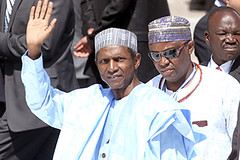
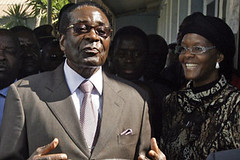
    There was no word on the health of the president, seen here in a file picture from last July

    Nigeria’s president has arrived back in the capital Abuja three months after seeking medical treatment in Saudi Arabia, raising fresh questions over the leadership of Africa’s most populous nation.

    A senior diplomat with Nigeria’s mission to the United Nations in New York confirmed to Al Jazeera that Umaru Yar’Adua had landed in the country on Wednesday.

    Two aeroplanes arrived at the presidential wing of Abuja’s Nnamdi Azikiwe international airport where one of them was met by an ambulance, the Reuters news agency, citing a witness, reported.

    The ambulance later left under a heavy police escort.

    There was no immediate word on Yar’Adua’s condition and it was unclear whether Goodluck Jonathan, the vice-president, would remain as acting head of state.

    Constitutional concerns

    Yvonne Ndege, Al Jazeera’s West Africa correspondent, said that while Jonathan had established himself as a leader, constitutionally power still lay with Yar’Adua.

    “There is potential, let’s say, for Goodluck Jonathan to try to consolidate his position and become the substantive president of Nigeria,” she said.

    “But my sense is that that will have to come with the blessing of President Yar’Adua because if the constitution is followed to the letter of the law President Yar’Adua will be back in the seat of power.”

    Nigeria’s constitution says the president must make a written declaration that he is on vacation or unable to carry out his duties before a transfer of power can take place.

    Yar’Adua had not officially given his consent to the transfer of power, but parliament said it based its decision on an interview that he gave the BBC last month, saying that he would return to work once his doctors gave him the go-ahead.

    Health problems

    Despite general government support, some critics have described the move to have Jonathan assume presidential powers as illegal.

    Yar’Adua left Nigeria on November 23 to receive medical treatment at a clinic in Jeddah for pericarditis, an inflammation of the membrane surrounding the heart that can restrict normal beating.

    He is also known to suffer from a chronic kidney condition and has long been criticised for not being able to work more than five or six hours a day.

    Aside from the near constitutional crisis, Yar’Adua’s long absence has prompted street protests by thousands across the country, demanding his resignation.

    It also threatened to paralyse the government until parliament installed Jonathan as acting head of state on February 9.

    Balancing act

    A delegation of Nigerian ministers had travelled to Saudi Arabia on Monday to ascertain Yar’Adua’s health, expecting to report back to a weekly cabinet meeting, but it appeared they had not managed to see him.

    Instead they were told that he was on his way back to Abuja.

    Nii Akuetteh, the former executive director of Africa Action, said that could have been a deliberate move to avoid further conflict.

    “My impression is now that the delegation that went to Jeddah [was] a small portion of the cabinet,” he told Al Jazeera.

    “Now the entire cabinet, if they want to assess the president’s health, will have him there to do that instead of depending on a few people who went to Jeddah and can come back with conflicting reports.”

    The Nigerian presidency reflects a regional balancing act between the Muslim north and the Christian south, with the role traditionally switching between the two sides with every election.

    Yar’Adua is from the Muslim north and Jonathan from the Christian south.

    While many activists in the south would be pleased to see a southerner in the presidency, others from the north would like their candidate to serve a full term.

    “A lot of this was precipitated by people from the south – activists – who actually went to court to say that he [Yar’Adua] has been away for too long,” Akuetteh said.

    Source: Al Jazeera and agencies

  • Socialism and the Right of Oppressed Nations to Self-Determination

    Socialism and the Right of Oppressed Nations to Self-Determination

    Reflections on African-American history and the national question in the U.S.

    By Abayomi Azikiwe
    Editor, Pan-African News Wire

    Note: The following address was delivered at an African-American History Month public forum held in Detroit on February 20, 2010. The event was sponsored by Workers World newspaper and the Harriet Tubman School. Other speakers at the forum were Sandra Hines of the Moratorium NOW! Coalition to Stop Foreclosures, Evictions and Utility Shut-offs, who did a presentation on Langston Hughes. Andrea Egypt of the Michigan Emergency Committee Against War & Injustice (MECAWI) spoke on the contributions of Claudia Jones to the struggle for Black liberation in the U.S. and the UK. Kevin Carey of the Detroit People’s Task Force spoke on the impact of the Cold War and McCarthyism on the Black Left after World War II. The forum was chaired by Debbie Johnson, a member of the Detroit branch of Workers World Party.
    ———————————————————————————————

    Since the development of socialist movements in the Europe and the United States, the question of the right of self-determination and independence of oppressed peoples has been a major point of rigorous discussion, debate and political struggle. Even with the emergence of over 100 former colonial states during the 20th century, the issue of how progressives, revolutionaries and socialists should approach developments in these states and the relationship of these countries and regions to the dominant imperialist powers largely determines the tactical approaches to such fundamental questions as war and peace, racism, national oppression, women’s rights and the character of the class structures within the oppressed nations.

    Every serious Marxist theoretician and socialist organization has been forced to address the question of how to analyze the role of the oppressed nations in the overall struggle against capitalism and imperialism. The degree to which progressive and revolutionary organizations and movements develop correct positions on the national questions related to their particular political situations, largely determine the success and viability of the actions taken and the victories achieved.

    Slavery, colonialism and capitalism brought destruction and death to billions of people throughout the world. Beginning in the 15th century, the western European nations of Spain and Portugal embarked upon the Atlantic Slave Trade which captured and exploited Africans, exterminated indigenous peoples in the colonies of the so-called new world and established colonies all over the world. As a result of these developments, the nations of Western Europe and eventually the United States, became the dominant economic and political powers in the world.

    Every major industry that came out of Europe and North America has its origin within the Atlantic Slave Trade. The profits accrued from the exploitation of African labor and the displacement of the indigenous people from their lands created the capital that developed and fueled the engines of industry, commerce, shipping and banking.

    This vast accumulation of wealth was rationalized by the ruling classes of these western European states and North America when they claimed that the indigenous peoples of North, South, Central America, Africa and the Caribbean needed to be “civilized” and converted to a distorted form of Christianity that upheld the false notions of the superiority of the whites over other peoples of color.

    Other apologists for slavery and colonialism said that the mineral wealth and agricultural potential of the world would have never been developed if the European ruling classes had not established these exploitative systems. These ruling class thinkers and philosophers went as far as to interpret religious doctrine to suit their own interests.

    Africans and indigenous peoples of the western hemisphere were taught that they were cursed and the oppressed were doomed to be servants of the ruling class. In addition, these peoples were told that if they accepted this worldview there would be a reward in the afterlife where paradise would be achieved. However, the only way the oppressed could realize paradise is that they must remain obedient and accept their social status as the natural order of society.

    Origins of African Resistance to Slavery

    Despite the efforts of the European ruling elites to impose a permanent system of exploitation on Africans and other oppressed peoples, these nations, societies and cultures constantly resisted and revolted against slavery, colonialism and genocide. In the Caribbean it has been reported that the indigenous people fought the imposition of slavery and colonial occupation. Many even jumped to their deaths in waterways in order to avoid the continued humiliation and oppression by the slave masters and colonialists.

    In Africa, despite the fact that the western Europeans came to the continent to enslave and colonize the people, there are numerous examples of battles waged aimed halting the encroachment of the slave traders. These instances of resistance that have been documented point to the fact African people were able to maintain their humanity and inherent desire for freedom and independence even under the threat of attack and domination.

    For example, as early as 1564 in the area now known as Sierra Leone, a group of British traders led by John Hawkins were attacked by an army of Africans who wounded several of these men and drove them from the inlands back to their ships on the coast. By the time that these slave traders had reached the shores, some 200 Africans were awaiting them.

    The ensuing battle resulted in the deaths of seven of Hawkins’ most prized subordinates, including the captain of the ship known as the Salmon. The king in this area then began to mobilize a larger contingent of his military forces, which propelled Hawkins and his survivors to retreat to their ships and sail back to the Caribbean. (Vincent B. Thompson, The Making of the African Diaspora in the Americas, 1441-1900, published in 1987)

    In another slave trading voyage, Hawkins was attempting to capture Africans along the Senegal River, when his group was attacked by the local people with bows and poisonous arrows. The Europeans then moved further east to avoid attack, eventually heading for the Spanish Main.

    After this disastrous episode, James Pope Hennessy pointed out that it was well into the next century before the British embarked upon slave expeditions again. Preferring less hazardous means of acquiring slave labor, the British began during the 17th century to attempt negotiation and trade as the principal method of obtaining Africans for exploitation in the newly established colonies in the western hemisphere. Such episodes during the 16th century were repeated during the entire history of the Atlantic Slave Trade in Africa.

    According to an article published in the South Carolina Gazette on July 7, 1759, “A Sloop commanded by a brother of Captain Igledieu, slaving up the River Gambia, was attacked by a number of the natives, about the 27th of February last, and made a good defense; but the Captain finding himself desperately wounded, and likely to be overcome, rather than fall into the hands of merciless wretches, when about 80 Negroes had boarded vessel, discharged a pistol into his magazine and blew her up; himself and every soul on board perished.” (Elizabeth Donnan, Taken from Documents Illustrative of the History of the Slave Trade to America, Volume 4, published in 1935)

    By providing these historical instances of resistance to slavery on the continent of Africa, it provides a basis for further research in order to more fully document the origins of pan-African revolt and consciousness. Since these actions by Africans in opposition to the Atlantic Slave system occurred in various regions of the Continent, it illustrates that there was a pattern of response to the advent of European imperialism.

    Even during the height of the slave period in the western hemisphere, the relationships between Africans and their homeland would continue to occupy a prominent role in the political discourse on the question of legalized bondage and the status of manumitted ex-slaves.

    When the Africans were transported and enslaved in the United States, the rebellions against the exploitative system continued. Yet the apologists for slavery utilized the fields of history and the social sciences to negate the humanity of the African people. This unscientific approach to the study of African people and American society served as a rationalization for oppression and exploitation.

    These racist notions of the innate African inferiority permeates the writings of such historians as Ulrich B. Phillips who were prominent in academia during the early part of the 20th century. Phillips’ views related to the slave-master relationships contend that they are the natural order of things between Africans and Europeans.

    In his book entitled “American Negro Slavery”: A Survey of the Supply, Employment and Control of Negro Labor As Determined by the Plantation Regime,” there is a chapter on law and state force where he claims that “In many lawyer’s briefs and court decisions it has been said that slavery could exist only by force of positive legislation. This is not historically valid, for in virtually every American community where it existed at all, the institution was first established by custom alone and was merely recognized by statues when these came to be enacted. Indeed the chief purpose of the laws were to give sanction and assurance to the racial and industrial adjustments already operative.”

    In reading the above quotation an interpretation could be made that laws created to confine, suppress and ensure the continued oppression and exploitation of African slaves served as a rationalization for the political and economic status quo. These laws designed to restrict the movement and expressions of African slaves have their origins during the earliest periods of the Atlantic trade in human cargo in the American colonies.

    As far back as 1693 in Pennsylvania, the Colonial Governor and Council passed an ordinance designed to limit the street gatherings of Africans who do not have permission from a slave owner or a white person to travel in the city of Philadelphia. This law required that any African male or female caught in the street without proper papers should be taken to jail for one night, without being given food or drink.

    In addition, the ordinance mandated the public whipping of the Africans found guilty of the said offense with 39 lashes against their bare backs, and the payment of 15 dollars to the person who administered the beating by the owner of the African slave.

    During the antebellum period of the late 18th and 19th centuries, the laws restricting the movements and expressions of African slaves increased in number and severity. In the southern border state of Tennessee, laws were passed in 1803 which prohibited anyone to voice sentiments that could be interpreted as disrespectful to a slave owner, particularly in the presence of slaves.

    Also these same laws disallowed any language that advocated insurrection against the slave system. Any discussions or speeches related to the notions of emancipation, rebellion, or conspiracy fell under the rubric of this Act. An 1836 law in the same state mandated that any person distributing literature that encouraged disruption or insolence among Africans, slave or free, was committing an act of felony, punishable by ten to twenty years in prison.

    Although Phillips’ “American Negro Slavery” does mention the passage of severe laws directed towards the maintenance of the slave system, he provides his own rationale for these legal measures that parallels those ideas of the southern slave owners of the period. According to Phillips “Burning at the stake, breaking on the wheel and other ferocious methods of execution which were occasionally inflicted by the colonial courts were almost universally discontinued soon after the beginning of the 19th century.”

    Phillips continues by saying that “The general trend of moderation discernible at that time, however, was hampered then and thereafter by the series of untoward events beginning with the San Domingo upheaval and ending with John Brown’s raid. In particular the rise of Garrisonian agitation and the quickly ensuing Nat Turner’s revolt occasioned together a wave of reactionary legislation the whole South over, prohibiting the literary instruction of negroes, stiffening the patrol system, restricting manumissions, and diminishing the already limited liberties of free negroes. The temper of administration however, was not appreciably affected for this clearly appears to have grown milder as the decades passed.”

    Consequently, it was the fear of rebellion during the 19th century that led to the increased violence directed against African people. By articulating this rationale, Phillips perhaps unconsciously provides a glimpse of the widespread discontent among Africans during the 19th century and the heightened degree of legal and extra-legal repression geared toward the suppression of the slaves and their free counterparts.

    In relationship to lynching Phillips contends that these acts of cruelty, that were largely supported by the criminal justice systems and Euro-American popular culture of the era, were a spontaneous response to heinous criminal actions carried by Africans. He says that “Lynchings, indeed, while far from habitual, were frequent enough to link the South with the frontier West of the time. The victims were not only rapist but negro malefactors of sundry sorts, and occasionally white offenders as well.

    Phillips goes on to state that “In some cases fairly full accounts of such episodes are available, but more commonly the record extant is laconic. Thus the Virginia archives have under date of 1791 an affidavit reciting that ‘Ralph Singo and James Richards had in January last, in Accomac County, been hung by a bank of disguised men, numbering from six to fifteen;’ and a Georgia newspaper in 1860 stated the following: ‘It is reported that Mr. William Smith was killed by a negro on Saturday evening at Bowling Green, in Oglethorpe County. He was stabbed sixteen times. The negro made his escape but was arrested Sunday, and on Monday morning a number of citizens who had investigated the case burnt him at the stake.’”

    Despite these efforts to justify the denial of due process to Africans accused of committing criminal acts by questionable whites within the community, Phillips gives the reader an idea of the irrational fear and hatred fostered by the slave system. As C.L.R. James stated in his “History of Pan-African Revolt “Every slave-owner did not spend every hour of the day beating and torturing his slaves. But few of his neighbors cared if he did, and if he tortured them, it was done so frequently that it occasioned no surprise in those who saw it. In this respect 1860 was not very different from 1660.” (A History of Pan-African Revolt, 1938)

    Response to Race Terror: Pan-Africanism and Self-Organization

    With the formation of independent African organizations and religious institutions during slavery and after the civil war that legally ended human bondage in the United States, the aspirations related to repatriation versus abolitionism became more interrelated often after a major push towards the emigration goals. Oftentimes the objective conditions would arise requiring near total preoccupation with developments in North America.

    One historian, P. Olisanwuche Esedede, points out in this regard that “Despairing of even attaining equal status with other racial groups, the African-American began to think seriously of returning to the fatherland. In 1787, a committee of the African lodge, whose Grand Master was Prince Hall, sent a petition to the Legislative Assembly of Massachusetts.’’

    Despite the egalitarian principles enshrined in the national constitution hammered out in Philadelphia that year, men of African blood continued to suffer discrimination, which they feared would remain the case so long as they and their children lived in America. Since they were poor and therefore in no position to return to Africa without help, the petitioners urged the legislature to assist them and other blacks who wished to emigrate. The petition was ignored, and Prince Hall was obliged to fight for civil liberties on American soil itself.” (Esedebe, “Pan-Africanism: The Idea and Movement, 1776-1991”)

    Other Pan-African activists during the 19th century such as Martin R. Delaney and Henry McNeal Turner were both proponents of repatriation and greater institutional links with the African continent. Despite this history, Turner and Delaney served in leading capacities during the U.S. Civil War as officers in the Union military.

    It is estimated that approximately 186,000 Africans were enlisted in the Union forces during the “war between the states,” resulting in the deaths of a reported 68,000 Black troops. In the aftermath of the war, Africans joined the Union Leagues where they entered the political process. As candidates for public office, many African-Americans were elected to the United States Congress as well as state legislative structures.

    With the collapse of reconstruction and the withdrawal of Federal troops from the former confederate states, the African population was forced into a social status analogous to the conditions that prevailed under slavery. By the 1880s and 1890s, the last vestiges of African-American political power were being eviscerated through the activities of white terrorist organizations such as the Ku Klux Klan and a series of draconian laws passed by the state legislatures that were dominated by the former slaving owning class.

    Turner, a leading Bishop in the African Methodist Episcopal Church (AME) and a former politician during the post-civil war period, said of the atmosphere in existence during the closing years of the 19th century that “There never was a time the Colored People were more concerned about Africa in every aspect, than at present. In some portions of the country it is the topic of conversations; and if a line of steamers were started from New Orleans, Mobile, Savannah or Charleston, they would be crowded to density in every trip made to Africa.

    “There is general unrest and whole dissatisfaction among our people in a number of sections of the country to my certain knowledge, and they sigh for conveniences to and from the continent of Africa. Something has to be done, matters cannot go on as present and the remedy is thought by tens of thousands to be a Negro nationality. This much the history of the world establishes, that races either fossilized, oppressed, or degraded must emigrate before any material change takes place in their civil, intellectual or moral status, otherwise extinction is the consequence.”

    Early Socialist Movements in Europe

    There were challenges to the advent of slavery, colonialism and national oppression within European society itself. In the United Kingdom and the United States, some religious leaders, intellectuals and artists took a stand against the horrors of the exploitation and social status of Africans and other indigenous people.

    On the European mainland in France and Germany, the antecedents of modern day socialist thought has its theoretical origins. During the 18th century revolutionary ideas arose in France in response to the feudal system. There were socialists involved in the French revolution of 1789. In the aftermath of the events of 1789, there was a gradual transition from radical enlightenment to socialism.

    In France one of the revolutionary leaders, Babeuf felt that the aims and principles of the upheaval of 1789 had been betrayed. Therefore, in 1796, he led an attempt to seize power in order to implement their conception of Rousseau’s social contract theory. This group was known as the Conspiracy of Equals and were eventually brought to trial in France. The Conspiracy of Equals is considered by many to be the first organization that attempted to seize power who were motivated by socialist ideals.

    Later during the 1830s and 1840s there was a strong emergence of socialist thought in France. This was the result of the rise of an industrially based middle-class which accumulated wealth at unprecedented levels. These economic developments in France as well as England, exacerbated class differences and greater impoverishment of the masses.

    In England, the rapid industrialization fueled by the profitability of the Atlantic Slave Trade, prompted the English Chartist movement that sought to extend the franchise to working people. During this period Robert Owen, a British socialist, sought the establishment of utopian communities, such as the New Lanark settlement. However, even though these forms of socialism understood the unjust character of the capitalist system, it did not rely on the working class as an engine for revolutionary change by seizing power from the burgeoning bourgeoisie in Europe.

    The developments leading up to the 1848 uprisings in France and other European countries saw the emergence of Karl Marx and Frederich Engels as the major theoreticians and tacticians of socialism. Marx in writing after 1844, placed the working class at the center of his analysis of the necessity of not only analyzing the problems created by capitalist industrialization but to develop a strategy and program for the overthrow of the oppressive system.

    Even though the attempted revolutions of 1848 failed, there were tremendous lessons learned from this period. Marx and Engels understood that it would take many more years for the class consciousness and experience of the working class to mature to the degree that the seizure of power by the proletariat would be possible. In the message to the Communist League in 1850, Marx puts forward a program of struggle for the organization that would distinguish it politically from the bourgeois democrats of the period.

    In 1870-1871, a working class uprising developed and culminated in what is known as the Paris Commune. These events raised the hopes of the workers seeking to break with the rule of the bourgeoisie. Marx’s essay “The Civil War in France” analyzes the outcome of the Paris Commune as a great advancement in working class organization, but it could not under the then existing circumstances maintain its influence and effectively shape the future political course of France.

    Engels in his essay entitled “Socialism: Utopian and Scientific,” traces the origins of socialism in Europe to the period of French Enlightenment. However, it would be the expansion and development of the proletariat in Europe that provided the basis for the transformation of socialism from an idealistic world view to a scientific ideology that can provide a program for the workers to seize power in their own name and interest.

    Other than bourgeois democracy, other movements grew up in Europe which competed with socialism. The anarchists under Michael Bakunin disagreed with Marx and Engels over the character of the state and its role after the revolution. Anarchism has an industrial form in syndicalism, which took root in several European countries as well. These disagreements in Europe hampered the growth of the First International founded by Karl Marx in 1864 in London.

    African Communalism

    In traditional Africa there was the development of communal societies where developed classes and class antagonisms did not exist. It was after the expansion of production of livestock and agriculture that the leadership within society accumulated greater wealth than the majority. In Africa there was the rise of fuedal societies as in ancient Egypt, Nubia, Ethiopia, Ghana, Mali, Songhai, Monomotapa, the Zulu kingdoms, the Kingdom of Congo, etc.

    Even within this process of development, the contradictions between incipient social classes appeared to not have been as antagonistic as those in Europe and Asia in particular. In Europe the advent of the Atlantic Slave Trade and colonialism coincided with the aggressive expansionist aims of the monarchy and the demand to enhance the wealth of the mercantilists.

    According to Kwame Nkrumah, one of the leading organizers and theoreticians of the African Revolution, ” In general, at the opening of the colonial period, the peoples of Africa were passing through the higher stage of communalism characterized by the disintegration of tribal democracy and the emergence of feudal relationships, hereditary tribal chieftaincies and monarchical systems. With the impact of imperialism and colonialism, communalist socio-economic patterns began to collapse as a result of the introduction of export crops such as cocoa and coffee.”

    Nkrumah continues by pointing out that ” The economies of the colonies became interconnected with world capitalist markets. Capitalism, individualism and tendencies to private ownership grew. Gradually, primitive communalism disintegrated and the collective spirit declined. There was an expansion of private farming and the method of small commodity production.” (Class Struggle in Africa, 1970, p. 14)

    Pan-Africanism and the Early Socialist Movements: 1880s Through 1920s

    After the Civil War in the United States, a new form of oppression was enacted with the failure of Reconstruction. In the 1880s there was a tremendous upsurge in labor action in the industrial regions of the country. In Chicago the so-called Haymarket Riot of 1886 thrust into the public one of the first revolutionary agitators in the African-American community in the personage of Lucy Parsons.

    Parsons self-identified as being of African and Native American heritage. She was married to Albert Parsons who was executed for his purported role in the Haymarket incident. It was the marking of this event that sparked May Day as an international holiday for working class people worldwide.

    Parsons, like other revolutionaries of the time period, started out as an anarchist. She would later adopt socialism as an ideology and join the early communist movement in the United States during the period after World War I.

    However, the early socialist in the United States were influenced by the utopians in western Europe. When Daniel DeLeon became the leader of the Socialist Labor Party this organization is considered the first serious effort to build such a movement in the U.S. DeLeon was Dutch and Jewish in origin and promoted a strong ideological orientation in the struggle to build the SLP. DeLeon was an intellectual who taught international law and philosophy at Columbia University.

    Nonetheless, the Social Democracy of America, which had been influenced by the utopians, advocated the formation of a separatist state in the western United States, eventually merged with the Social Democratic Party in 1898. This organization was led by Victor L. Berger, perhaps the first successful advocate and practitoner of socialism in the U.S.

    The utopian socialist more than likely had their ideological origins in the Christian church where during the late 18th century, groups such as the Shakers broke away from the established church in England and traveled to the U.S. The leader of the Shakers, Mother Ann Lee, advocated the withdrawal of members from the broader society in order to form their own community in preparation for the impending destruction of society and the world.

    Eventually the socialist movement became more secular and focused on the concrete needs of working people. However, its political program became more pratical and distanced itself from the anarchists and advocates of revolutionary violence and armed struggle to overthrow capitalism.

    For example, the SDP did not advocate rebellion and armed struggle as a means of achieving its goals, but political education. Berger’s base was in the city of Milwaukee which became a centerpiece for socialist policies in an urban setting. He would be elected to Congress in 1911 for a two year term. He would later serve in Congress between 1923-1929. Milwaukee also elected a socialist mayor Emil Seidel in 1910. Overall between 1910-12, socialists elected approximately 1,000 of its members to office across the country and had over 100,000 official members.

    During the turn of the 19th and 20th centuries, there was much ideological and political struggle within the various socialist organizations including the SDP. In 1901 the Socialist Party of America emerged as a coalition of various factions within the movement, with more conservative, moderate and revolutionary tendencies within its ranks. Eugene V. Debs, an organizer within the railroad industry would emerge as a charismatic figure, political candidate and public spokesperson for the socialist movement.

    Debs ran numerous times for presidential office and opposed wars of imperialism waged by the United States ruling class of the time. He served prison terms for his outspoken opposition to war and U.S. foreign policy.

    African-Americans would join the Socialist Party after its formation. People such as W.E.B. DuBois, Chandler Owens, A. Phillip Randolph, W.A. Domingo were members. As the internal struggle within the social democratic movement developed in Europe around the collapse of the Second International in the lead-up to World War I, a number of African-Americans began to lean towards communism in the period right after the Russian Revolution of 1917.

    African-American militants who formed the African Blood Brotherhood in the period after World War I, when there were race riots in various parts of the United States, looked toward the early communists as allies. Many member of the ABB would join the party during the early 1920s.

    American Socialism and the African-American National Question

    Within the Socialist Party there were two main currents of thought in regard to the role of African-Americans in the working class struggle. One tendency sought to broaden the socialist movement by downplaying the racism and national oppression suffered by the African-American people. At the same time a more left wing position spoke directly to the race terror faced by African-Americans and demanded that the socialist movement condemn racism and commit to the fight for its eradication.

    In highlighting these general positions, the words of Eugene V. Debs are instructive in an essay he published in the International Socialist Review in November 1903. Debs reflected on his experience in Yoakum, Texas when he came upon a group of white men at a railroad station who made disparaging and racist comments about African-Americans.

    Debs said in his essay entitled “The Negro in the Class Struggle”, that “Here was a savory bouquet of white superiority. One glance was sufficient to satisfy me that they represented all there is of justification of the implacable hatred of the Negro race. They were ignorant, lazy, unclean, totally devoid of ambition, themselves the foul product of the capitalist system and held in the lowest contempt by the master class, yet esteeming themselves immeasurably above the cleanest, most intelligent and self-respecting Negro, having by reflex the “nigger” hatred of their masters..”

    Debs went on to proclaim that “The whole world is under obligation to the Negro, and that the white heel is still upon the black neck is simply proof that the world is not yet civilized. The history of the Negro in the United States is a history of crime without parallel.”

    He concluded the essay by saying that “I have said and say again that, properly speaking, there is no Negro question outside of the labor question–the working class struggle. Our position as socialists and as a party is perfectly plain. We have simply to say: ‘The class struggle is colorless.’

    “For myself, my heart goes to the Negro and I make no apology to any white man for it. In fact, when I see the poor, brutalized, outraged black victim, I feel a burning sense of guilt for his intellectual poverty and moral debasement that makes me blush for the unspeakable crimes committed by my own race….” (Debs, ISR, Nov. 1903)

    Another essay in the same journal by Clarence Meily, entitled “Socialism and the Negro Problem”, seem to take a more moderate position. Meily addresses the white rationale for color prejudice and discrimination. He indicates that these attitudes stem from customs developed during slavery and the competition of African-American labor with white and that white workers are responding with racism to preserve their own economic interests.

    Meily states in the article that “Obviously with all this socialism has nothing whatever to do. It cannot compel one man to admit another to his house, seat him at his table, or marry him to his daughter. Nor can it on the other hand curb that pragmatic spirit which leads one man, afflicted with a race prejudice, to impose it by law or social convention on his fellows. Matters of this sort are ethical, and may become political,but they are certainly not economic.”

    Communism and the African-American National Question (1919-1959)

    With the collapse of the Second International on the eve of World War I and the turmoil generated by the factionalism of the socialist movement between 1912 and 1917, the socialist movement in the United States was effected heavily by the role of the American government in the War and the social unrest generated in its aftermath. In 1919 there was a series of race riots throughout the United States, with the violence in Chicago being the most severe.

    In these days race riots were characterized by white mobs and law-enforcement agencies invading the African-American communities to rob, loot, rape and murder scores of black people. However, in the race riots of 1919-1921, African-Americans militantly fought back against the white racist elements seeking to inflict terror on their communities. It was during this period that groups such as the African Blood Brotherhood (ABB) came into existence.

    Also there was the growth of nationalism and pan-Africanism in the African-American communities throughout the U.S. The Garvey movement grew exponentially after World War I, obtaining millions of adherents during the early 1920s. There was also the so-called “Harlem Renaissance” that was fueled by this new militantcy which found a strong base among those African-Americans who had migrated from the South to the North beginning during the War and its aftermath.

    At the same time, the socialist movement in the United States underwent a series of splits that lead to the formation of two communist parties in 1919. The impact of the Bolshevik Revolution in Russia in 1917 increased the desire among more militant elements within the socialist movement to intensify their struggle for fundamental change in the United States. The left wing factions began to criticize the social democrats for their electoral work and the apparent acceptance of the legitimacy of the bourgeois state.

    In 1919, the left wing of the Socialist Party was expelled after it made a bid to seize power from the more moderate forces. Several of the currents within the socialist and communists tendencies sought recognition from the Russian party during the first meeting of the Third International. The Bolsheviks in turn demanded that the major communist factions unite and form a Workers Party. The Third International would denounce the Socialists and reformist and then encouraged the formation and consolidation of the left wing tendencies.

    During this period, there was tremendous persecution against communists in the United States. Many were imprisoned, deported and driven underground. The communist would emerge above ground in 1921 with the formation of the Workers Party that later renamed itself the Communist Party in 1928. However, after 1924, with the death of V.I. Lenin there was a split within the Bolsheviks between the followers of Stalin and Trotsky. Trotsky was expelled from the Soviet Union and lived in exile until his murder in 1940 in Mexico.

    The rise of the Garvey movement and other political and cultural currents within the African-American community drew the attention of the Communists. In 1920, the Second Congress of the Communist International developed its thesis on the right of oppressed nations to self-determination. Lenin noted that the right of self-determination applied both to the Irish in Ireland and the African-Americans in the United States.

    During the 1920s the early African-American cadres in the Communist Party came from the ABB and the socialist party. In 1925, the American Negro Labor Congress (ANLC) was launched in an attempt to enhance Communist work inside the African-American community. That same year a group of African-Americans were sent to the Soviet Union to study at KUTVA, the training school for the Communist International.

    By 1928, the Sixth Congress of the Communist International would place more emphasis on the African-American national question as well as the liberation struggle in South Africa. The Black Belt thesis of 1928 was officially adopted by the CI and the Communist Party of the United States.

    This program recognized that the overwhelming majority of African-Americans resided in the South in the areas where slavery and cotton production had been predominant during and after slavery. According to the Black Belt thesis, Africans living in these areas constituted an oppressed nation with the right of self-determination as recognized by Lenin at the Second Congress of 1920.

    Prior to 1928, very few African-Americans had attended the CI congresses. Otto Huiswood, who had been associated with the ABB attended the fourth congress in 1922 along with the Jamaican-born poet Claude McKay. Even though the Sixth Congress had developed the Black Belt thesis and urged greater work among the African-American community, the right forces inside the CP advocated the notion of “American exceptionalism,” which implied that the economic conditions of the United States were different than what prevailed in European capitalists states. The rightist forces within the CP refused to fully implement the thesis adopted at the Sixth Congress of the Communist International.

    By 1929, another major split developed inside the Communist movement. The followers of Jay Lovestone, the majority faction, were expelled along with some members of a minority faction that included James P. Cannon and Max Schatman, who went on to form the Trotskyist movement in the United States.

    According to James Forman in his book entitled “Self-Determination and the African-American People,” Jay Lovestone and his faction “took the position that the views of the Sixth Congress concerning the acute crisis of capitalism were valid for the rest of the world but not for the United States. Lovestone also opposed the position of the Sixth World Congress that the African-American people were a nation in the Black Belt of the South. He maintained that the process of industrialization of the South would negate any special national characteristics to the life and struggle of the African-American people, resulting only in a class struggle between the workers and owners of the means of production.” (Forman, Self-Determination, 1981)

    The CI called for the reorganization of the Communist Party in the United States. Later in 1929, the Great Depression erupted throwing millions of people out of work. Banks and major corporations collapsed amid the failure of the Hoover administration to take decisive action to address the crisis.

    In 1930 the Communist Party initiated the Unemployed Councils which sought to develop a political program to fight the economic crisis. The Unemployed Councils fought evictions and demanded jobs and relief to the burgeoning masses of poor workers. When Roosevelt was elected in 1932, he road on the mass discontent of millions of workers in the United States.

    Other issues would win thousands of African-Americans over to the Communist Party and its mass work during the 1930s. The attempt to hang a group of African-American youth, known as the Scottsboro Boys, who were accused of raping two women on a freight train in Alabama, deepened the CP’s work among African-Americans. Prior to the Scottsboro case, the League of Struggle for Negro Rights (LSRN) was initiated by the CP to fight against lynching and race terror which escalated during the depression years.

    However, with the rise of Hitler in Germany in 1933 and the subsequent threats against the Soviet Union by fascism, the CI placed greater emphasis on the need to defend the USSR against these threats. In the United States the National Negro Congress (NNC) was formed. It was a broad-based popular front against the depression and for the realization of greater reforms.

    The general strikes and labor unrest of 1934 in San Franscisco, Minneapolis and areas throughout the South, led to the formation of the Congress of Industrial Organizations in 1935. The CIO had communists within its leadership ranks and in principle called for the organization of African-American workers on an equal basis.

    Other significant developments during the 1930s included the Italian invasion of Ethiopia in 1935 and the Spanish Civil War beginning in 1937. African-Americans played a significant role in mobilizing support for the Ethiopians against Italian fascism and imperialism. Also African-American communists such as Harry Haywood fought in Spain on the side of the anti-fascist forces.

    When the United States entered the Second World War in December 1941, in effective alliance with the Soviet Union against Hitlerite fascism, the implications of these political developments created tensions inside the Communist Party. By 1944, under the leadership of Earl Browder, the party was liquidated and turned into a Communist Political Association (CPA). This resulted in the shifting of the party’s position on the right of self-determination of the African-American people.

    After the war, the factionalism increased inside the organization at the same time that the Cold War developed resulting in repression against leftist in the United States. A political struggle against revisionism arose inside the CP where the repudiation of the national question during the war, as well as other issues, were subjected to rigorous criticism.

    Claudia Jones, who was a leading member of the CPUSA between the 1930s and the 1950s, published an article in Political Affairs in August 1945, criticizing the revisionist character of the party under the leadership Browder culminating in the line that became dominant during World War II. Jones says that “It is extremely necessary to examine thoroughly how our revisionist conclusions, under the name of Marxist-Leninist science, affected our work in all fields, so that we may now draw the correct conclusions with which to arm the working class and all the oppressed in our country for full victory over reaction and fascism.”

    Jones quotes Browder when he wrote in October 1943 that “the crisis of history has taken a turn of such character that the Negro people in the United States have found it possible to make their historic decision once and for all. Their decision is for their complete integration into the American nation as a whole, and not for separation…”

    Browder continued by stating that “The decision of the Negro people, is therefore, already made. It is that the Negro people do see the opportunity, not as a pious aspiration for an indefinite future, but as immediate political task under the present system of approximately the position of equal citizen in America. This is, in itself, an excercise of the right of self-determination by the Negro people. By their attitude, the Negro people have exercised their historical right to self-determination….” (Political Affairs, 1943, 1945)

    Jones then raised the questions related to this revisionist line: “On what premise that ‘the Negroes had made their historic decision’ based fundamentally? Was it based on a fundamental appraisal of the present economic, political and social status of the Negro people in the Black Belt, where (only) the question of self-determination holds?

    “Or was it based on a pious hope that the struggle for full economic, social and political equality of the Negro people would be ‘legislated’ and somehow brought into being through reforms from on top? (Some nine million Negroes live in the Black Belt under Jim Crow oppression. They are the mainstay of the source of cheap labor for monopoly capital in the United States. Their status is upheld and backed up by the Southern feudalists who are the foundation of monopoly capitalist oppression of the Negro people in the nation.”

    The Cold War and McCarthyism did tremendous damage to the left movement in the United States. Many leftists were driven from their professions, persecuted, imprisoned and driven into exile. Claudia Jones herself was imprisoned and eventually deported from the United States in 1955. By 1959, the Communist Party had once again abandoned its position on the right of self-determination for the African-American people.

    Forman points out in his book on Self-Determination that ” On December 10, 1959 the Communist Party USA held its 17th National Convention. At this convention it finally repudiated the Black Belt Thesis adopted at the Sixth Congress of the Communist International held in 1928. Reporting the procedures of that convention, the February 1960 issue of Political Affairs carried an article entitled ‘On the Negro Question in the United States.’ That article contained the following statement that ‘Though a specially oppressed part of the American nation, the Negroes in the United States are not constituted as a separate nation. They have the characteristics of a racially distinctive people or nationality. They are component parts of the whole American nation which is itself an historically derived national formation, an amalgam of more or less well differentiated nationalities.’”

    The Fourth International and the African-American National Question

    With the split inside the Communist International, the followers of Leon Trotsky attempted to establish a Fourth International. The Fourth International was beset with internal splits and factionalism that hampered its development from the onset. C.L.R. James, the most well-known African historian from the Caribbean nation of Trinidad, became a leading theoretician within the Trotskyist movement during the 1930s and 1940s. James wrote numerous articles on the African-American national question between 1939 and 1948.

    His views on the African-American question developed from his own experience inside the United States where he lived between 1938 and 1953. Prior to this time period he had lived in England from 1932 to 1938. In England, he was leading activist in the pan-Africanist movement where they rallied support for the Ehtiopian people during the Italian invasion of 1935. James worked with George Padmore in England during this period.

    Padmore had been a leading member in the Communist International between the late 1920s and the early 1930s, when he split with the CI over the questions related to fascism and colonialism. Padmore refused to downplay the role of Britain in colonizing Africa even in the face of rising fascism in Germany, Spain and Italy. Britain and France had more colonies in Africa than Germany, Italy and Spain.

    James published three important books during 1938: “A History of Negro Revolt,” “The Black Jacobins,” on the Haitian Revolution, and “World Revolution,” a history of the Russian Revolution between 1917 and 1936. After relocating in the United States in 1938, he observed and wrote about what he called the independent character of the African-American struggle. In 1948, he wrote a resolution which was adopted by the Socialist Workers Party conference entitled “A Revolutionary Answer to the Negro Problem in the United States.”

    In this article James says that the independent character of the African-American movement was not led by the trade union movement or the left and that this political current would exercise greater autonomy in the coming period. His views prefigured the rise of the civil rights and black power movements of the 1950s through the 1970s.

    Even though James made his transitional break with Trotskyism between 1948-1951, he would go on to champion the black power movement in the United States. In a speech delivered in England where he resided in 1967 entitled “Black Power,” James praised the new generation of leaders in the Student Nonviolent Coordinating Committee (SNCC), formost of them Stokely Carmichael and H. Rap Brown.

    James said in 1967 that “Number one, we support the fighters for Negro rights and for Black Power in the United States. That means we do not apologise or seek to explain, particularly to British people(and particular British marxists), or give any justification or apologise for whatever forms the struggle in the United States may take.”

    James continues by saying that “It is over one hundred years since the abolition of slavery. The Negro people in the United States have taken plenty and they have reached a stage where they have decided that they are not going to take any more. Who are we here to stand, or rather to sit in judgement over what they decide to do or what they decide not to do? I want to take in particular Mr. Rap Brown, who makes the most challenging statements, is prepared to challenge American racial prejudice to the utmost limit of his strength and the strength of the Negroes who will follow. Who are we to say ‘Yes, you are entitled to say this but not to say that; you are entitled to do this but not that’, If we know the realities of Negro oppression in the USA(and if we don’t we should keep our mouths shut until we do), then we should guide ourselves by a West Indian expression which I recommend to you: what he do, he well do. Let me repeat that: what the American Negroes do is, as far as we are concerned, well done. They will take their chances, they will risk their liberty, they will risk their lives if need. The decisions are theirs.” (James, reprinted in Spheres of Existence, 1980)

    Self Determination and Socialism Since the 1960s

    The eruption of the African-American struggle beginning in 1960 to the present has validated the independent character of the movement for self-determination and national liberation. In the 1960s the fight to end segregation and to achieve universal suffrage culminated in the urban rebellions and the insurgent actions of workers. In 1966 the Black Panther Party for Self-Defense took up the quotations of Mao Tse-Tung as a mechanism for promoting revolution as well as a funding mechanism to purchase guns to fight against racist police terror.

    By 1968, the BPP had adopted Marxism-Leninism as its ideology. This was also done by the League of Revolutionary Black Workers, formed in 1969 in Detroit. The LRBW was rooted in the automotive plants and the African-American communities. By the early 1970s, many black revolutionaries began to study and adopt socialism as the only viable economic system that would provide a mechanism for liberating the African-American people from capitalism and imperialism.

    This adoption of socialism was off course influenced by the revolutionary movements taking place in Africa and other parts of the so-called Third World. In Korea, Vietnam, China and Cuba, revolutionary parties came to power under the banner of socialism. These formally colonized and semi-colonized states composed of people of color, provided encouragement to the oppressed masses throughout the world.

    Since 1975, the world capitalist system has undergone tremendous restructuring which has undermined the strength and character of the working class in the United States. These changes have rendered millions of African-Americans and other workers unemployed and in low wage jobs with no future for advancement. Since 2007, some 8 million workers, many of whom are African-Americans and Latinos, have lost their jobs, homes, pensions and health care benefits.

    The current crisis in capitalism appears to be terminal in the sense that even the major ideologues of the system voice no optimism in regard to re-employing the millions who are out of work. What the Obama administration is saying is not that it will restore the capitalist system as it was some four decades ago, but that they will prepare the country for the economy of the future. What is the economy of the future? It will inevitably under capitalism result in the worsening of economic conditions for the African-American people and workers in general.

    Since 2008, through the work of the Moratorium NOW! Coalition in Detroit and the Bailout the People Movement (BOPM) nationally, a program of struggle has been developed which takes into the consideration the terminal crisis of capitalism and the need to fight for a socialist future. Socialism provides the only viable solution to the current collapse of the economic system.

    Moratorium NOW! has boldly called for a complete halt to all foreclosures, evicitons and utility shut-offs. It has demanded that the government create a jobs program to re-employ tens of millions of workers in good paying jobs with benefits. The coalition has linked the growing Pentagon budget of over $800 billion annually and the bank bailouts to the tune of trillions of dollars, directly to the growing impoverishment of the working masses in the United States and around the world.

    Knowing that the capitalist system and the U.S. state, that is beholden to the banks, insurance companies and industrialists, cannot create jobs or economic opportunities for African-Americans, Latinos and workers in general, the Moratorium NOW! Coalition has gone to the workers themselves to call for their independent organization to win these goals and to move the struggle to the next level which will culminate in the creation of a society devoid of all exploitation of people by the oppressive system.

    With the capitalist and imperialist systems in terminal crisis, there is no solution in either the Democratic or Republican parties. The workers and the oppressed must build their own political party that will organize and struggle without compromise to win back the wealth that working people have created over the centuries. It is within the course of this ongoing and intensifying struggle that the only real hope of overcoming unemployment and poverty will be realized.
  • African-American Farmers Continue Struggle for Economic Justice

    African-American Farmers Continue Struggle For Economic Justice

    New settlement announced by Department of Agriculture amid national demonstrations

    By Abayomi Azikiwe
    Editor, Pan-African News Wire

    A series of demonstrations took place during February in support of the demands put forward by African-American farmers who are seeking an end to land loss and the racist policies of the Department of Agriculture which have driven millions of people from the rural areas of the South for decades. Rallies were held in Washington, D.C., Little Rock, Memphis, Jackson, MS, Montgomery, Columbus, GA, Columbia, SC and Richmond, VA.

    The farmers were demanding a resolution to the 1999 legal settlement which was supposed to provide compensation for decades of systematic discrimination by the U.S. Department of Agriculture. However, the federal bureaucracy placed enormous roadblocks to the farmers receiving settlement funds.

    Only 15,000 African-American farmers were able to navigate the complicated paperwork to collect compensation which was reported to have averaged a mere $50,000 per family. Most of the farmers were excluded and in 2008 the U.S. Congress acknowledged the problems and granted additional time for another 70,000 people to apply for compensation.

    Despite this supposed commitment to speed up the processing of applications for compensation, Congress cut $1.5 billion in funding that President Obama had included in the first budget of the current administration that was specifically designated for black farmers. Obama has included a similar amount in the budget for the next fiscal year that is now going before the Congress.

    “The primary issue now, I think, is that there’s not money appropriated to pay the successful claimants,” according to Rep. Mel Watt, D-N.C., who is a member of the Congressional Black Caucus. Despite the fact that the Democratic Party controls both houses of Congress, there is no real commitment to address the problems of African-American farmers.

    In a demonstration outside the U.S. Department of Agriculture on February 15, John Boyd, the President of the National Black Farmers Association (NBFA) presented 538 ears of corns and packets of Forget-Me-Not seeds demanding that each member of the House of Representatives and Senate include the $1.5 billion in the 2010 budget for compensation. “Our long journey to justice should now come to a successful close,” said Boyd.

    Boyd continued by stating that “We have endured many hardships, waited many years and traveled many miles. Now it’s time for Congress to do its part and fund fairness for black farmers.” ((PRWEB, Feb. 15)

    Speaking for thousands of African-American farmers and their supporters throughout the country, Boyd said “Thousands of farmers who can’t be in Washington showed their support by traveling long distances through snow and rain to join our rallies. We’re here to represent them and get the job done.” (PRWEB, Feb. 15)

    In a press conference held on February 4, White House Press Secretary Robert Gibbs responded to a question related to ongoing plight of African-American farmers. Gibbs said “Clearly, it’s something important to him (Obama). It’s been an issue that has been worked on by the federal government now in several different administrations and dating back many years. Obviously, ensuring that justice is done is important in this situation.” (PRWEB, Feb. 15)

    On February 18, the Department of Agriculture announced the latest settlement to provide compensation and resources to African-American farmers. Another organization that represents African-American farmers, the Federation of Southern Cooperatives/Land Assistance Fund, that was founded in 1967, welcomed the announced settlement.

    Federation of Southern Cooperatives/Land Assistance Fund spokesperson Heather Gray said of the recent settlement that “After years of negotiations and questions, Black farmers who have never been able to have their claims of discrimination against the United States Department of Agriculture settled, there is finally some hope. The Obama administration and attorneys representing Black farmers have reached a settlement in the second phase of the lawsuit originally filed by Black farmers against the USDA in 1999.” (The Federation/LAF, Feb. 18)

    According to the Executive Director of the Federation, Ralph Paige, “The long-awaited settlement in this second phase of the Pigford lawsuit is a major step forward. The $1.25 billion settlement proposed by the Obama administration is a vast improvement over the $100 million offered by Congress in the 2008 Farm Bill. Now there is hope that the thousands of black farmers whose cases have been pending can receive awards and damages after decades of discrimination.”

    A History of Discrimination and Land Loss

    The plight of African-American farmers is by no means a new phenomena and the claims against the federal government did not originate in the lawsuit filed during the 1990s. This problem stems from the legacy of slavery, the failure of reconstruction and the ongoing discriminatory practices of the Department of Agriculture and the banks.

    Although the abolitionist movement fought for decades to end slavery in the United States, it would take a bloody four year Civil War to bring about the collapse of this institution rooted in the extreme exploitation and oppression of 4 million Africans in the United States. The question of what provisions would be made for the former slaves, as well as so-called free Africans, was discussed during the war but was never formally settled.
    In 1862 some Union army generals began to break up plantations in liberated areas of the South and provide settlements for small African farmers. For example, in St. Helena Island and Port Royal, SC in 1863, the Union government issued confiscated land to philanthropists who hired Freedmen to produce cotton and to make arrangements for mortgages so that Africans could purchase farm land for themselves.

    In 1865 the first Freedmen’s Bureau Act developed plans for 40-acre plots of land to be sold to former slaves at cheap rates. This land would have come from evacuated plantations and areas that were unsettled during this period.

    Nonetheless, by late 1865, President Andrew Johnson halted these initiatives by the Union army to allocate small farm settlements for the former slaves. Another agreement that was adopted in 1866 also made proposals for land redistribution but these actions lacked effective enforcement mechanism and consequently went largely unimplemented.
    With the lack of governmental commitment to land redistribution in the South, the acquisition of farms by African-Americans took place on a largely individual basis. Many African-Americans were able to acquire land as a result of the dire economic conditions prevailing in the South after the Civil War.

    In a study issued by Bruce J. Reynolds in 2002 entitled “Black Farmers in America, 1865-2000: The Pursuit of Independent Farming and the Role of Cooperatives,” he cites the work of earlier scholars in documenting the degree of land acquisition in the aftermath of slavery and reconstruction. Reynolds says that “W.E.B. DuBois estimated 19th century progress in land ownership by black farmers: 3 million acres in 1875, 8 million in 1890, and 12 million in 1900.”

    Reynolds goes on to point out that “The Census of Agriculture shows a steady increase in the number of farm operators owning land in the South from 1880 to 1890 and again in 1900, but does not distinguish between white and non-white owners until 1900. Census figures show 1920 was the peak year in the number of nonwhite owners of farmland in the South.”

    The author continues by stating that “In terms of acreage owned, the census shows 1910 as the peak year for the South. More than 12.8 million acres were fully and partly owned, respectively, by 175,290 and 43,177 nonwhite farmers.”

    Yet with the rise of terrorist organizations such as the Ku Klux Klan and the abandonment of reconstruction by the federal government, this left African-American farmers and their families open to systematic campaigns by the racists that drove many people off their farms through force of arms and state laws that favored the former slave owning elites. This process would continue well into the 20th century resulting in the loss of millions of acres of land acquired by African-Americans in the South.

    These efforts to drive independent African-American farmers off their land was coupled with the systematic denial of credit and the corporatization of agricultural which took hold during latter years of the 20th century. More farmers began to look toward cooperative agriculture as a means to maintain their livelihoods and access to land.

    However, as Reynolds points out “The population of independent farmers is declining through farm consolidations and through contracting systems that diminish decision-making requirements of farmers. As this trend continues, the usefulness of cooperatives, as well as the capacity of farmers to organize them, will decline.”

    By 1992, it was reported by the U.S. Census of Agriculture that there were only 18,000 African-American farmers remaining and land ownership was down to 2.3 million acres. Since the early 1990s the conditions for African-American farmers have worsened with the burgeoning economic crisis that has disproportionately affected nationally oppressed groups in the United States.

    The Need for Support of the African-American Farmers Struggle

    With the consistent efforts on the part African-American farmers through their organizations such as the Federation of Southern Cooperatives/Land Assistance Fund and the National Black Farmers Association, the federal government has been forced to at least address their demands. Nonetheless, it will take support from civil rights organizations, trade unions and progressive forces in general to ensure that the Obama administration and Congress upholds its pledges to provide compensation for African-American farmers.

    The plight of African-American farmers constitute an integral part of the overall question of national oppression in the U.S. It is inextricably linked to the economic crisis and its impact on African-Americans through millions of job losses and home foreclosures. Consequently, the fight for justice for African-Americans farmers must be raised alongside other demands including an end to home foreclosures, evictions, utility shut-offs and for a real jobs program to employ the tens of millions of workers who are bearing the brunt of the deepening economic crisis in the world capitalist system.

  • Uranium and the Military Coup in Niger

    Uranium and the Military Coup in Niger

    Army seizes power in the mineral rich West African state

    By Abayomi Azikiwe
    Editor, Pan-African News Wire

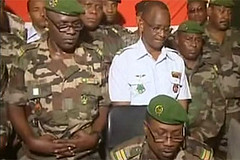
    A months-long political crisis in the West African nation of Niger reached a new level on February 18 when army officers stormed the presidential palace and arrested the head of state Mamadou Tandja along with other cabinet ministers. The former French colony has gone under tremendous strife since August 2009 when President Tandja held a referendum to extend his mandate to rule over the uranium-rich country.

    The soldiers who took control call themselves the Supreme Council for the Restoration of Democracy (CSRD) and since their taking of power have pledged to hold national elections as soon as possible. The African Union and the regional body, the Economic Community of West African States (ECOWAS) have condemned the coup and dispatched the president of the organization, Mohamed Ibn Chambas, to meet with Salou Djibo, the leader of the CSRD.

    A spokesperson for the military told representatives of the AU and ECOWAS that they had no intentions of holding on to state power. According to Colonel Djibri Hamidou Hima, one of the CSRD leaders, “If you want proof, in 1999 we had a similar situation and we handed back power and we had 10 years of stability.” (Al Jazeera, Feb. 22)

    Col. Hima also stated that “We are going to do the same thing. We left the political actors to try and find a solution. This did not happen.”

    Hima also noted that “Social tensions got worse. We didn’t launch a coup, we just reimposed legitimacy, because this had already disappeared.”

    After the meeting between ECOWAS President Chambas, the head of the regional body said of the coup leaders that “They have given us the necessary guarantees and all this will be done with the participation of civil society and the political parties.

    Chambas continued saying “Dialogue will be opened with all the vital forces of the nation which will end in the drawing up of a new constitution and a period of transition. We were encouraged by the fact that the authorities themselves are mindful that this is not their normal function and they are eager to finish this task and go back to their normal military and security duties.” (Al Jazeera, February 22)

    The coup came in the aftermath of the suspension of talks aimed at a negotiated settlement to resolve the political crisis. In a series of talks beginning on December 21, a draft agreement was hammered out under the mediation of former Nigerian military leader Abdulsalami Abubakar working on behalf of ECOWAS.

    The agreement proposed that President Mamadou Tandja remain in his post during a transition period. It also called for the appointment of an opposition Prime Minister and the holding of national elections. However, the opposition parties and the government could not reach an agreement.

    Amid the political unrest in the country, there is a mounting humanitarian crisis where 7.8 million of the nation’s 15 million people are facing food insecurity. According to a statement issued by ECOWAS on February 10, “An irregular, spottily distributed and prematurely shortened rainy season in 2009 led to insufficient cereal and fodder production for people and livestock, and the Government is currently evaluating how much more funding is needed.”

    Niger’s Uranium Wealth

    This West African state is major source for uranium mining which is utilized for nuclear technology supplied in the imperialist countries. At present it is listed as the world’s third largest source of uranium and is slated to double its production over the next two years.

    France’s government controlled nuclear energy firm, Areva, recently signed a contract with the country’s leaders to conduct uranium mining in the Imouraren region in the north of Niger. This contract with Areva will make Niger the second largest producer of Uranium in the international market.

    The uranium extracted from Niger supplies nearly all of the raw materials for the running of 50 nuclear plants providing electricity to French households. Also other countries such as Spain, Canada, South Korea and South Africa have expressed an interest in uranium sources in Niger.

    In addition, there is also mining taking place by China’s National Uranium Corporation which signed an agreement with Niger in 2007 to extract 700 tons of uranium per year from the Azelik region in the north. The People’s Republic of China has increased its investments and economic cooperation with various African states over the last several years.

    The deposed President Mamadou Tandja had sought alternative political and economic relations with the progressive states of Libya in North Africa and Venezuela in Latin America. It was rumored that Tandja had been discussing greater economic cooperation with Iran, which is under threat by the United States, Israel and various western imperialist countries.

    Even the BBC reported on Feb. 19 that “Some sources have suggested that talk of a deal with the Chinese whetted the appetite of some in the military for a share of the material rewards, intensifying tensions within the military over Mr. Tandja’s monopolization of power.” (BBC News, Press TV)

    Just one day prior to the coup, a Canadian-based firm, Orezone Gold Corporation, announced through its subsidiary, Brighton Energy Limited, that it “had completed the acquisition of three uranium exploration permits in the Republic of Niger.” The same statement goes on to say that “Orezone is a gold exploration and development company with more than 15 years experience in West Africa, one of the world’s fastest growing gold producing regions.” (MarketWatch.com, Feb. 17)

    Despite the tremendous mineral wealth in Niger and other countries in West Africa, the overall world economic crisis is resulting in food deficits due to the fact that most of the economic development inside the region is geared toward the export of mineral resources and agricultural commodities to the former colonial powers and the United States.

    In a recent post-coup report issued by Radio Netherlands, the broadcast reminded the international community that additional political problems exist in Niger where the Tuareg ethnic group has waged an armed struggle against what it believes is the official neglect of their interest in the mineral regions.

    “There is only one real threat: the Tuaregs in the territories where the mines are located, have organized two armed revolts in the past 20 years. They want more money and better representation at the top of national politics…. At their last revolt, Areva—and therefore the security of French energy—has been their target.” (Radio Netherlands, Feb. 22)

    The United States has called for the return to civilian rule in Niger. In a statement issued by the U.S. embassy in the capital of Niamey, it claims that “The United States continues to support the hopes of the Nigerian people to see constitutional order re-established and a peaceful transition leading to prompt, fair and transparent elections.”

    Niger is the country that former U.S. President George W. Bush falsely claimed was a potential supplier of uranium to the Iraq government in their fabricated case to justify the imperialist invasion and occupation of this middle eastern nation. A subsequent investigation by a former U.S. diplomat proved that the allegations against Iraq were false, yet the invasion took place in March 2003.

  • Grenade Attacks Rock Rwanda Capital

    Saturday, February 20, 2010
    17:59 Mecca time, 14:59 GMT

    Grenade attacks rock Rwanda capital

    Three simultaneous grenade attacks on public places in the Rwandan capital, Kigali, have left one person dead and another 18 wounded, national public radio has reported.

    Five of the injured were in a serious condition following Friday’s attacks on a train station, a restaurant and a building housing city centre businesses.

    “Two suspects were apprehended, they belong to the Interahamwe militia,” Eric Kayiranga, a police spokesman, told AFP, referring to the extremist Hutu militia responsible for Rwanda’s 1994 genocide.

    “Those who commit these kinds of crimes want to sow chaos, intimidate people and kill the genocide survivors,” Kayiranga said.

    “We are continuing the investigation and questioning the two suspects,” notably on whether any link exists between the blasts and the August presidential election, he said.

    ‘Political harassment’

    Rwanda is due to hold a presidential vote in August in which Paul Kagame, the country’s president, is widely expected to seek and secure re-election.

    Kagame, who heads a Tutsi-led government, has been in power since the end of the genocide in 1994.

    Earlier this month, the New York-based Human Rights Watch (HRW) condemned the harassment of political opposition figures in Rwanda, saying they faced increasing “threats, attacks and harassment” ahead of the poll.

    The group cited an incident in which Joseph Ntawangundi – a member of the FDU-Inkingi, a new opposition party critical of government policies – was attacked in front of a local government office.

    “The attack appeared to have been well co-ordinated, suggesting it had been planned in advance,” HRW said.

    Ntawangundi has since been jailed after being sentenced in absentia in 2007 to 19 years by a court set up to try the perpetrators of the genocide.

    Sarkozy visit

    The attacks come just days before a visit by Nicolas Sarkozy, the French president, to Rwanda, aimed to cement newly renewed diplomatic ties between Paris and Kigali after years of mutual recriminations over the 1994 genocide.

    Sarkozy’s trip next week will be the first by a French president since the massacre by extremist Hutus of around 800,000 people in Rwanda, mostly Tutsis and moderate Hutus. A new French ambassador to Kigali was accredited in January.

    The two countries announced in November the resumption of relations severed in 2006 after a French judge issued warrants against President Kagame’s top aides on suspicion of being behind the death of a Rwandan ex-president.

    For its part, Kigali alleged French forces had trained extremist Hutu militia which carried out the killings, a charge Paris has repeatedly denied.

    Source: Agencies

  • Ivory Coast Protesters Demand Vote

    Monday, February 22, 2010
    20:27 Mecca time, 17:27 GMT
    News Africa

    Ivory Coast protesters demand vote

    Protests were peaceful until last Friday, when police shot five demonstrators dead

    Protesters have marched through several cities in Ivory Coast, decrying the government’s inability to set a date for national elections.

    At least 2,000 demonstrators bearing anti-government banners and chanting that the president was a “thief” marched through Toumodi, south of the capital, on Monday as police and soldiers kept close watch.

    “We’ve been lied to all along,” shouted Amoin Tamini at the Toumoudi march. “We can’t sit with our arms folded. We are on the streets to get elections and liberate Ivory Coast.”

    In Abidjan’s northern suburb of Abobo, witnesses saw police disperse marchers, at least one of whom was wielding a machete, which officers confiscated.

    And several roadblocks were set up by protesters on the main route between the capital Yamoussoukro and the main commercial city of Abidjan.

    Demonstrations have taken place almost daily in the world’s top cocoa grower since President Laurent Gbagbo dissolved the government and the electoral commission on February 12, the latest delay in an election that was supposed to have taken place over four years ago.

    The polls were meant to draw a line under a 2002-2003 civil war that cut the country in two and brought economic growth to a near standstill.

    New government

    Protests had been largely peaceful until Friday, when security forces opened fire on demonstrators in the southwestern town of Gagnoa, killing five people and escalating an already tense situation across the country.

    The opposition has called for mass action to continue until Gbagbo reinstates the electoral commission.

    Gbagbo dissolved the commission after accusing its chief Robert Mambe of illegally adding names to the electoral register to boost the opposition vote.

    Ivory Coast is now certain to miss a March deadline to hold presidential polls already four and a half years overdue.

    Prime Minister Guillaume Soro, a rebel during the civil war, has been in the process of forming a new government for more than a week, but it is unclear when he will announce it.

    Gbagbo said in a statement in the state-owned press on Saturday that he had temporarily reinstated Michel N’Guessan Amani, the defence minister, as well as Desire Tagro and Charles Diby – the respective interior and finance ministers.

    Pressure from the United Nations, the Economic Community of West African States (ECOWAS) regional body and Blaise Compaore, Burkina Faso’s president, is mounting on Gbagbo to move swiftly to get the peace process back on track.

    Compaore, the mediator in Ivory Coast’s conflict, arrived in Abidjan on Monday for talks with the various factions about how to resolve the impasse, an official at the presidency said.

    Source: Agencies

  • Sudan President Al-Bashir to Sign Darfur Peace Deal

    Monday, February 22, 2010
    22:44 Mecca time, 19:44 GMT

    Al-Bashir to sign Darfur peace deal

    Omar al-Bashir has been charged with war crimes and crimes against humanity

    Omar al-Bashir, Sudan’s president, has arrived in Qatar to conclude a peace agreement that could see an end to the war in Darfur.

    Al-Bashir is expected to formally sign the peace agreement between the Sudanese government and the Justice and Equality Movement (Jem), Darfur’s largest opposition group, on Tuesday, in Doha, the Qatari capital.

    Leaders from both sides have promised to reach a final peace deal by March 15.

    Al Jazeera’s Zeina Awad, reporting from Doha, said: “There are some serious roadblocks ahead of peace talks.

    “The Sudanese government is quite upbeat about the whole situation. They say that they believe they will iron out the details on the key flashpoints in time to meet their own self-declared March 15 final ceasefire with the Jem movement.”

    A preliminary document for the “framework agreement” was signed on Saturday in Ndjamena, Chad’s capital, between representatives of the two sides, paving way for a ceasefire to facilitate forthcoming elections.

    Sudan is to hold its first multiparty elections in April for the first time in 24 years.

    Clashes

    But hours before both sides agreed to a ceasefire and signed the agreement, Sudan’s army clashed with Jem fighters.

    The clashes underline the challenges facing efforts to end the conflict.

    “The government troops attacked our forces just after midday,” Abubakr Hamid Nur, a Jem field commander, told the Reuters news agency on Saturday.

    “It is unbelievable. While they were sitting down with us in Ndjamena, they were attacking us in Darfur.”

    A UN source, speaking on condition of anonymity, said there were clashes involving Jem and Sudan’s army in the area on Saturday, but could not confirm who attacked or won.

    Fighting has intensified in the run up to past ceasefires and negotiations on Darfur as warring parties try to maximise territorial gains ahead of settlements.

    Ahmed Hussein Adam, a Jem spokesman, said the rebel force regretted the incident but said it could have been caused by a breakdown in communication between Sudan’s negotiators and their forces in the field.

    “This is something we can put behind us. Everyone here wants to enter into the new spirit.” He said the fighting ended before the deal was signed.

    Peace talks

    A spokesman for Sudan’s army dismissed Jem’s report, telling Reuters: “This story is absolutely wrong. Sudanese army didn’t attack this area alone or with other forces.”

    Last year, Sudan’s government and the Jem rebels signed an agreement in Qatar, a step toward ending a six-year conflict that has killed hundreds of thousands.

    Qatar has been mediating talks between the two sides in the Darfur conflict, which erupted in 2003 after rebels began an uprising against the Khartoum government.

    Al-Bashir is under pressure to end the fighting, particularly because he was charged with seven counts of war crimes and crimes against humanity in Darfur by the International Criminal Court (ICC) last year for the government’s campaign of violence in Darfur.

    Qatar is not a member of the ICC and would have no legal obligation to arrest al-Bashir on its territory.

    International experts say at least 200,000 people have been killed in Darfur and more than 2.7 million driven from their homes in almost six years of fighting.

    Khartoum disputes the figures and says 10,000 people have died.

    The conflict began when rebels took up arms against the government saying their region was being marginalised.

    A Sudanese court condemned 105 members of Jem to death after the group launched an assault in May 2008 that reached Khartoum’s twin city of Omdurman, just across the Nile from the presidential palace.

    Darfur’s other main rebel group, the Sudan Liberation Army (SLA), is refusing to talk to the government, demanding an end to all violence before negotiations begin.

    Source: Al Jazeera and agencies

  • Euro-Bosses Try to Make Workers Pay for Greece’s Debt Crisis

    Euro-bosses try to make workers pay for Greece’s debt crisis

    By G. Dunkel
    Published Feb 22, 2010 8:38 PM

    The elected leaders of the 16 countries of the euro zone gathered in Brussels, Belgium, on Feb. 11 and said they would work to prevent Greece from defaulting on its debt. By Feb. 14, they made it clear that their intention is not so much to bail out the Greek government but to pressure it into making a direct attack on the Greek working class.

    The European big bourgeoisie gathered in Brussels to prevent any possible collapse of the euro, and to assure that the cost of the debt crisis was placed on the shoulders of the workers — in Greece and in the rest of the euro zone.

    European Union President Herman Van Rompuy said, “We call on the Greek government to implement all these [austerity] measures in a rigorous and determined manner to effectively reduce the budgetary deficit by 4 percent in 2010.” (CNN World, Feb. 14)

    At a televised cabinet meeting on Feb. 12, Greek Prime Minister George Papandreou criticized the plan to “help” Greece as “timid” and late. The plan is supposedly designed to help Greece pay off the big European banks that hold its debt and get new loans. Greece has a debt of 53 billion euros, now equivalent to about $71 billion, coming due this year.

    Along with the dominant U.S. dollar and the Japanese yen, the euro is one of the world’s major currencies. The euro zone consists of the 16 countries in the EU that use the euro as their currency. The big capitalists and bankers of Western Europe created the EU and the euro zone so they could strengthen the hand of European capital against the European working class and the oppressed nations of their former colonies.

    Germany, France, Italy and Spain are the countries in the euro zone with the biggest economies. Greece is also a member, but one of the poorest. Besides Greece, Portugal, Ireland, Spain and even Italy face a sovereign-debt crisis, that is, the inability to pay debt service on their sovereign debt. A sovereign debt is one contracted by selling bonds the government issues, especially in a currency other than the one the government can print, such as a Greek government debt in U.S. dollar- or euro-based bonds.

    Shares in euro zone banks had slumped as the sovereign-debt crisis developed, with Greek banks falling by more than 50 percent.

    Greek workers refuse to submit

    The day before the Feb. 11 Brussels meeting, 500,000 Greek civil servants went out on a one-day strike. In Greece, civil servants include teachers, doctors, air traffic controllers, and many other workers who keep the country running. A major slogan of the workers on strike was, “It’s not us who should have to pay for this crisis.” (l’Humanité, Feb. 10).

    Maria Loakimidou, a middle-aged social worker at an Athens hospital said, “After 20 years on the job I only earn 1,300 euros [a month] and now the government wants to steal from me. The big guys who stole in the past [through corruption] should be paying,” she added, referring to Greece’s rich elite. (Financial Times, Feb. 11)

    On Feb. 11, Athens’ taxi drivers — a major part of that capital city’s transportation system — struck for a day over high fuel prices. Meanwhile, Greek farmers strengthened their blockades of roads along the border with Bulgaria to express their continuing outrage at the government. They have been blockading on and off for a month.

    Before the Brussels meeting, Papandreou’s government had announced an austerity program that includes freezing civil servants’ salaries and cutting bonuses and stipends. It includes raising the average retirement age by two years to 63 and hiking taxes. For every five civil servants who retire, the government is going to hire only one replacement. This means speedup for the remaining workers.

    The Greek workers, with Communist leadership in the PAME labor confederation, have a well-deserved reputation for combative responses to attacks on their living standards. Europe’s big capitalists also fear that a successful mass movement in Greece could inspire similar struggles in Portugal and in Spain, Italy or Ireland, where similar “reforms” are in the works.

    Sovereign debt and German tutelage

    Since the Greek government no longer controls Greece’s money supply — it uses the euro, not a national currency — it can’t devalue its way out of this economic crisis. Devaluing currency is the traditional cure for a government in financial distress. The Greek regime, however, plans instead to drive living standards for its workers down so far that it creates an “internal devaluation.”

    It appears likely that the European Central Bank or EU commissioners, with technical assistance from the International Monetary Fund, will have monitors or examiners in every department and major office of the Greek government to make sure that the budget guidelines that Papandreou’s government promulgated, under intense pressure, are followed.

    The ECB is already asking for even more intense austerity. Germany is the dominant financial power in the euro zone and its bankers will have the most influence with the “monitors.”

    Athens is on a very short leash, since there is to be a mid-March interim progress report, a further one in mid-May, and quarterly updates thereafter.

    Both industrial production and retail sales have been falling since the middle of 2007 (Financial Times, Feb. 6), so it is very unlikely that Greece is going to be able to export its way out of the crisis.

    Articles copyright 1995-2010 Workers World. Verbatim copying and distribution of this entire article is permitted in any medium without royalty provided this notice is preserved.

    Workers World, 55 W. 17 St., NY, NY 10011
    Email: [email protected]

  • As States Slash Budgets and Services: No Cuts! Make Banks, Bosses Pay

    As states slash budgets and services: No cuts! Make banks, bosses pay

    By Fred Goldstein
    Published Feb 18, 2010 10:24 PM

    After six months of so-called “recovery,” massive unemployment remains and foreclosures reach new highs. Now another fundamental aspect of the capitalist economic crisis — the budget crisis — is escalating as millions of people face the loss of vital services, threatening their futures and their very survival.

    Hundreds of billions of dollars are going to bankers and corporations in interest, bailouts and low-interest loans provided by the government. Hundreds of billions more are going for war and occupation. Yet states all across the country are taking the axe to budgeted social services and laying off public service workers.

    In addition to the state cutbacks, the Obama administration is preparing to issue an executive order for the creation of a so-called “independent budget commission” to cut Medicare, Medicaid and Social Security. The target time for the establishment of the commission is after the 2010 elections.

    As reported by Workers World on Jan. 21, the economic crisis has slashed state revenues and 43 states plus the District of Columbia have carried out severe budget cuts, with more on the way. According to a report by the Center on Budget and Policy Priorities, 28 states are cutting health care services; 24 are cutting services to the elderly and disabled; 36 are cutting aid to higher education.

    More than 132,000 state and local government workers have been laid off and hundreds of thousands more jobs are on the chopping block. The crisis has left the 50 states with projected total shortfalls of $350 billion for the years 2010 and 2011.

    The CBPP has now updated its study — “Governors’ New Budgets Indicate Loss of Many Jobs if Federal Aid Expires” — to warn about the coming year: “States confront an estimated $180 billion budget gap for fiscal year 2011, which begins July 1, 2010, in most states.”

    This date should become a deadline for mass mobilization across the country to stop the planned attacks from coming down.

    Hitting seniors, children, the sick and disabled

    As an example of the cuts, Arizona’s governor plans to eliminate the state’s children’s health insurance program, which covers 47,000 children, and repeal Medicaid coverage for more than 310,000 adults with low incomes and/or serious mental illness.

    Mississippi would cut funding for K-12 schools by more than 9 percent and close four state mental health clinics. Hawaii plans to eliminate a program providing cash assistance to low-income people who are elderly or have disabilities; the state also plans large layoffs of state workers.

    California Gov. Arnold Schwarzenegger is proposing deep cuts to health care, education, the state workforce and human service programs, beyond the draconian ones already in force. The cuts include reductions in Medi-Cal (Medicaid), a $1.5 billion cut in K-12 schools and community college funding, a 5 percent cut in state workers’ salaries, a reduction in monthly grants to low-income people who are elderly or have disabilities, and elimination of cash assistance for very poor families with children.

    New York Gov. David Paterson is proposing $1.1 billion in cuts to state education; more than $400 million in reduced payments to health care providers and $100 million in other health-care cuts; $143 million in funding cuts for four-year public colleges and cuts to a financial program serving students from low- and moderate-income families; and elimination of state revenue-sharing aid to New York City and other localities.

    Massachusetts proposes to eliminate $174 million in Medicaid provider rates, restorative dental services for 200,000 adults and state funding that provides housing vouchers for the homeless.

    All these cutbacks fall the very hardest on the African-American, Latino/a, Middle Eastern, Asian and Native communities, which were already in near-depression status before the economic crisis. It also greatly spreads and intensifies the suffering of undocumented workers.

    This is just a sampling of the types of planned cuts across the 50 states. They come at a moment when poverty and deprivation are escalating due to unemployment, foreclosures and evictions. Public services are needed more than ever at the very moment they are being destroyed by heartless government officials.

    Bankers demand ‘austerity’ — for workers, not themselves

    These officials are acting on orders from the bankers and bondholders who want to make sure that the state governments don’t default on their loans and that interest payments keep flowing to bolster profit margins.

    Social services, public education, subsidized medical care, cash assistance to the poor and many other benefits have been fought for and won over the decades. The purpose of these services is to protect sections of the working class from the harshest features of capitalism and its system of exploitation and oppression.

    Even in so-called “normal” times, the ruling class is always trying to cut back on social services. Beginning at the end of the Carter administration and continuing through the Reagan years and Clinton regime (which destroyed the welfare system), this trend has been steadily advancing.

    In the present economic crisis not only are the bankers and bosses laying off workers in the millions, but they want to cut back even more on those very services that would cushion the hardships.

    With massive unemployment and the shrinking of the capitalist economy, government revenues have declined drastically. A fundamental feature of the present economic crisis is that the capitalist governments, not just in the states and not just in Washington but all over the world, have to hold up the capitalist system. The bosses and the bankers are useless as far as getting masses of workers back to work.

    So the capitalist government has given tax breaks, bailouts and subsidies to the capitalists while having to provide some assistance to the workers in the form of extended unemployment insurance, food stamps and other subsidies to keep them from starving.

    The underlying cause of the present economic crisis is capitalist overproduction on a massive, global scale. So the capitalists, from the owners of the auto industry to the technology industry to the construction and housing industry, are shrinking the economy.

    The creation of new value — real value created by workers, not fictitious, purely paper value created by speculators, stock brokers, hedge fund managers, etc. — is lagging. Income in wages is declining. Thus taxes collected from workers and businesses are declining, along with state revenues.

    But the capitalists are the ones shutting down the factories, laying off the workers, lowering wages, forcing millions to work part time, foreclosing on homes, etc. The bosses and bankers are responsible for this economic crisis.

    When their governors cut budgets, it is to try to make the workers pay for this crisis. Meanwhile, trillions of dollars flow out of the public treasuries in the form of bank bailouts and unlimited funds to the military-industrial-banking complex for conquest, death and destruction. This adds up to trillions in bank bonuses and profits for stock brokers and speculators. The banks and corporations make huge profits off the exploitation of workers and then cry for government help when it looks like those profits may be whittled down.

    There is a budget crisis and the question boils down to which class created the crisis and which class is going to pay. The rich capitalists created this crisis and this tiny minority of parasites who live off the people should pay to keep disaster from falling on tens of millions of workers and on the communities in which they live.

    It will be very educational for the workers in this country to pay attention to what workers in Greece are doing about a similar budget crisis. The Greek government owes hundreds of billions of dollars to bankers around the world, especially in Europe but also in the U.S. — including the bandits at Goldman Sachs.

    Many European countries share a common currency, the euro. The world’s bankers, headed by the German ruling class, are demanding that the Greek government solve its budget crisis by cutting back on public workers’ pensions and salaries, extending retirement age and so on. One third of workers in Greece are government workers.

    ‘Not one euro to be sacrificed to the bankers!’

    The Greek working class has a very militant history of class struggle and has won many concessions from the Greek capitalists. Now the bankers in Europe and the ruling class in Greece want to destroy those concessions on the basis of bringing down Greece’s budget deficit.

    The answer to this argument was given in a massive one-day strike on Feb. 10 that shut down most of Greece. A reporter was on the scene of a mass demonstration and wrote the following:

    “[T]he government’s proposals for deep spending cuts to rein in the deficit have met significant resistance.

    “‘We won’t pay for their crisis!’ voices amplified by loudspeakers blared from Klafthmonos Square. ‘Not one euro to be sacrificed to the bankers!’” (New York Times, Feb. 12)

    And a few days before the strike, Panagiotis Vavougios, the 80-year-old head of the powerful, 200,000-strong retired civil servants union, told the Times: “It is not the workers that should be blamed for this; it is bankers and large capital. We will take to the streets.”

    This message should reach the labor movement here and all progressive forces in the community, on the campuses and in high schools, throughout the anti-war movement. The cutbacks must be stopped; services must be restored; layoffs must end. Not one dollar for the bankers! Let the rich pay!

    Articles copyright 1995-2010 Workers World. Verbatim copying and distribution of this entire article is permitted in any medium without royalty provided this notice is preserved.

    Workers World, 55 W. 17 St., NY, NY 10011
    Email: [email protected]
    Page printed from:
    http://www.workers.org/2010/us/state_budgets_0225/

  • Pentagon Spends Billions to Terrorize Civilians

    Pentagon spends billions to terrorize civilians

    By Deirdre Griswold
    Published Feb 17, 2010 5:12 PM

    Feb. 16 — It is now four days since U.S. Marines stormed into the town of Marjah in Afghanistan, backed up by helicopter gunships, fighter jets and drones. Some 9,000 U.S. troops are taking part in Operation Moshtarak, which means “together” in the Dari dialect — a bright idea from some psyops genius meant to beguile the local population.

    These U.S. troops, part of the Obama administration’s “surge” of 30,000 additional forces sent to Afghanistan, are supplemented by 4,000 British soldiers and a few thousand Afghans. So altogether you have some 15,000 troops, equipped with the most modern weapons, pitted against what the Pentagon estimated to be about 400 Taliban fighters with only handheld guns and mortars and dug-in improvised explosive devices to slow the advancing forces.

    The types who thrilled to Hitler’s tank battalions rolling across the farmlands of Eastern Europe and the Soviet Union would undoubtedly find this display of raw imperialist military power in Afghanistan equally stimulating. For ordinary working people around the world who are not turned on by the latest death machines, it is appalling.

    In what has become a monotonous Pentagon mantra, the media repeat that everything is being done to prevent civilian casualties. In this well-publicized-in-advance campaign, the U.S. generals told the people to stay home and not risk being hurt. So why did their fighter jets bomb a building in Marjah with people inside, killing 12, half of them children?

    The NATO commanders in charge also admit to another eight civilian deaths so far in the offensive in Helmand province, but shrug it off as an acceptable cost of war.

    How Afghans view the ‘surge’

    What kind of war is it where one side has all the tactical advantages? Where only the determination of the population to resist the invaders keeps the outsiders from completely taking over the country?

    No matter what cozy labels U.S. and British military planners attach to their hideous offensives in order to “win the hearts and minds” of the Afghan people, it isn’t working.

    A well-informed article in the British newspaper Guardian on Feb. 16, called “How Afghans see Operation Moshtarak,” says international coverage of this military push “is in sharp contrast to the way it is regarded on the ground in Afghanistan.”

    The writer, Nushin Arbabzadah, is an Afghan woman who grew up in Kabul. She reports that the opposition newspapers, which regard the government of Hamid Karzai as illegitimate after an election riddled with fraud, have “belittled the operation, casting doubt over the strategic importance of Marjah and Nade Ali, and highlighting the issue of civilian casualties there.”

    Her article also summarizes the main points in an interview with Mullah Abdul Rezaq Akhund, identified as the Taliban commander in Marjah. It was conducted in Pashto and posted on the Cheragh Daily website.

    Mullah Akhund put forward four reasons why the NATO forces considered Helmand province of geostrategic importance and therefore had chosen it for their well-publicized offensive. Reporter Arbabzadah characterizes these as “conspiracy theories,” but adds that “Mullah Akhund’s views reflect those of a majority in Afghanistan.”

    According to the Guardian reporter, “The Taliban commander alleged that the U.S. and the U.K. intend to set up surveillance centers along the border to collect Iranian military and intelligence data. Akhund further alleged that since Helmand is also close to Gwadar, a Pakistani port which is of economic significance to China, controlling Helmand allows Washington to curb the influence of its main economic rival in the region.

    “He then went on to allege that the U.S. and the U.K. were also interested in taking control of the drug production laboratories located in Helmand in a bid to profit from the international heroin business. The fourth reason, as alleged by Akhund, is Helmand’s uranium resources. In the Taliban commander’s own words: ‘According to eyewitnesses, British forces are bringing a large amount of equipment to the area and have started extracting uranium there and British transport planes land and take off from this area several times every day.’”

    What this shows is that, while the imperialist militaries may enjoy enormous technological advantages, the resistance in Afghanistan is neither insular nor ignorant of what is going on in the world. While U.S. politicians have used semi-religious terms, like “evil-doers,” to provide some rationale for the war, this Taliban commander is pointing out material reasons why the imperialists are trying to control the region.

    Workers in the U.S. and Britain — and Afghanistan too — are being forced to cough up the money for this war. Unlike the resistance fighters, who seem invisible because they dress and look like the people, the troops “surging” around Marjah look like they are landing on the moon, so swaddled are they in protective armor and encumbered with all the things that soldiers from an alien country need to survive — from water and food to night vision equipment, not to speak of weapons and ammunition.

    And it all costs — big time. At a time when bridges are falling down in the U.S., the Pentagon is buying portable ones strong enough to hold armored vehicles as they cross the canals that crisscross Helmand province. It’s another piece of equipment the grunts have to carry with them as they “surge.”

    How many school buses can be bought for the price of a light armored vehicle? The Army has signed a contract for 2,131 LAVs, adding up to $4 billion. That’s almost $2 million apiece, or the equivalent of nearly 30 school buses every time one of these wheeled tanks gets blown up in Afghanistan.

    Congress added $160 billion to the fiscal year 2010 Pentagon budget for Overseas Contingency Operations — about half of it for the war in Afghanistan. The drain of imperialist wars on the economy is bleeding all social programs in the U.S. — which is especially painful in this period of high unemployment and low wages, when tens of millions of workers and their families need every bit of help they can get.

    Several opportunities are coming up for the anti-war, pro-people movement in the U.S. to carry out its own “surge”: the March 4 demonstrations of students and youth against cutbacks and tuition hikes; the March 20 anti-war protests; and the April 10 March for Jobs in Washington. Be there! Stop the wars and occupations!

    E-mail: [email protected]

    Articles copyright 1995-2010 Workers World. Verbatim copying and distribution of this entire article is permitted in any medium without royalty provided this notice is preserved.

    Workers World, 55 W. 17 St., NY, NY 10011
    Email: [email protected]
    Page printed from:
    http://www.workers.org/2010/world/afghanistan_0225/

  • Iran to Add Two New Enrichment Sites for Nuclear Program

    Iran to add 2 enrichment sites

    Xinhua

    Teheran–Head of the Atomic Energy Organisation of Iran Ali Akbar Salehi said yesterday that Iran may start construction of two new enrichment sites in the Iranian new calendar year, which starts on March 21, the ISNA news agency reported.

    Salehi said Iran’s President Mahmoud Ahmadinejad is to announce “good news” on the kind of new centrifuges that are to be installed in the new enrichment sites.

    During a meeting held late December, Iranian ministers decided that the AEOI should within two months start construction of five enrichment sites and the locations of the sites have been set across the country.

    The organisation will also offer suitable locations for other five enrichment sites. Salehi said the AEOI has found nearly 20 locations for building the sites and the 10 new enrichment sites will be constructed in a way that they are protected against any attack.

    “We have informed President Ahmadinejad of these places . . . (which) have potentials for establishment of the enrichment sites,” Salehi said.

    Western powers suspected Iran of attempting to build nuclear weapons, but Teheran said its nuclear programme was aimed at generating nuclear energy for civilian purposes. — Xinhua.

  • Global Warming to Cause Less Frequent, But Disastrous Cyclones, Say United Nations Study

    Global warming to cause less frequent, but disastrous cyclones — UN study

    AFP

    PARIS–Tropical cyclones may become less frequent this century, but pack a stronger punch as a result of global warming, a paper published on Sunday said.

    The study is an overview of work into one of the scariest yet also one of the least understood aspects of climate change.

    Known in the Atlantic as hurricanes and in eastern Asia as typhoons, tropical storms are driven by the raw fuel of warm seas, which raises the question about what may happen when temperatures rise as a result of greenhouse gases.

    Tom Knutson and colleagues from the UN’s World Meteorological Organisation looked at peer-reviewed investigations that have appeared over the past four years, when the issue began to hit the headlines.

    Their benchmark for warming is the “A1B” scenario, a middle-of-the-road computer simulation which predicts a global average surface temperature rise of 2,8 degrees Celsius over the 21st century.

    “It is likely that the global frequency of tropical cyclones will either decrease or remain essentially unchanged,” says the paper.

    But storms could have more powerful winds — an increase of between two and 11 percent — and dump more water, it warns.

    Rainfall could increase by 20 percent within 100 kilometres of the eye of the storm.

    In addition, some storm basins will “more likely than not” see a big increase in the frequency of high-impact storms.

    The overview calls for an effort to fill in some big gaps in knowledge, including the variability of cyclones in the past and how global warming will affect storm behaviour in specific regions.

    It is published online by Nature Geoscience, a journal of Britain’s Nature Publishing Group.

    The findings broadly concur with those of the UN’s panel of climate scientists, which in a 2007 report said it was “likely” that tropical cyclones would become more intense this century, with heavier rainfall and stronger wind speeds.

    However, the panel said it was less confident in concluding whether the number of cyclones would decrease. — AFP.

  • Haiti As Seen Through Pan-African Eyes

    Haiti as seen through Pan African eyes

    By Tichaona Zindoga
    Courtesy of the Zimbabwe Herald

    FOLLOWING the devastating earthquake that left over 200 000 people dead and destroyed almost everything in Haiti last month, the world was treated to eccentric Western hype about self-inflicted poverty, hopelessness and the heroism of foreign rescue efforts.

    The West, through its media, even justified the occupation of this second largest Caribbean Island, which they religiously touted as the “poorest nation in the Western Hemisphere”.

    One example of the foregoing was aptly demonstrated by one Tony Itis who wrote for the Green Left weekly on January 23, questioning the derision of the suffering people of Haiti.

    In the article he cites “right-wing” columnist David Brooks of the New York Times who reminded his readers in a piece on January 15 that when, in October 1989, the San Francisco Bay Area was hit by a Haiti-like quake, the death toll was (only) 63.

    “Brooks used crude racism to blame ‘a complex web of progress-resistant cultural influences [including] the influence of the voodoo religion’,” the Green Left writer said.

    He continued as saying that although most (Western) media coverage of Haiti’s latest tragedy lacked Brooks’ crudeness, the same racist assumptions dominated.

    “This racist narrative is being used as a smokescreen, behind which the US is cynically using the earthquake to increase its military, political and economic control of Haiti. (Actively hampering relief efforts in the process.),” he inferred.

    Turn to February 1’s New York Times International story, “In quake’s wake, Haiti faces leadership void”.

    One understands the real reason why the United States could send a naval flotilla and almost 13 000 soldiers in a country that desperately needed food, medicines, water and shelter, among other essentials — guns and tanks not included.

    In this story, Ginger Thompson and Marc Lacey seem to justify a take-over of power in Haiti.

    “During this greatest disaster Haiti has ever faced,” they wrote, “its president (Rene Preval) has seemed incapable of pulling himself together, much less this deeply divided society.”

    They quote Mirlande Manigat, a former first lady of Haiti “who makes no secret of her presidential aspirations”.

    Manigat says what the country has “seen since the earthquake is not a leader but a broken man,” concluding that the country could not move with him as president.

    In fact, the paper caricatures the leader as wandering around “in a daze” and “lapsing into moments of disorientation”, claiming that the “disappointment with the president seems most palpable”.

    It critically reveals that United Nations and American officials “did not believe” in Preval and that because of alleged corruption and inefficiency “only a fraction of aid flowing into Haiti is permitted to pass through government channels”. That is what self-serving Western interests could only see, on top of barbaric acts of looting and need for Western salvation, in this bastion of African quest against racial domination that has of late become a colony of the West following years of Western subversion of democracy and people’s will.

    A UN military force has been occupying Haiti since 2004, when the US sent marines to support a coup against the democratic government of Jean-Bertrand Aristide.

    Following the quake, the UN announced it would add 2 000 soldiers and 1 500 police to the 9 000-strong force already there, sources say.

    Westerners could not heed the message in Preval’s “Kembe” (Creole for “hold on”) or the resilience of the Haitian people in heroically sifting through the rubble and rescuing their own with bare hands and improvised tools and implements.

    But for those who can genuinely identify with Africans, it has been a different case altogether.

    Coltrane Chimurenga of the pan-African grouping, the December 12th Movement, said he was amazed at the determination of the Haitian people amidst daunting odds, with the Creole message of hope, “Haiti will rise again”, being the dominant theme as people here grappled with the devastation of the 7.0 magnitude quake.

    The December 12 Movement sent a five-member team led by Haitian Collete Pean to Haiti to deliver a shipment of water on a “Pan-African support mission”, early this month.

    The water, 1 200 twenty-five-litre bottles, was purchased in the nearby Dominican Republic through US$25 000 funds raised by the movement in New York in an effort to help the people of Haiti and “to show the solidarity of black people in the United States.”

    In an interview with The Herald after returning from Haiti where the movement donated water to the people of Léogâne — a town near the epicentre of the quake — Chimurenga described the poverty of the country, the devastation of the quake and lamented foreign involvement in Haiti.

    “After crossing the border from neighbouring Dominican Republic, you can notice the stark change in infrastructure,” he said, referring to the level of poverty in Haiti, ironically the first-ever country to defeat colonialism.

    “Although the people live in shanties and they are poverty-stricken, you can see their industriousness and fighting spirit,” he said.

    He recounts that the level of destruction caused by the earthquake progressively magnified as one entered the capital, Port au Prince, hundreds of kilometres from the border with the Dominican Republic.

    “When you reach Port au Prince everything is level.

    “The buildings are all mounds of rubble and gigantic cracks knife through the earth’s surface. People’s homes have been destroyed completely and they have settled in open spaces and the streets,” he said.

    Yet amid a people trying to rediscover their shattered life — with little success — there is an overarching foreign and alien force in the midst.

    Chimurenga says that foreign military, and notably US forces, are everywhere depicting a virtual occupation of the island.

    “In Port au Prince, the military is pervasive. Soldiers holding M16 guns will be everywhere sometimes just walking about or setting up distribution camps for aid while military tanks are seen driving up and down,” he said.

    He insinuated that the military, far from providing security or prevent looting as pronounced in the public, played no real positive role here except to keep Haitian people oppressed and unable to rise.

    When the disaster struck, the US took over the main airport, a move that not only prevented but also delayed other rescue efforts.

    The high volume of military traffic prevented many aid flights from landing.

    One report says that five planes belonging to Doctors without Borders were turned back by the US forces.

    Chimurenga said he noted a certain aloofness of Western organisations in dealing with the people of Haiti, as contrasted with the solidarity of the people from countries like Cuba and Venezuela.

    Following the quake, the two countries were among the very first to send help in the form of doctors, search and rescue teams, as well as tents for temporary shelter.

    Some sections of the media have accused Western rescue teams for concentrating their efforts on tourists and expatriates. Because of the stranglehold that American forces maintained in Port Au Prince, the December 12 Movement chose Leogane where it could freely distribute the water.

    “One thing is that the town was one of the most affected areas,” Chimurenga explained.

    “Secondly, the town was relatively free from interference compared with the capital.”

    He said that when the movement reached the town, they were met with Haitian grassroots contacts who co-ordinated a rapid unloading of the water from the container truck.

    Old people, pregnant women and the weak were prioritised with each household receiving a 25-litre bottle each.

    There were no incidents of looting or violence, Chimurenga said.

    There will be a second such trip in the near future and the December 12 Movement has pledged to be involved in the reconstruction of Haiti, which the movement reckons is “a beacon of Pan-African liberation from the time of its successful war against slavery”.

    And from the modest gesture of giving water to thirsty brothers and sisters in Haiti, the movement wanted to send the simple, non-judgmental but powerful message: “Africans can always come to the assistance of Africans anywhere in the world in the fight for self-determination”.

  • Health Executive to Lead NAACP

    Health Executive to Lead N.A.A.C.P.

    By IAN URBINA
    New York Times

    The National Association for the Advancement of Colored People on Saturday announced the selection of its first new board leader in more than a decade.

    Roslyn M. Brock, 44, the board’s current vice chairwoman, will become chairwoman of the board, taking the reins from Julian Bond, who last year, on the eve of the organization’s centennial celebration, announced his decision to step down. The 64-member board is the policymaking arm of the organization.

    In being named vice chairwoman of the N.A.A.C.P. board at 35, Ms. Brock was the first woman and the youngest person to hold the position.

    Previously she worked in health care administration and policy. In her current job as a vice president of Bon Secours Health Care, Ms. Brock serves as the chief spokeswoman on government relations, advocacy and public policy.

    “This is the time for renewal,” said Mr. Bond, 70, who took over the chairmanship in 1998. “We have dynamic new leadership. Roslyn understands firsthand how important youth are to the success of the N.A.A.C.P. She was introduced to the N.A.A.C.P. 25 years ago when she served the N.A.A.C.P. as a youth board member and Youth and College Division State Conference president.”

    The most recognized organization in the civil rights establishment, the association was founded in 1909. One of its main missions was to fight the lynchings of blacks.

    The organization has played an important role in virtually every major civil rights issue of the last century, including the landmark 1954 Brown v. Board of Education desegregation case, the 1964 Civil Rights Act and the 1965 Voting Rights Act.

    It has struggled in recent years, however, with declining membership, financial and political problems and questions of how best to move forward. The group’s reputation was tarnished in the mid-1990s when it fired its president for using organization money to settle a sexual harassment claim against him. In 2007, it laid off more than a third of its staff because of a budget shortfall.

    In 2008, the board selected Benjamin T. Jealous, an activist and former news executive, as its youngest president, breaking with a tradition of picking ministers and political leaders and rebuffing criticisms that it was out of touch with the concerns of younger African-Americans.

    “We’re looking at a generational shift in our communities,” Ms. Brock said. “We have a 48-year-old president in the White House, an N.A.A.C.P. president who was 35 at the time of his election and a 44-year-old board chair. The wisdom of those who stood the test of time got us to this point, and the youth are who will ensure the future legacy of this organization.”

  • Imperialism Sponsors Global ‘Know-nothing’ Culture and ‘Free-flow of Lies’

    Imperialism sponsors global ‘know-nothing’ culture and ‘free-flow of lies’

    AFRICAN FOCUS By Tafataona Mahoso
    Zimbabwe Sunday Mail

    The month of February in Zimbabwe is associated with celebrations of the birthday of his Excellency President Robert Gabriel Mugabe on February 21.

    In turn, the President is associated with the awakening and emancipation of the African on a global Pan-African scale, not only because of his countless university degrees which he earned despite more than a decade of imprisonment and detention at the hands of the white racist settler regime of British stock in “Southern
    Rhodesia”.

    As a freedom fighter who lived and learned in Southern Rhodesia, in South Africa under apartheid, in Kwame Nkrumah’s Ghana, in Julius Nyerere’s Tanzania and in Samora Machel’s Mozambique — President Mugabe’s legacy will always be associated with the opening up of the African mind to the fullest possibilities of expanding and fulfilling indigenous aspirations and African power. He is associated with re-membering and expanding the African personality and memory through knowledge development.

    Indeed, even one of his South African detractors, Mondli Makhanya of The Sunday Times (January 17 2010), admitted that when it comes to the opening up of minds and the regeneration of a culture of excellence in knowledge development, President Mugabe has no match in the history of Africa. This is what The Sunday Times editor had to say:

    “Walking down the streets of Harare and Bulawayo, some years back, an amazing sight greeted me: pavement hawkers selling books: In the spaces where South African hawkers were selling potatoes an tomatoes at home, their Zimbabwean equivalents were peddling literature.

    “I must say I was extremely envious at this outward display of literacy by a country that many notches below us on the development scale. I was even more envious at the hunger to read as people paused, looked and dipped into their wallets as if they were buying cans of cold drink.

    “One day we will get there, I thought to myself. The impressive educational levels of Zimbabweans is no fluke. When Robert Mugabe came to power in 1980 he made education his top priority and ensured that come hell or high water, Zimbabweans would be an educated people. He insisted on all children of school-going age being in classrooms.

    “Zimbabwe was a nation that was hungry for knowledge and was punching above its weight in the international intellectual and commercial communities. You just have to look at some of the Zimbabwean high fliers in South Africa’s financial services of our economy to see what that education system produced.”

    White-Sponsored Anti-Mugabe Industry and the Spread of MDC-Related Know-Nothing Culture in Zimbabwe

    By agreeing to be used by the Anglo-Saxon powers to reverse the legacy of the African liberation movement led by President Mugabe, the MDC formations became purveyors of a creeping “know-nothing” culture whose objective was to recolonise the African mind through “terror by forgetting” and through the “free-flow of lies”. Zimbabweans were suddenly confronted by an opposition movement characterised by intellectual hooliganism and intolerance sponsored by the former colonial power.

    First a web of lies had to be spun to justify illegal and racist sanctions, imposed by white racist nations only, against Zimbabwe.

    Second, another web of media lies had to be spun to make the people of Zimbabwe believe that the destruction of their livelihoods concurrent with the sanctions had nothing to do with the same sanctions.

    Third, yet another layer of lies had to be developed to say that the sanctions did not constitute real economic warfare but just travel bans and “restrictive measures”.

    Then, when it became clear that the majority of the people knew that the sanctions were real and they really hurt, yet another layer of lies had to be created to argue that the now real sanctions were doing so much good that they needed to be “calibrated” (in the words of David Miliband) or “staggered” (in the words of Prime Minister Morgan Tsvangirai).

    The effects of this creeping culture of denial have been devastating.

    The MDC formations, particularly MDC-T, have had to train and deploy an army of “know nothing” anti-intellectuals and activists whose duty is to suppress African knowledge and memory on behalf of the Anglo-Saxon regime change axis. Let me give a few examples, for lack of space.

    The Zimbabwe Independent on February 12 2010 carried a piece entitled “GNU birthday: Consolidate democratic culture”. But how was “democratic culture” and “inclusivity” supposed to be consolidated? The writer for The Zimbabwe Independent wrote: “Political institutions and civil society need to be infused (which means they are not so infused) with democratic practices . . . Authoritarian political discourses need to be rejected and authoritarian political actors such as Christopher Mutsvangwa, Jonathan Moyo and Tafataona Mahoso need to be neutralised . . .”
    This is because of the realisation that informed people are creators, bearers and transmitters of knowledge.

    This is a colonial plea to replace the popular culture of the African liberation movement with a donor-funded NGO culture masquerading as civil society and funded by imperialism.

    The Financial Gazette of February 4 2010 published a long letter entitled “Mahoso’s Haiti piece showed lack of soul”. The key passage there says:

    “Human life is of paramount importance such that Dr Mahoso should have drawn a clear line between social and political issues. No one gets political mileage through linking a genuine and timeous humanitarian rescue operation to a ‘perceived regime change agenda’ unless one is addressing a ‘dark-age’ readership.”

    So any obvious connections between “social” and “political” issues should not be allowed.

    This was an effort by a Mr Benjamin Bendera, suggesting that The Sunday Mail’s African Focus instalment of January 24 should not have been published because the truth told in it was cruel and offensive to Haitians in the darkest hour of their history. Why?

    Because the African Focus article dared to suggest, as Sir Hilaty Beckles and masses of Haitians themselves were also saying: That without US regime change, without Anglo-Saxon interference in and strangulation of the independence of Haiti since 1791, the cost of the January 2010 earthquake in human lives would have been less by more than 50 percent; and that all the humanitarian relief coming to Haiti would have been on the basis of solidarity and sovereignty (as in Indonesia recently) rather than on the basis of colonialist and paternalistic charity.

    Indeed, on February 18 2010 the people of Haiti mounted demonstrations against the visiting racist French head of state, Nicholas Sarkozy, because, as Sir Hilaty Beckles has documented, the value of what France alone owes Haiti for its looting of Haiti (before the period of US regime-change interference) amounts to more than US$21 billion.

    In other words, Benjamin Bendera is saying that The Sunday Mail should have suppressed the February 24 column because it tried to make a distinction between relief based on solidarity, mutual respect and sovereignty, on one hand, and the criminal humanitarianism the world has witnessed in former Yugoslavia (Serbia 1999), Nicaragua, Iraq and Zimbabwe. Criminal humanitarianism refers to relief which has the following characteristics:

    –It is given by the same forces which either caused or worsened the crisis;
    –It is meant to hide the active roles of those same forces in precipitating or worsening the humanitarian crisis;
    –It is counter-revolutionary in that it seeks to further deepen the dependency of the population, making sure that the people won’t be able to help themselves or to have any say in how they should be helped; and
    –It is meant to make the recipients of relief forever grateful to the very same powers and forces who have done them the biggest harm in their history.

    What made The Sunday Mail column so upsetting was its resonance to the deceit which the same Anglo-Saxon powers are trying to get away with in Zimbabwe.

    Much of the damage to the economy of Zimbabwe was inflicted by the very same forces who cry the loudest about the deterioration in the livelihoods of the people of Zimbabwe. That is criminal humanitarianism, especially since the very same forces are already campaigning against Zimbabwe’s economic empowerment laws and against the legitimate exploitation and sale of Zimbabwe’s gold, diamonds and platinum!

    In other words, since the creation of a Western-funded opposition in Zimbabwe in 1999, Zimbabweans have been subjected to a growing tendency to deny or suppress historical information relevant for their continuing emancipation.

    So we find that MDC-T members of the House of Assembly on February 3 2010 sought to suppress a motion by Cde Kudakwashe Bhasikiti because that motion again made a link, revealed connections, where MDC-T wants to maintain a veil. The motion sought to compel leaders of the MDC formations to go abroad and campaign against the same illegal sanctions which they asked for and got 10 years ago. Such a motion made uncomfortable linkages between sanctions and the damage to Zimbabwe’s economy; between the MDC formations and the Anglo-Saxon powers opposing Zimbabwe’s economic sovereignty; and between that opposition to Zimbabwe’s economic sovereignty and the charity which the same powers are so willing to dish out and publicise as a cover-up for their contribution to the current crisis.

    Likewise, on February 2 2010, on ZTV’s Melting Pot programme, Senator Obert Gutu of MDC-T sought to prevent me from explaining to the people the meaning of British Foreign Secretary David Miliband’s House of Commons statement of January 19 2010. The Senator attempted to use insults and name-calling to stop me from being understood by the audience and to try to reduce (through sheer noise) the dignity and truth of the information I had.

    Equally, on November 12 2010, Zimbabweans woke up to yet another MDC-T attempt to suppress debate.

    In the second week of November 2009, Mashonaland East farmers demonstrated against the inclusive Government’s decision to remove direct Government support to farmers prematurely and in the middle of illegal sanctions and an impending drought.

    Two days after the demonstration, Prime Minister Morgan Tsvangirai’s spokesman James Maridadi told The Herald (November 12 2009) that Zimbabwe was not subject to sanctions at all:

    “Which sanctions? I am not aware of them, I only read about them in your newspaper.”

    On September 22 2009, former MDC Member of Parliament for Budiriro, Gabriel Chaibva, appeared on ZTV’s Melting Pot programme, again with Senator Obert Gutu.

    Chaibva said that he was there in Nyanga in 2000 when top MDC leaders then drafted the document which they submitted to the US Congress before it was turned into the US sanctions law against Zimbabwe, the Zimbabwe Democracy and Economic Recovery Act (Zidera).

    In that programme as elsewhere, Senator Gutu’s role became one of suppressing the truth, trying to heckle and insult his counterpart in order to prevent him from communicating what he had witnessed at Nyanga in 2000, where Gutu was definitely not present. The current official MDC-T spokesperson, Nelson Chamisa, on May 21 2008 played a similar role on ZTV’s Zimbabwe Today programme.

  • Zimbabwe News Update: President Mugabe Says Inclusive Government a Rarity

    Inclusive Govt a rarity: President

    Sunday Mail Reporter

    THE inclusive Government is expected to perform better this year, as its members have identified key areas of the political arrangement that need improvement, President Mugabe has said.

    Speaking to ZTV on the eve of his 86th birthday which falls today, Cde Mugabe also revealed that Zimbabwe will soon conduct its first sale of diamonds mined at the Chiadzwa diamond fields.

    He said the inclusive Government was a rarity which had seen the country recording more gains.

    “Of course, we would want to celebrate (the first anniversary of the formation of the inclusive Government) more when we look at the functions and performance of the Government as a whole,” he said.

    “It is as we celebrate that we also acknowledge the shortcomings that have arisen and the inadequacies. But inadequacies come where there have been adequacies; where there has been performance on one side.

    “And so, I believe personally, and I am saying this from inside knowledge, that we are bound to perform better this year. We are bound to add on to what we did last year and there won’t be any need for us to find each other, discover each other, any more.

    “We have done so and know what we are capable of. We also know the areas where it is necessary for us to improve — to improve politically; to improve in respect of getting our unity much more intact and to improve in terms of competence.

    “But when all is said and done, there is need to ensure that there are adequate resources to back the programmes of Government that we have put in place, and this is the area where I think there has been a great shortcoming.”

    The Head of State and Government and Commander-in-Chief of the Zimbabwe Defence Forces said the formation of the Government reflected Zimbabwe’s unity.

    He said disagreements over “outstanding issues” between Zanu-PF and the two MDC formations would not result in a breach of the Global Political Agreement (GPA), which gave birth to the Government.

    He added that much more had been gained “by way of working together”. However, the MDC-T’s reluctance to actively advocate the lifting of Western-imposed sanctions was a point of difference.

    “To tell you the truth, we are negotiating about nothing. It is the nothings that are holding us back.”

    All that was important is enshrined in the Global Political Agreement and there is hardly anything we are now discussing which falls within the purview of the agreement,” said the President.

    “. . . What comes within the orbit of the agreement that is outstanding and, is a main area of it, is the issue of sanctions and that one naturally needs much greater attention.

    “One wonders whether we all are at one in regard to it.

    “But we also recognise that the persons or countries that need to act are outside Zimbabwe — those who have imposed sanctions on us: Europe and America.

    “But our role as members of the inclusive Government is to call upon them to remove the sanctions.

    “And we have said, those of us who feel we are weaker in performing that role because we never were responsible for calling upon these countries to impose sanctions, let those who called upon Europe and America to impose sanctions now call upon them to remove the sanctions, and that is the only area of difference between us and the MDC-T.

    “The MDC-M has done it in a very vigorous and open way, and we would want the MDC-T to do it.

    “They should not be ashamed of doing it because that’s what must be done now. We would actually congratulate them for doing it. But psychologically, perhaps, they find it difficult to do so.”

    Cde Mugabe said the country was expected to soon sell diamonds extracted from the Chiadzwa diamond fields. He revealed that a significant amount of carats were stocked at the Minerals Marketing Corporation of Zimbabwe offices.

    The impending sale comes after concerted efforts by some Western countries to influence the Kimberly Process to shun local precious stones.

    “I understand things are ok. The Kimberly Process have now sent a man to monitor us here and sooner or later we will begin selling,” he said.

    “I understand we have quite a number of diamonds piled up in the Minerals Marketing Corporation of Zimbabwe offices. They are the ones approved by the Kimberly Process, not the Reserve Bank. So, they will be selling soon, according to the ministry.”

    The President said Mbada Diamonds and Canadile Mines — the two companies operating in Chiadzwa — had so far performed to satisfaction.

    He, however, highlighted the need for them to maintain honesty.

    Responding to queries on the commissioning of the companies, he said Government had used normal procedure to select them.

    “How are companies established at all? Why should people look at companies there as differing from companies elsewhere? The Ministry of Mines has got its system of processing.

    “They processed applicants and short-listed them and brought these to the top. We looked at them, I looked at them.

    “. . . I understand the inclusive Government team led by Deputy Prime Minister Mutambara was satisfied and actually satisfied beyond measure that the equipment they saw there was quite up-to-date, modern and very efficient.”

    US must do away with ZDERA

    THE last time the US Congressional delegation led by Mr Gregory Meeks visited Zimbabwe they only made a whistle stop at State House to meet President Mugabe on their way to the airport.

    They had spent more than a day in the country, meeting leaders of the MDC formations and other regime change projects.

    They did not think meeting the President was important.

    But last week they met the President for more than an hour and half.

    Emerging from the meeting, Mr Meeks described President Mugabe as “a great man” and said his delegation looked forward to continuing working with him until the right relationship has been established.

    How times have changed.

    When they were last here someone had misled them into believing that President Mugabe was no longer a factor; that the centre of power had shifted to Prime Minister Morgan Tsvangirai and that the regime change project was ripe for consummation.

    But we knew sooner or later they would come to know the truth. In the same way the US government, their British allies and other Western capitals have tried to delude themselves into refusing to recognise President Mugabe, time has shown the folly of their actions.

    As Head of State and Government and Commander-in-Chief of the Defence Forces, President Mugabe calls the shots. Anyone seeking to engage Zimbabwe has to do so through him. And this is what the Congressmen have found out and we are glad they have corrected their ways.

    The message of dialogue that they brought is a welcome one.

    In fact, we would want to acknowledge the refreshing efforts of US Ambassador to Zimbabwe Mr Charles Ray to build bridges between Harare and Washington.

    So far he has kept his word, which he gave when he presented his credentials to President Mugabe last year, that he would work for the normalisation of relations between Zimbabwe and the United States.

    His efforts are in stark contrast to those of the other Western ambassadors in Harare, who are persevering with their racist efforts to undermine the inclusive Government.

    They continue to work towards the disabling of Zimbabwe’s economy. The recent decision by the European Union to renew sanctions against Zimbabwe is informed by reports emanating from European embassies here in Harare.

    Mr Ray’s latest pledge to assist a delegation of members of the inclusive Government to visit Washington and engage authorities there is commendable. It is a departure from the previous US attitude to only welcome members of the inclusive Government from the MDC-T.

    We recall that when Prime Minister Tsvangirai visited the US last year he allowed one of his ministers, Tourism and Hospitality Industry Minister Walter Mzembi, to be locked out of one of the meetings even though he was part of the delegation.

    The time has come for Zimbabwe to present its case before the US authorities and top of the agenda will be the need to have the heinous US sanctions law — ZDERA — done away with.

    We believe an inclusive delegation from Zimbabwe, speaking the same language, would help to put across Zimbabwe’s argument more convincingly.

    We have every reason to believe that there could be a change of attitude from the US given its magnanimous decision to support the restoration of Zimbabwe’s voting rights at the IMF.

    The parties to Zimbabwe’s Global Political Agreement have worked hard to implement most of the things that they agreed on. Only extraneous matters remain and these don’t seem fundamental enough to ruin the inclusive Government.

    The leaders of Zimbabwe need to be encouraged to continue working towards full implementation of what they agreed on.

    It is international engagement rather than isolation that will bring the necessary impetus to these efforts.

    EU undermining GPA

    By Tandayi Motsi
    Zimbabwe Herald

    SO the European Union has finally resolved to extend the illegal ruinous economic sanctions imposed on Zimbabwe by another year?

    And the reasons? “Lack of progress in the implementation of the Global Political Agreement.”

    One wonders what lack of progress the EU is talking about.

    Yes, there are still outstanding issues in the GPA, but is it not true that the achievements of the inclusive Government far outweigh the remaining hurdles?

    We have a stable economic and political environment.

    What benchmark or criteria is the bloc applying in determining the progress in the implementation of the GPA?

    In whose interest is the EU maintaining the sanctions?

    The message calling for the removal of sanctions has been loud and clear starting from Zimbabwe, Sadc, Non-Aligned Movement, Pan African Parliament, among others.

    Only last month, the African Union Summit in Addis Ababa, Ethiopia, called for the removal of the economic embargo that has caused untold suffering to ordinary Zimbabweans.

    It is instructive to note that in its journal while announcing the renewal of sanctions, the EU said: “In view of the situation in Zimbabwe, in particular the lack of progress in the implementation of the Global Political Agreement signed in September 2008, the restrictive measures . . . should be extended for a further 12 months.”

    What restrictive measures? These are economic sanctions imposed first in 2002 and have been renewed annually with devastating consequences to Zimbabwe’s economy.

    The EU has opposed IMF extension of financial assistance to the Southern African nation and has also barred companies from trading with their counterparts in the EU bloc.

    So is this what they call “restrictive measures”?

    Furthermore, it does not need a rocket scientist for one to know that the illegal sanctions are hurting the economy.

    However, it is heartening to note that the inclusive Government is united against the sanctions.

    President Mugabe, speaking to journalists after officially opening the Pan-Africa Tourism Investment Conference in Harare, said Zimbabweans should ignore the EU’s decision of extending the illegal sanctions and concentrate on exploiting the country’s vast natural resources.

    “In Ghana they say ‘don’t mind’. We know their attitude. They do not want anyone, any country in the developing world to make any meaningful development strides.

    “That attitude is pronounced in regard to Zimbabwe,” he said.

    The President said the bloc was envious of Zimbabwe’s abundant natural resources and was scuttling efforts to use them for development.

    “We have resources which they envy, natural resources that belong to us.

    “There is the issue of land here. When they make those noises, it is because they have lost that which they occupied illegally, which is now in our possession,” he said.

    Coming to the crux of the matter, President Mugabe said: “We are all against sanctions, but some among us, because of their past, might think it is difficult to call for their removal.”

    I am sure the statement that the inclusive Government is united against the illegal economic embargo might have sent shock waves within the EU community, simply because this was a slap in the bloc’s face following the renewal of the economic embargo.

    Prime Minister Morgan Tsvangirai, who still refers to sanctions as “restrictive measures”, recently said there is urgent need for the inclusive Government to speak with one voice regarding the lifting of sanctions especially now when the country is facing a looming drought.

    Addressing people gathered at Mataga Growth Point, PM Tsvangirai said Zimbabwe could not afford to continue being isolated by the international community.

    “As the Government of National Unity, we are all agreed that we cannot revive our economy including our agricultural sector, as long as these restrictive measures are in place.

    “Zimbabwe used to be the breadbasket of Southern Africa and for us to regain this status, these restrictive measures must go,” he said.

    To this end, PM Tsvangirai said there was need for the country to engage, especially the EU countries, so that they could support efforts of the inclusive Government in reviving the economy.

    “This is therefore a challenge to us in the inclusive Government to make sure that we engage international partners and friends to fight this drought,” he said.

    Deputy PM Professor Arthur Mutambara is on record as saying the illegal sanctions should be removed immediately as they are eroding the country’s ability to access credit lines and financial assistance.

    So if the three principals to the GPA are united against the economic embargo on what basis is the EU extending the sanctions by another year?

    It appears in extending the illegal sanctions the EU has sinister motives, especially taking into consideration the debate building up to the extension of the embargo.

    It is imperative to note that British Foreign Secretary David Miliband recently told the UK House of Commons that they would be guided by MDC-T on the sanctions issue.

    Furthermore, the issue of the removal of the illegal sanctions is one of the outstanding issues in the GPA.

    So by renewing the sanctions by another one year, is the EU trying to rock the inclusive Government boat?

    Much to the chagrin of the bloc, President Mugabe was able to read between the lines and has rightfully advised Zimbabweans to ignore the extension of the much-discredited sanctions.

    Yes, Zimbabwe is making efforts to re-engage the EU as it cannot live in isolation. But that does not mean that we have “to be whipped into line” in order for us to dance to the whims of some powerful rich nations. NO.

    The renewed sanctions, which include an arms ban and restrictions on trade, will run until February 20, 2011.

    So does it mean that in the meantime we have to bury our heads in the sand, crying and waiting for February at the mercy of the EU?

    As President Mugabe rightly pointed out, this is the time to exploit our resources for the benefit of the nation.

    If by the grace of God the sanctions are finally lifted, this will be a bonus.

    This is our moment of truth.

    IMF restores Zim’s voting rights

    Sunday Mail Reporter

    THE International Monetary Fund (IMF) on Friday unanimously restored Zimbabwe’s voting rights in a move that underlines the international community’s confidence in the political and economic reforms of the unity Government.

    Finance Minister Tendai Biti, who made the request to restore the voting rights, was in jubilant mood yesterday, as he celebrated the decision, which he said was a great victory for Zimbabwe.

    “Yes, we got back our voting rights. It was a unanimous decision of the 24 directors. There is great excitement here,” said Minister Biti from Washington DC, the United States.

    “As a restored member, we can now fully enjoy the privileges of membership. These include access to resources and technical assistance. More importantly, embarking on this step means the beginning of our rehabilitation and re-integration. For instance, in the not-so-distant future it is important to secure decent credit ratings from bodies like Moodies or Spoor & Fisher.

    “At a sovereign level, bilateral countries will only look at your standing with the fund. Put simply, the sad reality of modern financial geography is that the fund is the gatekeeper.”

    Minister Biti said the gate had been opened for Zimbabwe to deal head-on with the debt arrears that were chocking it.

    “As I have argued elsewhere, arrears are the biggest and cheapest excuse or reason for refusal to re-engage Zimbabwe. We therefore need to execute an accelerated arrears debt and development strategy.

    “In short, yesterday’s unanimous vote is the opening gambit in the long chess game of development and re-integration. Sadly, many of us don’t understand that like the great game itself, every move is part of an intricate build-up. More importantly, the game is not won in the end game but in the first five moves.”

    The restoration of the voting rights raises hope that other financial sanctions on Zimbabwe will also be lifted.

    The financial sanctions have been regarded as the most critical and destructive of the embargoes against Zimbabwe.

    In a statement after the crucial meeting on Friday, the IMF said the decision meant that Zimbabwe would have the opportunity to negotiate for extension of further funds.

    “The executive board of the International Monetary Fund (IMF) decided today to restore Zimbabwe’s voting and related rights, and its eligibility to use resources from the IMF’s General Resources Account (GRA), following a request from Zimbabwe’s Finance Minister Tendai Biti.

    “However, the country would have to first take steps to clear its US$140 million debt with the monetary authority.

    “Notwithstanding the restoration of the eligibility to use GRA resources, Zimbabwe will not be able to use resources from the GRA or the Poverty Reduction and Growth Trust (PRGT) until it fully settles its arrears to the PRGT (US$140 million),” the IMF said.

    The country would also have to abide by other IMF conditions.

    “Access to IMF lending resources is also subject to IMF policies on the use of such resources, including a track record of sound policies and the resolution of arrears to official creditors, which would require donor support.”

    The monetary authority said it was committed to assisting Zimbabwe, adding that it would continue to address other outstanding issues to normalise relations with the country.

    Some of the outstanding issues include the non-co-operation, the suspension of IMF technical services and the removal of Zimbabwe from the list of PRGT-eligible countries. In an earlier interview with ZTV, President Mugabe said it was important for the country to craft home-grown solutions to address Zimbabwe’s international debt, which stands at US$5,7 billion, regardless of the restoration of the voting rights.

    He said the debt was “really no money” as Zimbabwe could service it by fully utilising its vast natural resources.

    “There are some people who think we must become economic Bushmen and go begging on our knees for assistance (to reduce the debt). We say no, that US$5,7 billion is really no money.

    “We owe it, yes, but it’s no money if you take what we have by way of resources. Why can’t we negotiate with countries for the debt to be managed otherwise?” he said.

    The Government has been making positive steps to reduce the IMF debt as it has been paying quarterly payments of US$100 000 since May last year. The IMF voting rights were suspended in June 2003 after the economy deteriorated and the Government fell behind on debt repayment.

    Zimbabwe has 0,22 percent of shareholding and the ability to use it means the country can negotiate for the extension of funds
    Before Friday’s crucial meeting, Minister Biti had told local and international media that the United States, Britain and Germany, three of the IMF’s most influential members, indicated they would support the restoration of voting rights.

  • FBI Consultant, Biochemist Researcher, Blamed for Anthrax Attacks

    February 20, 2010

    F.B.I., Laying Out Evidence, Closes Anthrax Case

    By SCOTT SHANE
    New York Times

    WASHINGTON — More than eight years after anthrax-laced letters killed five people and terrorized the country, the F.B.I. on Friday closed its investigation, adding eerie new details to its case that the 2001 attacks were carried out by Bruce E. Ivins, an Army biodefense expert who killed himself in 2008.

    A 92-page report, which concludes what by many measures is the largest investigation in F.B.I. history, laid out the evidence against Dr. Ivins, including his equivocal answers when asked by a friend in a recorded conversation about whether he was the anthrax mailer.

    “If I found out I was involved in some way…” Dr. Ivins said, not finishing the sentence. “I do not have any recollection of ever doing anything like that,” he said, adding, “I can tell you, I am not a killer at heart.” But in a 2008 e-mail message to a former colleague, one of many that reflected distress, Dr. Ivins wrote, “I can hurt, kill, and terrorize.”

    He added: “Go down low, low, low as you can go, then dig forever, and you’ll find me, my psyche.”

    The report disclosed for the first time the F.B.I.’s theory that Dr. Ivins embedded in the notes mailed with the anthrax a complex coded message, based on DNA biochemistry, alluding to two female former colleagues with whom he was obsessed.

    The report described how an F.B.I. surveillance agent watched in 2007 as Dr. Ivins threw out a article and a book, Douglas Hofstadter’s “Godel, Escher, Bach: An Eternal Golden Braid,” that could betray his interest in codes, coming out of his house in Frederick, Md., at 1 a.m. in long underwear to make certain the garbage truck had taken his trash.

    Whether the voluminous documentation will convince skeptics about Dr. Ivins’s guilt was uncertain on Friday. Representative Rush D. Holt, a New Jersey Democrat and a physicist who has sharply criticized the bureau’s work, said the case should not have been closed.

    “Arbitrarily closing the case on a Friday afternoon should not mean the end of this investigation,” Mr. Holt said, noting that the National Academy of Sciences was still studying the F.B.I.’s scientific work. He said the F.B.I. report laid out “barely a circumstantial case” that “would not, I think, stand up in court.”

    Dropped into a mailbox in downtown Princeton, N.J., the anthrax letters were addressed to news organizations and two United States senators and contained notes with radical Islamist rhetoric that appeared to link them to the Sept. 11 attacks, which occurred a week before the first of the two mailings.

    In the jittery wake of 9/11, they set off a nationwide panic over random discoveries of white powder that people feared might be more anthrax. The real anthrax — a few teaspoons of very fine powder — infected at least 22 people, including several postal workers, and killed 5.

    Congressional offices and the Supreme Court were evacuated as a result of anthrax contamination, and the Postal Service spent hundreds of millions of dollars to clean up mail-processing centers. The federal government increased spending on biodefense, with a total of nearly $60 billion since 2001, and rejuvenated the faltering military anthrax vaccine program on which Dr. Ivins had worked for many years.

    The investigation included more than 10,000 interviews on six continents, the report said, and F.B.I. investigators conducted preliminary investigations of 1,024 people and “in-depth investigations” of more than 400 people, examining those with possible financial motives, links to the drug and pesticide industries or a history of corresponding with the lawmakers targeted by the mailings.

    In response to requests under the Freedom of Information Act, the bureau also posted on the Web more than 2,700 pages of interview notes and investigative documents to bolster its case.

    Dr. Ivins, a microbiologist who had worked with anthrax for decades as part of the vaccine program at the Army’s biodefense laboratory at Fort Detrick, Md., took a fatal overdose of Tylenol in July 2008 at the age of 62, after months of intense scrutiny by the F.B.I., which had placed a GPS device on his car, examined his trash and questioned his wife and two children.

    They discovered his penchant for taking long drives at night, sometimes mailing letters and packages from distant spots under assumed names. They discovered his obsession with a sorority, Kappa Kappa Gamma, and with images of blindfolded women, hundreds of which were found on his computer, the report says.

    Days after his suicide, Justice Department and F.B.I. officials said they believed that Dr. Ivins had carried out the anthrax attacks alone and they released search warrant affidavits that included some of the evidence against him.

    The affidavits included e-mail messages in which he confessed to paranoia and delusion; time records showing he had worked alone in the laboratory late at night before the anthrax mailings in September and October 2001; and genetic analysis tracing the mailed anthrax powder to a flask overseen by Dr. Ivins and stored in his lab.

    But some of Dr. Ivins’s colleagues at the United States Army Medical Research Institute of Infectious Diseases in Frederick, including several supervisors who knew him well, publicly rejected the F.B.I.’s conclusion. They said he was eccentric but incapable of such a diabolical act, and they questioned whether he could have produced the deadly powder with the equipment in his lab.

    Skeptics also pointed to F.B.I. investigators’ long focus on another suspect, Dr. Steven J. Hatfill, another former Army scientist whom the F.B.I. pursued in 2002 and 2003, keeping him under constant surveillance. In 2008, the government exonerated Dr. Hatfill and agreed to a settlement worth $4.6 million to resolve a lawsuit alleging that his privacy rights had been violated.

    Long before he became a serious suspect, Dr. Ivins, one of the government’s most experienced anthrax researchers, was a valued consultant to the F.B.I. investigators on the letters case. Only after path-breaking genetic analysis led to his lab did investigators consider that their genial scientific adviser might actually be their quarry.

    As they focused on Dr. Ivins and read his e-mail messages, the report said, they began to be increasingly convinced that he was the mailer. And as he became aware that he was under scrutiny, he directed the F.B.I. repeatedly to other potential suspects. Once, in 2007, he wrote what the F.B.I. calls “an illogical 12-point memo” suggesting that the two female former colleagues with whom he was obsessed might have mailed the letters.

    When one of the women, made aware of the memo, confronted Dr. Ivins about it in 2008, he wrote to her, blaming an alternate personality he called “ ‘Crazy Bruce,’ who surfaces periodically as paranoid, severely depressed and ridden with incredible anxiety.” He complained that “it seems as though I have been selected as the blood sacrifice for this whole thing.

  • Niger Soldiers Promise Elections

    Sunday, February 21, 2010
    23:34 Mecca time, 20:34 GMT

    Niger soldiers promise elections

    Nigerien soldiers seized power after storming the presidential palace on Thursday

    The leaders of Niger’s military coup have told visiting diplomats that they will return the country to civilian rule as soon as possible.

    The soldiers, who call themselves the Supreme Council for the Restoration of Democracy (CSRD), told representatives of the African Union and the regional economic bloc Ecowas that they had no intention of holding on to power.

    “If you want proof, in 1999 we had a similar situation and we handed back power and we had 10 years of stability. We are going to do the same thing,” Colonel Djibril Hamidou Hima, one the group’s leaders, said after Sunday’s meeting.

    The army removed Mamadou Tandja, Niger’s president, on Thursday after a lengthy dispute within the country over his moves to extend his mandate and his powers.

    However, Hamidou Hima rejected the characterisation of Tandja’s removal as a coup.

    “We left the political actors to try and find a solution. This did not happen. Social tensions got worse. We didn’t launch a coup, we just reimposed legitimacy, because this had already disappeared,” he said.

    Tandja ‘in good conditions’

    Tandja has not been seen since soldiers stormed a cabinet meeting on Thursday, but Hamidou Hima said the ousted president was in custody at the presidential palace.

    “Mr Tandja is in a service quarters of the presidency and is being kept in very good conditions,” he said.

    Hima said that three of Tandja’s ministers who were with the president at the time of the coup were also still being held.

    The African Union and Ecowas both condemned the overthrow of Tandja, along with the United Nations, European Union and former colonial power France.

    But after meeting members of the military, the delegate from Ecowas spoke positively of their intentions.

    “They have given us the necessary guarantees and all this will be done with the participation of civil society and the political parties,” Mohamed Ibn Chambas, the head of the 15-nation Ecowas, said.

    “Dialogue will be opened with all the vital forces of the nation which will end in the drawing up of a new constitution and a period of transition.

    “We were encouraged by the fact that the authorities themselves are mindful that this is not their normal function and they are eager to finish this task and go back to their normal military and security duties.”

    Public support

    The overthrow of Tandja appears to have been met positively inside Niger, with thousands of people turning out on the streets to back the military over the last two days.

    Voix du Sahel radio said that thousands of people had taken part in “gigantic demonstration” in Zinder, the country’s second city, on Sunday.

    The turnout was “to salute the defence and security forces for the patriotic work which it has accomplished,” the radio station reported.

    That came after about 10,000 people gathered outside the parliament building in Niamey, the Nigerien capital, the previous day after a coalition of opposition parties, trade unions and human rights groups called on people to show their support for the military.

    The military rulers have suspended the constitution have suspended the constitution brought in by Tandja after he won a referendum that gave him three extra years in power.

    Source: Al Jazeera and agencies

  • US Marines Do Heavy Lifting as Afghan Puppets Lag in Battle

    February 21, 2010

    Military Analysis: Marines Do Heavy Lifting as Afghan Army Lags in Battle

    By C. J. CHIVERS
    New York Times

    MARJA, Afghanistan — As American Marines and Afghan soldiers have fought their way into this Taliban stronghold, the performance of the Afghan troops has tested a core premise of the American military effort here: in the not-too-distant future, the security of this country can be turned over to indigenous forces created at the cost of American money and blood.

    Scenes from this corner of the battlefield, observed over eight days by two New York Times journalists, suggest that the day when the Afghan Army will be well led and able to perform complex operations independently, rather than merely assist American missions, remains far off.

    The effort to train the Afghan Army has long been troubled, with soldiers and officers repeatedly falling short. And yet after nearly a decade of American and European mentorship and many billions of dollars of American taxpayer investment, American and Afghan officials have portrayed the Afghan Army as the force out front in this important offensive against the Taliban.

    Statements from Kabul have said the Afghan military is planning the missions and leading both the fight and the effort to engage with Afghan civilians caught between the Taliban and the newly arrived troops.

    But that assertion conflicts with what is visible in the field. In every engagement between the Taliban and one front-line American Marine unit, the operation has been led in almost every significant sense by American officers and troops. They organized the forces for battle, transported them in American vehicles and helicopters from Western-run bases into Taliban-held ground, and have been the primary fighting force each day.

    The Afghan National Army, or A.N.A., has participated. At the squad level it has been a source of effective, if modestly skilled, manpower. Its soldiers have shown courage and a willingness to fight. Afghan soldiers have also proved, as they have for years, to be more proficient than Americans at searching Afghan homes and identifying potential Taliban members — two tasks difficult for outsiders to perform.

    By all other important measures, though — from transporting troops, directing them in battle and coordinating fire support to arranging modern communications, logistics, aviation and medical support — the mission in Marja has been a Marine operation conducted in the presence of fledgling Afghan Army units, whose officers and soldiers follow behind the Americans and do what they are told.

    That fact raises questions about President Obama’s declared goal of beginning to withdraw American forces in July 2011 and turning over security to the Afghan military and the even more troubled police forces.

    There have been ample examples in the offensive of weak Afghan leadership and poor discipline to boot.

    In northern Marja, a platoon of Afghan soldiers landed with a reinforced Marine rifle company, Company K, Third Battalion, Sixth Marines, which was inserted by American Army helicopters. The Marine officers and noncommissioned officers here quickly developed a mixed impression of the Afghan platoon, whose soldiers were distributed through their ranks.

    After several days, no Marine officer had seen an Afghan use a map or plan a complicated patrol. In another indicator of marginal military readiness, the Afghan platoon had no weapons heavier than a machine gun or a rocket-propelled grenade.

    Afghan officers organized no indirect fire support whatsoever in the week of fighting. All supporting fire for Company K — airstrikes, rockets, artillery and mortars — was coordinated by Marines. The Afghans also relied entirely on the American military for battlefield resupply.

    Moreover, in multiple firefights in which Times journalists were present, many Afghan soldiers did not aim — they pointed their American-issued M-16 rifles in the rough direction of the incoming small-arms fire and pulled their triggers without putting rifle sights to their eyes. Their rifle muzzles were often elevated several degrees high.

    Shouts from the Marines were common. “What you shooting at, Hoss?” one yelled during a long battle on the second day, as an Afghan pulled the trigger repeatedly and nonchalantly at nothing that was visible to anyone else.

    Not all of their performance was this poor.

    Sgt. Joseph G. Harms, a squad leader in the company’s Third Platoon, spent a week on the western limit of the company’s area, his unit alone with what he described as a competent Afghan contingent. In the immediacy of fighting side by side with Afghans, and often tested by Taliban fighters, he found his Afghan colleagues committed and brave.

    “They are a lot better than the Iraqis,” said the sergeant, who served a combat tour in Iraq. “They understand all of our formations, they understand how to move. They know how to flank and they can recognize the bad guys a lot better than we can.”

    Capt. Joshua P. Biggers, the Company K commander, said that the Afghan soldiers “could be a force multiplier.”

    But both Marines suggested that the Afghan deficiencies were in the leadership ranks. “They haven’t had a chance yet to step out on their own,” Sergeant Harms said. “So they’re still following us.”

    Shortfalls in the Afghan junior officer corps were starkly visible at times. On the third day of fighting, when Company K was short of water and food, the company command group walked to the eastern limit of its operations area to supervise two Marine platoons as they seized a bridge, and to arrange fire support. The group was ambushed twice en route, coming under small-arms fire from Taliban fighters hiding on the far side of a canal.

    After the bridge was seized, Captain Biggers prepared his group for the walk back. Helicopters had dropped food and water near the bridge. He ordered his Marines and the Afghans to fill their packs with it and carry it to another platoon to the west that was nearly out of supplies.

    The Marines loaded up. They would walk across the danger area again, this time laden with all the water and food they could carry. Captain Biggers asked the Afghan platoon commander, Capt. Amanullah, to have his men pack their share. He refused, though his own soldiers to the west were out of food, too.

    Captain Biggers told the interpreter to put his position in more clear terms. “Tell him that if he doesn’t carry water and chow, he and his soldiers can’t have any of ours,” he said, his voice rising.

    Captain Amanullah at last directed one or two of his soldiers to carry a sleeve of bottled water or a carton of rations — a small concession. The next day, the Afghan soldiers to the west complained that they had no more food and were hungry.

    It was not the first time that Captain Amanullah’s sense of entitlement, and indifference toward his troops’ well-being, had manifested itself. The day before the helicopter assault, at Camp Leatherneck, the largest Marine base in Helmand Province, a Marine offered a can of Red Bull energy drink to an Afghan soldier in exchange for one of the patches on the soldier’s uniform.

    Captain Amanullah, reclining on his cot, saw the deal struck. After the Afghan soldier had taken possession of his Red Bull, the captain ordered him to hand him the can. The captain opened it and took a long drink, then gave what was left to his lieutenant and sergeants, who each had a sip. The last sergeant handed the empty can back to the soldier, and ordered him to throw it away.

    The Marines watched with mixed amusement and disgust. In their culture, the officers and senior enlisted Marines eat last. “So much for troop welfare,” one of them said.

    Lackluster leadership took other forms. On Friday night, a week into the operation, Captain Biggers told the Afghan soldiers that they would accompany him the next day to a large meeting with local elders. In the morning, the Afghans were not ready.

    The Marines stood impatiently, waiting while the forces that were said by the officials in Kabul to be leading the operation slowly mustered. Captain Biggers, by now used to the delays, muttered an acronym that might sum up a war now deep into its ninth year.

    “W.O.A.,” he said. “Waiting on the A.N.A.”

    February 21, 2010

    Dutch Government Collapses Over Its Stance on Troops for Afghanistan

    By NICHOLAS KULISH
    New York Times

    BERLIN — A last-ditch effort to keep Dutch troops in Afghanistan brought down the government in the Netherlands early Saturday, immediately raising fears that the Western military coalition fighting the war was increasingly at risk.

    Even as the allied offensive in the Taliban stronghold of Marja continued Saturday, it appeared almost certain that most of the 2,000 Dutch troops would be gone from Afghanistan by the end of the year. The question plaguing military planners was whether a Dutch departure would embolden the war’s critics in other allied countries, where debate over deployment is continuing, and hasten the withdrawal of their troops as well.

    “If the Dutch go, which is the implication of all this, that could open the floodgates for other Europeans to say, ‘The Dutch are going, we can go, too,’ ” said Julian Lindley-French, professor of defense strategy at the Netherlands Defense Academy in Breda. “The implications are that the U.S. and the British are going to take on more of the load.”

    The collapse of the Dutch government comes as the Obama administration continues to struggle to get European allies to commit more troops to Afghanistan to bolster its attempts to win back the country from a resurgent Taliban. President Obama has made the Afghan war a cornerstone of his foreign policy and, after months of debate, committed tens of thousands more American troops to the effort.

    Dutch leaders had promised voters to bring most of the country’s troops home this year. But after entreaties from the United States, Prime Minister Jan Peter Balkenende tried to find a compromise to extend the Dutch presence, at least on a scaled-back basis. Instead, the Labor Party pulled out of the government after an acrimonious 16-hour cabinet meeting that ran into the early hours of Saturday.

    The Dutch troops have been important to the war effort, despite their small numbers, because about 1,500 of them were posted in the dangerous southern Afghan province of Oruzgan.

    Analysts said that new elections in the Netherlands, as well as the departure of the Dutch troops, now appeared inevitable.

    The war in Afghanistan has been increasingly unpopular among voters in the Netherlands, as in many other parts of Europe, creating strains between governments trying to please the United States and their own people.

    But the tension in the Netherlands also reveals how deep the fissures over the war have grown within the NATO alliance.

    As the number of Dutch military casualties has increased — 21 soldiers have died — the public back home has grown increasingly resentful at the refusal of some other allies, in particular the Germans, to join the intense fighting in the south.

    The probable loss of the Dutch contingent and the continuing resistance to significant increases in manpower by other allies demonstrate the extent to which the dividend expected from the departure of President George W. Bush, who was so unpopular in capitals across the Atlantic, has not materialized, despite Mr. Obama’s popularity in Europe.

    “The support for Obama was always double-faced,” said Stefan Kornelius, foreign editor of the German newspaper Süddeutsche Zeitung. “It was never really heartfelt. People loved what they heard, but they never felt obliged to support Obama beyond what they were already doing.”

    Since taking office, Mr. Obama has been pressing the non-American members of the coalition to increase their contribution, seeking up to 10,000 additional troops. While NATO has pledged around 7,000 troops, critics of the alliance’s efforts accuse it of fuzzy math: counting up to 2,000 soldiers who were already in Afghanistan but had been scheduled to leave after the recent election.

    And even the 7,000 figure was notional; NATO is holding a “force generation conference” this week at which time official pledges will be made, and there are questions about whether it will reach that number.

    The Dutch contingent is part of the roughly 40,000 troops from 43 countries who are aiding the United States in Afghanistan, most of those from NATO. The United States is fielding about 75,000 troops, but that number is expected to rise to about 98,000 by the end of the summer.

    The Dutch troops were deployed to Oruzgan in 2006 and were originally supposed to stay for two years; that mandate already had been extended another two years to August 2010.

    Analysts in the Netherlands said they expected the Dutch troops to leave on time because any deal to keep them there appeared all but impossible in the tumult following the government’s collapse.

    “I don’t think there’s room, with a government falling and waiting for elections, for there to be a decision,” said Edwin Bakker, who runs the security and conflict program at the Netherlands Institute of International Relations.

    Although American officials are concerned that an exodus by the Dutch could prompt other allies to follow suit, a sudden rush to exit seemed unlikely.

    “There is a groundswell of distress in Europe, of feeling this isn’t working, but does that translate into electorates saying we’re going to vote you down? I don’t see that,” said Constanze Stelzenmüller, a senior fellow at the German Marshall Fund in Berlin.

    But the collapse of the Dutch government reinforced the difficulty of holding together an alliance made up of a multitude of countries, each with its own fractious domestic politics.

    On Saturday, Mr. Balkenende informed Queen Beatrix, the country’s head of state, of the government’s resignation. According to the Dutch media, she is vacationing in Austria, and the Ministry of Internal Affairs said a decision about whether to hold new elections would probably be made in the next several days. By law the election would have to be held within 83 days of the queen’s decision.

    The question of retaining troops in Afghanistan was far from the only issue pulling apart the parties in the governing coalition in the Netherlands; the parties were also divided over a controversial decision to increase the retirement age and the impending need for deep budget cuts. But the dispute over the troops brought relations to the breaking point.

    “The majority of the Dutch people say, ‘Go, we’ve done enough. Let other countries do it now.’ That’s a big majority and also the majority in the Parliament,” said Nicoline van den Broek-Laman Trip, a former senator from the Liberal Party, who said she supported the Dutch mission but also believed that it was time to pull back most of the troops, leaving F-16s and perhaps trainers for local Afghan troops.

    “They’ve got a small military,” said Mr. Lindley-French of the Netherlands Defense Academy. “The force has suffered a great deal of wear and tear. The Dutch have hung in there.

    “The real failing is the ability of NATO partners and allies to rotate through the south and the east of the country, where the real center of the struggle exists.”

    Dexter Filkins contributed reporting from Kabul, Afghanistan, Scott Sayare from Paris, and Thom Shanker from Washington.