Author: Pan-African News Wire

  • African-American Farmers Update: Organizations Demand Compensation for Discrimination

    Video News Report on African-American Farmers’ Protests
    http://english.aljazeera.net/news/americas/2010/02/2010216122918747518.html

    Editorial | Black farmers’ plea

    February 16, 2010

    In a 1999 settlement, the U.S. Department of Agriculture acknowledged that its officials had discriminated against black farmers by systematically delaying or denying loans to help them survive in a tough business. About 15,000 black farmers managed to navigate the paperwork to collect an average of $50,000 each through the class-action suit.

    But other black farmers weren’t aware that a settlement had been reached, and they missed the deadline to apply. In 2008, Congress agreed to give the estimated 70,000 late-filers additional time to apply — and many did, but they still haven’t been paid. That is why a delegation of black farmers are in Washington this week to urge Congress to cough up the cash.

    Shame on the Democratic-controlled Congress that cut the $1.5 billion that President Obama included in his first budget for the black farmers. The President included a similar amount in his proposed budget for the coming fiscal year.

    This isn’t a case of whether discrimination has occurred. It did. Nor is this a case of the government not agreeing to pay. It has, which is why the black farmers are rallying in the capital this week.

    “The primary issue now, I think, is that there’s not money appropriated to pay the successful claimants,” said Rep. Mel Watt, D-N.C., a member of the Congressional Black Caucus. Though Republicans rightly can be blamed for a lot of things that aren’t happening in Washington, in this instance it’s the Democrats who need to support their leader by seeing to it that black farmers get their just due.

    Justice long delayed is ultimately justice denied, and that’s unfair to black farmers, whose numbers continue to dwindle, whose average age today is 60, and who have suffered and been patient for so very long.

    February 15, 2010

    Black farmers protest delays to settle claims of racial bias

    Posted: February 15th, 2010 01:30 PM ET
    From CNN Senior Producer Paul Courson

    Washington (CNN) – A group representing African-American farmers hopes to persuade Congress to fund a court settlement compensating them for long-standing claims of racial bias in federal farm programs.

    But a rally Monday outside the U.S. Department of Agriculture took place on a federal holiday, and only about a dozen black farmers showed up for their cause.

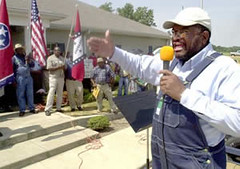
    Undeterred by the turnout as well as the fact that they had to shovel snow to create a place to deliver remarks, the group brought crates of corn and packets of seed labeled with messages they plan to deliver to Capitol Hill.

    “We are here acting on a law that was enacted in 2008 by Congress,” said John Boyd, founder of the National Black Farmers Association. “So this is already law and the black farmers are still waiting.”

    This month the group has organized demonstrations throughout historically black agricultural areas of the South, including Arkansas, Tennessee, Mississippi, Virginia, Alabama, South Carolina, and Georgia.

    Using Monday’s rally outside the Agriculture Department as a culmination of their protest, Boyd and other demonstrators expressed frustration that Congress has yet to approve a budget that would pay for a 1999 class action settlement ordered by a federal judge.

    In 2008, lawmakers established a system to review claims of racial bias from more than 70,000 farmers who were denied various types of farm support by the USDA. But Congress has yet to approve the 2010 farm bill, in which President Barack Obama has proposed including more than a $1 billion to cover the compensation claims.

    Black Farmers Take Discrimination Case To Congress, USDA

    After string of rallies, farmers arrive with corn and seeds bearing message to lawmakers. President acts, now it’s Congress’ turn, says National Black Farmers Association.

    Washington, D.C. (PRWEB) February 15, 2010 — Black farmers have spoken by the thousands and, on Monday, took their message to the nation’s capital: Congress should act now to remedy decades of discrimination. At an event outside of the U.S. Department of Agriculture, John W. Boyd, Jr., president of the National Black Farmers Association (nbfarally.com), recounted his week-long journey through the South holding rallies and gathering support.

    Unveiling 538 ears of corn, Boyd promised to deliver one to each member of Congress this week, along with packets of Forget-Me-Not seeds urging lawmakers to make compensation for discrimination — $1.15 billion — part of the 2010 budget. On Feb. 12, President Obama issued a letter to House Speaker Pelosi adding an amendment to remedy discrimination to his 2010-2011 budget. Now, it’s Congress’ turn to act.

    “Our long journey to justice should now come to a successful close,” said Boyd. “We have endured many hardships, waited many years and traveled many miles. Now it’s time for Congress to do its part and fund fairness for black farmers.”

    Boyd logged more than 1,500 miles traveling to a series of rallies, starting on Feb. 6 in Little Rock, AR and including Memphis, TN; Jackson, MS; Montgomery, AL; Columbus, GA; Columbia, SC and Richmond, VA. The rally in Jackson on Feb. 9, drew approximately 1,200 farmers and supporters. You can view photos at http://www.flickr.com/photos/nbfarally and videos at http://www.youtube.com/user/NBFARally.

    “Thousands of farmers who can’t be in Washington showed their support by traveling long distances through snow and rain to join our rallies,” Boyd said. “We’re here to represent them and get the job done.”

    Signs are encouraging. On Thursday, Feb. 4, White House Press Secretary Robert Gibbs responded this way to a question about the black farmers settlement and President Obama: “Clearly, it’s something important to him. It’s been an issue that has been worked on by the federal government now in several different administrations and dating back many years. Obviously, ensuring that justice is done is important in this situation.”

    The New York Times led a chorus of newspaper editorials calling for justice: http://www.nytimes.com/2010/02/08/opinion/08mon3.html?th&emc=th. Boyd himself published this piece in The Huffington Post: http://www.huffingtonpost.com/john-w-boyd-jr/justice-is-the-best-stimu_b_449757.html. And elected officials have weighed in with support, including Sen. Jim Webb, Rep. Artur Davis, Rep. Sanford Bishop, Rep. Jim Clyburn, and Rep. Bobby Scott.

    Boyd’s next stop is Congress, where he will deliver an ear of corn and packet of Forget-Me-Not seeds to each member while encouraging them to at long last deliver justice to black farmers. For more information, please visit nbfarally.com.

    About National Black Farmers Association:
    Founded: 1995 by John Boyd, Jr. of Baskerville, VA

    John W. Boyd Jr. is a fourth generation farmer as well as one of America’s most effective defenders of civil rights. He has been featured in The Washington Post, “60 Minutes,” “Nightline,” CNN and as ABC News Tonight’s “Person of the Week.” He is a past nominee for the NAACP’s highest honor, The Springarn Award, and currently ranks as one of Ebony Magazine’s most influential African-Americans.

    In 1995, Boyd founded the National Black Farmers Association after encountering the US Department of Agriculture’s discriminatory practices first-hand and meeting many more black farmers who shared this experience. Boyd soon led NBFA members in a march on the White House. He went on to meet with President Clinton and to testify before Congress. The plight of black farmers had caught the nation’s attention, but Boyd’s pursuit of justice continues to this day.

  • Lessons From the Legacy of Malcolm X

    African-American History Month 2010 Series:

    Lessons From the Legacy of Malcolm X

    45 years after his assassination the national question and the oppression of Muslims remain major issues of struggle

    by Abayomi Azikiwe
    Editor, Pan-African News Wire

    February 21 represents the 45th anniversary of the assassination of Malcolm X, El Hajj Malik Shabazz, in New York City at the Audubon Ballroom. Malcolm was beginning his address to a mass meeting of the Organization of Afro-American Unity (OAAU) when several men opened fire on him with shotguns and pistols.

    At the time the corporate media framed the threats, attacks and assassination of Malcolm X as a feud between the Nation of Islam under Elijah Muhammad and former members of the organization who were led by Malcolm X. Yet it has been well documented that the membersip of the Nation of Islam and Malcolm X were all under FBI and local police surveillance. The FBI wanted to cause a rift between Malcolm X and the members of Elijah Muhammad’s family in order to weaken the impact of this organization on developments within the broader African-American struggle.

    Malcolm X’s assassination came at a critical period during the African-American political movement of the 1960s. The Nation of Islam’s newspaper, the Muhammad Speaks, had done a superb job in covering developments within the civil rights movement between 1961-1963, but had remained largely aloof from the direct action efforts of the Southern Christian Leadership Conference (SCLC), the Student Nonviolent Coordinating Committee (SNCC), the Congress of Racial Equality (CORE) and other organizations.

    The program of the NOI called for the creation of a separate state for African-Americans in the United States or in Africa. The organization felt that based on the legacy of racism and national oppression it would be impossible for blacks and whites to be integrated into the same society on an equal basis.

    After the April 1962 police attack on the NOI mosque in Los Angeles, that resulted in the murder of one of their members Ronald Stokes, and the wounding of several others, Malcolm X wanted to engage in broader political efforts to seek justice in the case, which was deemed justifiable by the city authorities. Differences between Malcolm X and Elijah Muhammad over the character of the NOI’s response to the murder of Ronald Stokes, coupled with the burgeoning mass movement for civil rights, increased tensions inside the organization.

    When the Ku Klux Klan bombed the 16th Street Baptist Church in Birmingham in September 1963, which left four African-American girls dead, Malcolm X’s statements became even more militant in response to this act of racist terrorism and the failure of the Kennedy administration to take effective action in support of civil rights. Consequently, when Kennedy was assassinated on November 22, 1963 and Malcolm later made comments at the Manhattan Center on December 1 that his death was a case of the “chickens coming home to roost,” he was silenced by Elijah Muhammad and would eventually leave the organization by March 1964.

    Despite Malcolm’s departure from the NOI, he formed two other organizations, the Muslim Mosque, Inc., a Sunni Islamic organization, and the Organization of Afro-American Unity (OAAU), a pan-africanist group patterned on the Organization of African Unity in an effort to build a united front in the United States in solidarity with the struggle for independence and unity on the continent of Africa.

    Malcolm X: A Transformative Figure in African-American History

    Building on the legacy of Marcus Garvey, Malcolm X as a leader within the Nation of Islam, emerged during the 1950s as a militant spokesperson for urbanized African-Americans in the United States. Born to Garveyite activist parents, Earl and Louise Little in 1925, Malcolm exposure to nationalist and pan-africanist thought began at a very early age.

    As one of seven children in the Little family, Malcolm stated in his autobiography that Earl, a Baptist minister, often carried him to the mass meetings he attended during the depression years of the 1930s. His father Earl was originally from Georgia and his mother Louise, had been born in the Caribbean nation of Grenada. (The Autobiography of Malcolm X)

    Earl and Louise originally met at a Universal Negro Improvement Association-African Communities League (UNIA-ACL) conference, the organization founded by Marcus Garvey, in 1919 in Montreal. Louise and Earl were leading members of the UNIA-ACL. Louise’s articles were often published in the Garveyite newspaper the Negro World.

    Despite the economic crisis facing the United States at the time, Malcolm’s family were a close unit and remained self-reliant. The nationalist mood and self-pride exhibited by this family caused tremendous hostility among racist whites in Nebraska where Malcolm was born. Malcolm and other family members believed that Earl Little was murdered by white racists in 1931 in Mason, Michigan, near the state capital of Lansing.

    As a result of the social pressure and economic isolation from the white power structure in the area around Lansing, Michigan, these factors precipitated a nervous breakdown for Louise Little. Her eventual commitment to a state mental hospital and the break up of the family by the welfare department had a tremendous impact on the Little children.

    During his primary school years Malcolm exhibited intellectual capabilities and talents. He dreamed of being a lawyer but was discouraged by a racist teacher who told him that he had to be realistice because he was black. By 1941, Malcolm had relocated in Boston to stay with his older sister, Ella Collins, the daughter of Earl Little from a previous marriage.

    Malcolm worked in menial jobs in pool halls and on transport trains during World War II. He eventually drifted into criminality and drug abuse that resulted in his arrest and sentencing to prison for burglary in 1946.

    While in prison he was influenced by an older inmate to read and develop his mind. He then set out to learn as much as possible and to participate in the prison debating teams.

    Malcolm soon accepted the teachings of the Nation of Islam at the aegis of his brothers who had entered the organization prior to him. When he was paroled in 1952, he immediately began to work as an organizer for the Nation of Islam under the leadership of Elijah Muhammad.

    He rose swiftly through the ranks of the NOI to become the minister in Boston and later New York during the mid-to-late 1950s. After gaining national exposure through public speaking and media coverage, the press once again set out to discredit another fearless spokesperson for the African-American masses.

    Like the Garvey movement, Malcolm X created a newspaper for the Muslim organization, the Muhammad Speaks, which proved to be a powerful vehicle for the transmission of its ideas to the general public. In addition, his radio and television interviews and debates drew national attention from both the African-American masses as well as the Federal Bureau of Investigation (FBI) and other law-enforcement agencies in the United States.

    By 1963, Malcolm X’s speeches had become more decisively political and secular. He began to de-emphasize certain aspects of the Black Muslim theology of Elijah Muhammad. At a mass rally held during a grassroots organizers’ conference in Detroit in November 1963, his remarks reflected his developing world outlook.

    In this address that was recorded and issued under the title “Message to the Grassroots”, Malcolm X said that “The same man that was colonizing our people in Kenya was colonizing our people in Congo. The same one in the Congo was colonizing our people in South Africa, and in Southern Rhodesia, and in Burma and in India, and in Afghanistan, and in Pakistan. They realized all over the world where the dark man was being oppressed, he was being oppressed by the white man; where the dark man was being exploited, he was being exploited by the white man.” (Malcolm X Speaks, 1965)

    In March 1964, Malcolm announced the formation of a rival orthodox Muslim Mosque and arranged to make Hajj in April to Saudi Arabia in order to authenticate himself as a Sunni Islamic believer. When he returned to the U.S. in May 1964, he then established a political group, the Organization of Afro-American Unity (OAAU) whose objectives were decisively revolutionary nationalist and pan-africanist in orientation.

    In July 1964, Malcolm departed again for Africa and the Middle East to engage in further study, analysis and research and to establish deeper contacts between the OAAU and other revolutionary movements in the so-called Third World. Although many writers have placed emphasis on his conversion to Sunni Islam, Malcolm never lessened his commitment to the revolutionary transformation of the United States and the world.

    Malcolm spent the bulk of his time between July and November of 1964 in various revolutionary and progressive states in Africa, including Egypt, Ghana, Algeria, Tanzania and Guinea. He developed close political relations with Kwame Nkrumah of Ghana, Ahmed Sekou Toure of Guinea, Gamal Abdel Nassar of Egypt and Abdul Rahman Mohamed Babu, a leading government official and marxist theoretician from Tanzania.

    It was Malcolm’s connections with Babu that resulted in a meeting with Cuban revolutionary Che Guevara during his visit to the United Nations in late 1964. Malcolm took a keen interest in Cuba’s pending intervention in Congo during 1965.

    Malcolm had been one of the most outspoken critics of U.S. foreign policy towards Congo during 1964, when the Johnson administration had intervened to halt the advances of the revolutionary forces fighting against the western-backed forces that had overthrown and assassinated Patrice Lumumba in 1960-61. His public statements became more anti-capitalist and anti-imperialist in character and many believed that had he lived, Malcolm would have advanced socialism as a political objective.

    Malcolm X also visited England and France during late 1964 and early 1965. In England he made alliances with organizations within the black and Islamic communities. In France, he embarked upon efforts to form alliances with expatriate Africans and Caribbean nationals residing in Paris. A few days prior to his assassination he was denied admission to France without explanation by the government or the Johnson administration.

    During this period Malcolm began to emphasize the central role of women in the national liberation process. In an interview in Paris he told the public that “One thing I became aware of in my traveling recently through Africa and the Middle East, in every country you go to, usually the degree of progress can never be separated from the woman. If you’re in a country that’s progressive, the woman is progressive. If you’re in a country that reflects the consciousness toward the importance of education, it’s because the woman is aware of the imprtance of education.”

    Malcolm continued on this point saying “But in every backward country you’ll find the women are backward, and in every country where education is not stressed it’s because the women don’t have education. So one of the things I became thoroughly convinced of in my recent travels is the importance of giving freedom to the woman, giving her education, and giving her the incentive to get out there and put that same spirit and understanding in her children. And I frankly am proud of the contributions that our women have made in the struggle for freedom and I’m one person who’s for giving them all the leeway possible because they’ve made a greater contribution than many of us men.” (By Any Means Necessary, p. 179, 1970)

    Malcolm X’s Secure Position Within African-American History

    Despite the efforts of the corporate media to distort his legacy and international image since his assassination on February 21, 1965, Malcolm X has been immortalized by many writers and commentators on African-American affairs. According to journalist M.S. Handler “No man in our time aroused fear and hatred in the white man as did Malcolm, because in him the white man sensed an implacable foe who could not be had for any price–a man unreservedly committed to the cause of liberating the black man in American society, rather than integrating the black man into that society.” (El Hajj Malik Shabazz, Documentary Film)

    During the later years since his martyrdom Malcolm has gained a secure position within the collective consciousness of Africans, oppressed peoples and workers world-wide. His image proliferates the urban areas of America and his name and spirit is often evoked in relation to the uncompromising character of the African-American struggle for total liberation from national oppression and economic exploitation.

    Consequently, the efforts of the mass media, the national intelligence services of the United States and the capitalist class in general, who have sought to either obscure or coop his message, have failed due to the efforts of the political heirs of Malcolm X who have continued to maintain the integrity and principled character of his legacy.

  • US/NATO Offensive Meets Resistance From the Afghan People

    Tuesday, February 16, 2010
    07:07 Mecca time, 04:07 GMT

    Afghan offensive meets resistance

    Afghan and Nato troops have been hit by sniper attacks and booby-traps

    Nato-led and Afghan forces have met sporadic resistance on the third day of a major offensive to secure a town in Afghanistan’s southern Helmand province.

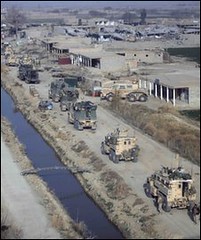
    Troops taking part in Operation Moshtarak were reportedly targeted with heavy gunfire, sniper fire and booby-traps as they attempted to push forward in Marjah and the surrounding areas on Monday.

    “We are making steady progress, but being very methodical about detecting and clearing routes in an area heavily saturated with IEDs [improvised explosive devices],” Abraham Sipe, a US Marine captain, told the Reuters news agency.

    “In many parts of Marjah, we have seen very little opposition. There are areas where Marines have met with stiff resistance, but they are making steady progress throughout the area.”

    US Marine units were twice beaten back by heavy gunfire as they tried to reach a market in the town and another armoured column reported that it had come under fire from three different sniper teams.

    “It’s a pretty busy day but we expected that because we are penetrating,” Lieutenant Colonel Brian Christmas, the commander of 3rd Battalion, 6th Marines, told The Associated Press news agency.

    Ambush tactics

    Zeina Khodr, Al Jazeera’s correspondent in Kabul, said the resistance, although limited, showed that Taliban fighters were still operating around Marjah.

    Al Jazeera’s James Bays reports on the offensive to recapture Marjah
    “Although we are not seeing, for example, face-to-face combat it seems that the Taliban is not going away for now,” she said.

    “This has been their tactics, ambushing international forces, roadside bombings. The forces are advancing but it is a slow process simply because the area is heavily booby-trapped.”

    However, Afghan military leaders said that Taliban fighters had fled as about 15,000 US, British and Afghan soldiers had moved in to take control of Marjah and Nad Ali.

    “All of the areas of Marjah and Nad Ali have been taken by combined forces. They are under our control, almost all Nad Ali and Marjah,” General Aminullah Patiani, the senior Afghan commander in Operation Mushtarak, said.

    “The Taliban have left the areas but the threat from IEDs remains.”

    Rahim Wardak, Afghanistan’s defence minister, called on any remaining Taliban fighters to put down their weapons and take up a government reintegration offer.

    “I want to call on all Afghan Taliban, the ones who are besieged or maybe hiding … put down your arms and join our reconciliation programme, take part with us in the rebuilding of our country,” he said.

    Operation objectives

    Operation Moshtarak, is the first major test of the strategy of Barack Obama, the US president, to take on the Taliban and end the eight-year conflict with one of the biggest offensives since the 2001 US-led invasion.

    It is designed to clear Taliban fighters from the Marjah region of the southern province and hold it so that the civilian administration can establish itself.

    “The objective here is to protect the people and help the government provide services to the people of Afghanistan, even in the most difficult areas,” Richard Holbrooke, the US special envoy to the region, told Al Jazeera.

    Afghan officials say they have a “government-in-a-box” ready to sweep in and set up institutional services and security that will ensure the Taliban do not return to areas captured by US-led forces.

    However, the long-term success of the offensive is likely to depend on securing the support of the local population, something which will be made more difficult by civilian casualties in the offensive.

    Nato on Monday expressed its “deep regret” over the deaths of 12 civilians after their house was hit by a rocket that missed its target.

    Source: Al Jazeera and agencies

    Civilian death toll climbs in Afghan offensive

    By ALFRED de MONTESQUIOU, Associated Press Writer

    MARJAH, Afghanistan – Three more Afghan civilians have been killed in the assault on a southern Taliban stronghold, NATO forces said Tuesday, highlighting the toll on the population from an offensive aimed at making them safer.

    The deaths — in three separate incidents — come after two errant U.S. missiles struck a house on the outskirts of the town of Marjah on Sunday, killing 12 people, half of them children. Afghan officials said Monday that three Taliban fighters were in the house at the time of the attack.

    About 15,000 NATO and Afghan troops are taking part in the massive offensive around Marjah — the linchpin of the Taliban logistical and opium poppy smuggling network in the militant-influenced south. U.S. Marines are spearheading the assault.

    The offensive is the biggest joint operation since the 2001 U.S.-led invasion of Afghanistan and a major test of a retooled NATO strategy to focus on protecting civilians rather than killing insurgents.
    But in the fourth day of an assault that could take weeks, the drumbeat of gunfire and controlled detonations of planted bombs is sparking fear that civilians will bear the burden of the fight.

    In two of the most recently reported incidents, Afghan men came toward NATO forces and ignored shouts and hand signals to stop, NATO said. The troops shot at the men and killed them. One of the shootings appeared to match an incident previously reported by The Associated Press.

    In the third incident, two Afghan men were caught in the crossfire between insurgents and NATO forces. Both were wounded and one died of his injuries despite being given medical care, NATO said.

    Taliban fighters have stepped up counterattacks against Marines and Afghan soldiers in Marjah, slowing the allied advance to a crawl despite Afghan government claims that the insurgents are broken and on the run.

    Taliban fighters appeared to be slipping under cover of darkness into compounds already deemed free of weapons and explosives, then opening fire on the Marines from behind U.S. lines.

    Afghan President Hamid Karzai approved the assault on Marjah only after instructing NATO and Afghan commanders to be careful about harming civilians. “This operation has been done with that in mind,” the top NATO commander, U.S. Gen. Stanley McChrystal, said Monday.

    Despite those instructions, NATO reported its first civilian deaths Sunday, saying two U.S. rockets veered off target by up to 600 yards and slammed into a home — killing six children and six adults.

    In London, Britain’s top military officer, Air Chief Marshal Sir Jock Stirrup, called the missile strike a “very serious setback” to efforts to win the support of local communities, who are from the same Pashtun ethnic group as the Taliban.

    NATO suspended the use of the rocket system that killed the civilians following the 12 deaths, pending an investigation.

    In a separate incident unrelated to the Marjah offensive, a NATO airstrike in neighboring Kandahar province killed five civilians and wounded two. NATO said in a statement that they were mistakenly believed to have been planting roadside bombs.

    On Monday, Afghan commanders spoke optimistically about progress in Marjah, a town of about 80,000 people that is seen as key to securing the south. They said resistance was low, Taliban were fleeing across the border and that the town should soon be cleared of insurgents.

    In Marjah, however, there was little sign the Taliban were broken. Instead, small, mobile teams of insurgents repeatedly attacked U.S. and Afghan troops with rocket, rifle and rocket-propelled grenade fire. Insurgents moved close enough to the main road to fire repeatedly at columns of mine-clearing vehicles.

    Allied officials have reported only two coalition deaths so far — one American and one Briton killed Saturday. There have been no reports of wounded. Afghan officials said at least 27 insurgents have been killed so far in the offensive.

    Two NATO service members died Monday from bomb strikes in Helmand; neither was part of the Marjah offensive, military spokesman Sgt. Kevin Bell said. NATO did not provide their nationalities.

    Nonetheless, the harassment tactics and the huge number of roadside bombs, mines and booby traps planted throughout Marjah have succeeded in slowing the movement of allied forces through the town.

    As long as the town remains unstable, NATO officials cannot move to the second phase — restoring Afghan government control and rushing in aid and public services to win over inhabitants who have been living under Taliban rule for years.

    The main attack began before dawn Saturday when dozens of helicopters dropped hundreds of Marines and Afghan soldiers into the heart of the city.

  • PANW Editor Quoted in Detroit News Article on the FBI Response to the Assassination of Imam Luqman Ameen Abdullah

    February 15, 2010
    http://detnews.com/article/20100215/METRO/2150330

    FBI followed protocol in imam’s shooting in Dearborn, ex-agent says

    He says SWAT team followed protocol in raid that killed imam

    PAUL EGAN
    The Detroit News

    Detroit — A retired agent who spent more than 20 years on the Detroit FBI’s SWAT team says he believes agents acted appropriately in an Oct. 28 operation in which an imam was shot 20 times at a Dearborn warehouse.

    The FBI, which controlled the warehouse as part of a sting operation, was trying to arrest Luqman Ameen Abdullah on a criminal complaint charging him with stolen goods and weapons offenses.

    The indictment identified Abdullah, 53, also known as Christopher Thomas, as “a highly placed leader of a nationwide radical fundamentalist Sunni group” that sought to establish a separate state within the United States governed by Sharia law.

    Muslim and community groups have accused the FBI of excessive force in the raid, which Abayomi Azikiwe of the Michigan Emergency Committee Against War and Injustice described as “a targeted assassination.”

    Among the concerns is the number of gunshot wounds detailed in the medical examiner’s report and the fact Abdullah’s corpse was left handcuffed while an FBI dog allegedly shot by Abdullah was airlifted for medical treatment.

    A report of a Dearborn Police investigation of the incident has not been released. The report of an internal FBI investigation is completed but has not been released and is being reviewed by the civil rights division of the U.S. Justice Department.

    Gregory Stejskal served more than 30 years with the FBI until his retirement in 2006, was on the SWAT team from 1977-98, serving as senior team leader, and now teaches at the police academy at Washtenaw Community College.

    He said he has studied the medical examiner’s report and media reports and has discussed the incident with FBI agents. Stejskal believes the bureau acted properly and that its agents will be exonerated.

    It is FBI policy to use overwhelming force when arresting a suspect believed to be armed and dangerous, Stejskal said. A dog is sometimes used to help subdue a suspect who has refused to surrender, he said.

    Agents would have been justified in firing if Abdullah had reached for a weapon, let alone having brandished a weapon and fired three shots, as Stejskal said he understands Abdullah did and as a person familiar with the investigation told The Detroit News.

    In a space of three to four seconds, four agents fired an average of five shots each, striking Abdullah 20 times, with one shot creating two wounds for a total of 21 entry wounds, according to the medical examiner’s report and a person familiar with the investigation.

    “Once you’ve made the decision to use deadly force, you fire until the threat is eliminated,” Stejskal said.

    FBI procedures called for Abdullah to be immediately handcuffed when the agents approached, he said. Agents would have then checked for vital signs, found that he was already dead, and would have not disturbed the shooting scene by removing the handcuffs, he said.

    Dawud Walid, executive director of the Council on American-Islamic Relations of Michigan, said he wants to wait and review the investigative reports of the shooting and have an independent pathologist review the medical examiner’s report.

    “The reality is that none of us were at the scene,” he said. “We really don’t know what happened.”

    Nabih Ayad, an attorney representing Abdullah’s widow, said it was needlessly confrontational to send a dog after Abdullah because Muslims view dogs as unclean and anyone attacked by a dog could react violently.

    Stejskal said he thought the concern about the use of the dog would be more legitimate if Abdullah was a Muslim from the Mideast, rather than an American who converted while in prison.

  • Car Seizures at Checkpoints Prove Profitable for Cities, Raise Legal Questions

    Car seizures at DUI checkpoints prove profitable for cities, raise legal questions

    February 13, 2010 | Ryan Gabrielson

    Sobriety checkpoints in California are increasingly turning into profitable operations for local police departments that are far more likely to seize cars from unlicensed motorists than catch drunken drivers.

    An investigation by the Investigative Reporting Program at UC Berkeley with California Watch has found that impounds at checkpoints in 2009 generated an estimated $40 million in towing fees and police fines – revenue that cities divide with towing firms.

    Additionally, police officers received about $30 million in overtime pay for the DUI crackdowns, funded by the California Office of Traffic Safety.

    In dozens of interviews over the past three months, law enforcement officials and tow truck operators say that vehicles are predominantly taken from minority motorists – often illegal immigrants.

    In the course of its examination, the Investigative Reporting Program reviewed hundreds of pages of city financial records and police reports, and analyzed data documenting the results from every checkpoint that received state funding during the past two years. Among the findings:

    * Sobriety checkpoints frequently screen traffic within, or near, Hispanic neighborhoods. Cities where Hispanics represent a majority of the population are seizing cars at three times the rate of cities with small minority populations. In South Gate, a Los Angeles County city where Hispanics make up 92 percent of the population, police confiscated an average of 86 vehicles per operation last fiscal year.
    * The seizures appear to defy a 2005 federal appellate court ruling that determined police cannot impound cars solely because the driver is unlicensed. In fact, police across the state have ratcheted up vehicle seizures. Last year, officers impounded more than 24,000 cars and trucks at checkpoints. That total is roughly seven times higher than the 3,200 drunken driving arrests at roadway operations. The percentage of vehicle seizures has increased 53 percent statewide compared to 2007.
    * Departments frequently overstaff checkpoints with officers, all earning overtime. The Moreno Valley Police Department in Riverside County averaged 38 officers at each operation last year, six times more than federal guidelines say is required. Nearly 50 other local police and sheriff’s departments averaged 20 or more officers per checkpoint – operations that averaged three DUI arrests a night.

    Law enforcement officials say demographics play no role in determining where police establish checkpoints.

    Indeed, the Investigative Reporting Program’s analysis did not find evidence that police departments set up checkpoints to specifically target Hispanic neighborhoods. The operations typically take place on major thoroughfares near highways, and minority motorists are often caught in the checkpoints’ net.

    “All we’re looking for is to screen for sobriety and if you have a licensed driver,” said Capt. Ralph Newcomb of the Montebello Police Department. “Where you’re from, what your status is, that never comes up.”

    Additionally, the 2005 appellate court ruling includes exceptions, allowing police to seize a vehicle driven by an unlicensed motorist when abandoning it might put the public at risk. Examples include vehicles parked on a narrow shoulder or obstructing fire lanes.

    But reporters attending checkpoints in Sacramento, Hayward and Los Angeles observed officers impounding cars that appeared to pose no danger.

    Reporters also noted that many of the drivers who lost their cars at these checkpoints were illegal immigrants, based on interviews with the drivers and police. They rarely challenge vehicle seizures or have the cash to recover their cars, studies and interviews show.

    Some tow truck company officials relayed stories of immigrant mothers arriving at impound lots to remove baby car seats and children’s toys before leaving the vehicle to the tow firm.

    “I have to stand here for days and watch them take their whole life out of their vehicles,” said Mattea Ezgar, an office manager at Terra Linda Towing in San Rafael.

    This wasn’t what lawmakers intended when they passed an impound law 15 years ago – the same law that the federal court has since questioned, said David Roberti, former president of the state Senate.

    “When something is that successful, then maybe it’s too easy to obtain an impoundment, which should usually be way more toward the exception than the rule,” Roberti said.

    The impound law granted police the authority to seize unlicensed drivers’ cars for 30 days. The California Attorney General’s Office said in a written statement that the state law is murky in terms of whether vehicles driven by unlicensed motorists can be taken at all.

    Police do not typically seize the cars of motorists arrested for drunken driving, meaning the owners can retrieve their vehicles the next day, according to law enforcement officials.

    To be sure, DUI checkpoints have saved countless lives on the nation’s roadways and have brought thousands of drunken drivers to justice. And by inspecting driver’s licenses, police catch motorists driving unlawfully, typically without insurance, and temporarily remove them from the road.

    With support from groups such as Mothers Against Drunk Driving, California more than doubled its use of sobriety checkpoints the past three years.

    State officials have declared that 2010 will be the “year of the checkpoint.” Police are scheduling 2,500 of the operations in every region of California. Some departments have begun to broaden the definition of sobriety checkpoints to include checking for unlicensed drivers.

    Checkpoint impact not limited to drunken drivers

    The checkpoints have rocked lives of sober motorists such as Luis Gomez.

    In the early evening of Jan. 2 of this year, Gomez was driving his Chevy truck through downtown Los Angeles when traffic slowed to a stop.

    A couple blocks from the Staples Center, orange cones narrowed Olympic Boulevard’s three westbound lanes to two. Los Angeles Police Department officers, stationed beneath a freeway overpass, began questioning drivers as part of a DUI checkpoint.

    Gomez, a 42-year-old construction worker, said the roadblock didn’t concern him. He said he doesn’t drink alcohol.

    But the illegal immigrant was driving without a license. Gomez received a traffic citation.

    A tow truck operator took his truck.

    Owners who do recover their vehicles pay between $1,000 and $4,000 in tow and storage charges and fines assessed by local governments, municipal finance records show.

    Officers do not inquire about the drivers’ residency status. Nor do they contact U.S. Immigration and Customs Enforcement when they suspect unlicensed motorists are in the country illegally.

    Gomez said he’d try to save whatever money he could to get back his truck. The Chevy is critical for him to continue finding work at construction sites, jobs that have supported him for two decades in the United States.

    “It’s going to be hard, because times are hard,” Gomez said.

    Impounds aid cash-strapped local governments

    Cities have their own money problems.

    Since 2007, the sales tax revenues of California municipalities have shrunk by $471 million, figures from the California State Board of Equalization show.

    Property values have withered, too, causing financial woes at every level of government.

    “If a city wants to try to raise revenue, in mostly all cases you have to go to the voters,” said Daniel Carrigg, legislative director for the League of California Cities. Local governments, instead, are adding to fees for services and fines for an assortment of violations.

    Local governments often charge unlicensed drivers a fine to get their vehicles released from impound – on average more than $150, finance records show. Cities, increasingly, also get a cut of the fees that tow operators charge vehicle owners, generating hundreds of thousands of dollars a year.

    Some local governments ensure they get a larger share as their police departments seize more and more cars.

    In Los Angeles County, the city of Montebello requires its tow operator to increase its cut of impound revenue when the police department seizes a higher volume of cars.

    Tow company Helms and Hill Inc. pays Montebello $200 per tow when officers order more than 151 cars hauled away each month, the city’s finance records show.

    Montebello’s DUI checkpoints rank among California’s least effective at getting drunks off the road.

    Last year, officers there failed to conduct a single field sobriety test at three of the city’s five roadway operations, state records show.

    Montebello collected upward of $95,000 during the last fiscal year from checkpoints, including grant money for police overtime.

    The California Office of Traffic Safety, which is administered in part by officials at UC Berkeley, continues to fund Montebello’s operations, providing a fresh $37,000 grant for this year.

    Checkpoint location may influence impounds

    Most of the state’s 3,200 roadblocks over the past two years occurred in or near Hispanic neighborhoods, the Investigative Reporting Program’s analysis shows. Sixty-one percent of the checkpoints took place in locations with at least 31 percent Hispanic population. About 17 percent of the state’s checkpoints occurred in areas with the lowest Hispanic population – under 18 percent.

    Further, police impound the most cars per checkpoint in cities where Hispanics are a majority of the population, according to state traffic safety statistics and U.S. Census data.

    For 12 years, Francisco Ruiz has run El Potro, a Latin music nightclub, at the northeast corner of A Street and Hesperian Boulevard in Hayward. Not once had he seen a DUI checkpoint. Then, in 2009, the city’s police department conducted four operations just outside his front door.

    “They’re not taking drunk drivers,” Ruiz said as he watched cars crawl through a Dec. 18 checkpoint at the intersection. “They’re taking people without a license.”

    An hour into the operation that evening, officers had yet to make a DUI arrest, reporters observed.

    But about a half dozen cars were impounded, leaving drivers stranded. Only one of the drivers could show he was a legal U.S. resident.

    The state does not consistently collect data on where local police departments set up checkpoints. A majority of California law enforcement agencies declined to release records showing which intersections they target, or what transpired at checkpoints, making it difficult to perform a statistical analysis of seizures in heavily minority communities.

    But cities across the state operate checkpoints in high-minority communities, the Investigative Reporting Program found through demographic data and more than three dozen interviews with law enforcement officials at DUI crackdowns.

    In the Los Angeles suburb of South Gate, Hispanics make up 92 percent of the population. The police department averaged 86 impounds each time officers shut down a road last year for a sobriety checkpoint. By comparison, they averaged a little more than four drunken driving arrests.

    Checkpoints in cities where Hispanics are the largest share of the population seized 34 cars per operation, a rate three times higher than cities with the smallest Hispanic populations, the Investigative Reporting Program’s analysis shows.

    The checkpoint data tells a similar story in two-dozen other cities. A majority of these communities are crowded together east of Los Angeles within the Inland Empire.

    The disparity between vehicles impounds and DUI arrests exist in virtually every region of California.

    Marin County checkpoints raise questions

    San Rafael sits at the entrance to the northern Bay Area, crisscrossed by freeways from San Francisco and East Bay cities.

    Hispanics comprise only a quarter of the city’s residents, according to demographic data from the U.S. Census Bureau. San Rafael’s Hispanic neighborhoods cluster along the freeways, near the water in what is called the Canal District.

    During the past two years, 10 of the city’s 12 sobriety checkpoints took place on streets surrounding these neighborhoods. Those operations resulted in four DUI arrests and 121 impounded cars for driver’s license violations.

    “We do not put checkpoints right there in the Canal District,” said Lt. Glenn McElderry, head of San Rafael police’s traffic unit.

    While police have not staged operations directly inside the Canal District, the department’s records show San Rafael officers repeatedly conducted checkpoints right outside the neighborhood.

    During the past two years, police sobriety checkpoints halted traffic on the Canal District’s two primary feeder streets – Francisco and Bellam boulevards.

    McElderry said San Rafael police start their checkpoints in the southern part of the city, near the Canal District, and then move to intersections further north after 10 p.m. when traffic slows.

    San Rafael’s data on drunken driving arrests, made independent of checkpoints during the past three months, show police made 20 DUI arrests, only three of which took place in the Canal District.

    Impounds at DUI checkpoints are incidental, not intentional, law enforcement officials argue. And the operations do not target Hispanic communities, they say.

    “Our checkpoints are sobriety and driver’s license, but one thing we always emphasize: The reason why we’re out here are drunk drivers,” said Officer Don Inman, grant administrator for the Los Angeles Police Department’s traffic division. “The driver’s license, that’s just a side issue that we deal with. We always try to make sure we pick in locations where we’re going to get drunk drivers.”

    LAPD averaged six DUI arrests per checkpoint in 2009, state data shows, more than most California departments.

    The state traffic safety agency requires that police wait until 6 p.m. to begin screening cars, though a few start earlier. The checkpoints typically last six hours over a single night.

    Even still, the LAPD’s driver’s license impounds doubled the past two years. One operation in December netted 64 vehicle seizures and four drunken driving arrests.

    One police agency, the California Highway Patrol, has far different results at its checkpoints. In 2008, state records show, the CHP arrested four intoxicated motorists for every one car that deputies seized.

    The highway patrol does not charge a fee to release impounded vehicles and collects no revenue from seizures, said Sgt. Kevin Davis, who oversees checkpoints in CHP’s research and planning division.

    Police say they consider a number of factors when setting up a checkpoint.

    Sgt. Dennis Demerjian, of the El Monte Police Department, said he typically consults his agencies’ internal data to find intersections where clusters of alcohol-involved collisions have taken place.

    Riverside County Sheriff’s Office Deputy Jarod Howe said roadways must have heavy traffic to justify placing officers there.

    A street needs to be wide enough to allow cars to pull off safely. Officers also need space to conduct field sobriety tests and question motorists without licenses.

    And the area needs to accommodate the tow trucks to remove seized vehicles, Howe acknowledged.

    Police and state traffic safety officials contend that impounding the cars of unlicensed drivers is, like catching drunken drivers, a critical part of making California’s roads less dangerous.

    “It’s well known that drivers driving without licenses are frequently involved in accidents,” said Sgt. Jeff Lutzinger, the head of Hayward’s traffic safety division.

    Research by the National Highway Traffic Safety Administration has shown that motorists driving with a suspended or revoked license cause collisions at a higher rate. These drivers are also typically uninsured.

    The state’s traffic safety office has declared vehicle seizures an effective way to remove risky, uninsured drivers.

    “Law enforcement agencies have stated that these tools have helped decrease the number of unsafe drivers on public roads as well as reduce the number of hit-and-run traffic collisions,” a 2005 report from the state agency said.

    Funding for DUI crackdowns plays major role

    The federal government provides the California Office of Traffic Safety about $100 million each year to promote responsible driving that reduces roadway deaths. Of that, $30 million goes into programs that fund drunken driving crackdowns, particularly checkpoints.

    Police officer overtime accounts for more than 90 percent of the expense of sobriety checkpoints. Departments do not assign officers to work checkpoints during their regular shifts.

    Law enforcement agencies tend to use more officers than a checkpoint requires, according to guidelines established by the National Highway Traffic Safety Administration.

    Statewide, police departments on average deployed 18 officers at each checkpoint, according to state data. The federal traffic safety agency advises that police can set up DUI checkpoints with as few as six officers.

    The additional dozen officers typical at a California roadway operation cost state and federal taxpayers an extra $5.5 million during the 2008-09 fiscal year, according to the Investigative Reporting Program’s analysis.

    The LAPD sent 35 officers, on average, to every sobriety crackdown.

    At least a dozen officers spent hours sitting and chatting at an operation in early January in downtown Los Angeles. A couple of officers smoked cigars as they watched cars go through the screening.

    Officers seized 22 cars that evening and made one DUI arrest.

    The state data shows that last fiscal year LAPD spent $16,200 per checkpoint, all of it on officer overtime.

    Impounds a lucrative business for cities, towing companies

    Cities and private towing operators make tens of millions of dollars a year from checkpoints. This cash comes from tow fees and daily storage charges, finance records at a half dozen cities show.

    If the car’s owner cannot afford to recover the vehicle, then after 45 days, the tow operator can sell it to pay the bill.

    Cities are also increasingly charging franchise fees to tow operators.

    The fees give cities a cut of the more lucrative side of towing, the long-term storage costs from 30-day impounds.

    In early 2007, El Monte’s top officials went shopping for new tow contracts.

    The suburb, east of Los Angeles, had called on tow operators to remove almost 5,000 cars a year from its streets, El Monte Police Chief Ken Weldon explained in a memo to the city manager.

    The operators hauled the cars at no cost to El Monte; however the chief found the city was denying itself a source of cash.

    “A survey of surrounding agencies revealed that many agencies are recovering costs by collecting a ‘franchise fee’ from the tow company,” Weldon, now retired, wrote.

    On average, nearby cities charged tow operators $50 for every car the police department ordered towed or impounded. Weldon calculated the fee would provide El Monte $241,600 a year.

    The city wrote the fees into its new contracts with Albert’s Towing and Freddie Mac’s Towing.

    During holiday checkpoints last fiscal year, El Monte police seized 680 cars for driver’s license violations, state data shows.

    Each of the impounds was worth at least $2,035 in tow charges and fees, according to city financial records. El Monte received at least $164,000 from the vehicle seizures.

    The city’s tow operators likely collected about $1.2 million from the seizures. That figure might have been higher or lower, depending on how many car owners retrieved their vehicles and what price the companies got for the remaining impounded cars.

    Owners abandon their cars at tow lots roughly 70 percent of the time, said Perry Shusta, owner of Arrowhead Towing in Antioch and vice president of the California Tow Truck Association.

    Tow operators provide communities a kind of garbage service, removing junk cars that don’t operate and are worth only the value of their metal frame.

    DUI checkpoints catch a higher quality of vehicle, Shusta said. “The good cars are how we afford to get rid of all the cities’ junk.”

    Impounds spur search and seizure concerns

    The Fourth Amendment specifically restricts law enforcement’s authority to seize private property without a court order.

    “It is assumed under the law that the taking of personal property without a warrant is unconstitutional,” said Martin J. Mayer, a founding partner in the Fullerton law firm Jones & Mayer, which represents numerous police agencies.

    The law protects everyone within the United States, regardless of whether they are in the country illegally.

    California police have seized the cars of unlicensed drivers for 15 years under the state law that allows such vehicles to be impounded for 30 days.

    But in 2005, the Ninth U.S. Circuit Court of Appeals ruled in an Oregon case that law enforcement can’t impound a vehicle if the only offense is unlicensed driving.

    One exception is called the “community caretaker” doctrine, which permits police to impound a car if it poses a threat to public safety, is parked illegally or would be vandalized imminently if left in place.

    The ruling dramatically altered the law regarding vehicle impounds. In response, the Legislative Counsel of California in 2007 called into question the legality of the state’s impound procedures.

    “If a peace officer lawfully stops a motor vehicle on the highway and the driver of the motor vehicle is an unlicensed driver, that alone is not sufficient justification for the peace officer to cause the impoundment of the motor vehicle,” Legislative Counsel Diane F. Boyer-Vine, who advises state lawmakers, wrote in a response to Sen. Gilbert A. Cedillo, D-Los Angeles. The legislative counsel has no authority over police departments.

    A lawsuit challenging the constitutionality of California’s 30-day impound law is awaiting oral arguments before the Ninth Circuit Court of Appeals later this year. The state and several cities that are defendants in the case argue that impounds are penalties for a criminal offense, and therefore car owners are not subject to Fourth Amendment protection.

    Most California law enforcement agencies continue to seize vehicles based on driver’s license violations alone.

    Reporters with the Investigative Reporting Program observed police at checkpoints in three different cities impound cars after the vehicles had been moved out of harm’s way and parked legally.

    Mayer represents the California Peace Officers Association and also alerted law enforcement that the federal ruling prohibited the state’s police from seizing cars solely on the charge of unlicensed driving.

    The attorney said he was startled by his clients’ angry response to his memo explaining the appeals court case.

    “I never expected the volume of e-mails, phone calls and death threats all from law enforcement, especially motor officers,” Mayer said. “I’m being flippant you understand. They wanted to kill me though because I’m interfering with a process they’ve been doing for years.”

    Former state Sen. Roberti, then chairman of the Senate’s Judiciary Committee, said he and his fellow lawmakers did not consider how the 1995 impound law might impact unlicensed drivers.

    “It’s turned out to be a far more vigorous enforcement than any of us would have dreamed of at the time,” he said.

    Ryan Gabrielson, the winner of the 2009 Pulitzer Prize for Local Reporting, is a reporter and fellow at UC Berkeley’s Investigative Reporting Program directed by Lowell Bergman, one of the founders of the Center for Investigative Reporting.
  • Civilian Casualties Result From US/NATO Offensive Against the Afghan People

    Civilian casualties cast shadow on offensive on Afghan Taliban

    English.news.cn 2010-02-15 14:32:48

    by Zhang Ning

    KABUL, Feb. 15 (Xinhua) — The NATO-Afghan joint force Sunday mistakenly fired rockets on a civilian shelter killing 12 villagers. Local analysts said civilian casualties will make the ongoing massive crackdown on the Taliban a more challenging task.

    Around 15,000 servicemembers with the NATO-led International Security Assistance Force (ISAF) and Afghan National Army soldiers late on Friday launched the biggest ever operation on the Taliban since the United States waged the war on terror in 2001.

    The final goal of the mission was believed to be uprooting the Taliban in the central part of the southern Helmand province, the major financial resource of the group.

    NATO commanders and the Afghan government said the task is more aimed at resuming the administration, restoring the normal social life and reconstruction of the economy in the region rather than killing Taliban fighters.

    To win public confidence and support is the key point of the Operation Moshtarak, (“Together” in English), but Sunday’s tragedy would make the rosy result gloomy.

    The NATO-Afghan force has surely been in a hard bid to prevent civilian casualties as it gave up a blitz plan and intentionally publicized the offensive more than one week ahead of the Day One.

    Some of the 80,000 locals living in Marjah town, the centerpiece of the battlefield, were believed to have been out of town prior to the start of the operation and a number of the insurgents were thought to have fled the area as well.

    This helped decrease the casualties but still not enough.

    In the town of Marjah, many landmines, roadside bombs and booby- trap were planted to stop the troops’ charging. Quite a number of insurgents could have been hiding among residents firing on troops sporadically.

    To clear all these obstacles, the civilian casualties were thought to be inevitable and that will put the whole operation in risk of failure.

    Foreign troops in Afghanistan have long been criticized for killing civilians and the recent tragedy will not help soothe the public rage.

    NATO and Afghan forces carried out large offensives in Helmand province before but failed to secure the central government’s authorities. The reason is simple: people do not support those who killed their families and relatives. The Taliban kills, but the troops kill too, they said.

    Ahead of the launching of the offensive, Afghan Interior Minister Mohammad Hanif Atmar held a meeting with tribal elders of Marjah and the neighboring district of Nad Ali to woo the public support for the government’s future reconstruction plan.

    The tribal elders displayed reservation during the meeting, laying the minimization of civilian casualties as the preconditions of their support.

    Some analysts feared that as the possible increase of the civilian casualties are doomed, a number of residents might even pick up weapons and fight side by side with the Taliban.

    NATO commanders said the Operation Moshtarak were designed for three phases of Shaping, Clearing and Reconstruction.

    The most important stage would be the Reconstruction and without the public support, the reconstruction plan will see no chance.

    Civilian casualties will not help gain the public support in the war-ravaged nation, analysts said.

    NATO rockets kill 12 Afghan civilians

    KABUL, Feb. 15 (Xinhua) — NATO rockets killed 12 Afghan civilians on Sunday in an offensive against Taliban in southern Afghanistan.

    NATO claimed responsibility for the deaths, which it said happened when two rockets missed their target and landed on a compound as troops came under fire in the the Nad Ali district of Helmand province.

    Marja offensive a test for NATO’s ability in uprooting Taliban

    KABUL, Feb. 13 (Xinhua) — The much-awaited and the ever-biggest offensive since the collapse of Taliban regime in late 2001 was launched against Taliban fiefdom in Marja district of southern Helmand province Saturday amid Taliban vow to defend tooth and nail.

    Regarded as the breeding center of militancy and main stronghold of Taliban fighters in south Afghanistan, the strategically important Marja district enables Taliban to influence the neighboring Nawa, Nad Ali, Babaji districts as well as the provincial capital Lashkar Gah.

    Afghan, U.S.-led NATO forces launch major offensive against Taliban in Afghanistan

    KABUL, Feb. 13 (Xinhua) — The United States, British and Afghan forces have kicked off a major offensive operation against Taliban insurgents in southern Afghanistan, which is liable to prove the biggest battles in the eight-year-long war on terror in the post-Taliban country.

    Operation Mushtarak, or Together, in Marjah area of Helmand province is the biggest joint military campaign of the U.S.-led NATO and Afghan forces to uproot the hardcore Taliban fighters from their main bastion in the troubled country.

    Editor: Xiong Tong

  • Deaths in Haiti School Collapse

    Tuesday, February 16, 2010
    05:53 Mecca time, 02:53 GMT

    Deaths in Haiti school collapse

    Schools in northern Haiti reopened last week following January’s devastating quake

    At least four children have been killed and several injured after a school collapsed in the town of Cap-Haitien in northern Haiti.

    About 200 children were in the school at midday on Monday when the collapse occurred.

    Al Jazeera’s Todd Baer reporting from the scene said rescuers believe a landslide may have caused a boulder from a nearby hill to crash down onto the roof of one of the classrooms.

    He said there had been heavy rains and flooding in the area that could have loosened the soil in the surrounding hills.

    Ambulances took several injured children to nearby hospitals, while rescue workers were combing through the rubble looking for any other casualties who may be trapped.

    UN peacekeepers and members of the US coast guard were helping with the rescue effort.

    Some reports have suggested a small earthquake, possibly an aftershock from last month’s deadly magnitude 7 earthquake, may have caused the landslide.

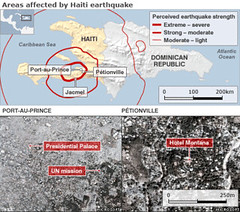
    Cap-Haitien is about 130km north of the Haitian capital, Port-au-Prince, where more than 200,000 people are thought to have died in the January quake.

    Schools in the north of Haiti reopened last week, although they remain closed in the capital.

    Years to rebuild

    The latest tragedy to hit the quake-devastated country came as Haiti’s president predicted it would take up to three years to clear the rubble from the capital, and many more years to rebuild.

    Speaking to the Associated Press, Rene Preval said Haiti faces a drawn out period of reconstruction that will result in far fewer people living in Port-au-Prince.

    The January 12 quake has left more than a million people homeless, many of whom now live in makeshift camps or have left the capital for other areas of the country.

    Before the quake the Port-au-Prince was home to some 3 million people.

    Preval said it would take “1,000 trucks moving rubble for 1,000 days, so that’s three years. And until we move out rubble, we cannot really build.”

    He said the government has destroyed some hastily rebuilt structures in the capital, but added that until alternative housing plans can be completed, the government’s ability to regulate reconstruction will be limited.

    Government base

    On Monday Canada’s prime minister began a two-day visit to Haiti, pledging an additional $215m collected from relief campaigns to help the country’s reconstruction.

    Stephen Harper said Canada would also help build a temporary administrative base for the Haitian government after the quake destroyed several key ministries.

    The temporary administrative base will consist of semi-permanent modular shelters and soft-sided inflatable shelters, accommodating key ministries and Haitian civil servants so they can work together on recovery efforts.

    “The establishment of a temporary government administrative base is an important step toward early recovery and reconstruction efforts,” Harper said after talks with the Haitian president.

    He said Canada would provide the base with office equipment and supplies such as computers and desks, as well as electricity, water and cooling systems and sanitation facilities.

    Last month’s quake destroyed the presidential palace and national assembly and destroyed or damaged several major ministries, forcing Preval and his government to work from a police station and other temporary locations.

    “Canada will continue to support the Haitian government as it moves forward with its reconstruction and development agenda,” Harper said.

    Source: Al Jazeera and agencies

  • Trafficking Charges for Adviser to Jailed Americans in Haiti

    February 16, 2010

    Trafficking Charges for Adviser to Jailed Americans in Haiti

    By MARC LACEY and IAN URBINA
    New York Times

    PORT-AU-PRINCE, Haiti — As the 10 Americans imprisoned in Haiti for trying to remove children from the country awaited a decision on their fate Monday, the legal woes of the man who falsely portrayed himself as the group’s lawyer mounted.

    The one-time legal adviser, who calls himself Jorge Puello, now acknowledges that he faces sex trafficking charges in El Salvador under the name Jorge Anibal Torres Puello. He remained at large on Monday, as Dominican, Salvadoran and American law enforcement officials worked with Interpol to interview his relatives and search border and immigration records to find him.

    Mr. Puello is wanted by the police in at least four countries in connection with charges including sex trafficking of girls and women, and making counterfeit documents and violating parole.

    The Salvadoran police unveiled a sex trafficking ring last May in which they said Mr. Puello was helping to bring women and girls from Central America and the Caribbean into El Salvador and luring them into prostitution through offers of modeling and office jobs. Nude and semi-nude photographs were taken of women and girls and put on Internet sites, the police said.

    The case against Mr. Puello broke open when three under-age Nicaraguan girls escaped from a house where they said they had been held captive for up to ten days by Mr. Puello’s wife, Ana Josefa Galvarina Ramirez Orellana, and another man, according to Jorge Callejas, head of the Salvadoran border police.

    The girls had been recruited in Nicaragua by a Nicaraguan man who offered them jobs. Upon arriving in El Salvador, they complained that they were photographed and not allowed to leave the house.

    When the police raided the house, they found two other girls from the Dominican Republic. The police arrested the Nicarguan man and Mr. Puello’s wife, who is believed to have managed logistics and fed the girls. Mr. Puello, who was tied to the scene by documents at the house, got away, the police said.

    There were suggestions that the ring may have had the protection of government officials. A car parked out front at the time of the raid was registered to Pablo Nasser, who was deputy director of immigration at the time, Mr. Callejas said.

    The police also found a letter sent by Mr. Nasser to Dominican immigration authorities requesting approval for two Dominican women to travel to El Salvador for company training. Those two women are believed to be victims in the sex ring, Mr. Callejas said.

    Mr. Nasser, who has denied involvement in the ring, told local press that he had sold the car to Ms. Galvarina months before the raid. No charges have been filed against him.

    Carlos Velasquez, who was the head of the prosecutor’s office on human trafficking at the time of the raid, told local press that he suspected the letter signed by Mr. Nasser was falsified and closed the case on Mr. Nasser. Mr. Velasquez has since been removed from his post, said Luis Ever, a spokesman for the prosecutor’s office.

    Mr. Puello, whom Salvadoran police believe fled the country, was a fugitive when he enmeshed himself late last month in the case of the 10 church members from the United States.

    Two days after they were arrested on Jan. 29 while attempting to take 33 children across the border from Haiti into the Dominican Republic, Mr. Puello called up an Idaho church where five of the 10 Americans attend, offering pro bono legal services. Two relatives called him back and accepted, and Mr. Puello then began acting as the group’s lawyer, even though he lacked a law degree. Since his background has emerged, some of the detainees have sought to distance themselves from the man.

    “My clients have never met Mr. Puello and know nothing about him,” said Caleb Stegall, the district attorney of Jefferson County, Kansas, who is representing Drew Culberth, Paul Thompson, Silas Thompson and Steve McMullin. “As far as my clients are concerned, Mr. Puello never spoke on their behalf and as far as I am concerned, Mr. Puello has no involvement in this case now on behalf of my clients.”

    Hiram Sasser, who is representing Jim Allen, said his client never authorized Mr. Puello to represent him, either.

    When first confronted by The Times about the sex trafficking charge on Thursday, Mr. Puello said he had never stepped foot in El Salvador, portraying the issue as a case of mistaken identity.

    Later, his version changed and he acknowledged in a telephone interview with CNN that he was the man charged in El Salvador, but said he was innocent.

    He said he spent 18 months in a Canadian jail pending an unsuccessful extradition request by United States authorities. He also said he had served jail time in the United States for handling money related to a drug-trafficking operation, and he was jailed again briefly for violating parole. He denied the drug charge.

    Dave Oney, spokesman United States Marshal Service said Monday that several marshals visited Mr. Puello’s parents’ house in Santo Domingo on Monday to question them about his whereabouts. Mr. Oney said that there were multiple warrants for Mr. Puello’s arrest.

    On Monday, Bernard Saint-Vil, the Haitian judge who is handling the case of the detained Americans, said he intended to further question Laura Silsby, the group’s leader, about any connection she might have with Mr. Puello.

    A decision on release appeared days away. The judge on Monday afternoon was awaiting a written response from the prosecutor, Jean Serge Joseph, who said that because of a power outage at his office he was unable to print the full decision for the judge. Mr. Saint-Vil said he will not be working on Tuesday because of Mardi Gras, making Wednesday the earliest day for a ruling on the Americans’ release.

    “The final decision is mine and when I get all the documents I’ll decide,” he said in a telephone interview. “The judge has the last word.”

    Marc Lacey reported from Port-au-Prince, and Ian Urbina from Washington. Kitty Bennett contributed reporting in Washington, and Blake Schmidt in Managua, Nicaragua.

  • Kenya Prime Minister Urges Annan Intervention

    Kenya PM urges Annan intervention

    Kenyan Prime Minister Raila Odinga will ask former UN chief Kofi Annan to intervene in an increasingly bitter power struggle, his office has said.

    Mr Odinga is at loggerheads with President Mwai Kibaki over who has power over cabinet affairs.

    On Sunday, the prime minister suspended two ministers suspected of corruption – only for Mr Kibaki to overrule him.

    The BBC’s Will Ross in Nairobi says many Kenyans have been left wondering who is in charge of the country.

    He says people fear that the wrangling will end any hope of winning the fight against corruption, and many Kenyans have lost faith in all politicians.

    School money stolen

    Mr Kibaki and Mr Odinga – bitter political rivals – joined together in a unity government to end violence that swept the nation after the 2007 election.

    But now, both men have accused each other of overstepping their constitutional remit.

    “The legal provisions on which the prime minister acted, do not confer him the authority to cause a minister to vacate his or her office,” the president’s office said in a statement.

    But Mr Odinga told the BBC’s Network Africa programme he had not sacked the ministers, he had merely suspended them – which he was entitled to do.

    “I think that what I’ve done actually has been within my constitutional powers, and that the president does not have the powers to countermand what I have done,” he said.

    Mr Odinga’s office now say they will ask Mr Annan to intervene.

    The former UN secretary general mediated the power-sharing agreement between Mr Kibaki and Mr Odinga.

    The two ministers at the centre of the spat – Agriculture Minister William Ruto and Education Minister Samuel Ongeri – both turned up for work on Monday and say only the president has the power to discipline them.

    A recent audit into a maize scandal revealed that $26m (£16.5m) had gone missing.

    And more than $1m was stolen in an education scam.

    Mr Odinga said there was enough evidence implicating the two ministers for an investigation, so they should be suspended.

    Story from BBC NEWS:
    http://news.bbc.co.uk/go/pr/fr/-/2/hi/africa/8515941.stm
    Published: 2010/02/15 15:14:15 GMT

  • Guinea Unveils Interim Government

    Guinea unveils interim government

    Guinean authorities have appointed a transitional government to steer the country from military to civilian rule, an official statement has said.

    The 34-member line-up was selected by interim Prime Minister Jean Marie Dore, appointed last month by the general in charge of Guinea, Sekouba Konate.

    The new caretaker government consists both of civilian and military leaders.

    Mr Dore has pledged to hold elections within six months, ending a crisis sparked by a coup in December 2008.

    That would lead to the first democratically-elected administration in Guinea, which has been controlled by the military for decades.

    Mr Dore was appointed by Gen Konate in January after crisis talks in which the military government agreed on a programme to step down.

    He has vowed to reform the armed forces and prioritise the economic revival of Guinea – the world’s largest exporter of bauxite.

    Reform programme

    His new government contains a mixture of opposition politicians, trade unionists and members of the outgoing military government, the BBC’s West Africa correspondent, Caspar Leighton, reports.

    Getting them to work together will be difficult task for Mr Dore, our correspondent adds.

    Meanwhile, the man technically in charge of the military government, Capt Moussa Dadis Camara, is convalescing in Burkina Faso.

    He has been incapacitated since an assassination attempt in December.

    The unveiling of the caretaker government coincides with the arrival of a team from the International Criminal Court that is investigating the army’s killing of more than 150 opposition demonstrators last September.

    The ICC team is deciding whether to launch a formal investigation into the killings, rapes and other assaults that took place on 28 September 2009.

    An earlier United Nations probe pointed the finger at Capt Camara and other members of the military government.

    The question of who is to blame for the deaths has been central to the past few chaotic months of Guinea’s history, our correspondent says.

    The very reason Capt Camara is in exile in Burkina Faso is because he was seriously wounded when a top aide tried to kill him because he feared he would be made to take the blame for what happened in September.

    His removal set the stage for more moderate elements of the military to begin handing power to civilians, he adds.

    Story from BBC NEWS:
    http://news.bbc.co.uk/go/pr/fr/-/2/hi/africa/8517301.stm
    Published: 2010/02/15 23:47:26 GMT

  • Mandela Makes Appearance as Lawmakers Honour Him

    Sunday, 14 February 2010

    Mandela makes appearance as lawmakers honour him

    Former South African freedom fighter-turned-president Nelson Mandela made a rare public appearance Thursday as the nation’s parliament met to honour him on the 20th anniversary of his release from prison.

    “President Mandela united this country behind the goal of a nonsexist, nonracial democratic and prosperous South Africa,” President Jacob Zuma told lawmakers.

    Mandela, 91, is known in the country as Madiba, his clan name. He and his wife, Graca Machel, were present to hear Zuma speak. His former wife, Winnie Mandela, also attended.

    “We should reflect on how far we have travelled as a country,” Zuma said. “Honourable members, we recall the words of Madiba on his release when he said, ‘I stand before you not as a prophet, but as a humble servant of you, the people. Your tireless and heroic sacrifices have made it possible for me to be here today. I therefore place the remaining years of my life in your hands.’

    “These words inspire us not to rest until we achieve the ideals of a society free of poverty and deprivation. In the two decades since the release of Madiba, our country has changed fundamentally.” Mandela was already in prison when he was convicted of treason in 1964 and given a life sentence. He was a living symbol of the struggle against South Africa’s racist apartheid system, enacted when he was 30 years old.

    Mandela was imprisoned for 27 years for opposing South Africa’s government, which enforced its strict segregation laws through brutality. Following his release, he worked with South Africa’s white president, F.W. de Klerk, to end those policies. De Klerk also was in attendance Thursday.The African National Congress – once again legal after being banned in 1961 – elected Mandela as its president, and he won South Africa’s presidential election in a landslide in 1994, the country’s first black president.

    In his last public words before he was jailed, Mandela said, “I have fought against white domination, and I have fought against black domination. I have cherished the ideal of a democratic and free society in which all persons will live together in harmony, and with equal opportunities. It is an ideal which I hope to live for, and to see realized. But if need be, it is an ideal for which I am prepared to die.” Zuma said Thursday, “As we celebrate Madiba’s release today, let us recommit ourselves to building a better future for all South Africans, black and white. Let us pursue the ideal for which Madiba has fought his entire life: The ideal of a democratic and free society in which all persons live together in harmony and with equal opportunities.” Mandela is not remembered simply for ending apartheid. He also was behind reconciliation, a painful and lengthy process that attempted to hold those responsible for the brutality accountable for their acts without alienating other white South Africans.

    He also was instrumental in bringing soccer’s World Cup to South Africa. It will be held there this year, six years after soccer’s world body awarded the event.

  • Sparks Fly in Addis Ababa as Top Officials Debate Governance Panel

    Africa: Sparks Fly in Addis as Top Officials Debate Governance Panel

    Steven Gruzd
    15 February 2010
    guest column

    Sparks flew in Addis Ababa recently as representatives of the 29 member states of the African Peer Review Mechanism (APRM) – the continent’s home-grown governance promotion instrument – gathered for their biannual meeting on the fringes of the African Union Summit.

    Many APRM “focal points” – ministers and other senior officials – raised grave concerns about the transparency, integrity and governance of this innovative experiment.

    A particular concern emerged over the criteria and process for selecting the four new members of the APRM’s Panel of Eminent Persons, the key body steering the process. Ghana’s representatives even went to the media to decry “dictatorial” tendencies in APRM leadership.

    Who are these eminent persons? What is the health of the system that they will steer? And what do Africa’s citizens expect of them?

    The four new Panel members are:
    • Professor Amos Sawyer, former president of Liberia and political scientist;
    • Akere Muna, a Cameroonian lawyer and president of the AU’s Economic, Social and Cultural Council;
    • Ambassador Siteke Mwale, Zambia’s special representative to the Great Lakes Region and former minister of foreign affairs; and
    • Julienne Ondziel-Gnelenga, a Congo-Brazzaville lawyer who served as special rapporteur on the Rights of Women in Africa and on the African Court for Human and People’s Rights.

    They join three incumbents on the seven-member panel:
    • Domitilia Mukantaganzwa, who headed Rwanda’s gacaca courts;
    • Professor Mouhamed-Seghir Babes, head of the Algerian National Economic and Social Council; and
    • Professor Adebayo Adedeji from Nigeria, long-time head of the United Nations Economic Commission for Africa and current chairperson of the APRM Panel of Eminent Persons.

    The APRM was established at the African Union’s inaugural summit in Durban in July 2002. At first closely connected to the New Partnership for Africa’s Development (Nepad) – which this summit decided, after years of deliberation, to subsume into the AU – the APRM has forged an independent path.

    Atypically, it is voluntary, and requires the maturity of leaders to undergo critical self-reflection, scrutiny from their people and examination by their peers. The review includes (1) a national self-assessment process, in which local researchers and citizens participate, (2) a review by external African experts led by one of the “eminent persons” and (3) a debate of the final report on each country at a meeting of the presidents and prime ministers of participating nations.

    It delves into sensitive processes vital for democratic progress: separation of powers, elections, service delivery, human rights, economic management, corruption, corporate governance and development. The results are made public.

    And it requires governments to commit to resolve the problems in a wide-ranging, ambitious National Programme of Action.

    So what value has this process added?

    First, the APRM has defied the sceptics and moved successfully from concept to concrete existence, albeit slowly at times. It has grown into a vibrant, dynamic, multifaceted system – with many actors, institutions and stakeholders – that is more of a living organism than a robotic mechanism.

    It has survived the political departure of its creators, presidents Thabo Mbeki of South Africa and Olusegun Obasanjo of Nigeria. It has established its identity; developed rules, institutions and processes; generated funding and political support in Africa and beyond.

    It has collegially yet publicly tackled thorny issues, such as corruption, presidential dominance and electoral fairness, that few Western leaders would ever contemplate discussing openly.

    Second, while it’s not a numbers game, the APRM has continued to attract new countries. Twenty-nine of Africa’s 53 states have voluntarily signed on, covering more than three-quarters of the continent’s people.

    Although bigger is not always better, the steady growth suggests that countries still see opportunity and value. Nations are not ranked or rated against each other, but are compared by the panel to their own potential. Other regions, notably Latin America, are considering adapting Africa’s experiment to their own context.

    Third, the momentum has snowballed. Now a dozen states – Ghana, Rwanda, Kenya, Algeria, South Africa, Benin, Uganda, Nigeria, Burkina Faso, Mali, Mozambique and Lesotho – have been through the first cycle of the review. In Addis, the presidents of Uganda and Burkina Faso presented their progress reports, South Africa requested a deferral to June, and Benin could not present as its president was absent.

    Fourth, the reports are solid, sober analyses of critical issues. They provide a comprehensive and candid diagnosis of key governance problems. They predicted the ethnic violence that flared after Kenya’s 2007 elections and warned about the powder keg of xenophobia which ignited in South Africa in 2008 and again last year, although both governments ignored their advice.

    Fifth, this process has started to open up political space. Through its novel admixture of peer pressure, diplomacy and dialogue, the process can spark, spur and sustain change. To varying degrees, the APRM has initiated conversations in societies about what is wrong and how to fix it, often from groups unused to being asked, or listened to. And reforms are slowly taking root.

    Many challenges, however, face the incoming panellists. The acrimony in Addis demonstrates how seriously the APRM community takes its process, and how concerned actors are about the perceived erosion of the core values of transparency, openness and accountability. They have sent a strong signal to the panel that stakeholders will not allow this process to be compromised for political expediency or personal agendas.

    Questions about the restructuring of the continental APRM Secretariat based in Midrand, South Africa – which assumes greater significance with the demise of Nepad as we know it – were deftly ducked in Addis. The new panellists will be asked why. The institution has lacked a chief executive since June 2007, and faces tremendous capacity constraints in dealing with the demands of countries for help.

    The panel will need to confront the problem that newly-acceded states like tiny Djibouti face: lack of support from the centre. To avoid reinventing the wheel, they are compelled to look to other countries as mentors. They need practical advice on how much the APRM costs and how to raise funds; what a typical marketing plan or sensitisation campaign looks like; and the scientific rigour required to conduct governance surveys.

    The panel also faces a bifurcated system. Almost half the members have completed a full review cycle and are starting the next one, while the other half has barely left the starting blocks.

    This raises questions: Who gets prioritized? How are political blockages removed? How can the national action programmes add value, gain traction and show real results, without duplicating existing development plans? And how can progress be tracked effectively?

    Most of the new panellists come from a civil society background and have fought for justice, human rights, dignity and development in Africa. They should know how much ordinary people care about making their lives better. But civil society has hitherto been the neglected poor cousin of the APRM, scarcely consulted, often ignored and frequently vilified, especially when they have dared to raise flags about the integrity of the process.

    The panellists therefore need to know how much the people of Africa expect from them. They must build on the foundations laid by their predecessors, ensure integrity, rigour and accountability, and acknowledge the legitimacy and concerns of non-state actors who want to contribute to this continental dream. They must prove their eminence through their actions.

    Above all, going by the acrimony in Addis, their most important task is to restore faith in the APRM and make it more than merely a public relations gimmick. Otherwise, we all risk losing the investment we have made in this remarkable, powerful phenomenon over the past decade, and will struggle to recapture the support it has generated.

    Steven Gruzd is the head of the Governance and APRM Programme at the South African Institute of International Affairs in Johannesburg.

    Note: The current APRM member states are: Algeria, Angola, Benin, Burkina Faso, Cameroon, Congo (Brazzaville), Djibouti, Egypt, Ethiopia, Gabon, Ghana, Kenya, Lesotho, Malawi, Mali, Mauritania, Mauritius, Mozambique, Nigeria, Rwanda, São Tome and Principé, Senegal, Sierra Leone, South Africa, Sudan, Tanzania, Togo, Uganda and Zambia. Mauritania remains a member, but was suspended due to a coup in 2008. Cape Verde indicated willingness to join in July 2009, but has yet formally to sign the accession memorandum of understanding.

  • Somalia Pirates Get 15-year Sentences, Says Officials

    Somali pirates get 15-year sentences: officials

    MOGADISHU (AFP) – – A court in Somalia handed out 15-year prison sentences to 11 pirates on Sunday, the presiding judge said.

    Prosecutors at the court in Berbera, in the breakaway northern state of Somaliland, brought a number of charges against the men, including piracy and attempted armed kidnapping.

    They showed the court photos obtained from NATO naval forces showing the pirates when they were arrested last December.

    “The trial, which lasted a week, was finally concluded today after the evidence brought before the court showed that the eleven were involved in piracy and hijacking. The court finally announced its verdict — a jail term of 15 years each”, Osman Ibrahim Dahir, the presiding judge, told AFP by phone from Berbera.

    The pirates were detained last December after they attacked an international naval force ship mistaking it for a commercial ship off the Somali coast.

    The international forces released them after disarming them, but they were arrested against a few days later by Somaliland coastguards who spotted them in a coastal village near Djibouti.

    “Some of the pirates confessed their crimes while others were still reluctant to confess, but they were sentenced and sent to jail,” Jamal Abdikarin, security officer in Berbera told AFP by phone.

  • Zimbabwe Sanctions Must Be Lifted, Says African Union

    Zimbabwe: Country’s Sanctions Must Go – AU

    Owen Gagare and Sydney Kawadza
    Zimbabwe Herald
    3 February 2010

    Harare — THE African Union has demanded the immediate lifting of illegal Western economic sanctions on Zimbabwe.

    Speaking at the Harare International Airport soon after his return from Addis Ababa, Ethiopia, yesterday afternoon, President Mugabe described the just-ended 14th AU summit, which made the declaration on the sanctions, as the “most successful” he had ever attended.

    In an earlier interview at Addis Ababa’s Bole International Airport, Foreign Affairs Minister Simbarashe Mumbengegwi said the sanctions scrapping proposal was made by officials from Senegal’s Foreign Ministry under instruction from President Abdoulaye Wade.

    Minister Mumbengegwi said the summit unanimously adopted Senegal’s proposal.

    “The AU has called for the speedy lifting of all sanctions imposed on Zimbabwe. The decision was, in fact, drafted by the Senegalese with our input. The Foreign Minister of Senegal came to us, under instruction from his President, to draft the decision.

    “It was unanimously adopted and the chairman of the AU Commission (Dr Jean Ping) was asked to follow the matter up and give a report at the July AU summit,” Minister Mumbengegwi said.

    Minister Mumbengegwi said he had “fruitful” discussions with European Commission delegates on the illegal sanctions.

    He said the delegates had no problems with Zimbabwe although their member-states needed to change their attitudes.

    On recent comments by British Foreign Secretary David Miliband that his country would only remove sanctions when advised by the MDC, Minister Mumbengegwi said it was good that the international community now knew the truth about the embargo.

    “To me, it sounded like a confession, and I’m sure the rest of the world heard it. It is now up to the members of the inclusive Government who were mentioned to act but I haven’t heard anything from them about the matter yet,” he said.

    Minister Mumbengegwi welcomed Zimba-bwe’s election into the AU’s Peace and Security Council, although some Western nations were angered by the development.

    Zimbabwe, he said, had the right to be in any organ as it was an AU member.

    He added the fact that Zimbabwe was elected by a full majority showed that Africa had confidence in the country.

    Addressing journalists at the Harare Interna-tional Airport, President Mugabe described the Summit as the “best-ever.”

    “The summit was a tremendous success. It was one of the best summits that I have ever attended. Even during the election of a new chairman, there was not much hassle and we are very happy that our region has been honoured through the election of President Bingu wa Mutharika (of Malawi) as the chairman.”

    On the summit theme — “Information Communication Technologies: Challenges and Prospects for Development” — President Mugabe said the topic remained important to Zimbabwe and Africa.

    “We remain committed to the development of communication in our operations as Govern-ment. Information communication technology is very functional in all spheres of governance in the country.”

    He, however, bemoaned the lack of growth in some sectors, especially at TelOne saying that company needed a “major overhaul”.

    Speaking on Zimbabwe’s election to the AU Peace and Security Council, President Mugabe said the country would use the opportunity to deal with issues of Western interference in other countries’ domestic affairs.

    “That (election into the council) is very important. We will be able to ward off interference from external forces that are always trying to tarnish our image,” he said.

    President Mugabe met his Tanzanian counterpart, Jakaya Kikwete, on Monday night and shared notes on various issues.

    “He briefed me on the Davos (World Economic Forum) meeting and said it went very well. He also told me that they are going to have an African version of Davos in Tanzania where he will invite all African leaders.”

    He said President Kikwete briefed him on the forthcoming elections in Tanzania, pointing out they too had experienced undue foreign interference in regard to Zanzibar.

    “We, however, would like to work with them so that we strengthen our co-operation with Chama Cha Mapinduzi and our party, Zanu-PF,” President Mugabe said.

    The two leaders, he said, had an opportunity to discuss issues outstanding from the Copenhagen Summit on Climatic Change.

    “We are yet to be clear where we are going; with Africa in support of the Kyoto Agreement and the West going away from the Kyoto Agreement. They do not want to follow the agreement but as Africa we are directed by the principles of the Kyoto Agreement,” he said.

    President Mugabe was received at the airport by Vice Presidents Joice Mujuru and John Nkomo, senior Government officials and service chiefs.

  • The 2010 Havan Book Fair, Expression of a Socialist Society

    Havana February 12, 2010

    The 2010 Havana Book Fair, expression of a socialist society

    Raúl and Russian Foreign Minister Sergey Lavrov attend inauguration at La Cabaña fortress

    Pedro de la Hoz

    PRESIDENT Raúl Castro Ruz inaugurated the XIX International Book Fair at the La Cabaña Fortress, east of the capital, on Thursday night.

    The publication of approximately 1,000 titles and the availability of seven million copies at the 19th International Book Fair is explained by the priority that a socialist revolution gives to culture in a country blockaded by imperialism for 50 years.

    That idea was contained in the speech prepared by Zuleica Romay, president of the Cuban Book Institute who, because of a throat condition, was unable to read it, and it was read by Rafael Bernal, first deputy minister of culture. Her speech highlighted the enormous efforts made to satisfy the demands of readers who, for 10 days in Havana and two more weeks in 15 other cities, will be at the center of this event.

    Russian Foreign Minister Sergey Lavrov spoke in the name of his country, the fair’s guest of honor, expressing thanks for the event. Others attending the inauguration, in addition to Cuban Party and government leaders, were Salvadoran Vice President Salvador Sánchez; Ticio Escobar, Paraguayan minister of culture; and Nobel Literature laureate Nadine Gordimer of South Africa.

    The quality of Cuba’s arts education was demonstrated with performances of difficult pieces by Dmitri Shostakovich and Pyotr Tchaikovsky by the Youth Symphonic Orchestra of the Amadeo Roldán Conservatory. The contribution from the sizeable Russian cultural delegation at the event came from saxophonist Igor Butman and his jazz quintet.

    Translated by Granma International

  • Bolivian Women Spearhead Socialist Revolution

    Bolivian women spearhead Morales revolution

    By Andres Schipani
    BBC News, La Paz

    In the early 19th Century, Bolivian women fought alongside men for the country’s independence from colonial Spain. They stormed into battle on horseback, seized cities and were on the frontline.

    But their presence on the battlefield did not translate into presence in the political life of their nation. For many, their education, job opportunities and political rights were limited – until now.

    “For a long time, we women have been excluded – it was one of the dark legacies of the colonial model,” the recently appointed Justice Minister, Nilda Copa, told the BBC at her office.

    “I remember my mother didn’t know how to read and write, neither did my grandmother… not because they didn’t want to learn,” Ms Copa says.

    Ms Copa joined a trade union very young, when she was only 16, because she felt a drastic change was needed and that was the only platform where women “had some voice”.

    And that change seems to have arrived. Today, posters proclaiming the slogans of female Bolivian heroes such as indigenous rebel Bartolina Sisa and independence icon Juana Azurduy plaster the walls of several ministries.

    That shows the fervour felt in the Bolivia of President Evo Morales, who seems to be changing things not only for the country’s indigenous majority, but also for its women.

    Today women are involved in running the country as never before. Mr Morales began his second mandate last month with a cabinet reshuffle that complies with the gender parity stated in the new constitution he pushed for.

    Now the new cabinet has 10 men and 10 women, three of them indigenous.

    “There used to be a lot of racism and machismo. There is still some, but now that structure is changing thanks to brother Evo Morales,” Ms Copa says.

    “Today, for example, there are no illiterate women, but women with enough capacity to develop activities at the same level as men. But the fight has been harsh and long.”

    Her voice trails off and she focuses on a picture of her and Mr Morales from the times when she was a member of the assembly that wrote Bolivia’s new constitution.

    Homage

    For Mr Morales, achieving gender parity in the cabinet was a long-held aim.

    “One of my dreams has come true – half the cabinet seats are held by women,” Mr Morales said recently. “This is a homage to my mother, my sister and my daughter.”

    Mr Morales said that since his early days as a leader of the coca trade union, he had always worked towards getting women into decision-making posts based on the chacha warmi, a concept that in the local Aymara indigenous culture means that men and women are complementary in an egalitarian way.

    But another sign that women’s political influence is on the rise is the fact that they now occupy an unprecedented 30% of seats in Bolivia’s new legislative branch.

    One of them is Gabriela Montano, a senator who represents the eastern city of Santa Cruz – Bolivia’s opposition heartland – on behalf of Mr Morales’s party, the Movement Towards Socialism (MAS).

    “This is the fruit of the women’s fight: the tangible proofs of this new state, of this new Bolivia are the increasing participation of the indigenous peoples and the increasing participation of women in the decision-making process of this country,” Ms Montano told the BBC.

    Ms Montano was the subject of several physical attacks during her stint as the government’s envoy to Santa Cruz, and last year she was kept at a secret location as a safety precaution after she was threatened by opposition groups.

    “The awakening of women has been brewing for a while. Women have been a key element in the consolidation of this process of change led by President Morales, from the rallies, the protests, the fights. Now, they will be a key element in affairs of national interest,” Ms Montano says.

    However, while change for women is under way, for some there is still a long way to go until full equality is achieved.

    “Not long ago, 10 years ago, nobody talked about women in power in this country, that was unimaginable,” explains Katia Uriona, of the women’s advocacy group Coordinadora de la Mujer.

    “And even if I applaud all of these victories, I am aware this is not enough. Now we have to see if all of this is translated into something concrete that will truly change the gender face of this country.”

    Story from BBC NEWS:
    http://news.bbc.co.uk/go/pr/fr/-/2/hi/americas/8498081.stm
    Published: 2010/02/11 10:15:41 GMT

  • Wall Street Helped Greece to Mask Debt Fueling Europe’s Crisis

    February 14, 2010

    Wall St. Helped Greece to Mask Debt Fueling Europe’s Crisis

    By LOUISE STORY, LANDON THOMAS Jr. and NELSON D. SCHWARTZ
    New York Times

    Wall Street tactics akin to the ones that fostered subprime mortgages in America have worsened the financial crisis shaking Greece and undermining the euro by enabling European governments to hide their mounting debts.

    As worries over Greece rattle world markets, records and interviews show that with Wall Street’s help, the nation engaged in a decade-long effort to skirt European debt limits. One deal created by Goldman Sachs helped obscure billions in debt from the budget overseers in Brussels.

    Even as the crisis was nearing the flashpoint, banks were searching for ways to help Greece forestall the day of reckoning. In early November — three months before Athens became the epicenter of global financial anxiety — a team from Goldman Sachs arrived in the ancient city with a very modern proposition for a government struggling to pay its bills, according to two people who were briefed on the meeting.

    The bankers, led by Goldman’s president, Gary D. Cohn, held out a financing instrument that would have pushed debt from Greece’s health care system far into the future, much as when strapped homeowners take out second mortgages to pay off their credit cards.

    It had worked before. In 2001, just after Greece was admitted to Europe’s monetary union, Goldman helped the government quietly borrow billions, people familiar with the transaction said. That deal, hidden from public view because it was treated as a currency trade rather than a loan, helped Athens to meet Europe’s deficit rules while continuing to spend beyond its means.

    Athens did not pursue the latest Goldman proposal, but with Greece groaning under the weight of its debts and with its richer neighbors vowing to come to its aid, the deals over the last decade are raising questions about Wall Street’s role in the world’s latest financial drama.

    As in the American subprime crisis and the implosion of the American International Group, financial derivatives played a role in the run-up of Greek debt. Instruments developed by Goldman Sachs, JPMorgan Chase and a wide range of other banks enabled politicians to mask additional borrowing in Greece, Italy and possibly elsewhere.

    In dozens of deals across the Continent, banks provided cash upfront in return for government payments in the future, with those liabilities then left off the books. Greece, for example, traded away the rights to airport fees and lottery proceeds in years to come.

    Critics say that such deals, because they are not recorded as loans, mislead investors and regulators about the depth of a country’s liabilities.

    Some of the Greek deals were named after figures in Greek mythology. One of them, for instance, was called Aeolos, after the god of the winds.

    The crisis in Greece poses the most significant challenge yet to Europe’s common currency, the euro, and the Continent’s goal of economic unity. The country is, in the argot of banking, too big to be allowed to fail. Greece owes the world $300 billion, and major banks are on the hook for much of that debt. A default would reverberate around the globe.

    A spokeswoman for the Greek finance ministry said the government had met with many banks in recent months and had not committed to any bank’s offers. All debt financings “are conducted in an effort of transparency,” she said. Goldman and JPMorgan declined to comment.

    While Wall Street’s handiwork in Europe has received little attention on this side of the Atlantic, it has been sharply criticized in Greece and in magazines like Der Spiegel in Germany.

    “Politicians want to pass the ball forward, and if a banker can show them a way to pass a problem to the future, they will fall for it,” said Gikas A. Hardouvelis, an economist and former government official who helped write a recent report on Greece’s accounting policies.

    Wall Street did not create Europe’s debt problem. But bankers enabled Greece and others to borrow beyond their means, in deals that were perfectly legal. Few rules govern how nations can borrow the money they need for expenses like the military and health care. The market for sovereign debt — the Wall Street term for loans to governments — is as unfettered as it is vast.

    “If a government wants to cheat, it can cheat,” said Garry Schinasi, a veteran of the International Monetary Fund’s capital markets surveillance unit, which monitors vulnerability in global capital markets.

    Banks eagerly exploited what was, for them, a highly lucrative symbiosis with free-spending governments. While Greece did not take advantage of Goldman’s proposal in November 2009, it had paid the bank about $300 million in fees for arranging the 2001 transaction, according to several bankers familiar with the deal.

    Such derivatives, which are not openly documented or disclosed, add to the uncertainty over how deep the troubles go in Greece and which other governments might have used similar off-balance sheet accounting.

    The tide of fear is now washing over other economically troubled countries on the periphery of Europe, making it more expensive for Italy, Spain and Portugal to borrow.

    For all the benefits of uniting Europe with one currency, the birth of the euro came with an original sin: countries like Italy and Greece entered the monetary union with bigger deficits than the ones permitted under the treaty that created the currency. Rather than raise taxes or reduce spending, however, these governments artificially reduced their deficits with derivatives.

    Derivatives do not have to be sinister. The 2001 transaction involved a type of derivative known as a swap. One such instrument, called an interest-rate swap, can help companies and countries cope with swings in their borrowing costs by exchanging fixed-rate payments for floating-rate ones, or vice versa. Another kind, a currency swap, can minimize the impact of volatile foreign exchange rates.

    But with the help of JPMorgan, Italy was able to do more than that. Despite persistently high deficits, a 1996 derivative helped bring Italy’s budget into line by swapping currency with JPMorgan at a favorable exchange rate, effectively putting more money in the government’s hands. In return, Italy committed to future payments that were not booked as liabilities.

    “Derivatives are a very useful instrument,” said Gustavo Piga, an economics professor who wrote a report for the Council on Foreign Relations on the Italian transaction. “They just become bad if they’re used to window-dress accounts.”

    In Greece, the financial wizardry went even further. In what amounted to a garage sale on a national scale, Greek officials essentially mortgaged the country’s airports and highways to raise much-needed money.

    Aeolos, a legal entity created in 2001, helped Greece reduce the debt on its balance sheet that year. As part of the deal, Greece got cash upfront in return for pledging future landing fees at the country’s airports. A similar deal in 2000 called Ariadne devoured the revenue that the government collected from its national lottery. Greece, however, classified those transactions as sales, not loans, despite doubts by many critics.

    These kinds of deals have been controversial within government circles for years. As far back as 2000, European finance ministers fiercely debated whether derivative deals used for creative accounting should be disclosed.

    The answer was no. But in 2002, accounting disclosure was required for many entities like Aeolos and Ariadne that did not appear on nations’ balance sheets, prompting governments to restate such deals as loans rather than sales.

    Still, as recently as 2008, Eurostat, the European Union’s statistics agency, reported that “in a number of instances, the observed securitization operations seem to have been purportedly designed to achieve a given accounting result, irrespective of the economic merit of the operation.”

    While such accounting gimmicks may be beneficial in the short run, over time they can prove disastrous.

    George Alogoskoufis, who became Greece’s finance minister in a political party shift after the Goldman deal, criticized the transaction in the Parliament in 2005. The deal, Mr. Alogoskoufis argued, would saddle the government with big payments to Goldman until 2019.

    Mr. Alogoskoufis, who stepped down a year ago, said in an e-mail message last week that Goldman later agreed to reconfigure the deal “to restore its good will with the republic.” He said the new design was better for Greece than the old one.

    In 2005, Goldman sold the interest rate swap to the National Bank of Greece, the country’s largest bank, according to two people briefed on the transaction.

    In 2008, Goldman helped the bank put the swap into a legal entity called Titlos. But the bank retained the bonds that Titlos issued, according to Dealogic, a financial research firm, for use as collateral to borrow even more from the European Central Bank.

    Edward Manchester, a senior vice president at the Moody’s credit rating agency, said the deal would ultimately be a money-loser for Greece because of its long-term payment obligations.

    Referring to the Titlos swap with the government of Greece, he said: “This swap is always going to be unprofitable for the Greek government.”

  • Somalia News Bulletin: Al-Shabab Declares All-out War Against US-backed TFG

    Al-Shabab declares all-out war in Somalia

    Sat, 13 Feb 2010 09:22:56 GMT

    Al-Shabab fighters have declared an all-out war against the fragile transition Somali government and African Union peacekeeping forces in Mogadishu.

    Al-Shabab’s declaration of war on Friday comes amid heightened tensions over a possible government campaign against the militia’s fighters.

    A senior al-Shabab official, Sheikh Mukhtar Robow Abu Mansur, said his group has prepared its fighters for a holy war against the UN-backed government and its supporters.

    “Our fighters are prepared to take part in this war that we are declaring against the enemy of Allah. We must take part in this war because it is our responsibility as Muslims to defend the religion and eliminate the enemy from our country,” he told a congregation at Nasrul-din Mosque in southern Mogadishu.

    You are aware of the recent “indiscriminate shelling of the enemy against our people. This war is a religious obligation for all of us to join and fight them,” Robow told the crowd after prayers.

    He added that his group was aware of plans by neighboring countries to deploy newly trained recruits to fight them in some regions in the war-torn country.

    “We are aware that Kenya and Ethiopia are discussing on how they can send in Somali militia trained for the western puppet (government), but we are telling them that we are ready,” Robow stated.

    Thousands flee Mogadishu

    Published: Feb. 13, 2010 at 9:15 PM

    MOGADISHU, Somalia, Feb. 13 (UPI) — More than 8,000 people have left Mogadishu in February, trying to escape fighting in the Somali capital, United Nations officials say.

    The U.N. High Commissioner for Refugees said there had been at least 24 deaths and 40 people have been injured in the city since Wednesday, the BBC reported Saturday.

    Melissa Fleming, a spokeswoman for UNHCR, said the violence has limited the agency’s ability to help refugees. She said UNHCR is increasing efforts in Somalia so help will be available when security improves.

    Ahmedou Ould-Abdallah, the U.N. special representative for Somalia, said the interim government is making some progress.

    “Unfortunately, they have had to spend time and resources trying to stop the violent attacks by extremists who oppose all their attempts to bring normality back to the country,” he said. “Many people recognize that Somalia is moving from being a failed state in conflict to a fragile state with major development and reconstruction needs.”

    Violence in Somalia claimed another victim Friday when the sports minister, Saleban Olad Roble, 46, died in a hospital in Saudi Arabia, Arab News reported. He was injured in December in a suicide bombing that killed 23 people, including three cabinet members, at a graduation ceremony for medical students.

    Garowe Online (Garowe)

    Somalia: 5 Killed in Mogadishu Clashes, Al Shabaab Declares Jihad

    12 February 2010

    At least five people are killed and 15 others injured on Friday in fresh clashes that rocked parts of Somalia’s restive capital Mogadishu, medics and witnesses said.

    Witnesses said clashes erupted on the evening in Mogadishu’s Shibis, Abdiasis and Bondhere neighbourhoods where several mortar shells fired by warring forces landed at residential areas, killing at least five civilians and injuring more than 35 others.

    The shelling comes as newly deployed Al-Shabaab fighters take positions in the northern districts ahead of planned government offensives.

    Almost the entire residents of those neighborhoods have vacated their homes for fear of being caught in the middle of the disarray.

    The clashes come as top Al-Shabaab official declares jihad agsint the UN-backed Somali government and African Union troops.

    Sheikh Mukhtar Robow Abu Mansur told hundreds of supporters gathered after Friday prayers in Nasrul-din mosque, located south of Mogadishu that his group has prepared well for the war and would launch as soon as possible.

    “We have prepared our Mujahidiins for this war and we are urging you to join us in this religious undertaking because it’s your religious responsibility, are you ready?” he asked the crowd who replied with ‘Yes’.

    The government, backed by AU troops has already announced its plans to take over the control of the country by force but has not yet stated when the full scaled onslaught will be launched.

    Thursday, February 11, 2010
    18:37 Mecca time, 15:37 GMT

    Deaths in Mogadishu clashes

    Al-Shabab fighters have been pushing to oust the Somali government from Mogadishu

    Somali sources say at least 17 people have been killed and 61 more injured in fighting between government forces and opposition fighters.

    Government forces fired mortars on Thursday at fighters said to have been positioned in the busy market of Bakara in the capital Mogadishu, the sources said.

    “We admitted 61 wounded people from yesterday’s shelling,” a doctor at the Medina (City) Hospital told the German Press Agency DPA.

    “Three of them died inside the hospital during treatment.”

    Al-Shabab group, which recently announced it was joining al-Qaeda’s international jihad, is pushing to oust the weak Western-backed government and controls much of Mogadishu and south-central Somalia.

    Civilians are often caught in the crossfire, and human rights organisations and aid agencies have called on both the government and armed groups to minimise civilian casualties.

    Forces build-up

    Ali Muse, the head of Mogadishu’s ambulance service, told DPA that 11 civilians died, while other witnesses said that another three had been killed.

    The shelling came as forces built up in Mogadishu in advance of an expected government assault on al-Shabab’s positions.

    Witnesses saw hundreds of heavily armed groups pour into Mogadishu on Wednesday, while the government was also building up its forces as it tries to extend its weak influence in Mogadishu.

    Thousands of civilians have fled the city over the last few days in anticipation of heavy fighting.
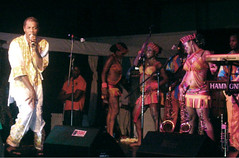
    The Horn of African nation has been embroiled in chaos since the 1991 ouster of Mohamed Siad Barre, the president, and the subsequent US invasion in 1992.

    Official says top Al Qaeda leader in Somalia killed

    The weak transitional government of Somalia claimed Tuesday that its forces killed Amar Ibrahim, a leader of Al Qaeda in Somalia and the Islamist group Al Shabab.

    By Scott Baldauf Staff writer
    posted February 10, 2010 at 10:23 am EST
    Johannesburg, South Africa —

    Somali government forces have killed Al Qaeda’s top commander in Somalia, a government spokesman said. The killing comes as the government is receiving newly trained Somali soldiers – fresh from boot camps in Ethiopia, Djibouti, Kenya, and Uganda – who have already begun the first forays of a major offensive to push Islamist rebels out of their strongholds in Mogadishu and southern Somalia.

    Somali National Security Minister Abbdullahi Mohamad Ali told the BBC that government forces had killed a top Al Qaeda commander but declined to provide the man’s name. Somali state radio had earlier reported that the victim was Amar Ibrahim, a Jordanian national and member both of Al Qaeda and of the Somali Islamist group Al Shabab. The radio station, however, said Mr. Ibrahim was killed by his own bodyguards, not Somali troops.

    Whatever the circumstances, this would be the second senior Al Qaeda commander to be killed in six months. US and Somali officials say that Mr. Ibrahim had replaced Kenyan-born Saleh Ali Saleh Nabhan, the man blamed for attacks on a Mombasa hotel and an Israeli airliner in 2002, after US Navy Seals killed Mr. Nabhan in a helicopter raid last September.

    Most experts agree that foreigners still make up a tiny minority of Al Shabab’s forces – perhaps 200 from Pakistan, India, Yemen, Afghanistan, Lebanon, South Africa, and even a few white Muslims from the US. One regional analyst in Nairobi calls them a “force multiplier.” Some Somali military officials says the skills these foreigners brought with them pushed them quickly to the top of Al Shabab’s command structure – with Afghans teaching Somalis how to assemble and use suicide bombs, for instance.

    Now some Somalis say that the foreigners – and particularly members of Al Qaeda — are in charge of Al Shabab. Shabab’s current leader is Fazul Mohamad, who comes from the Comoros Islands off of the east coast of Africa.

    National Security Minister Ali told the BBC that the government would “provide evidence later” about who was killed. Some caution is warranted. Previous attacks by both US commandos and by Somali forces have initially been reported as successful raids on Al Shabab or Al Qaeda fighters, only to be corrected later as having resulted only in the deaths of Somali civilians.

    Al Shabab has not made a comment about Ibrahim’s death.

    Under Obama, more targeted killings than captures in counterterrorism efforts

    By Karen DeYoung and Joby Warrick
    Washington Post Staff Writer
    Sunday, February 14, 2010; A01

    When a window of opportunity opened to strike the leader of al-Qaeda in East Africa last September, U.S. Special Operations forces prepared several options. They could obliterate his vehicle with an airstrike as he drove through southern Somalia. Or they could fire from helicopters that could land at the scene to confirm the kill. Or they could try to take him alive.

    The White House authorized the second option. On the morning of Sept. 14, helicopters flying from a U.S. ship off the Somali coast blew up a car carrying Saleh Ali Nabhan. While several hovered overhead, one set down long enough for troops to scoop up enough of the remains for DNA verification. Moments later, the helicopters were headed back to the ship.

    The strike was considered a major success, according to senior administration and military officials who spoke on the condition of anonymity to discuss the classified operation and other sensitive matters. But the opportunity to interrogate one of the most wanted U.S. terrorism targets was gone forever.

    The Nabhan decision was one of a number of similar choices the administration has faced over the past year as President Obama has escalated U.S. attacks on the leadership of al-Qaeda and its allies around the globe. The result has been dozens of targeted killings and no reports of high-value detentions.

    Although senior administration officials say that no policy determination has been made to emphasize kills over captures, several factors appear to have tipped the balance in that direction.

    The Obama administration has authorized such attacks more frequently than the George W. Bush administration did in its final years, including in countries where U.S. ground operations are officially unwelcome or especially dangerous. Improvements in electronic surveillance and precision targeting have made killing from a distance much more of a sure thing. At the same time, options for where to keep U.S. captives have dwindled.
    Republican critics, already scornful of limits placed on interrogation of the suspect in the Christmas Day bombing attempt, charge that the administration has been too reluctant to risk an international incident or a domestic lawsuit to capture senior terrorism figures alive and imprison them.

    “Over a year after taking office, the administration has still failed to answer the hard questions about what to do if we have the opportunity to capture and detain a terrorist overseas, which has made our terror-fighters reluctant to capture and left our allies confused,” Sen. Christopher S. Bond (Mo.), the ranking Republican on the Senate Select Committee on Intelligence, said Friday. “If given a choice between killing or capturing, we would probably kill.”

    Some military and intelligence officials, citing what they see as a new bias toward kills, questioned whether valuable intelligence is being lost in the process. “We wanted to take a prisoner,” a senior military officer said of the Nabhan operation. “It was not a decision that we made.”

    Even during the Bush administration, “there was an inclination to ‘just shoot the bastard,’ ” said a former intelligence official briefed on current operations. “But now there’s an even greater proclivity for doing it that way. . . . We need to have the capability to snatch when the situation calls for it.”

    Lack of detention policy

    One problem identified by those within and outside the government is the question of where to take captives apprehended outside established war zones and cooperating countries. “We’ve been trying to decide this for over a year,” the senior military officer said. “When you don’t have a detention policy or a set of facilities,” he said, operational decisions become more difficult.

    The administration has pledged to close the military prison at Guantanamo Bay, Cuba; Congress has resisted moving any of the about 190 detainees remaining there, let alone terrorism suspects who have been recently captured, to this country. All of the CIA’s former “black site” prisons have been shut down, and a U.S. official involved in operations planning confirmed that the agency has no terrorism suspects in its custody. Although the CIA retains the right to briefly retain terrorism suspects, any detainees would be quickly transferred to a military prison or an allied government with jurisdiction over the case, the official said.

    Military officials emphasized that terrorism suspects continue to be captured in Iraq and Afghanistan. But in Iraq, where counterterrorism operations must be approved in advance by its government and conducted with Iraqi forces in the lead, all prisoners must be turned over to Baghdad.

    In Afghanistan, the massive U.S.-run prison at the Bagram air base is scheduled to be relinquished to the Afghan government by the end of the year. Its 750 prisoners include about 30 foreigners, some of them captured in other countries and brought there. But recent legal decisions, and Afghan government restrictions, have largely eliminated that option.

    “In some cases,” the senior military official said, captives in Afghanistan have been taken to “other facilities” maintained by Special Operations forces. Such detentions, even on a temporary basis, have become more difficult because of legal and human rights concerns, he said.

    Cooperation overseas

    Outside the established war zones, senior administration and military officials said, how an operation is conducted and whether its goal is killing or capturing depend on where it is taking place and which U.S. agency is involved. American personnel have worked closely on counterterrorism missions with local forces in Indonesia, the Philippines and elsewhere, with those countries in the lead.

    Al-Qaeda and Taliban havens in Pakistan’s Federally Administered Tribal Areas along the border are considered part of the Afghanistan war theater. The Pakistani government tacitly permits CIA-operated unmanned aircraft to target terrorist sites and militants up to 50 miles inside the country. Under an executive order first signed by Bush and continued in force under Obama, the CIA does not have to seek higher administration authority before striking.

    But while U.S. Special Forces work closely with the CIA on the Afghan side of the border, any ground operation in Pakistan would require specific White House approval, which so far has not been granted. In addition to the difficulty such a mission would pose amid a hostile population in rugged terrain, the Pakistani government has drawn a red line against allowing U.S. boots on the ground, and the risk of sparking an anti-American backlash is seen as too great.

    Beyond Afghanistan, Pakistan and Iraq, potentially lethal operations must be approved by Obama or his designee, which can include the CIA director and the defense secretary. In Yemen, stepped-up military and intelligence cooperation with the country’s government, including the use of U.S. aircraft and munitions for raids against a list of targets suspected of involvement with terrorist groups, was approved by Obama late last year, and at least two lethal attacks have taken place in coordination with Yemeni ground forces. Any captives belong to Yemen.

    The Somalia calculus

    Somalia poses unique problems. In the vast majority of the country, there is no functioning government to approve or coordinate operations, or to take custody of captives. Under the Bush administration, the military conducted several White House-approved air operations against alleged senior terrorist figures fleeing south after the 2006 U.S.-backed ouster of the Islamic government there. But while military teams made quick forays over the border to the targeted sites, finding and identifying bodies proved difficult.

    Nabhan, a 30-year-old Kenyan, had long been a prime U.S. target. A senior official in the al-Shabab militia fighting to overthrow the U.S.-supported transition government in Somalia and impose strict Islamic law, he was said to be the chief link between the main al-Qaeda organization and its East African allies. Wanted by the FBI in connection with the 1998 attacks on U.S. embassies in Kenya and Tanzania, he was also accused in the 2002 bombing of an Israeli-owned resort in Kenya and an attempt to shoot down an Israeli airliner that year.

    After tracking him for a while, the Special Operations Command thought it had established a sufficient pattern of activity to target him and had the time to plan for it. Several alternatives, including capture, were developed and assessed under military procedures for missions outside recognized war theaters.

    Planners were asked for more details on the proposed force to be used, intelligence proving the target’s location and the level of verification, and operational details — including, in the case of capture, where Nabhan would be taken. Planned under U.S. Central Command, the operation was turned over to the U.S. Africa Command for implementation.

    On the political side, the National Security Council received detailed versions of each proposed course of action. At that level, the senior administration official said, “there is an evaluation making sure you are able to prosecute the mission successfully . . . and minimize the dangers and risks.”

    The Somalia calculus, several officials said, included weighing the likelihood that U.S. troops on the ground for any amount of time in the militia-controlled south would be particularly vulnerable to attack. Looming large, they said, was the memory of the last time a U.S. combat helicopter was on the ground in lawless Somalia, the 1993 Black Hawk debacle that resulted in the deaths of 18 soldiers.

    “There are certain upsides and certain downsides to certain paths,” the administration official said. “The safety and security of U.S. military personnel is always something the president keeps at the highest level of his calculus.”

  • Femi Kuti Celebrates Grammy Nomination in Lagos

    Sax and satire

    By Akintayo ABodunrin
    Nigeria Next
    February 13, 2010 05:46PM

    An enjoyable performance was what Femi Kuti treated fans to at the show to celebrate his Grammy nomination held at Tribeca, Victoria Island, Lagos, on Friday, February 5.

    The show titled ‘Let’s Celebrate with Femi Kuti’ lived up to the hype by promoters who had played up the fact that it was the first solo performance by the Afrobeat heir outside the New Afrika Shrine in four years.

    In the classic Afrobeat tradition pioneered by his legendary father, Femi’s concert was a mixture of music and ‘yabis’ (scathing social commentary). Nothing escaped the irreverent attention of the singer and instrumentalist who never mentioned the fact that he lost the Grammy prize to Bela Fleck at the Award ceremony held at Staples Centre, Los Angeles, on January 31. A good time was what the fun seekers comprising Nigerians and foreigners came for, and that exactly was what Femi gave them in about two hours.

    Upcoming acts including guitarists Pure and Simple; keytarist Jaiye, singer Ibiyemi and guitarist Tosin were the opening acts on the night. Pure and Simple’s self composed ‘Just Like That’ was a moving jazz number while self-styled Nigeria’s number one keytarist, Jaiye, did songs including Ras Kimono’s ‘Rhumba Style’ and Danny Wilson’s ‘Mr. Ragamuffin.’ He also did Funmi Adams ‘Nigeria’ and Snoop Dog’s ‘Sensual Seduction’ on his unique keyboard worn around the neck and shoulders like a guitar.

    Ibiyemi showed off her vocal prowess on the love song, ‘Don’t Leave Me.’ The high point of their performance was the free styling session where they all jammed together on stage.

    Femi’s Positive Force Band opened with some of Fela’s evergreen songs including ‘One Day’ and ‘Army Arrangement’ before moving to songs by the headliner. They served the audience ‘Traitors of Africa’ and ‘What Will Tomorrow Bring’ until around 12.30am when their leader came on stage, to applause from the audience.

    Political songs

    A true son of his father, Femi started with the political song, ‘Truth Don Die.’ He displayed his skills on the keyboard and saxophone doing the number. Though visibly aging, the musician showed he has powerful lungs by the way he sustained his breath blowing the sax. “Ararara,” he called out to the audience. “Arororo,” regular visitors to the Afrika Shrine who knew the correct response to Femi’s unique mode of acknowledgement answered. “It’s good to be here with you tonight on the Island all the way from Agidingbin, Ikeja,” he began.

    The artist, though, couldn’t resist throwing a barb at the audience he perceived as elitist. “Some of you are afraid and so won’t come to the Shrine to see what we are doing” he noted in jest. He touched on the lack of security in Nigeria, mentioning some of the dangers to peoples’ lives – including generator fumes and poor infrastructure. The leadership crisis and prevalent dishonesty among technicians didn’t escape his attention. “We have brains gan o (We are very brilliant) because leaders of this country have made us crooked,” he added for emphasis.

    Femi and his three female dancers kept up the energetic display with his popular number, ‘Wonder Wonder’ and the risqué ‘Bang Bang Bang.’ He couldn’t resist being salacious as he slowed down the tempo to offer some advice. “I got my degree in 1994 when I got a professorship in Sexology. If you don’t know how to do it, the girl will be controlling you. You need to know what to do when you are with a woman o,” he joked.

    He went political again with ‘Sotan’ (2004) condemning the state of affairs in the country. “Obasanjo ‘spoil’ Nigeria. My father told us about Obasanjo but we went in the rain to vote him in,” he began his critique of the former president,. “He told us he didn’t know Yar ‘Adua was ill, it was a ploy to remain in power,” said Femi in reference to Obasanjo’s widely reported denial of Umaru Yar’Adua’s ill health. He also decried the impoverishment of Nigerians and railed against Federal legislators. “Instead of fighting for us, they were fighting for allowance. They wanted to do gain-gain (enjoying benefits).”

    Caustic tongue

    Nobody escaped the musician’s tongue. He had something for his sister, Yeni, who brought him a list of artists in the house. “This your isepe (unclear) writing gan,” he said obviously because he couldn’t see the writing well. Femi however commended D’Banj, Ikechukwu, Asa and others at the show for always obliging him and his siblings during the annual ‘Felabration’ in honour of their father. Rumours of lingering rivalry between Femi and his younger brother, Seun, were doused somewhat, Seun was in attendance.

    “Your N10, 000 finished 30 minutes ago,” began Femi around 2am as he prepared to leave the stage. “The gate fee at the Shrine is N500. Come to New Afrika Shrine, come and see what is happening.” He, however, bowed to popular wish and returned to the stage for some minutes more before his final exit.

  • Jonathan’s Installation Now Backed By Nigerian Law

    Sunday, February 14, 2010

    Jonathan’s Installation Now Backed By Law

    From Alifa Daniel (Asst. Political Editor, Abuja)
    Nigeria Guardian

    ACTING President Goodluck Jonathan has had his elevation backed by “a force of law.”

    This is sequel to a letter that was sent to the Secretary to the Government of the Federation (SGF), Alhaji Mahmud Yayale Ahmed, from the National Assembly.

    The Assembly exalted Vice President Jonathan to Acting President and Commander-in-Chief of the Armed Forces of the Federation on Tuesday.

    The contents of the National Assembly letter were expected to be conveyed to the Chief Justice of Nigeria, Justice Ignatius Katsina-Alu, the Executive Council of the Federation (EXCOF) and the Acting President.

    The letter, which a legislative source said is tantamount to a law being passed by the National Assembly, is referenced NASS/C5/R/05/III/92 and dated February 10, 2010.

    It came from the Clerk of the National Assembly (CAN), Mr. Yemi Ogunyomi, to the Secretary to the Government of the Federation.

    Titled, ‘State Of The Nation And The Way Forward – National Assembly Resolutions, Of 9th, February, 2010’, it reads in full:

    “On Tuesday 9 February, 2010, the Senate and House of Representatives adopted Resolutions on the State of the Nation occasioned by the prolonged medical holidays of the President, Commander-in-Chief of the Armed Forces, His Excellency, Alhaji Umaru Yar’Adua in the Kingdom of Saudi Arabia.

    “Members of the National Assembly noted that Nigerians fervently prayed for the speedy recovery of Mr. President and his early return to Nigeria.

    “However, on 12 January 2010, Mr. President informed Nigerians through the British Broadcasting Corporation (BBC), that he was receiving medical treatment in Saudi Arabia, and would only return to Nigeria to resume his functions as President when his doctors so certify.

    “Satisfied that this declaration by Mr. President amounts to substantial compliance with the provision of Section 145 of the Constitution of Nigeria 1999, the National Assembly resolved that:

    (i) the Vice President, His Excellency Dr. Goodluck Ebele Jonathan, shall henceforth discharge the functions of the Office of the President, Commander-in-Chief of the Armed Forces of the Federation as Acting President; and

    (ii) the Vice President shall cease to discharge the functions of the Office of the President when the President, Commander-in Chief of the Armed Forces of the Federation, transmits to the President of the Senate and the Speaker of the House of Representatives in writing, that he has returned from his medical vacation.

    “Kindly convey these National Assembly Resolutions to His Excellency, Dr. Goodluck Ebele Jonathan, the Chief Justice of the Federation for his information, and Members of the Federal Executive Council for compliance.

    “Find attached hereto, the Votes and Proceedings of the Senate and the House of Representatives in this regard, please.

    “Accept the assurances of my highest regards for your office.”

    A knowledgeable source said last week that because the resolutions of both Houses of the National Assembly were similar, it could pass of as a law and be tendered as such.

    The source said: “Perhaps unknown to both Houses, that is the way to give a force of law to their resolutions. Pass the same resolution and it has the same force as a law.

    “But when you pass resolutions intermittently and they are not similar, the other arms of government can afford to ignore them and nothing will be done.”

    The battle to be Vice President

    By Elor Nkereuwem
    Nigeria Next
    February 14, 2010 12:23AM

    Despite the jostle for an imagined vacancy in the office of the vice-president by cronies of ailing president Umaru Yar’Adua, Acting President Goodluck Jonathan could run a one man presidency until 2011, legal experts and political insiders say.

    Highly connected sources, who spoke on conditions of anonymity, told NEXT at the weekend in Abuja that the friends of Mr. Yar’Adua, now notoriously called the ‘cabal,’ are actively seeking to insinuate a friendly party into the presidency.

    Mr. Jonathan, who only became Acting president after 78 days of obstructionist politics by the cabal, has through some obscure arrangement, been allowed a 40-day window to select a deputy from a list of Yar’Adua loyalists. The five frontrunners for this job, whenever it becomes viable, are the governor of Katsina State, Ibrahim Shema; the Secretary to the Government of the Federation, Yayale Ahmed; Aliyu Gusau, Nigeria’s former army and intelligence chief; and Sule lamido, the incumbent governor of Jigawa State, our source said.

    But while the group continues to ignore the constitutional implications of their ambitions, lawyers argue that Mr. Jonathan does not have the powers to select a vice president as no vacancy currently exists for the seat.

    According to the lawyers, while Mr. Jonathan now serves as the commander-in-chief of the Nigerian Armed Forces, there currently exists no vacancy in the vice presidency, the position Mr. Jonathan occupied until last week when a resolution by the National Assembly declared him the Acting President of the country. The lawyers said that Mr. Jonathan will continue to run the presidency without an official deputy until 2011 unless the ailing president, Umaru Yar’Adua, ceases to be president as a result of his impeachment or permanent incapacitation.

    “It is envisaged that the president is alive; it is envisaged that the President is not permanently incapable; it is envisaged that he is only temporarily incapable and so whenever he comes back, he becomes the president while Jonathan returns to the position of Vice President. So if the president does not come until the 2011 elections or whatever, there will be no Vice President, that office becomes permanently vacant,” said Bamidele Aturu, a prominent Lagos based human rights attorney.

    A senior Advocate of Nigeria, Ricky Tarfa, described the scramble by the politicians for the office of the Vice-President is ‘an act of illegality and unconstitutionality’.

    Vice-presidency for the North

    In the miasma of events leading to the political arrangement that saw Mr. Jonathan become Acting President is an obscure pact that the Acting President should pick a deputy from a myriad of names, all northern elites, in the event that the vice-president slot does become open.

    While it is not clear in what manner such a position will become vacant, politicians are frenetically pulling strings in Abuja, positioning themselves for the job.

    Mr. Yar’Adua’s friends continue to push forward names of close allies and in a bizarre move, some have even nominated the wife of the president, Turai, for the No.2 position.

    Sources say that the unconstitutionality of the selection of a vice-president is a matter which the absent president’s kitchen cabinet had not initially put into consideration.

    “There now exists a renewed challenge in the wake of the Goodluck presidency,” our sources said, adding that there is the likelihood that Mr. Jonathan may remain as the Acting President until 2011, when the next presidential elections will take place, because of circumstances beyond his control.

    Still, reluctant to lose their influence, Mr. Yar ‘Adua’s allies who have been worried that power appears to have slipped from the northern elites following the crucial memo from the National Assembly, continued their manoeuvres at the weekend, narrowing their options around Mr. Shema, the youthful governor of Katsina State and an acolyte of the ailing president.

    Mr. Shema is believed to have the backing of the northern governors who, in a desperate need for political survival, threw their considerable support behind Mr. Jonathan’s presidency, effectively negating the Yar ‘Adua presidency.

    The Shema candidacy

    All this however comes with its own complications and embarrassment. Already, an intense political warfare is raging in Katsina, home state of Mr. Yar Adua. Political insiders suspect that political fratricide is destined to consume Mr. Yar Adua’s own three political godsons of whom Mr. Shema is the most prominent at the moment. The two others are Tanimu Yakubu, the economic adviser of Mr. Yar Adua, and Abba Ruma, his agriculture minister, both of whom are also eyeing the governorship of Katsina State.

    If Mr. Shema ultimately loses it, People Democratic Party insiders told NEXT last weekend, the only reason will be because “he was marginalised these past 78 days and Tanimu and Ruma were closer to the first lady who never really wants Sherma for a second term as governor let alone something as high as the vice presidency.

    Shema too, may be a victim of the principle of elimination by prominence since his early promotion as a candidate may be a strategy destined to sideline or even damage his candidacy” said our source.

    There are other contenders however, and the name of the current secretary to the federal government, Mr. Ahmed had been promoted with the same fervour as that of Sule Lamido, the current governor of Jigawa. Both men are credited with experience and good judgement. Mr. Ahmed comes from Bauchi, which together with Jigawa shares the same zone with Katsina in the country’s geo-political zoning block.

    Constitutionality or Unconstitutionality

    Some lawyers however condemn not only the current quest for the vice presidency by the politicians but also the very resolution that has made Mr. Jonathan the Acting President.

    “Mr. Jonathan can continue as Acting President till next elections or until either President Yar’Adua comes back or until after the elections, or until a court declares his emergence unconstitutional. Because the way he was appointed is not legal, strictly speaking, it’s not constitutional. The constitution was not followed, because no letter was written. The National Assembly said the broadcast on radio is deemed to be a letter. I do not know how you can do that, but they said the doctrine of necessity is a constitutional necessity,” said Charles Musa, another human rights lawyer.

    Like Mr. Musa, the opposition Action Congress (AC), has also condemned the National Assembly resolution.

    “Our party, the AC, believes in constitutionality and the rule of law, hence our stand is not determined by what is popular but by what is legal and Constitutional,” said the National Publicity Secretary of the party, Lai Mohammed.

    The opposition against the constitutional propriety of Mr. Jonathan’s emergence is currently running askance with the popular mood. “If the opposition can just take time to read the currents well” said Hassan Ado Ibrahim, an Abuja policy analyst, “they will see that the currents are so strong that even our parliamentarians and the governors have read the trend so accurately, and have opportunistically grafted their own interest into the mix.”

    Mr. Ibrahim believes that the Jonathan presidency will ride this wave of popular will long enough to make the question of a deputy needless, adding that “no one caused this problem anymore than the Yar’ Adua people who abused the intelligence of the whole nation for so long that they whipped up so much negative sentiments against their patron and their platform.”

    He said, “from all indications the governors were genuinely angry that they got no access to the ailing president, and had no credible report on his status forcing them to switch loyalty to Mr. Jonathan” but added that they, “craftily yoked this objective grounds for outrage with their selfish desire to get someone that will sign off on the excess crude account which is their main motivation; and their selfish desire to change some of the people they had nominated to the federal cabinet.”

    Additional reporting by Idris Akinbajo and Ifedayo Adebayo