Author: Pan-African News Wire

  • Campaigning for Sudan Vote Begins

    Saturday, February 13, 2010
    18:14 Mecca time, 15:14 GMT

    Campaigning for Sudan vote begins

    Al-Bashir will be challenged by Arman who is counting on the solid support of the south

    Campaigning for Sudan’s forthcoming election has begun, with 12 presidential hopefuls set to challenge Omar al-Bashir, the current president.

    The exercise kicked off on Saturday, paving the way for the first multi-party poll since 1986. Al-Bashir seized power in 1989 in a coup in Africa’s largest country.

    After being pushed back twice, the presidential election is set to take place on April 11, alongside legislative and regional polls.

    A referendum on whether southern Sudan should become independent is expected in 2011.

    Al-Bashir, who seized power with support from conservative Muslim groups, is facing off against 11 other hopefuls.

    They include Fatima Ahmed Abdelmahmud, the first woman ever to aspire to the presidency, and Sadiq al-Mahdi, the two-time former prime minister whom al-Bashir ousted.

    Al-Bashir is the world’s first sitting president facing an international arrest warrant from the International Criminal Court (ICC) on charges of alleged crimes against humanity in Sudan’s western Darfur region.

    Costly conflict

    The UN says up to 300,000 people have died and 2.7 million fled their homes since the ethnic minority rebels in Darfur first rose up against the Arab-dominated Khartoum government in February 2003.

    But the Sudanese government disputes the death toll, saying around 10,000 people have died.

    Al-Bashir’s main challengers are Yasser Arman, a secular Muslim from north Sudan representing the former rebel Sudan People’s Liberation Movement, and al-Mahdi, the former prime minister from the influential Umma Party.

    Arman, 49, is counting on the solid support of south Sudan, while the 74-year-old Mahdi’s main support base is in the north.

    But in a country without opinion polls and which has not held real elections in decades, the outcome of the polls is wide open.

    Rallies banned

    The opposition fear al-Bashir will use the levers of power, including the security forces, to win the vote.

    Rallies have been banned, but the opposition plans to test the waters during campaigning to try and stage one in Omdurman, the twin city of Khartoum, Sudan’s capital.

    Sudan has emerged from a devastating 22-year civil war that pitted the dominant Muslim and Arab northern Sudanese against the largely non-Muslim, non-Arab southerners.

    A comprehensive peace agreement was signed with the south in 2005, ending the conflict.

    But the most basic services are lacking in much of the remote and underdeveloped regions of Sudan, which has 41 million people.

    Source: Agencies

  • Malcolm X Deserves a Michigan Monument

    February 8, 2010

    JEFF GERRITT
    Detroit Free Press

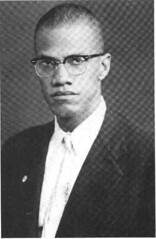
    A Michigan man, Malcolm X deserves a Michigan monument

    Brought up in Lansing and nicknamed Detroit Red, Malcolm X, like former President Gerald R. Ford, is a Michigan man. You wouldn’t know it, though, by driving around the state or flipping through a tourist guide. As far as I can tell, the only concrete reminder of Malcolm’s Michigan roots is an obscure homesite marker at 4705 S. Martin Luther King Jr. Boulevard in Lansing.

    Malcolm X — born Malcolm Little in Omaha, Nebraska — spent much of his youth in Lansing, where the family moved when Malcom was 4, and, later, in Detroit, the birthplace of the Nation of Islam and home to one of the first temples Malcolm attended. Still, our state has no monuments, libraries or public waysides devoted to this seminal freedom fighter, who was assassinated in New York City on Feb. 21, 1965, at the age of 39.

    It’s a shame. I believe Malcolm X to be the greatest American leader in the last century. (I’ll explain why in a print edition column this week.) As part of a Black History Month celebration, a concert Sunday night at Second Ebenezer Church in Detroit, organized by the Detroit International Jazz Festival and Bishop Edgar L. Vann II, will honor Malcolm X, King, Rosa Parks and Muhammad Ali, performing a jazz opus by Christian McBride.

    More than any leader before or since, Malcolm X reminded us how far we have to go, and continues to do so today. An advocate for the dispossessed, his message should have special relevance to Michigan, a bleeding state whose largest city virtually defines the crisis of America’s cities.

    Acknowledging his life in a concrete way would encourage others to carry on his work, and that’s the best way to honor this fearless and uncompromising freedom fighter. It’s time the state created a monument to Malcolm, a Michigan man who changed the nation, and the world.

  • US/NATO Launches Major Offensive Against the Afghanistan People

    Nato launches major Afghanistan offensive

    GOLNAR MOTEVALLI | MARJAH, AFGHANISTAN – Feb 13 2010 07:28

    US-led Nato troops launched an offensive on Saturday against the Taliban’s last big stronghold in Afghanistan’s most violent province and were quickly thrown into a firefight with the militants.

    The assault is the first since President Barack Obama ordered a “surge” of extra troops to Afghanistan in December and the start of a campaign to impose government control on rebel-held areas this year, before US forces start to withdraw in 2011.

    Within hours of the operation getting under way, US marines at the tip of the assault battled with Taliban militants in the town of Marjah, the last big militant bastion in Afghanistan’s violent Helmand Province.

    Reuters reporter Golnar Motevalli saw marines engaging in a firefight with Taliban fighters after the US troops landed in helicopters near the city.

    Marines fired at least four rockets at militants who attacked from compounds. At least one marine was wounded by shrapnel.

    “They are about 300m away,” Motevalli said as the sound of assault rifles crackled in the background. Moments earlier, two large explosions resounded and a large black plume of smoke rose into the sky.

    The offensive began with waves of helicopters ferrying marines into the city in the early morning hours. British troops then flew into the northern part of the surrounding Nad Ali district, followed by tanks and combat engineering units.

    The first objective of marines was to take over the town centre, a large cluster of dwellings, despite the risk of being blown up by bombs rigged by the Taliban.

    Gunfire, explosions

    Bursts of gunfire rattled through the area as servicemen anticipated their first contact with the militants.

    By mid-morning, a couple of large explosions boomed, with a big plume of black smoke rising skywards. One was apparently an improvised rocket with plastic explosives designed to set off roadside bombs.

    The 15 000-troop operation may have been named Mushtarak, or together, to highlight that Nato and Afghan forces were determined to work closely to bring stability to Afghanistan, a country often brought to its knees by one war after another.

    Decades ago the Marjah area was home to an Afghan-American development project. Its canals, which criss-cross lush farmland, were built by the Americans.

    Now Nato is trying to recapture it from a militant group that is highly unlikely to contemplate cooperation with the West.

    “Insurgents who do not accept the government’s offer to reintegrate and join the political process will be met with overwhelming force,” the joint Nato-Afghan coalition said in a statement announcing the start of clearing operations.

    A local Taliban commander, Qari Fazluddin, told Reuters earlier about 2 000 fighters were ready to fight in the densely-populated area.

    The safety of civilians may be the vital issue for Nato in one of the eight-year-old war’s biggest offensives against the Taliban, which have re-emerged as a powerful fighting force since they were toppled by a US-led invasion in 2001.

    Any heavy civilian casualties would make it even more difficult for the American-backed Afghan government to win support in towns that have been held by Taliban insurgents.

    Nato forces have decided to advise civilians not to leave their homes, although they have said they do not know whether the assault will lead to heavy fighting.

    ‘Just my house’

    Most residents of the area, estimated at up to 100 000, have stayed put. But others have headed 30km east to the provincial capital of Lashkar Gah. “All the walls between the streets and houses are surrounded by bombs. Most people have gone to Lashkar Gah. That’s where we want to go today,” resident Abdel Aziz (16) told the marines through a translator.

    Soon after, an old woman emerged from her house and asked the troops not to fire at it.

    “This is just my house,” she told the marines.

    Unlike previous military operations, the assault on Marjah has been widely flagged for months. Commanders say they hope this will persuade many fighters to lay down their arms or flee.

    Residents have been afraid to leave their homes in fear of roadside bombs planted by the Taliban to slow the US advance.

    Marjah has been a breeding ground for both insurgents and opium poppy cultivation for years. Much may depend on whether the state can ensure long-term political and economic stability to erase the conditions that have encouraged militancy. – AFP

    Source: Mail & Guardian Online
    Web Address: http://www.mg.co.za/article/2010-02-13-nato-launches-major-afghanistan-offensive

    Saturday, February 13, 2010
    20:22 Mecca time, 17:22 GMT

    Nato launches major Afghan assault

    The assault is the largest undertaken since Obama ordered extra US troops to Afghanistan

    US-led Nato troops have launched a long-expected attack on the biggest Taliban-held town in the south of Afghanistan.

    Helicopter-borne US marines and Afghan troops backed by British forces swept into Taliban-held town of Marjah, in the centre of Helmand province, early on Saturday.

    Thousands of US and Afghan troops are taking part in the offensive, which seeks to undermine support for the Taliban and re-establish government control in the area.

    The offensive, known as Operation Moshtarak, the Dari word for “together”, is the biggest joint Afghan-international offensive of the war.

    It is the largest combat operation since Barack Obama, the US president, ordered 30,000 US reinforcements to Afghanistan last December.

    Danish, Estonian and Canadian troops are also involved in the campaign.

    Several casualties

    Soon after the offensive began, five Taliban fighters were reported killed.

    And by the first day’s end, one service member of the International Security Assistance Force (Isaf) had died in a bomb attack while another was killed by gunfire, according to a spokesman for the Nato-led multinational force.

    Nato declined to give their nationalities.

    Separately, the UK defence ministry announced the death of one British soldier from the 1st Battalion Grenadier Guards in an explosion while on vehicle patrol in Nad-e-Ali district of Helmand.

    Elsewhere in southern Afghanistan, a suicide bomber detonated an explosive device on a motorbike near US and Afghan troops on a joint foot patrol in Kandahar province on Saturday.

    A police commander told Al Jazeera that two children were killed and that US forces also suffered casualties in the attack, which took place in Arghandab district, northwest of Kandahar city.

    Fight for Marjah

    Marine commanders say they expect anywhere between 400 to 1,000 fighters to be holed up inside Marjah, a town of 80,000 people, including more than 100 foreign fighters.

    But Taliban sources have insisted the number is closer to 2,000.

    Qari Yousef, a Taliban spokesman in the south, told Al Jazeera that foreign forces had been bombarding the area around Marjah for days and that the operation had in fact begun on February 7.

    He also warned that the Taliban would offer stiff resistance.

    “Our decision is that there will definitely be resistance because foreign invaders have come to invade our country,” he said.

    “If they need 15,000 troops to take over a small village – what will they need to take over a province which is under the Taliban’s hands,” he told Al Jazeera.

    Al Jazeera’s Zeina Khodr reporting from Kabul, the capital, said: “We’ve been talking to the Taliban over recent days and they are making clear that they will defend the territory and fight till death.”

    “Foreign troops want to also send a clear message that the Afghan government will re-establish government presence in Marjah and separate the town from the Taliban to improve people’s lives, open roads and government institutions, which is all part of the new Obama strategy being employed in the region,” she said.

    “It’s not all military tactics because Marjah is really strategic, it’s at the doorstep of Lashkar-Gah, the provincial capital of Helmand and if you open those roads you can improve economic development for the people, but they are worried, mostly about civilian casualties.”

    ‘Clearing’ operation

    Isaf termed the offensive a “clearing” operation to be followed by “smaller-scaled ‘shaping’ operations”.

    Mohammad Gulab Mangal, the governor of Helmand, said earlier this week that local authorities were poised to move in behind the military operation to set up civil services, including police and security.

    But Gilles Dorronsoro, a scholar at the Carnegie Endowment for International Peace, said the plan’s key weakness was that it failed to include a long-term plan to prevent the Taliban from returning to the area.

    “The Afghan state is just a network of warlords [and] opium dealers – to think that these people are going to take Marjah and build a solid state there, I don’t think so,” he told Al Jazeera.

    Marjah is at the heart of Afghanistan’s opium production. Fighters there have exploited an irrigation system built in the 1950s with US aid aimed at turning the central Helmand River valley into Afghanistan’s bread basket.

    Janan Mosazai, an political analyst in Kabul, told Al Jazeera that while a military win in the area seemed assured, it would be the second stage of the operation that would be crucial.

    “The test to this new approach … will come when the operation is over – when the military stage is over – when there is a requirement for Afghan civilian authorities and for reconstruction specialists to move into Marjah and … give the people of this area the confidence that this time it’s different,” he said.

    “[They must show] that there will be a cleaner, more efficient, less corrupt government put into place and that there will be a police force that is not corrupt and doesn’t scavenge on the local population … [and] that this will be a fundamental, long-term change.”

    Exodus of civilians

    Isaf and the Afghan government have stressed that they hope civilian casualties will be avoided, publicising their operation in advance.

    Hundreds of civilians fled the area, but many have stayed.

    Jamil Karzai, the head of the Afghan government’s commission for national security, and a relative of the Afghan president, said that publicising the operation so heavily in advance had given away military advantage.

    “They are just coming to the media and talking to the media and letting their enemies know there is a big operation against them … everyone out in the country knows about this operation and of course the Taliban and al-Qaeda left the area,” he told Al Jazeera.

    He said that long-term success would only come from having Afghan forces playing a lead role in any assault.

    “Our Afghan forces understand the ground realities, they understand the region, they understand how to fight al-Qaeda and [the] Taliban. When our army or our police are supported from international forces – by American forces – when they are on the ground … we will win,” he said.

    “If international forces are ahead, on the frontline, and our national forces are are in the backstage, we will never win this war.”

    Source: Al Jazeera and agencies

  • Ivory Coast Opposition Groups Challenge President Gbagbo’s Rule

    Ivory Coast opposition challenges president’s rule

    Saturday, February 13 06:36 pm
    Reuters Tim Cocks and Ange Aboa

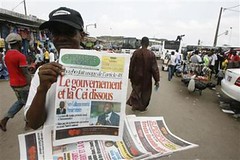
    Ivory Coast’s main opposition groups said they no longer recognised Laurent Gbagbo as president of the country on Saturday after he dissolved the government and electoral commission.

    The top cocoa grower’s leading opposition parties, who accused Gbagbo of staging a coup with the decision, said supporters should reject the president and called on the security forces to “conform scrupulously with their republican mission.”

    They did not elaborate on that call, and no clarification was immediately available. Police units tear-gassed about 100 opposition supporters trying to gather in the streets of Abidjan, Ivory Coast’s main city, shortly after the statement.

    Gbagbo dissolved the government and election body on Friday in a row over the preparation of voter lists ahead of long-delayed polls meant to end the nation’s political crisis.

    “In consequence of this announcement, the (opposition coalition) RHDP proclaims that we no longer recognise Mr Laurent Gbagbo as the head of state of Ivory Coast,” said a statement read out by opposition leader Alphonse Djedje Mady.

    The parties of Henri Konan Bedie and Alassane Ouattara, Gbagbo’s leading challengers, signed off on the statement.

    “(We) will not recognise the new election commission, nor the new government,” the opposition parties added.

    The elections are needed to end years of instability and stalemate after a 2002-2003 war that divided the country, leaving rebels running the north hands despite various peace deals. Gbagbo has a firm grip on soldiers in the south

    Gbagbo’s announcement on Friday night is certain to delay the vote, which is already more than four years overdue and central to reforms aimed at helping the ailing cocoa sector.

    SCARED RESIDENTS

    Abidjan residents had rushed indoors after work on Friday, anticipating trouble. The normally bustling streets and palm-fringed outdoor bars were largely deserted overnight.

    Traffic resumed on Saturday, but the atmosphere was tense. The leader of Bedie’s youth wing earlier on Saturday called for Ivorians to take to the streets and burn tyres, stoking fears among residents of more turmoil.

    “I’m really scared,” said Arsene Yao, 30, a mechanic.

    “There’s going to be more violence and everything’s going to burn. I can’t imagine what the president was thinking.”

    Nothing in a peace agreement signed in 2007 gives Gbagbo the authority to dissolve the electoral commission, which is independent of all the warring factions. In his address, he invoked an article of the constitution to justify it.

    Prime Minister Guillaume Soro must pick a new government on Monday but the process of choosing an electoral commission boss could be long and drawn out, as all parties to the conflict are supposed to agree on the appointment.

    After years of delays, many Ivorians have grown cynical about their leaders and their talk of elections.

    “If they were going to have elections, they’d have had them already,” said Rosie N’Goran, 28, who sells fruit by the roadside despite her college degree.

    “I no longer trust any of them at all,” she said.

    Frustration is growing after more than seven years of crisis in a country that was once the envy of its neighbours, prospering while many of them stagnated or went to war.

    Nationwide power cuts because of damage to a turbine have worsened the mood. Rioters burnt down a government building in the rebel-held west on Tuesday over the handling of the polls.

    (Additional reporting by Loucoumane Coulibaly; Writing by David Lewis; Editing by Mark Trevelyan)

  • South African President Jacob Zuma Hails Former Leader Nelson Mandela’s Legacy

    Zuma hails Mandela’s legacy

    AFP

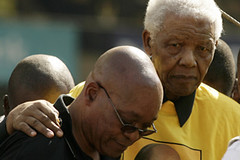
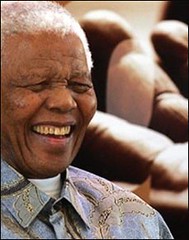
    CAPE TOWN. President Jacob Zuma hailed Nelson Mandela’s legacy of a non-racial, unified South Africa in a state address that celebrated the 20th anniversary of his release from prison.

    The 91-year-old icon made a rare public appearance at the opening of parliament where Zuma pledged to boost South Africa’s economic recovery as the country readies to host Africa’s first football World Cup.

    “As we celebrate Madiba’s release today, let us recommit ourselves to building a better future for all South Africans, black and white,” said Zuma, using Mandela’s clan name.

    “President Mandela was central in assisting the country to win the rights to host this great event.

    ‘‘We therefore have to make the World Cup a huge success in his honour.”

    Zuma joined South Africans and world leaders who heaped praise on Mandela on Thursday as the country celebrated his release from 27 years of imprisonment on February 11, 1990 — an event which signalled the end of apartheid.

    “Let us pursue the ideal for which Madiba has fought his entire life — the ideal of a democratic and free society, in which all persons live together in harmony and with equal opportunities,” said Zuma.

    He acknowledged that his government “must work faster, harder and smarter”. As South Africa prepares for the World Cup kick-off in June, Zuma said the economy was now creating work after shedding 900 000 jobs last year.

    “Economic indicators suggest that we are now turning the corner. Economic acitivity is rising in South Africa, and we expect growth going foward.

    “It is too soon, though, to be certain of the pace of recovery,” he said.

    “Now is the time to lay the groundwork for stronger growth going foward, and for growth that gives rise to more jobs. “This year, 2010, shall be a year of action,” he said.

    State support measures to mitigate the economic fallout will not be withdrawn, with 846 billion to be spent on public infrastructure over the next three years, he said.

    In the wake of crippling electricity price hikes and power shortages, Zuma said the government will establish a new independent system operator, that will buy power from independent power producers and the ailing state utility Eskom.

    A new measure will also see a one billion rand government-backed fund to broaden access to housing finance, with additional plans to also set aside 6 000 hectares of state land for low income and affordable housing.

    Amid renewed violent protests over poor service delivery, Zuma said the government aimed to provide proper service and land tenure to half a million households by 2014.

    Vowing to beef up government service, Zuma said his ministers will sign delivery agreements and tackle violence, which averages 50 murders a day, and increase the police force.

  • Rebels, Government Troops Clash in Somalia

    Rebels, govt troops clash

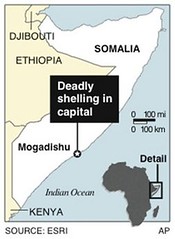
    MOGADISHU. Somalia’s Shebab-led rebels rallied support after yesterday’s prayers and vowed all-out war as the conflict-riven country braced for a huge nationwide government offensive to crush insurgents.

    As residents poured out of the capital in recent days, Islamist fighters poured in to face off with newly-trained government forces backed by African Union troops ahead of the battle. A skirmish that broke out early yesterday when fighters from the Al Qaeda-inspired Shebab movement opened fire on government troops, drawing heavy retaliatory shelling, left five civilians dead and 20 others wounded. At the Nasreddin mosque in southern Mogadishu, Sheikh Muktar Robow Abu Mansur, a top military leader with the Shebab, said his movement was ready to face an onslaught by the Western-backed government.

    “You are aware of the recent indiscriminate shelling of the enemy against our people. This war is a religious obligation for all of us to go to and fight them,” Robow told the crowd after prayers. — AFP.

  • Zimbabwe News Update: ZANU-PF Names New Politburo

    Zanu-PF names new Politburo

    By Sydney Kawadza
    Zimbabwe Herald

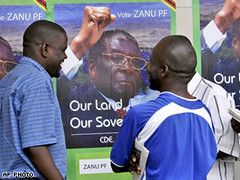
    PRESIDENT Mugabe yesterday announced a new Zanu-PF Politburo that contains a few surprises while a number of the old guard have been retained in an expanded organ with more committee members.

    Opening an extraordinary session of the Central Committee at Zanu-PF Headquarters in Harare yesterday, the First Secretary and President of the party said the Presidium had given due regard to the state of the party and challenges it was facing in coming up with the Politburo.

    Former committee member Cde Webster Shamu is now secretary for the commissariat.

    He has the onerous task of mobilising and reinvigorating party structures.

    Cde Shamu will be deputised by former deputy party spokesperson Cde Ephraim Masawi.

    Former deputy secretary for administration Cde Rugare Gumbo takes over the information and publicity department from Cde Nathan Shamuyarira and he will be deputised by Cde Cain Mathema.

    Cde Mathema is a career journalist and author.

    Cde Shamuyarira becomes a committee member.

    Cde Dzikamai Mavhaire rose to take over the department of production and labour, while Cde Obert Mpofu and Cde David Parirenyatwa were appointed to head the economic affairs and health and child welfare departments, respectively.

    Former deputy secretary for youth affairs Cde Saviour Kasukuwere takes over the indigenisation and economic empowerment portfolio that was left vacant following national hero Cde Vitalis Zvinavashe’s death last year.

    Cde Abigail Damasane heads the gender and culture department.

    Cde Sithembiso Nyoni and Cde Francis Nhema have been appointed to the new portfolios of business development and liaison, and environment and tourism respectively.

    Members who retained their positions are Cde Didymus Mutasa (administration), Cde David Karimanzira (finance), Cde Emmerson Mnangagwa (legal affairs), Cde Oppah Muchinguri (women’s affairs), Cde Absolom Sikhosana (youth affairs), Cde Ignatius Chombo (land reform and resettlement), Cde Stanley Sakupwanya (welfare of the disabled and disadvantaged persons) and Cde Olivia Muchena (science and technology).

    Some Politburo members that have moved portfolios are Cde Sydney Sekeramayi (national security); Cde Stan Mudenge (external relations) and Cde Nicholas Goche (transport and welfare).

    New and returning Politburo members include Cde Edson Ncube (deputy secretary for administration), Cde Charles Tawengwa (deputy, finance); Cde Abednico Ncube (deputy, external relations); Cde Samuel Mugande (deputy, transport and welfare); Cde Patrick Chinamasa (deputy, legal affairs); Cde Richard Ndlovu (deputy, production and labour), Cde Eunice Sandi-Moyo (deputy, women’s affairs); Cde Eddison Chakanyuka (deputy, youth affairs) and Cde Lazarus Dokora (deputy, education).

    Cde Kudakwashe Bhasikiti (deputy, economic affairs); Cde Douglas Mombeshora (deputy, health and child welfare), Cde Tendai Savanhu (deputy, indigenisation and economic empowerment); Cde S. Mukusha (deputy, gender and culture); Cde Herbert Murerwa (deputy, land and resettlement), Cde Joshua Malinga (deputy, disabled and disadvantaged persons), Cde Patrick Zhuwao (deputy, science and technology), Cde James Gumpo (deputy, business development and liaison) and Cde Nelson Mawema (deputy, environment and tourism).

    Committee members include Cdes Solomon Mujuru, Tsitsi Muzenda, Victoria Chitepo, Kumbirai Kangai, A. Chimbudzi, Nathan Shamuyarira, Naison Ndlovu, Thokozile Mathuthu, Angeline Masuku, Khantibai Patel, Tshinga Dube, Munacho Mutezo, Cephas Msipa, Josiah Hungwe, Jacob Mudenda, Flora Bhuka, Cliveria Chizema, Edna Madzongwe and O. Maluleke.

    President Mugabe said the new Politburo had to tackle a number of issues.

    “We have to re-organise all our people so they remain in a state of permanent readiness. We have the constitution-making process, which is already underway.

    “There are crucial issues to be decided through that process. Persistent attempts by outsiders at influencing matters being handled under the constitution-making process need to be warded off. What is the interest of these powerful outsiders in the writing of our constitution?”

    President Mugabe said Zanu-PF needed structures that were in touch with developments.

    “The ideological side of our party needs revamping so we are able to be a party which defines issues, debates emerging ones, indeed, one which places new matters on the national table.

    “The party needs a strong underpinning on policy issues and we shall be making further proposals.

    “We are a national party and all our people must identify with the structures we create and persons assigned to man them.

    “Once Zanu-PF is divided or any of its organs is faulted on whatever grounds, a negative message is transmitted in our nation.

    “We cannot be all leaders at one time. What is more, there are no persons who are more leaders than others in the party. What we have are persons wielding higher responsibilities for which more is expected out of them.

    “It is a call to serve, never an opportunity for flaunting imagined power. The power rests with the people and the party emerging from the organisation.

    “We have huge duties to discharge, bigger battles to fight, great wars to win. And victors do not bicker.”

    The announcement of the new political bureau was deferred at the Fifth National People’s Conference in December 2009 to allow for more consultations.

    The Presidium consists of First Secretary and President Cde Mugabe; Second Secretaries and Vice Presidents Cdes Joice Mujuru and John Nkomo; and National Chairman Cde Simon Khaya Moyo.

    GPA: Central Committee backs Politburo

    Herald Reporter

    Zanu-PF’s Central Committee yesterday endorsed a Politburo decision to stop their party’s negotiators from making any more concessions in current talks on the full implementation of the Global Political Agreement until illegal Western economic sanctions on Zimbabwe are lifted.

    Addressing the organ at Zanu-PF Headquarters in Harare yesterday, President Mugabe said MDC-T had been the biggest beneficiary of the sanctions at the expense of ordinary Zimbabweans.

    “Regrettably, we have not heard or seen as much clarity and forthrightness from the other formation, namely the MDC-T led by Prime Minister Morgan Tsvangirai.

    “Let us be very clear. When the British Foreign Secretary (David Miliband) told the world that his government would lift sanctions upon request by its partners in the MDC, he was clearly telling us that those hurtful sanctions have continued to this day, because a request to have them lifted has not yet been made by the MDC-T.

    “We also note that this is a message the British government has constantly made, namely, that it has always worked with the MDC on this matter, beginning with the drafting of the sanctions measures themselves.”

    President Mugabe said MDC-T could not run from the responsibility of calling for the removal of the sanctions.

    “There are individuals on the sanctions list.

    “Their relatives and friends have also been put on these lists. But the British do not know our relatives. So who has given them our names?

    “The MDC has benefited from the sanctions. They can travel anywhere. They are still getting funding at the expense of unity and the ordinary people.

    “Chii chinoita kuti munhu atadze kutaura kuti masanctions abviswe? Zvinorevei izvozvo? Asi zvirikuremera vamwe.

    “The Government and the country we are running together have been affected by sanctions.

    “Why can’t there be vigour and clarity to have them removed because they are hindering progress?”

    Speaking after the meeting, newly-appointed secretary for information Cde Rugare Gumbo said: “The Central Committee approved the decision to stop making concessions until other parties honour their obligations.

    “Sanctions remain the key outstanding issue in the ongoing talks and the whole process will not go anywhere until this issue is addressed.”

    Cde Gumbo said the party acknowledged progress made by the inclusive Government after a briefing from Cde Patrick Chinamasa.

    He said a major concern raised was the illegal broadcasting by pirate radio stations based in Botswana and Madagascar into Zimbabwe.

    The Central Committee, Cde Gumbo said, recommended that the issue be addressed by the Joint Monitoring and Implementation Committee to the satisfaction of GPA requirements.

    China to invest in Zim power projects

    By Reuben Madzivo

    Harare and Beijing are finalising agreements that could see Zimbabwe’s power generation capacity topping 5 000 megawatts if completed, making the country a net exporter of electricity.

    The deals will see the construction of new power generation plants as well as the expansion of existing power stattions.

    In an interview with The Herald on Thursday, Energy and Power Development Deputy Minister Hubert Nyanhongo said China had shown great interest in investing in Zimbabwe and expressed optimism that the projects would soon go through.

    Though he could not be drawn into giving figures, enquiries by this paper show the projects are potentially worth over US$1 billion.

    “China has shown great interest in investing in this power project. Three companies to be shortlisted by the Chinese government will undertake the projects.

    “I am hopeful that the project will bring the current power deficits to an end,” said Deputy Minister Nyanhongo.

    He said the first project will be the construction of two additional units with a capacity of 600MW at Hwange Thermal Power Station.

    Hwange is currently producing 700MW of electricity, about 200MW short of its full capacity.

    Kariba Hydropower Station will get two more units with a total capacity of 300MW.

    That station is presently producing 250MW.

    The Chinese have said they will construct two new hydroelectric power stations on the Condo and Batoka gorges.

    At Batoka, a dam and two hydropower stations will be built on either side of the Zambezi River with a total capacity of 1 600MW.

    The dam on the Condo Gorge will have a capacity of 150MW.

    Zimbabwe and China will partner to construct a thermal power station on a build-operate-transfer basis in Gokwe North with a total capacity of 1 400MW.

    Deputy Minister Nyanhongo said one of the projects would see the rehabilitation of the existing electricity transmission and distribution network.

    The network has suffered at the hands of vandals over the years.

    Zimbabwe presently produces 950MW of electricity from Kariba and Hwange power stations against infrastructural capacity of 1 800MW and has been relying on imports from Mozambique, South Africa and the DRC.

    The Energy Ministry has said with output of 2 200MW and at present industrial and domestic use, the country will not experience any power cuts.

    Deputy Minister Nyanhongo said: “We are currently relying on 950MW of electricity from Kariba and Hwange, but the country needs between 2 000 and 2 200MW of electricity.”

    Zim labour standards hailed

    Labour Reporter

    Zimbabwe has been rated the best country in terms of observing fair and best labour standards among African Regional Labour Administration Centre members, Labour Minister Paurina Mpariwa has said.

    In an interview yesterday after the week-long 36th session of the Arlac governing council of ministers meeting in Kariba, Minister Mpariwa — who is the Arlac chairperson, said Zimbabwe had the best record in observing workers rights in the region.

    “Zimbabwe is rated first in the region on the International Labour Organisation country decent work programme after our social partners agreed and signed a decent work declaration last year.

    “Arlac members started by presenting their labour experiences and briefs and from there it was realised that our country, despite the challenges we are facing, is a step ahead.

    “We are not far away from achieving Millennium Developmental Goals in terms of fair labour standards.

    “Some have argued that it is because we are the host of Arlac headquarters but we believe it is because of the dedication and commitment that our social partners have towards uplifting labour standards. There are, of course, some areas that we need to improve as a country but compared to other member States we are the best,” she said.

    Ministers pledged to improve working conditions.

    “The ministers acknowledged the effects of the global financial crisis as it hinders the achievement of the Millennium Development Goals.

    “The region has agreed to work together in improving labour policies within the region,” she said.

    Minister Mpariwa said the United Nations Development Programme pledged to extend technical assistance.

    “Arlac as our regional administration centre was tasked to properly disseminate labour market information so as to help member states develop strategies and measures to improve labour standards,” she said.

    Ministers shared experiences on how members were implementing the Global Jobs Pact of 2009. They also deliberated on how to guide national and regional policies aimed at stimulating economic recovery, generating jobs and providing protection to workers and their families.

    Twenty-four African ministers attended the meeting, four of them as observers.

    Arlac members are Botswana, Egypt, Ethiopia, Ghana, Kenya, Lesotho, Liberia, Malawi, Mauritius, Namibia, Nigeria, Seychelles, Sierra Leone, South Africa, Somalia, Sudan, Swaziland, Uganda, Zambia and Zimbabwe.

    Eritrea, the Gambia, Mozambique and Tanzania attended the meeting as observers.

    MPs honour Msika

    Herald Reporter

    The House of Assembly on Thursday united in applauding the late national hero Vice President Joseph Msika’s contributions to Zimbabwe’s independence and development.

    The fearless, founding nationalist died in August last year..

    Legislators from across the political divide were unanimous in acknowledging that Cde Msika was a great leader. Mazowe West House of Assembly representative Cde Richard Chirongwe (Zanu-PF), had moved a motion to take note of the late VP’s sterling role in Zimbabwe’s liberation.

    He implored the House to make a resolution conveying its deepest sympathy to the nation and the Msika family.

    Cde Chirongwe chronicled Cde Msika’s life.

    Goromonzi East Member of House of Assembly, Cde Biata Nyamupinga (Zanu-PF), said Cde Msika had walked a painful road leading to the liberation of Zimbabwe.

    “He was not selfish, neither was he greedy.

    “He admired farming and the best honour we can give him is to farm extensively,” Cde Nyamupinga said.

    Zanu-PF legislators who contributed to the debate include Cde Simba Mudarikwa (Uzumba), Cde Margaret Zinyemba (Mazowe South), Cde Betty Chikava (Mt Darwin East) and Cde Ailess Baloyi (Chiredzi South).

    Insiza Member of the House of Assembly Mr Siyabonga Ncube (MDC) hailed VP Msika’s work saying he was a frank and forthright man.

    Mr Shepherd Mushonga (Mazowe Central, MDC-T) said: “Throughout our campaigns in Chiweshe, his home area, he would not advocate for violence.

    “He did not want a racially-based land reform programme; that is why he would protect some of the white farmers.He was a dedicated politician.

    “What we learnt from him is that Zimbabwe is for Zimbabweans and not about race.”

    Cde Msika was buried at the National Heroes acre on Heroes’ Day 2009.

    Civil servants’ strike illegal

    By Felex Share
    Zimbabwe Herald

    THE Public Service Commission has declared the ongoing civil servants’ strike illegal and ordered all State employees to report for duty or face the legal consequences.

    In a statement yesterday, PSC chairman Dr Mariyawanda Nzuwah said the process of negotiations was not yet over and civil servants should follow the dictates of the Public Service Act before declaring an industrial action.

    Dr Nzuwah’s statement came as unionists described Prime Minister Morgan Tsvangirai’s remarks that civil servants should not complain about the salaries they are getting as “irresponsible” and the utterances of a “heartless politician”.

    Civil servants’ representatives yesterday also said PM Tsvangirai should dismantle parallel government structures in his office and use the money being paid to his select group to ensure that State employees are better remunerated.

    However, Dr Nzuwah said: “In terms of the law, and by their admission, there is no deadlock between the employer and the public service employees.

    “Accordingly, any strike or industrial action by civil servants is premature and illegal in terms of the law . . .

    “In light of the foregoing, the Public Service Commission notifies members of the public service who are not reporting for duty that they are doing so in violation of the standing regulations and statutes.

    “Any member of the public service who does not report for duty should be prepared to face the consequences of his or her actions.”

    Dr Nzuwah said civil servants must comply with Section 16:04 of the Public Service Act and the Public Service Regulations (2000).

    The cited sections of the law spell out the processes for negotiations and declaring any deadlocks of industrial action.

    According to the law, negotiators first engage each other, and if no solution is found, they can call in an independent arbitrator.

    If the arbitrator’s decision does not go down well with the employee, that party can then proceed to give notice of a strike; which did not happen in the present case.

    However, union leaders yesterday vowed to press on with the strike and would be in Chinhoyi on Monday to update their membership on their chosen course of action.

    Teachers’ Union of Zimbabwe chief executive officer Mr Manuel Nyawo told a rally in Mutare that PM Tsvangirai should redirect money being spent on parallel government staff to genuine civil servants.

    “We are talking of the same Government which is broke paying some individuals US$7 000 a
    month.

    “How many civil servants can be paid with these resources?

    “The Prime Minister should divert this money to Treasury because it is creating divisions among civil servants.

    “No one is superior to anyone; we are all Government workers.

    “We want to emancipate ourselves from the vagaries of political manipulation by some heartless politicians who only remember that we are vital come election time.

    “We condemn such behaviour by the Honourable Prime Minister,” Mr Nyawo said.

    In an interview, Pubic Service Association president Mrs Cecilia Alexander said Government was yet to communicate with them.

    “The inclusive Government has failed the workers.

    “Our strike is not a political issue but all parties must put their heads together and find a way out because we are digging in and drumming up support everyday,” she said.

    Zimbabwe Teachers’ Association chief executive officer Mr Sifiso Ndlovu added: “We are talking of bread and butter issues here and no politician can influence us because we are driven by our members.

    “If he (PM Tsvangirai) is serious he should have engaged us in dialogue not to tell us to return to work without anything.

    “Government has not come forward to us asking for negotiations since the strike started and we read in the papers that (Public Service) Minister (Eliphas) Mukonoweshuro will be meeting us.”

    Progressive Teachers’ Union of Zimbabwe secretary-general Mr Raymond Majongwe said the PM wanted them to return to work on empty stomachs.

    “We are saying to our members; the struggle continues until we are given something,” Mr Majongwe said.

    Minister Mukonoweshuro told the media on Tuesday that he would meet union leaders on Thursday, but civil service representatives insisted they had received no communication to that effect from him.

    PM Tsvangirai on Thursday said: “When they downed tools they said Tsvangirai promised us money but I did not say how much Government would give the workers.”

    A few hours after President Mugabe swore him into office last year, PM Tsvangirai told a rally that civil servants could expect a meaningful salary review in a matter of a few months.

    He is also on record as saying he had the “keys” to unlock resources.

    The civil servants’ strike, the first since the early 1990s, has coincided with the first anniversary of the inclusive Government and has been going on for over a week now.

    Some State employees have been reporting for work while others have heeded the strike call.

  • Single Mother Is Spared U.S. Court-Martial

    February 12, 2010

    Single Mother Is Spared Court-Martial

    By JAMES DAO
    New York Times

    Specialist Alexis Hutchinson, a 21-year-old Army cook and single parent, was days from deploying to Afghanistan last fall when her mother backed out of an agreement to take care of her 10-month-old son for the duration of her one-year tour.

    Specialist Hutchinson’s mother, Angelique Hughes, had a child of her own at home and was also caring for a sick sister while running a day care center from her home in Oakland, Calif. Feeling overwhelmed, Ms. Hughes took the boy back to Savannah, Ga., where Specialist Hutchinson was based, and begged her to find someone else.

    That is when Specialist Hutchinson did what might seem natural to a parent but to the Army was a serious offense: she stayed home with her child and missed her flight to Afghanistan. She was arrested and later charged with offenses that could have led to a court-martial and jail time.

    On Thursday, Specialist Hutchinson received an other-than-honorable discharge, ending an impasse that had surprised many legal experts and spurred lively debate in military circles.

    In a news release, the Third Infantry Division at Fort Stewart, Ga., said Specialist Hutchinson’s rank had been reduced to private and that she would lose some Army and veterans’ benefits.

    The statement asserted that evidence from other soldiers and Specialist Hutchinson herself indicated that she “didn’t intend to deploy to Afghanistan with her unit and deliberately sought ways out of the deployment.”

    Rai Sue Sussman, Specialist Hutchinson’s lawyer in San Francisco, said the soldier was prepared to deploy and that they would have rebutted those accusations at trial. “This resolution will give Alexis closure and the ability to move on immediately, without a lengthy trial and possible jail term,” Ms. Sussman said.

    Legal experts said it would have been extraordinary if Specialist Hutchinson had been court-martialed over child care issues, saying they could not recall a similar case. However, hundreds and perhaps thousands of soldiers have been administratively discharged for such problems in recent years.

    Some legal experts speculated that Specialist Hutchinson’s commanders threatened court-martial to send a message to other single-parent soldiers in the brigade. Last year, more than 10,000 single parents on active military duty deployed overseas.

    “It could be that they have a ton of single parents and deploy regularly and can’t afford to have disruptions like this,” said Michelle M. Lindo McCluer, a former Air Force lawyer who is now director of the National Institute of Military Justice, a nonprofit group in Washington.

    In its statement, the Third Infantry Division noted that there were many other single parents or dual-military families in Specialist Hutchinson’s unit who deployed to Afghanistan. “They have experienced similar challenges but have been able to overcome them so they could deploy with their units,” the statement said.

    Specialist Hutchinson’s case unfolded about the same time as the division’s commander was embroiled in another controversy. In December, the commander, Maj. Gen. Anthony A. Cucolo III, who oversees forces in northern Iraq, issued orders threatening to punish soldiers, married or single, who become pregnant. (Punishment was also threatened for sexual partners.) The general, who has sent home about eight soldiers from Iraq because of pregnancy, later backed off the threat of court-martialing such soldiers.

    Raised in Oakland, Specialist Hutchinson was a member of the Junior Reserve Officers Training Corps in high school and then enlisted in the Army upon graduation. She wanted, she said in a written response to questions, “to get away from home and try something new.” Her son, Kamani, was born in January 2009.

    Specialist Hutchinson declined to say anything about the boy’s father, other than that he had never been involved with Kamani. Ms. Hughes said she believed he was a former soldier.

    Single parents are required to file family care plans months before deployment. In her plan, Specialist Hutchinson listed her mother as a long-term caregiver and in October she used a two-week leave to take her son to Oakland.

    But it took only a few sleepless nights of caring for the infant for Ms. Hughes, 42, to decide she was in over her head. “I was working a full day and then staying up all night with Kamani,” she said.

    Ms. Hughes said that she called Specialist Hutchinson’s company commander to explain the problem and that he said the specialist could delay deployment for 30 days to find alternative care. But apparently the delay was never granted because Specialist Hutchinson was arrested in November when she returned to her post, Hunter Army Airfield, a day after missing her flight to Afghanistan. In January, she was charged with absence without leave, dereliction of duty, insubordinate conduct and missing movement.

    Kevin Larson, a spokesman for Fort Stewart, said Specialist Hutchinson had been given a previous extension to work out her family care plan, though he could not say when. Mr. Larson also said that a “notable national veterans organization,” which he declined to name, had offered to care for Kamani during Specialist Hutchinson’s deployment, but that she refused the help.

    The legal wrangling over Specialist Hutchinson’s case stirred much discussion on blogs, with sympathizers wondering why the Army would prosecute a parent struggling with child care problems and critics questioning the soldier’s motives.

    Ms. Hughes has heard some of that criticism firsthand. “People have said to me: ‘She signed this contract. She’s supposed to go. That’s her first priority,’ ” Ms. Hughes said. “My response is: ‘I don’t think so. This is her child. This is her family. This is her priority. The military is a job.’ ”

  • Terrorism Target: US Gives Nigeria Conditions to Get Off Watch List

    Terrorism: US Gives Nigeria Conditions To Get Off Watch List

    Written by By Adesuwa Tsan, Abuja
    Nigerian Leadership
    Thursday, 11 February 2010 20:55

    The United States of America has given Nigeria four conditions that it must fulfill if it intends to be de-listed from the terrorism watch list which the country was placed on after a failed attempt by Umar Farouk Abdulmutallab to blow up a US airliner in December last year.

    Listing the conditions to newsmen after a closed door meeting with the Minister of Foreign Affairs, Chief Ojo Maduekwe, the Chairman of the House Committee on Foreign Affairs, Hon Umar Bature, said Nigeria was not listed as a terrorist country as widely believed by Nigerians, but was only listed as a country under the watchlist due to the bombing attempt by a Nigerian.

    “There is no way the US can say that Nigeria is a terrorist state, all they said in the report is that Nigeria is a country of interest after the failed terrorist attack in December by Abdulmutallab,” he emphasised.

    The conditions which were listed by the American Transport Security Agency (TSA), are as follows; that the security in Nigerian airports would be improved, that Nigeria must be vocal about terrorism by speaking more about the topic, that provisions would be made to deploy air marshals on international flights to ensure security and that a legislative framework would be created to criminalise terrorist acts.

    Bature, however, expressed optimism that the country might not be on the list for long because there were already processes in progress to ensure compliance with the conditions listed by the US authorities, adding that Nigeria was commended in 2007, 2008 and 2009 by the American government for its involvement in anti- terrorism activities.

    He pointed out that there was an anti-terrorism bill in the House of Representatives which had passed through second reading and was set for a public hearing, adding that airport authorities were already in the process of providing body scanners at international airports.

    Speaking on whether President Obama had sought audience with Nigerian authorities on the terrorist scare, the chairman stated that “there was no requirement for the president to speak on the matter. It was basically a diplomatic negotiation.”

    UK Issues Tougher Rules For Foreign Students

    Written by By Raliat Ahmed, Abuja
    Nigerian Leadership
    Thursday, 11 February 2010 20:50

    Foreign students from outside Europe wanting to come to the UK to study will be required to meet stricter entry criteria, the Home Secretary, Alan Johnson announced yesterday.

    According to a press statement made available to LEADERSHIP by the British High Commission in Abuja, the new regulations will ensure that students studying below degree level have a limited ability to work in the UK and that their dependants cannot work there at all.

    It will be even harder for bogus students, whose only aim is to work in the UK, to come into the country, said the release.

    Johnson also confirmed yesterday, that the UK government will implement plans to introduce points test by 2011 for those who wish to earn British Citizenship.

    The new measures include: a good standard of English (equivalent of holding just below a GCSE in a foreign language) will be needed to come to the UK and study to improve English language competency further; a good standard of English (again equivalent of holding just below a GCSE in a foreign language) will need to be demonstrated in order to study any other course below degree level;restricting the lowest level courses (A-levels and equivalent) to only the most trusted institutions; halving the amount of time a student studying below first degree level or on a foundation degree course, will be able to work, to just ten hours during term time; a ban on bringing in dependants for anyone studying a course for less than six months; and a ban on dependants of anyone studying a course lower than foundation or undergraduate degree level from working, adding that they will face removal from the UK if found doing so.

    Terror List: Senate Urges US Restraint

    Written by By Uchenna Awom, Abuja
    Nigerian Leadership
    Thursday, 11 February 2010 20:54

    The President of the Senate, David Mark has asked the government of the United States of America to stop treating Nigeria as a potential terrorist threat.

    He also urged the US to exercise restraint in the way it handled the fallout of the Christmas day attempted bombing of a US airliner by Farouk Abdulmutallab.

    Senator Mark spoke during a courtesy visit by the U.S Secretary of state for Africa Affairs, Ambassador Jonnie Carson in Abuja .

    Mark in a statement by his Chief Press Secretary, Mr. Paul Mumeh, condemned and described the attempted suicide bombing by Farouk as unfortunate, but however, urged the U.S “not to treat Nigeria as a potential terrorist state.”

    Nigeria, he said, is a great nation and a friendly one at that, adding that what happened on December 25, 2009 was unfortunate.

    “Nigerians are not violent people and we do not support the actions of Abdulmutallab,” he said.

    Mark, therefore, urged the visiting American envoy to speak in defence of Nigeria in this respect, saying “all our actions and policies are opposed to terrorism. Abdulmutallab’s case is a one-off thing and should be treated as such.”

    He, however, disclosed that the Senate Committee Chairman on Foreign Affairs, Senator Jubril Aminu, would soon visit the American Congress to explain the position of Nigeria to his counterpart over the issue.

    “I hope the America congress will understand our position and exercise restraint on Nigeria,” he said.

    On the Senate’s resolution to endorse Goodluck Jonathan as Acting President, Mark said the action was guided by national interest, sanctity of the constitution, patriotic zeal and the need to uphold the nation’s democracy.

    He noted that with the action, the tension in the land had been doused and had ushered in “focus and direction for the nation.”

  • Prof. Ango Abdulahi Delivers Lecture on the Economy and Future of Nigeria

    Friday, February 12, 2010

    The state of the economy and future of Nigeria

    Being a lecture delivered by Prof. Ango Abdulahi in memory of Sir Ahmadu Bello, the Sardauna of Sokoto and Premier of former Northern Region of Nigeria in Kaduna on January 15, 2010

    INTRODUCTION

    I WISH to first of all thank Arewa House and all those behind the organisation of this annual event for the honour and privilege conferred on me by their invitation to me to give the Ninth Memorial Lecture on the great leader, the Late Sir Ahmadu Bello, the Sardauna of Sokoto; the first and only Premier of the Northern Region of Nigeria.

    I accepted honour with great humility and considerable trepidation. Looking at the galaxy of eminent personalities who undertook this assignment, I felt justified in questioning the wisdom which led Arewa House to my selection this year against their own risk of lowering the high standards already set, and in the process expose me as the odd one out in what can be described as “Hall of Fame”. Be that as it may, I accepted both the honour and the challenge to speak on the assigned topic – “The state of the economy and the future of Nigeria.”

    Indeed this topic is apt and topical and worthy of sustained discourse in any nation even in normal times let alone in times of serious crises like is the case today not only in Nigeria but throughout the entire world. However, people in the audience familiar with my antecedents, may legitimately question my academic credentials as inappropriate and irrelevant to deal with this complex subject which seemed, over the years, to have defied even the mighty among past and present social/political scientists.

    When some years back President Ibrahim Babangida became frustrated by the apparent persistent policy failures in the Nigerian economy during his administration, he raised the embarrassing alarm why this should be so in spite of the deluge of economic theories and postulations from both domestic and foreign experts advising his government! Eventually even the experts had to concede that the. Nigerian economy owed its formidable resilience to its informal, rather than, its organised corporate. Sector. This is why, ladies and gentlemen, I will seek your indulgence to treat this topic in a pedestrian style devoid of your expectations of the familiar intellectual jargon of economists laced with ‘ifs and buts’.

    The Economy – Historical Overview

    The Journey to 1960

    As a 71 year-old Nigerian citizen, I have been fortunate and privileged to have been involved and to know a little about Nigeria’s history both before and after independence in 1960. Like most parts of Africa, Nigeria was also colonised by an imperial foreign power.

    The present day Nigeria (plus ~ or minus some territories) came into existence with the formal amalgamation of conquered territories of the north and south by the colonial Governor – Lord Lugard in 1914. By this historic action the numerous diverse peoples who constitute the present day state, willy-nilly, began the difficult and ardious journey to a modern nationhood. The suspicion and mistrust between these diverse peoples were indeed palpable.

    However, over the years, through the spirit of give and take exhibited by the leaders and people at large, a national spirit began to manifest to the point when the leaders agreed to work together, if only to kick out the British in 1960. In the 46 years of direct colonial administration, as would be expected, the British designed and organised how the economic resources of the colony should be harnessed and managed.

    It is noteworthy that when the British were in-charge, they made sure that they employed the full power of government to direct the administration as well as the economic management of the colony – meaning that the public and so-called private sectors (mainly foreigners) were not easily distinguishable since both were designed to achieve obvious imperial interests. In other words, during the colonial era, capitalism (the British variety) was at home when the British themselves were in direct charge of governance. It is fair to assert that the economy of Nigeria, under direct British control between 1914 and 1960, was organised to mainly serve the interest of the imperial power while the residuals in the form of some infrastructures like” railway (narrow gauge), port facilities, and some road transport used for the convenience of exploiting the economy, were some of the benefits left behind by the British.

    The British realised that at some point, they would have to relinquish direct political control to the natives. It was therefore imperative for them to plan a long term strategy to ensure continued control and exploitation of the former colony long after the attainment of political independence. The British were able to achieve its neocolonial hold on Nigeria largely through the following:

    Education System: Through the education system they created, they seemed to have succeeded in entrenching a mental condition, which continues to-date, to deprive Nigerians, of their self-esteem and self confidence.

    Political System: They left behind a political arrangement which to-date perpetuates national instability and resultant poor governance.

    Economy: Through the failure of our educational and political systems, the British and their western allies have been able to remain in control of the commanding heights of Nigerian economy.

    (b) Between 1960 and 1966

    The British bequeathed a Federal Constitution to Nigeria with three largely autonomous regions as the federating units, and a parliamentary system based on the British model (with some modification to suit peculiar needs), to operate our federal system. Against this background of new political freedom, there were great expectations that Nigeria, with its vast endowment in human and natural resources would, within the shortest time possible, transform into the “GIANT OF AFRICA” in terms of its political and socio-economic structure, and become a land flowing with “milk and honey” for its citizens to live in peace and prosperity and to take its rightful place in the community of nations.

    However, beyond the expected euphoria of the new freedom, our pioneer leaders were very mindful of the enormous challenges ahead of the young nation. Despite a federal system where the Regions were powerful and autonomous, the leaders quickly realised the advantage, in fact the necessity, for a coordinated development planning for the country where the centre and the federating regions must come together to discuss and agree on the overall direction for the country’s development. This was the basis of putting together the 1962 – 1968 National Development Plan. To drive the plan the philosophy of “Mixed Economy” was adopted to compel governments to play a major, if not a leading role, in the development of the country. Indeed under this doctrine, the private sector was encouraged to partner, wherever possible, for greater impact in the development process. Under the 1962 – 1968 plan vital areas emphasised to impact on the economy and social developments include.

    Agriculture: This was recognised as the backbone of the economy for its crucial roles in providing employment, food security, foreign exchange earnings; and as source of raw materials for industrial development.

    Industry: Given Nigeria’s huge market and raw materials, an industrial policy which emphasized use of local raw materials for manufacturing of goods for domestic needs and reducing imports, was recognised.

    Mining: Here the country’s solid minerals, coal, tin, limestone and iron ore deposits and others were properly identified for development. The potential of the country’s oil, and gas reserves. were also recognised in the plan.

    Education and Health: The 1962-1968 plan and future plans would not succeed without skilled manpower and a healthy population. The plan gave birth to a number of our first generation tertiary education and health institutions.

    The philosophy of “Mixed Economy” within the 1962-1968 Development Plan laid the foundation of the relative successes of our leaders in the First Republic. We must however mention the significant sacrifices, integrity and dedication exhibited by the political leadership as well as by the back-up civil service of their time. The quality of leadership and dedicated service can be illustrated using the budgeted provisions of £329 million for the six-year Development Plan for Northern Region under the great Sardauna of Sokoto. This averaged at about £55 million per annum for capital and recurrent expenditures, for the entire Northern Region. This was what would be available and managed to provide infrastructures and social services throughout the Northern Region. This size of revenue, then available to the Northern Region is today equivalent to the revenue being received by only three of about 370 Local Governments in the present-day 19 Northern States!

    (c) Between 1966 and 1979

    The military took over the reins of government in 1966, thus forcefully terminating the first democratic civil rule. The consequences, which followed this military mis-adventure included:

    Civil war which lasted from 1967 – 1970

    Creation of 12 States out of the former four Regions existing as at 1966. Greater appropriation of political and financial power at the centre away from the 12 new federating states.

    During this period, the economy suffered the obvious setback that a considerable part of the limited financial resources of the country was diverted to the prosecution of the civil war as well as to the reconstruction effort which followed the conclusion of the war. Fortunately, however, large inflows of revenue from high oil prices (caused by another conflict in the Middle East) provided the post- civil war period with new opportunities and challenges for an accelerated economic development, using the 1968 – 1974 Development Plan. Instead, the large inflow of revenue at Federal and State levels was not used wisely and prudently. Wasteful investments in white elephant projects with little value addition to the economy became the order of the day. That also initiated the military leadership and the supporting civil service into the first stage of what was to become an endemic corruption phenomenon in later years. This also led to the virtual abandonment of long term plans for the sustainable development of the agricultural sector, and a move away from the earlier tradition of developing and promoting essential industries based on our strategic economic and security interests.

    By mid-1970s there were indications that the Gowon’s regime was becoming unpopular because of indications that they might not honour an earlier promise to return the country to civil democracy early enough after the civil war. This led to the replacement of Gowon’s government by the Murtala/Obasanjo group in 1975. Apart from pledging to hand over in 1979, the new rulers initiated certain political reforms which included “Local Government Reforms” and the change from Parliamentary to Presidential System of government.

    These reforms were aimed at bringing about better and efficient governance from the grassroots upwards, and would, hopefully, accelerate faster social and economic development. In the brief period he was in charge, General Murtala took some exemplary drastic measures to reduce corruption within the public services, and by shunning of ostentatious living styles rampant in the daily lives of Nigerians, especially the so-called affluent elite. Murtala also showed courage in insisting that Nigeria must be its own master both at home and in its foreign policies. Most people would agree that the elimination of General Murtala stemmed from this posture.

    (d) The Shagari Era (1979-1983)

    Nigeria began to practice the new Presidential System of government based on the provisions of the 1979 Constitution. Those who favoured the system argued that it was going to be more efficient in the delivery of good governance which would usher in a more prosperous economy to benefit all Nigerians. This should be even more so if the provisions of chapter II of the 1979 Constitution were diligently observed and applied. Furthermore, it was argued, the Presidential System, through the provisions of checks and balances in the Constitution, would ensure more transparency and accountability by public officers and in government generally.

    The four years of Shagari’s presidency, produced no significant indicators of positive change, except that the people in-charge were not soldiers in uniform! Corruption was rampant, abuse of office and mismanagement of scarce resources were visible. Flamboyant life style of public office holders was an added insult to the already injured feelings of the vast majority of Nigerians left to wallow in poverty. By the 1983 general elections, the ruling elite had lost popular support, and had to resort to massive rigging to remain in power. Violent reactions to election rigging in some parts of the country prepared the ground for yet another military adventure in governance.

    The Buhari Era

    Given the circumstances of his coming, General ‘Buhari had to make a difference from his immediate predecessors. He had to deal with pervasive malaise of indiscipline in the society generally. He firmly and decisively went for corrupt public officers to account for their misdeeds, which resulted in the worsening economic downturn of the country in the previous four years. His most challenging and daring decision was how Nigeria MUST MANAGE, DOMESTICATE, AND OWN ITS ECONOMY. This of course, would not go down well with entrenched foreign interests as well as the interests of their parasitic local agents. The inevitable came and General Buhari was pushed out.

    (1) The Babangida Era

    On assumption of power Babangida’s immediate challenges included.

    * The deteriorating economy.

    * Political detainees.

    * A transition to civil rule programme which will satisfy a generally restive polity.

    Even though Nigerians overwhelmingly wanted to free their economy from an ever increasing foreign interference, manipulation, and control by rejecting the IMF conditionalities for a loan, Babangida agreed to reject the loan but still went ahead and introduced most of the elements in the IMF proposals. Most reviews of the economic policies of the Babangida era agreed that the consequences of the Structural Adjustment Programme (SAP) on the Nigerian socioeconomic development had very profound permanent persistent negative effects. Central to the SAP reforms included:

    (I ) Devaluation of the Naira because IMF/World Bank insisted that our national currency was “over-valued”

    (ii) Deregulation of the private and public finance institutions in the name of “free market” doctrine.

    (iii) Effort to “remove” government from active and direct participation in managing the economy.

    (iv) Divesting of public financial interest already existing in various corporate enterprises through a programme of “privatisation”.

    By the time Babangida ‘stepped aside’, the economic situation was not getting better and life was becoming unbearable for ordinary Nigerians. The bad economic situation was complicated by the failure of Babangida to conclude an election which should have ushered in a popularly elected civilian government in 1993.

    (g) Shonekan/Abachal/Abubakar Era

    When Babangida vacated, ‘power’ was handed over to Chief Shonekan – a businessman. This was bound to fail because Shonekan was not backed by any constitutional power nor by any popular support in this rather awkward arrangement. General Abacha shoved away the Shonekan hoax in a matter of three months and the military was back in power. Then suddenly, in politically cloudy circumstances, General Abacha died; and was succeeded by General Abdulsalam Abubakar, who hurriedly organized a 10 months transition for the arrival of a democratically elected government for Nigeria in 1999. During the Abacha period there was an attempt to take the country out of the adverse effects of SAP which has already brought about 65 per cent of Nigerians below the poverty line. The Petroleum Trust Fund (PTF) was the instrument introduced by General Abacha to relieve poverty pressures in many social services like transportation, health, and education. In addition, the Abacha Vision 2010 document did not receive any attention by General Abdulsalami, and was eventually abandoned completely by General Obasanjo when he took over power in 1999.

    (h) Obasanjo Era to-date

    Once again, Nigerians had so much to look forward to from the Obasanjo-Ied new civil government, especially because of the broad popular base of the majority party at the take-off of the administration. In addition, the country was already enjoying an unprecedented inflow of revenue, mainly from its oil export. Instead of converting these advantages to address issues basic to rapid sustainable socio-economic development of the country, the new leadership decided to take the country back to the doctrines of IMF/World Bank which were rightly rejected by most Nigerians a decade earlier; and on which Nigerians were vindicated by the massive failure of SAP. In order to please our foreign masters, the following policies were introduced/or strengthened:

    (a) Vision 2010 document which sought to take the Nigerian economy back to the path of development planning was ignored, in fact shoved aside, by General Obasanjo (may be because it emanated from Gen. Abacha!). It is note worthy that Vision 2010 was very much a product of Nigerians themselves with Chapter II of the 1979 Constitution very much in their mind.

    (b) The “Free Market” doctrine (delusion) was intensified through more deregulation which led to further devaluation of the national currency from N90 to 1 US$ in. 1999, to the present ever downward exchange rate. Remember that in 1986 the Naira was stronger than the dollar (W1.00 – US$1.2).

    (c) Apart from deregulating the financial institutions, Obasanjo’s government introduced, ironically, the policy of “MEGA BANKS”, al1 in the name of creating the elusive environment of attracting “big foreign investments” into the country. Needless to say, this led to less banking facilities for the majority poor and small business in favour of the so-called “big time” business. It is now clear that the purpose for the MEGA BANKS was to create safe havens for public officers who have stolen billions from the nation which they could neither easily launder outside nor was it easy for them to stash such huge sums of money in our ordinary banks.

  • Nigeria News Update: Jonathan Appoints New Permanent Secretaries

    Friday, February 12, 2010

    Jonathan receives N’Assembly leaders, swears in perm secs

    From Martins Oloja, Madu Onuorah (Abuja) and Niyi Bello (Akure)
    Nigerian Guardian

    ACTING President, Dr. Goodluck Jonathan yesterday morning held a breakfast meeting with the leadership of the Senate led by Senate President, David Mark at his residence at Aguda House, within the precincts of the Presidential Villa Abuja. He pledged to start official correspondence with the Senate immediately.

    The issue of correspondence was the main point raised by the Senate leadership with the Acting President.

    Jonathan commended the senators for their commitment to Nigeria which he said, moved them to empower him as Acting President, adding that this has removed the tension and anxiety prevalent in the country as a result of the absence of President Umaru Musa Yar’Adua.

    According to the Acting President: “I love the spirit the National Assembly has been working with the President and myself. From the day we came till today, and from what has happened, I have to compliment and commend your courage and commitment to the country. As a nation, we must move forward. And I assure you that we will work with you, because governance is not one man’s business. In terms of the correspondence, I believe you will get some today. For one reason or the other we couldn’t get some correspondence out yesterday. Of course, you know that I had some pending issues that we really need to get them through.”

    Also yesterday, Jonathan urged the three arms of government to work together in order to provide good governance and democratic promises to Nigerians.

    He said when he received a delegation of principal officers of the House of Representatives led by the Speaker, Dimeji Bankole that the doctrine of separation of powers does not mean that the arms of government should operate in isolation of one another.

    “It is a pleasure for me today to receive the leadership of the Senate in my sitting room before going to work. Let me use the opportunity to thank the National Assembly members for what you have been doing for this country before this period, even before my boss our President (Umaru Musa Yar’Adua) left for medical attention abroad; and especially within this period, from November (last year) that he travelled out. When you read the papers and listen to the news, you will know that the nation has been so heated and only needs the National Assembly members that are focused and committed to make sure that the country moves forward.

    “The challenges are enormous and obvious to all of us. But with your support, I will try to hold brief for Mr. President until he returns. Like all Nigerians, both Christians and Muslims are praying daily for his quick recovery. We hope and we pray that he will come back soon. On our own part, I personally believe that the separation of powers does not mean that the parliamentarians and the executives are different. We all belong to the same political family, even from our own local governments, states and national level and there is no way you can separate people who belong to the same political family leading by the same political manifesto.”

    Senator Mark had earlier told the Acting President “we are now ready and prepared to take correspondences from you as it ought to be because that is the right thing. It is to let you know that we are very willing and very prepared to work with you, conscious of the separation of powers. And with your wealth of experience, am sure that you are very conversant with the way the Assembly used to work with the executive.”

    He added: “It is a very rather informal visit. We thought we should come here early enough to let you know that as soon as your correspondences are ready, they can now begin to come to us. We are looking forward to reading the first three. We expected one yesterday and it didn’t come. And am not sure we are getting any today. But am sure you will see the ovation once your first letter comes to the Senate. Your Excellency, we pray that God will give you courage and the wisdom to lead this country aright. And we join you in continuing to pray for the quick recovery of the President, his Excellency Umaru Musa Yar’adua.”

    The House of Representatives’ delegation was in the Acting President’s office yesterday evening “on a solidarity visit.”

    He noted that in the present situation the National Assembly cannot allow the democratic process in the country to collapse but plays a key role stabilizing it.

    Jonathan thanked the National Assembly for the courage and commitment to bring to an end the intense debate caused by the absence of President Yar’Adua who travelled out of the country for medical treatment.

    According to the Acting President: “Though the political scientists are talking about separation of powers they cannot really separate the executive from the parliament even in the presidential system of government. We belong to the same political family and under the same political party, there is no separate manifesto for the executive and the legislature. My advice is that we should work together for good governance and deliver democratic dividends to Nigerians.”

    Jonathan promised to encourage harmonious relationship between all arms of government while he steers the reigns of governance.

    Bankole said he and the principal officers of the House of Representatives came to register their solidarity to the Acting President.

    He assured that “the House of Representatives is going to work with the Acting President to ensure that the promises made to Nigerians to deliver the dividends of democracy are executed”. He assured further that as representatives of various constituencies in the country, they are determined to work with Acting President Jonathan to ensure that things are done properly to move the country forward.”

    Besides, indications emerged last night that members of the House of Representatives on a mission to see President Umaru Musa Yar’Adua in Saudi Arabia may have been stranded as they were said to be unable to see him yesterday.

    They were said to have been restrained by Nigeria`s envoy who told them that the Saudi authorities were in charge of Yar’Adua security.

    Meanwhile, a presidency source confirmed last night that the former Attorney General of the Federation and Minister of Justice, Michael Kaase Aondoakaa, yesterday applied to go on some accumulated leave.

    Aondoakaa who was redeployed by Jonathan on Wednesday to head the Special Duties Ministry, had not got any response from the office of the Secretary to the Government of the Federation (SGF) at press time.

    In the meantime, in one of his early official assignments two days after he assumed office, Jonathan yesterday at the Council Chambers of the Presidential Villa swore in 17 Permanent Secretaries.

    He charged them to eschew corruption and ensure smooth and effective running of government machinery.

    Meanwhile, the appointment of former Labour Minister, Adetokunbo Kayode (SAN) as the Minister of Justice and Attorney-General of the Federation (AGF) by Jonathan, has elicited encomiums from members of the Nigeria Bar Association (NBA) in Ondo State.

    Jonathan said based on the process that brought them into office through the new civil service reforms you should display “your competences and readiness to satisfactorily hold the office.

    “It’s a privilege for you to be called to serve at this time as we go into the crucial last lap of this administration. You are therefore expected to bring your experience to bear in all aspects of your duties and be prepared to accept responsibilities always. You must also bear in mind that as accounting officers of Ministries, Departments and Agencies of government, you must live above board and must not condone corrupt practices.

    “Therefore, let the zero tolerance to corruption of this administration be your watch word and guiding principles. I admonish you to give your honourable ministers the required co-operation and support to ensure smooth and effective running of government machinery. In particular, you must take all natural actions to assure that you have good relations with ministers especially in Ministries that have more than one Minister, and avoid being agent of division and rancour. Distinguish ladies and gentlemen; let me remind you of the very high expectations that Nigerians and especially this administration demand of you in this assignment.”

    The new Permanent Secretaries represent their states of origin and the six geo-political zones. They include Ambassador Sani Lawal Mohammed (Sokoto), Oloforede Willoughby (Lagos), Odusete Ibokun Abimbola (Ogun), Mohammed Sambo Bashir (Sokoto), Baba Umar Farouk (Bauchi), Anthony Ozodinobi (Anambra), Biodun Nathaniel Olorunfemi (Kogi), Ibrahim Jalo Daudu (Gombe), Aliyu Salihu (Zamfara), Sheik Goni Musa (Borno), Anjorin Dere Awosika (Delta)

    Others are Fatima Binta Bamidele (Oyo), Ibrahim Gaya Maye (Kano), Dr Martin Olumobi (Edo), Charles Boma (Kaduna), Ene Ita Ann Nkese (Delta State) and Dauda Shuaibu Ibu (Nasarawa).

    Out of the 17, six were picked to represent the six geo-political zones – Daudu (North-East), Olorunfemi (North-Central), Maye (North-West), Ozodinobi (South-East), Nkese (South-South) and Bamidele (South-West).

    Late last October, Head of Service, Mr Steve Orosanye announced the appointment of 15 new permanent secretaries to replace those who retired under the new policy on tenure for top civil servants and also to fill other slots.

    Nine of the new officials filled vacancies in states hitherto not represented while the six others are appointed to represent the geo-political zones.

    The new appointments came after examinations conducted between September 23 and 30 by the Federal Civil Service Commission and office of the Head of Service for directors in the service who want to move up to the position of permanent secretary.

    In August, the Federal Government introduced the tenure policy, which provides a four-year term renewable once for permanent secretaries and eight-year term for directors, irrespective of the public service rules which prescribe 60 years of age and/or 35 years of service for mandatory retirement.

    The policy led to the retirement early this month of nine permanent secretaries, while over 100 directors are expected to quit by January 1.

    In a statement by its Public Relations Officer (PRO), Rotimi Olorunfemi, the Akure Chapter of the NBA described Kayode’s appointment as “made in the best interest of the nation and the judiciary as he is a round peg in a round hole.”

    According to the Akure NBA which expressed optimism that the new AGF would not disappoint the nation in his new calling, “the incessant friction between the NBA and office of the AGF which had characterized the tenure of the former occupier of the office would be a thing of the past.

    “Kayode’s appointment cannot come at a better time when the nation is in critical need of an experienced legal luminary that will chart a clear and unambiguous legal part for the nation. And with Kayode’s wealth of experience as quintessential senior advocate of Nigeria and a foremost bar man, being a former first Vice President of NBA, he is no doubt well endowed and equipped for the top job”, he added.

    While congratulating Jonathan “for taking the right decision in the Kayode appointment”, the NBA pledged total support of its members to the observance of the Rule of Law agenda of the President Musa Umaru Yar’Adua administration with expectations that a noble course would be charted for the legal profession and the justice system in the new dispensation.”

    In a similar manner, members of the Peoples Democratic Party (PDP) in Ondo, Kayode’s home state, have expressed satisfaction with the appointment .They said “Jonathan had definitely read the mind of the nation correctly when he moved the former AGF and appointed a new one.”

    One of the party leaders, Muyiwa Asagunla, a former Special Assistant to former Governor Olusegun Agagu, said “Kayode is a pride not only to Ondo State and Akokoland, his place of birth, but to the country in general.”

    He added: “Kayode was good as Minister of Culture, better as Minister of Labour and now that the acting president has put him where he will do what he knows best.”

    Ex-envoys flay U.S. over terror list

    By Francis Obinor
    Guardian

    THE Association of Retired Ambassadors of Nigeria has criticised the United States (U.S.) government for putting the country on its terror list following the failed bomb attempt by a Nigerian, Farouk Abdulmutallab, on December 25, last year.

    The association said that Washington should have used the necessary diplomatic channels available with Abuja instead of using the media to announce its decision to enlist the country on its terror list.

    It, however, urged the Nigerian government to urgently put in place measures to assure the international community of its readiness and seriousness to fight terror.

    At a briefing held at the Nigerian Institute of International Affairs (NIIA) Lagos yesterday, the envoys called on the government to tighten the country’s airports, address issues that could spark ethno-religious strife and strengthen its war on drug and human trafficking.

    “Nigeria needs to do certain things at home to assure the international community of its readiness to fight terror. The civil societies and government should ensure that the causes of strives are addressed,” said former permanent representative to the United Nations (UN), Ambassador Akporode Clark.

    Led by their President, Olujimi Jolaoso and Secretary, Jumoke Obafemi, the envoys welcomed the desire of the government and the U.S. to continue to cooperate in all aspects of their bilateral relations despite the failed bomb incident.

    They said by the move, “it is hoped that efforts will be made to resolve the unfortunate misunderstanding which has risen recently with Nigeria being included on the U.S. watch list of countries with terrorist tendencies.

    “The association hopes that the two countries will continue their diplomatic dialogue with a view to having Nigeria removed from that list in view of the positive and constructive role it has always played in the fight against international terrorism and the promotion of international peace and security.”

    The envoys said further that with such an opportunity, the U.S. Secretary of State, Hillary Clinton, would avail herself of that dialogue in keeping more with the traditional diplomatic channels of communication between two friendly countries and some aspects of her recent pronouncements which have tended to paint an unfavourable picture of Nigeria.

    The envoys also noted with deep concern and apprehension the situation created in the country since the departure of President Musa Yar’Adua for medical treatment in Saudi Arabia.

    They welcomed the quick resolution of the crisis constitutionally with the emergence of the Dr. Goodluck Jonathan as the Acting President of the Federal Republic of Nigeria.

    The envoys said with the resolution, they believe that “governments at all levels will now focus their attention on addressing expeditiously, the social and economic problems prevalent in the country to enable Nigeria to pull her weight in international affairs.”

    While urging the government to define its goals in a particular country before any ambassador is posted, the envoys said it would be in the country’s interest should career diplomats be put in key countries.

    The envoys commiserated with the people in Haiti over the deadly earthquake which devastated the country on January 12, killing thousands and rendering many more homeless. They commended the federal and state governments as well as the civil society for providing relief materials.

    However, they said Nigeria could and should do more in future and be ready with contingency plans to enable the country respond with greater speed and effectiveness.

    Meanwhile, Founder/Chairman of the Nigeria-China Friendship Association (NICAF), Ambassador Victor Chibundu, who was also at the event, said the Chinese People’s Association for Friendship with Foreign Countries (CPAFFC), including local government officials and corporate bodies would pay an official visit to Nigeria from April 19 to 21 to boost bilateral and diplomatic ties.

    The Chinese People’s Association for Friendship with Foreign Countries, founded in 1954, is a parastatal of the government of the People’s Republic of China responsible for promoting friendship and mutual understanding between Chinese and other people all over the world.

    The association, according to Chibundu, was the link between Nigeria and China before and until the establishment of diplomatic relations between both countries in February 1971.

    Meanwhile, the Senate has resolved to send its committee on Foreign Affairs to address the United States Congress on the issues generated by Umar Farouk AbdulMutallab’s attempt to bomb an American Airline last December.

    While receiving the U.S. Assistant Secretary of State, Amb. Jonnie Carson in his office yesterday, Senate President David Mark also asked America to review its decision on Nigeria regarding the issue of terrorism.

    The panel to undertake that trip is the Senate Committee on Foreign Affairs and is to be led by its Chairman, Senator Jibril Aminu.

    Mark told Carson to persuade the government of his country to exercise restraint in handling the case.

    “I hope the U.S. Congress will understand our position and exercise restraint on Nigeria. Nigeria is a great nation and a friendly one at that. What happened on December 25, 2009 was unfortunate. Nigerians are not violent people and we do not support the action of Abdulmuttallab. We abhor it and condemn it in its entirety,” the Senate President said.

    On the decision of the Senate to empower Goodluck Jonathan to become Acting President, Mark said that it was guided by the national interest and the need to protect democracy in Nigeria.

    According to him, tension generated by President Umaru Musa Yar’Adua’s absence had died down since Jonathan became Acting President.

    Earlier, Carson told Mark that the U.S. was proud of all measures taken by Nigeria to remain on the path of democracy and constitutionality.”

    The pillars of Jonathan’s Acting Presidency

    By Akpo Esajere
    Group Political Editor
    Nigerian Guardian

    “A minority is now there; let’s wait and see what he makes of it.” Some politicians have been making this remark ceaselessly since Tuesday’s (February 9, 2010) resolution by which the National Assembly empowered Vice President Goodluck Jonathan, who hails from Bayelsa State in the minority South-South geo-political part of the country, to assume responsibilities as Acting President. One politician put it this way: “now he (Jonathan) has it; it depends what he does with it; how he goes about it.”

    Although the Federal legislature’s unprecedented resolution enabled Jonathan to step in as Acting President in place of ailing President Umaru Musa Yar’Adua, there seems to be an unspoken assumption in several quarters that the President may not be returning soon from the Saudi Arabian hospital where he had spent 81 days today receiving treatment. Also, it seems now being taken for granted, especially in the circles of politicians, that even if the President returned this night, he would not be expected to be in hurry to resume at his desk unless he is certified well and fit.

    Indeed, the National Assembly on Tuesday faced this issue during the debate of the historical resolution. At least one Senator on the floor of the Senate and several, who did not have the chance to speak, insisted that it is not enough for the President to return; that he has to be capable to carry on with the duties of his office. Mrs. Joy Emordi representing Anambra North in the Senate put it thus on the floor of the Senate: “there should be a caveat to prayer two because it was not enough for the President to return but should also be capable of discharging his duties before returning to his seat.”

    The “prayer two” on which Emordi demanded further “strengthening” is the second half of the two-point resolution of the Senate that read: “the Vice President shall cease to discharge the functions of the office of the President when the President pursuant to section 145 of the constitution of the Federal Republic Of Nigeria 1999 transmits to the President of the Senate and Speaker of the House of Representatives in writing that he has returned from his medical vacation.” The first half of the resolution was: “the Vice President, His Excellency, Dr. Goodluck Jonathan, GCON, shall henceforth discharge the functions of the office of President, Commander-in-Chief of the Armed Forces of the Federation, as Acting President.”

    Emordi’s concern obviously is to prevent the country from being subjected any further to the manipulations and plain lies told continuously about the President’s state of health and recuperation, which characterized the 78 days before the resolution was taken. Yar’Adua’s apologist and other hawks in government wouldn’t let go. Hours before the National Assembly warmed up to the historical resolution, tales that the President was being brought back in an air ambulance even suddenly seized airwaves. There were stories of somebody being forced to “sign certain undertakings.” Which is why some politicians acclaimed the Senate resolution as a “call to order” and “setting the stage for Jonathan to perform and prove himself,” adding that the next two weeks will be crucial for the Acting President. He is expected in the period “to stamp in the character” of his Acting Presidency.

    Between legality and political expediency

    Many critics of the February 9 resolution argue that the Senate (and House of Representatives) ought to have acted more firmly and positively by invoking section 144 of the 1999 constitution. Although the section addresses the possibility of permanent incapacity whereby the President or Vice President would cease to hold office on account of permanent incapacity and spells out the procedure for determining permanent incapacity, critics of the National Assembly argue that the body should have “used it pragmatically to address the situation once and for all.”

    Pragmatism here means that the President should have been declared permanently incapacitated and impeached (removed from office). The argument here dismisses the doctrine of necessity based on section 145 of the constitution as the Senate did. The section requires the President to “transmit” in form of a “written declaration” to the Senate President and Speaker of the House of Representatives that he is proceeding on vacation or for whatever reason he will be temporarily absent and unable to discharge the functions of his office-a declaration which automatically enables the Vice President to take up discharging the functions of the President’s office as Acting President.

    The argument here is that the Senate basing its resolution on section 145 instead of 144 acted “circumspectly and self-servingly to protect the Yar’Adua Presidency” rather than “go for a clear, tidy and forthright solution to the situation.” That the BBC interview of January 12, 2010 said to be granted by Yar’Adua from his sick bed is not a written declaration, contrary to the Senate logic. That from day one of Yar’Adua government, the whole world, and in particular, Nigerians knew or have been aware, despite attempts by government to make it a hush-hush affair, that the President was unwell and un-fit. And that a President who took off abroad on health ground without a written declaration and had spent 78 days and it continuing to stay abroad, without information about exactly where he is or his exact condition should be declared incapacitated and removed-all of which, it is argued, adds up to gross misconduct as to necessitate impeachment.

    It is the reason the pan-Yoruba organization Afenifere leader, Chief Reuben Fasoranti, for example, rated the Senate resolution as a “first step.” He argues that the Senate would need to apply another resolution to concretize its action by declaring the President incapacitated and in effect remove him from office.

    On the other hand, however, Senate President David Mark had pointed out that impeaching the President or declaring him incapacitated would amount to criminalizing illness. Both the Mark-led Senate and governors of the 36 states, a very powerful group among various stakeholders who made landmark representations to the Assembly came across that nothing must be done to humiliate the President.

    Thus, some have rated the resolution as an act of compromise: the President is ill; obviously seriously ill; illness is not gross misconduct and must not be made to look like one; the President had left without a written declaration, he have been in no position to write and sign; if the President were going into his toilet and accidentally fell and broke his head and went into coma for one year, would you be expecting him to write a written declaration?

    Jonathan and politics of necessity

    Since the Tuesday resolution, the airwaves have been seized by analysis of the doctrine of necessity, which Senate President Mark cited to justify the Assembly action. It is a common law device and lawyers are apt to refer to it as a “judicial prerogative of the courts” to adopt a practical, reasonable and sensible approach in applying the law in a manner consistent with justice and equity.

    They also refer to it as applicable to a situation or circumstance where “there is no other solution” or “every known solution has been exhausted.” Thus, some argued that the resolution was faulty and dangerous in that all known solutions were not exhausted. The Senate had passed a resolution on January 27, 2010 urging the ailing President to transmit a vacation letter.

    When no vacation letter was foreseeable, the Senate passed another resolution giving the Federal Executive Council (FEC) seven days within which to write the House to formally underscore the President’s illness-a requirement stipulated under section 144 of the 1999 constitution. That, too, was not forthcoming. Members of FEC, called Executive Council by the constitution, were playing safe and maintaining their stand that the President was fit to govern even when he is clearly unwell and continuing to be unwell.

    Thus, some argued that from that point the Senate’s “action” should have been to “get somebody to go to court-up to the Supreme Court, all of which could be done in one week, and the basis of the Senate could then either resolve as it did or impeach the President.” Which is why some described the Senate resolution as akin to a military coup. When the military stage a coup to take over the reins of government, they employ (doctrine of) necessity; thus, their first act is to suspend the law of the land-the constitution- whereby they would proceed to justify the illegal act by describing the “unacceptable situation in the country.” Which is why some said Mark’s remarks on why the Senate took the resolution read like a coup broadcast…. “the last 78 days have been very challenging to us as a nation. We have come under intense pressure, stress and pain. However, we have examined all the options available to us and today rightly concluded that it is necessary to take this stand and allow the country to move forward…”

    Before the Senate resolution, there had been a court ruling. Wittingly or unwittingly, however, the ruling merely served to satisfy the well-advertised preference of Mike Aoandoakaa, the former Attorney-General and Minister of Justice (moved to special duties on Wednesday) that Vice President Goodluck Jonathan should continue to function in a “delegated” capacity and not as Acting President.

    Even so, the Assembly resolution is still rated as saddling Aso Rock under Jonathan with “legal burden.” In any case, the debate about legality is mostly about the steps stipulated in the constitution handle the President or Vice President incapacitation, which the Senate had side stepped in dealing with the problem. And the bottom line is that President Yar’Adua should have been impeached and “not to allow his shadow as President to be hovering over Jonathan.”

    Those arguing on legality insist that the National Assembly is a law-making body and not a court. That if concluded, as it did, that the situation the nation was plunged was not contemplated by the constitution, it should have “got the court to say so.” Jonathan is however taking charge. It is, seriously speaking, up to Jonathan as Acting President proclaimed by the National Assembly to charge although he may choose not to act too differently from the way he has been as Vice President under President Yar’Adua.

    His critics had often seen him as lacking political clout. They are inclined to compare him to Atiku Abubakar who would take “full charge” when Olusegun Obasanjo was temporarily absent. But unlike Atiku, Jonathan has the burden of applying himself to a Presidency, which under the informal arrangement of the ruling Peoples Democratic Party (PDP) “the North,” it is assumed, “should also have two terms or eight years.” He could probably have to look over his shoulder all the time. And he could simply be content acting on behalf of his ailing boss, settling down to play the role of facilitator among the majorities.

    Yet, he is faced with other tricky political considerations. If he were to finish the Acting Presidency, what will he do: go home? Can he run in 2011?

    There seems to be an unspoken assumption in several quarters that the President may not be returning soon from the Saudi Arabian hospital where he had spent 81 days today receiving treatment. Also, it seems now being taken for granted, especially in the circles of politicians, that even if the President returned this night, he would not be expected to be in hurry to resume at his desk unless he is certified well and fit.

    His critics had often seen him as lacking political clout. They are inclined to compare him to Atiku Abubakar who would take “full charge” when Olusegun Obasanjo was temporarily absent. But unlike Atiku, Jonathan has the burden of applying himself to a Presidency, which under the informal arrangement of the ruling Peoples Democratic Party (PDP) “the North,” it is assumed, “should also have two terms or eight years.”
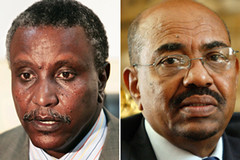
  • African Union Warns Military Against Coup in Nigeria

    AU Warns Military Against Coup In Nigeria

    By Paul Arhewe, Online/Foreign Editor (With Agency Reports)
    Nigerian Daily Independent

    A day after Goodluck Jonathan took over the reins of power as Acting President of the country, the African Union on Thursday warned Nigeria military to respect the decision until the recovery of ailing President Umaru Yar’Adua.

    In a statement, African Union Commission chairman, Jean Ping, commended the move to install Jonathan as Acting President for demonstrating “respect for the constitution, good governance, democracy and the rule of law”.

    “In so doing, the government and people of Nigeria have, again, resolved a delicate and sensitive political situation within the constitutional and legal provisions available and without recourse to violence or unconstitutional means,” the statement added.

    “The chairperson of the commission encourages all the stakeholders in Nigeria, including the military, to continue in their firm support for and practice of constitutionality.”

    Nigeria’s cabinet had initially opposed the idea of the vice president being formally appointed as Acting President in the absence of Yar’Adua who has been undergoing treatment in a Saudi Arabian hospital for a heart condition since November.

    But ministers rallied round Jonathan on Wednesday, the day after both houses of the National Assembly had voted to hand him the reins of power.

    Nigeria, Africa’s most populous nation and one of the world’s biggest oil exporters, has a long history of coups and military leadership, and only returned to civilian rule a little over a decade ago.

    After his installation as Acting President, Jonathan commended the security services for “their loyalty and devotion to duty during this trying period”.

  • South Africa Salutes Nelson Mandela on 20th Anniversary of Release

    South Africa salutes Mandela on anniversary of release

    CAPE TOWN, Thursday

    South Africa heaped praise on Nelson Mandela today as the nation celebrated the 20th anniversary of his release from prison, an earth-shaking event which hastened the demise of apartheid.

    Key figures of the anti-apartheid struggle including Archbishop Desmond Tutu paid tribute to the 91-year-old icon in a ceremony at the former Victor Verster Prison from which Mr Mandela was released after nearly three decades in captivity.

    Hundreds of people re-enacted the historic moment when the black leader, hand in hand with his then-wife Winnie, walked proudly out of the prison with his fist raised high as the world watched.

    Neither Mandela nor his former wife was present for the occasion, though they were both expected to attend a special session of parliament later today.

    The walk was part of a full day of ANC celebrations of the historic day and among the most senior in attendance were Deputy President Kgalema Motlanthe, Cosatu leader Zwelinzima Vavi, ANC secretary-general Gwede Mantashe and a host of cabinet ministers and other ANC leaders.

    A crowd of several thousand ANC supporters were disappointed, however, at the non-appearance of the two most senior figures expected – President Zuma and Winnie Madikizela Mandela, who had not arrived by midday.

    The dignitaries arrived from 7am onwards and first enjoyed tea and breakfast in a massive marquee on the prison grounds, before threading their way en masse back out of the gates as Mandela and Madikizela Mandela had on February 11, 1990.

    Cabinet ministers Trevor Manuel and Cyril Ramaphosa spoke outside the gates of their roles as part of Mandela’s “reception committee”.

    Nobel peace laureate Tutu exhorted South Africans to use the day to remember the long road the country had travelled since February 11, 1990.

    “The day Nelson Mandela walked free from Victor Verster Prison our collective spirit soared. It was a day that promised the beginning of the end of indignity.”

    Hundreds of people erupted in a triumphant raised-fist chant of “Amandla Awethu” (power to the people) as they passed a giant bronze statue of Mandela outside the prison, recalling the popular liberation-struggle mantra.

    Many braved the scorching sun to sing and dance in the streets, waving ANC and multicoloured national flags.

    Ms Madikizela-Mandela herself cancelled an appearance at the celebration at the last minute.

    Tutu, widely hailed as the nation’s conscience keeper, said that while much had been achieved, there was still more to be done.

    “If we really want to make a difference we must recapture the spirit of that day of Nelson Mandela’s release … We must not forget the past,” he said.

    Mandela spent the final months of his 27-year imprisonment at the prison outside Cape Town, now known as Groot Drakenstein Prison, negotiating his release with apartheid’s last president F.W. de Klerk.

    He had spent the bulk of his time behind bars on the notorious Robben Island, and later at Pollsmoor Prison near Cape Town.

    Increasingly frail

    Mr Mandela, increasingly frail and rarely seen in public, will make his only appearance of the day when he arrives at parliament in Cape Town to hear a special commemorative State of the Nation speech by President Jacob Zuma.

    British Prime Minister Gordon Brown said in a tribute that the anti-apartheid struggle was the “defining political question of our time” and praised Mandela as “forgiving, playful, utterly gracious and with a generosity of spirit that lifts the world”.

    Mr Mandela won the Nobel Peace Prize in 1993, jointly with de Klerk, and became South Africa’s first black president in a landslide election victory for his African National Congress a year later.

    Some politicians downplayed de Klerk’s role in ordering Mandela’s release, insisting he had only bowed to pressure.

    “In fairness to him, he saw the writing on the wall,” said veteran anti-apartheid activist Ahmed Kathrada, released four months before Mandela.

    “If he did not take the route that he did take, this country was going to be plunged into an era of violence that we had never seen before,” he said.

    Mr Ramaphosa recalled that Mr Mandela was serene as he prepared to walk out a free man.

    “Here is a man who’s about to be released out of prison after 27 years. He was as cool as a cucumber and younger people would say he’s a cool cat,” said Mr Ramaphosa, who was part of the team that welcomed Mandela.

    With Mr Mandela sitting nearby, President Zuma is later expected to tap into the optimism of two decades ago, while outlining a roadmap of the way forward in the year South Africa hosts the football World Cup. Mr Zuma campaigned with promises to fight poverty in a nation with the widest gap between rich and poor in the world. (AFP)

  • Jesse Belvin: The Most Gifted of All

    Jesse Belvin: The Most Gifted of All

    By Norman (Otis) Richmond

    Barry White, The Whispers, Dr. Dre, Snoop Dogg and Brenda Holloway are all indebted to Jesse Belvin.

    The legendary Etta James was high on Belvin. She bluntly called
    Belvin, “The most gifted of all…even now I consider him the greatest
    singer of my generation. Rhythm and blues rock and roll, crooner, you name it. He was going to be bigger than Sam Cooke, bigger than Nat Cole.”

    Why are most of today’s youth unaware of Belvin? There are many
    reasons for this. In my judgement, Belvin’s death is a potato that is
    too hot for the U.S. ruling circles to handle. Belvin was killed
    along with his manager/wife Jo Ann on Feb 6, 1960 in Hope, Arkansas, the home town of William Jefferson Clinton.

    He was only 27 and his wife was a mere 25 when they joined the
    ancestors. Belvin was a prolific songwriter who wrote R&B classics
    like “Earth Angel”, “Girl of My Dreams” and “Goodnight My Love”.
    ‘Guess Who’ – was written by Jo Ann.

    When The Penguins recorded “Earth Angel”, the then 11-year-old Barry White was the pianist on the recording session. His composition “Earth Angel”, eventually co-credited to Belvin and Hollywood Flames singers Curtis Williams and Gaynel Hodge after a legal dispute, was recorded by The Penguins, and became one of the first R&B singles to cross over onto the pop charts, selling a million copies in 1954/55.

    In 1958, Belvin formed a vocal quintet, the Shields (which included
    Johnny “Guitar” Watson), to record for Dot Records. They recorded the national Top 20 hit ‘You Cheated’.

    Shortly after he was signed to RCA Records, which harbored plans to shape him in the mould of Nat ‘King’ Cole and Billy Eckstine. He hit it big with RCA.

    Alan Freed used to close his nationally syndicated radio show
    with” Goodnight My Love”. Harold Melvin used to close the Blue Notes
    shows by singing “Goodnight My Love.” He could get away with
    performing this song after Teddy Pendergrass had fired the crowd up.

    Belvin influenced many vocalists, including Marvin Gaye. Says Gaye,
    “When I saw Sam Cooke and Jesse Belvin, I’d try to avoid my friends and family for days. I didn’t want to talk or be talked to ’cause I was busy practicing and memorizing everything I heard those singers do.”

    I met Barbara Cooke, the former wife of Sam Cooke, in Jonesboro,
    Louisiana during a visit with my family. She showed me an album bag which included all of Cooke’s albums. The only other artist in the bag was Jesse Belvin. She included Belvin’s RCA, album Guess Who along with her late husband’s work.

    Belvin was born in Texarkana, Texas, and moved with his family to Los Angeles at the age of five. He attended Jefferson High School in Los Angeles. Jefferson High also produced Dorothy Danridge, Roy Ayers and Etta James. L. C. Cooke, the brother of Sam Cooke, says he was born on December 14 and Belvin on December 15, 1932.

    When he stayed in Los Angeles, Sam sent him to stay with the Belvins. L.C. says Jo Ann said he and Jesse were like two peas in a pod. He remembers seeing the Belvins in Atlanta shortly before they where killed.

    “He and Jo Ann hugged me and I bid them goodbye.” He didn’t realize that would be the last time he’d see them.

    Shortly after finishing a performance in Little Rock on a bill with
    Jackie Wilson and Arthur Prysock. , the Belvins were killed in a
    head-on collision in Hope, Arkansas. Jesse and the driver died
    instantly and Jo Ann succumbed a few days later.

    In the book, “Dream Boogie: The Triumph of Sam Cooke, “Peter Guralnick, talked about how the Belvins died.There had been several death threats on Belvin prior to the concert, and there was speculation that Belvin’s car had been tampered with prior to the accident. A Black weekly newspaper,”The Norfolk Journal and Guide”, ran a headline, “Did Racism Kill Jesse Belvin?”.

    Says Guralnick, “It was the same old ugly peckerwood story: the show was booked to play a segregated dance, and when Jackie refused to do a second show for whites, after a “hot dispute with (the) dance manager, “the Los Angeles Sentinel reported, “Wilson and his group were allegedly ordered out of town at gunpoint.”

    “Investigators believed”, the story went on, “that … disgruntled white
    dance fans were responsible for slashing Belvin’s tires, a conclusion
    bolstered by the rumor that both Jackie and Prysock also
    suffered problems as they drove to there next date in Dallas.”

    The Louisiana Weekly, a Black weekly, reported that shortly after the
    Belvin affair, Wilson, Prysock and the Larry Williams (he recorded
    “Bad Boy in 1958) performed in New Orleans. Wilson, a former boxer,
    punched out white police officer in self defence. He was bailed out of
    jail at three in the morning and was in the whirlwind.

    Belvin had a huge impact on Jamaican music. No one will ever know what would have happened had he performed on the island.

    Jamaican record collectors in Toronto, Miami, London and New York treasure the recorded output of Belvin, according J. Alexander Francis. His songs were recorded by the giants of ska and reggae.

    “Girl of My Dreams” has been recorded by Johnny Holt and Sly and
    Robbie, featuring Glen Ricketts. The Blues Busters and Alton Ellis
    and others have also covered Belvin’s work.

    Etta James remains one of Belvin’s staunchest defenders. James
    maintains that Belvin should be in the Rock and Roll Hall of Fame.

    She had this to say about Belvin in her book, “Rage To Survive”, which she co-wrote with David Ritz: “Part of me is thrilled to be recognized, but another part resents the lily-white institutions that sends down its proclamations from on high.

    They decide who is rock and roll and who isn’t; they decide who was
    important and who wasn’t . Man, I grew up with some cats who should have been inducted years ago – Jesse Belvin and Johnny “Guitar” Watson to name two.”
    ——————————————————————–
    Norman Richmond can be contacted at [email protected]
    Richmond can be heard on Diasporic Music which is aired on Uhuru
    Radio. He did a two hour radio tribute to Jesse Belvin on Uhuru
    Radio. To listen: http://uhurunews.com/radio/show?show_id=dm

  • African-American History Month Series: The Role of the Student Nonviolent Coordinating Committee

    African-American History Month: The Role of the Student Nonviolent Coordinating Committee

    Youth played a pivotal role in the civil rights and black power movements

    By Abayomi Azikiwe
    Editor, Pan-African News Wire

    It was on February 1, 1960, some five decades ago, that the student movement was initiated. On this date four youth were arrested for demanding service at a segregated white-only lunch counter in Greensboro, North Carolina.

    When the Southwide Student Leadership Conference on Nonviolent Resistance to Segregation was held in April of that same year, at least 56 colleges in the region had participants linked to the so-called “sit-in movement.” These activists were spread out over 12 states and had links with students from 19 northern colleges and universities.

    This gathering was sponsored by the Southern Christian Leadership Conference (SCLC) headed by Dr. Martin Luther King, Jr. and under the executive director Ella Baker. The over 300 students who were delegates and observers to the conference walked away having witnessed the formation of a continuing Student Nonviolent Coordinating Committee (SNCC) which would constitute itself later as a more structured organization with a headquarters as well as field workers.

    With the intensification of the campaigns to abolish legalized segregation and to win universal suffrage for African-Americans in many areas of the southern United States, SNCC began to play an even more critical role in the Civil Rights Movement. In 1961, the “Freedom Rides” were launched by the Congress on Racial Equality (CORE) resulting in the bombing of an integrated busload of freedom riders in Anniston, Alabama and the severe beating of persons by white racists in a Greyhound bus depot in Birmingham.

    As a result of these actions carried out against the freedom riders, CORE called off the campaign aimed at outlawing segregated inter-state transportation facilities in the South. However, it was the student activists from SNCC based in the Nashville area, who pledged to continue the freedom rides until the segregation laws governing inter-state transportation in the South were overturned.

    The SNCC activists in the area worked with the Nashville Christian Leadership Conference under the influence of Rev. James Lawson who taught seminars on nonviolent action protest methods.

    Student activist Lucretia Collins summed up the sentiments within SNCC when she stated the following: “In Nashville, we had been informed that CORE was going to have Freedom Rides that could carry people all over the South and their purpose was to test the facilities at the bus stations in the major cities.

    “Later we heard of the bus of Freedom Riders that could carry people all over the South and their purpose was to test the facilities at the bus stations in the major cities. Later we heard that the bus of the Freedom Riders had been burned on Mother’s Day in Anniston, Alabama, and that another bus had been attacked by people in Birmingham.

    “CORE was discontinuing the Freedom Rides, people said. We felt that it had to continue even if we had to do it ourselves. We knew we were subject to being killed. This did not matter to us.

    “There was so much at stake, we could not allow segregationists to stop us. We had to continue that Freedom Ride even if we were killed in the process.” (Statement published in “The Making of Black Revolutionaries,” by James Foreman, 1972)

    After the continuation of the Freedom Rides by SNCC, the government was forced to intervene and repeal the segregation laws that regulated inter-state public transportation. This was only done after numerous activists were beaten, tortured and imprisoned on false charges in Parchman Correctional Facility in Mississippi.

    SNCC, however, was not content to merely abolish the segregation laws, they recognized that political power being denied to African-Americans in the South would continue to perpetuate the system of oppression and inequality. Consequently, the organization took a great interest in developments in Fayette County, Tennessee, where the African-American community had suffered severe reprisals for their efforts aimed at registering to vote.

    By 1963, the slogan “one-man, one vote”, became the cornerstone of SNCC’s organizational program. This slogan demanding the establishment of universal suffrage in the United States, paralleled the efforts taking place within the anti-colonial struggle in Africa.

    When Oginga Odinga, the Home Affairs Minister of the newly independent government in Kenya, visited the United States in late 1963, Atlanta was his last stop on the itinerary. Several representatives of SNCC, which was headquartered in Atlanta, visited Odinga at his hotel in the city, where they presented him with gifts and exchanged solidarity greetings.

    After the meeting with Odinga, SNCC members held a sit-in at a local segregated restaurant in the city resulting in the arrests of 17 of their members. This event prompted other protest activities against segregation in the city, where several hundred people participated and were arrested.

    James Forman, the executive secretary of SNCC stated some years later that “All these activities, beginning with our visit to Oginga Odinga, must have made some people on a higher level squirm too. Here was a high-ranking foreign dignitary, on an official visit, commenting that the racial situation in the United States was ‘very pitiful’ and that the United States ‘practices segregation-which is what we are fighting in Africa.’

    “The racist image of this country that SNCC’s work exposed was in sharp conflict with the picture of democracy at work painted by the bureaucratic beavers in Washington, D.C.” (Forman, The Making of Black Revolutionaries)

    During 1964, SNCC embarked upon its most challenging effort with the Mississippi Summer Project that was launched in coalition with other civil rights organizations operating in the state. Under the direction of this alliance known as the Council of Federated Organizations (COFO), nearly 1,000 volunteers were mobilized from northern universities and communities to travel to Mississippi that summer to organize an independent Freedom Democratic Party (MFDP) and to register thousands of African-Americans to vote.

    The state’s racists responded with the murder of several civil rights workers and the jailing and beating of scores of others. By the conclusion of the summer, the MFDP activists had attempted to unseat the all-white Mississippi Democratic party delegation to the national convention in Atlantic City.

    Although the MFDP was never seated at the National Democratic Convention in 1964 and the federal legislation on universal suffrage would not be passed until after the Selma campaign of early 1965, the efforts of the MFDP and its SNCC supporters were successful in bringing broader segments of the community into the struggle for political empowerment and national recognition.

    SNCC and the Global Anti-Colonial Struggle

    As a result of the pioneering work of SNCC, they were invited to send a delegation to tour several independent nations in Africa during the fall of 1964. The group spent two weeks in the Republic of Guinea at the special invitation of the then President Ahmed Sekou Toure. After this, John Lewis and Donald Harris continued the sojourn in Kenya, Zambia as well as other countries, while the other members of SNCC returned to the United States.

    Forman, who was a leading member of the SNCC delegation to Africa said in 1972 that “the trip for me was a culmination of my life in several ways. Africa as a black continent, as our homeland, had always been on my mind. The SNCC executive secretary went on to say that “I had also dreamed for years of helping to build an organization to achieve popular power in the United States and then to relate it with one or more African countries for common revolutionary purposes.” (Forman, The Making of Black Revolutionaries)

    After 1966, SNCC would create an International Affairs section under the direction of James Forman, who would represent the organization at an international conference on settler colonialism in Southern Africa that was held in Zambia in 1967, as well speak before the United Nations Fourth Committee on Decolonization later in the same year.

    The role of SNCC during this period illustrated the interconnectedness of the African-American struggle and developments on the Continent. This intersection between the history of Africans in various parts of the world would continue throughout the remaining years of the 20th century.

    SNCC, Urban Rebellions and the Workers’ Movement

    What distinguished SNCC from other civil rights organizations was its work within the cities, small towns and rural areas of the South where the development of local leadership was a key aspect of its political program. In 1965-66 in Lowndes County, Alabama, SNCC worked with farmers and youth leading to the formation of the original Black Panther Party.

    Not only did the Black Panthers in Alabama push for the right to vote and the development of an organization that was independent of the racist-controlled state Democratic Party, it also advocated and practiced self-defense for the activists and the community as a whole. These efforts spread throughout the country and created the conditions for the founding of the Black Panther Party for Self-Defense by Huey P. Newton and Bobby Seale in Oakland, California in October 1966.

    Between 1964-1968, hundreds of urban rebellions erupted throughout the United States. Chapters of the Black Panther Party grew rapidly between 1967-1969 all over the country. The FBI and local law-enforcement agencies responded to the upsurge in revolutionary activity by directly and indirectly murdering Malcolm X in 1965, Martin Luther King, Jr. in 1968, Fred Hampton and Mark Clark in 1969. Hundreds of members of SNCC and the Black Panther Party as well as other revolutionaries were harassed, imprisoned and driven into exile.

    In 1968, African-American workers in Detroit began to engage in wildcat strikes demanding an end to racism and super-exploitation in the automotive industry. These struggles were soon linked to the efforts of community organizers and students who were waging battles around education issues, housing and police brutality.

    The National Black Economic Development Conference was held in Detroit in April 1969 where the demand for reparations was put forward when James Forman issued the Black Manifesto calling for massive compensation for centuries of slavery and national oppression. Forman would soon join the League of Revolutionary Black Workers (LRBW), which grew out of the African-American independent labor struggles of the period in Detroit and around the country.

    The students at Wayne State University in Detroit took control of the campus newspaper and turned it into the official publication of the LRBW. The daily newspapers published on campus were distributed at plant gates and within the African-American community.

    These developments illustrated clearly the necessity for the student movement to merge with the broader movement of workers against capitalism and national oppression. The student activists of the present period must learn from the struggles of the 1960s.

    By linking the cutbacks in education to the overall economic crisis of capitalism, students and youth can became an important force in the burgeoning movement against the most aggressive attacks against the working class since the Great Depression.

  • Release of Muslim Leader’s Autopsy Causes Shockwaves Throughout the World

    Release of Muslim Leader’s Autopsy Send Shockwaves Throughout the World

    Protest, press conferences demand justice for Imam Luqman Ameen Abdullah

    By Abayomi Azikiwe
    Editor, Pan-African News Wire

    On Feb. 1 the long suppressed autopsy of slain Muslim leader Imam Luqman Ameen Abdullah was released to the public at the Dearborn Police headquarters. Imam Abdullah was killed in Dearborn, right outside Detroit on October 28, 2009.

    The autopsy reported that the imam was shot 21 times, with numerous wounds in the mid-section, waist and groin areas. At least one shot was through the back. There were also numerous lacerations on his hands and forehead, presumably from the attack dog that was killed during the FBI operation.

    There was much anticipation in the Detroit area prior to the release of the autopsy report. The Michigan Emergency Committee Against War & Injustice (MECAWI) held a demonstration and press conference outside Dearborn police headquarters on the day of the release.

    This demonstration and press conference was supported by the Detroit Coalition Against Police Brutality and was attended by the son of Imam Luqman Ameen Abdullah as well as members of his mosque, Masjid al-Haqq. At present ten members of the mosque have felony charges pending against them in connection with the FBI infiltration of the the Masjid al-Haqq.

    MECAWI described the death of the imam as a “targeted assassination.” This quote was picked up by news agencies throughout the world including the Associated Press, UPI, Islamonline.net, Russia Today, among others.

    The following day, Feb. 2, another press conference was held at the Michigan Bldg. in downtown Detroit. It was called by U.S. Congressman John Conyers, Jr., who issued a letter requsting an internal investigation of the actions of the FBI field office in Detroit.

    Conyers wrote in the letter to Attorney General Eric Holder that “I write seeking your personal assurance that the Department’s investigation into the shooting death of Imam Luqman Ameen Abdullah in Dearborn, Michigan on October 28, 2009, will be appropriately rigorous, thorough, and –most critically–transparent. In addition, I call for the Department’s Civil Rights Division to conduct a separate, independent review of whether the Federal Bureau of Investigation’s use of confidential informants in our nation’s houses of worship may constitute a deprivation of protected constitutional rights under 42 U.S.C. 14141.”

    At the Feb. 2 press conference called by Cong. Conyers, the widow of Imam Abdullah was present on the panel and it was revealed that federal immigration authorities are attempting to deport her from the United States. Amina Abdullah, a national of the East African state of Tanzania, has also been placed on a tether.

    In addition to the harassment of Imam Luqman Ameen Abdullah’s widow by immigration authorities, one of the sons of Imam Abdullah, Mujahid Carswell, is a defendant in the Detroit 10 case. Members of the imam’s family and mosque were victims of the FBI infiltration of their group. The information supplied by the FBI lured the imam and his followers to the warehouse where he was gunned down by federal agents.

    MECAWI told members of the international press on Feb. 1 that the assassination of Imam Abdullah represented a pattern of systematic harassment and persecution of Muslims in the United States and abroad. With the imam being African-American it must also be viewed within the context of the standard government policy to both neutralize and liquidate the effective leadership emanating from this oppressed community.

  • Haiti Protesters Denounce Aid Corruption, Hoarding

    Haiti protesters denounce aid corruption, hoarding

    Jorge Vega
    PORT-AU-PRINCE
    Mon Feb 8, 2010 2:23pm EST

    PORT-AU-PRINCE (Reuters) – Hundreds of Haitian earthquake survivors protested in a suburb of the wrecked capital on Sunday, accusing a district mayor of corruption and hoarding food aid provided by relief groups, witnesses said.

    The protest in the Petionville neighborhood of Port-au-Prince was one of the largest since the January 12 quake that killed more than 200,000 people and left over 1 million homeless. It reflected still simmering anger among survivors over problems in the massive international relief effort.

    Aid agencies from around the world have moved tons of rice and other food into Haiti but distributions to the hungry and homeless have been slow and sometimes chaotic.

    Banging on plastic buckets and waving branches and palm fronds, the protesters surged past piles of earthquake rubble — and a woman bathing by the side of the road — to the city hall in Petionville, where they accused Mayor Lydie Parent of hoarding aid.

    “I am hungry, I am dying of hunger. Lydie Parent keeps the rice and doesn’t give us anything. They never go distribute where we live,” one protester said.

    Parent was not immediately available for comment.

    Most of the demonstrators were women. Aid agencies are doling out food to women to prevent men from dominating distribution sites, and because they believe women are more likely to share it with children and relatives.

    Donor nations have poured tens of millions of dollars into the impoverished Caribbean nation and some Haitians have blamed corruption for the sometimes sluggish distribution of aid.

    Sacks of donated rice have turned up in local street markets. Aid officials said it was inevitable that some aid would find its way to the black market in Haiti, which was ranked 10th from the bottom of Transparency International’s latest corruption rating of 180 nations.

    1 MILLION NEED SHELTER

    Haitian President Rene Preval, who has been seen only occasionally in public since the quake, has been targeted by some protests, and graffiti messages of “Down with Preval” have been scrawled on some buildings and walls.

    “We are all victims. It is a fallen country. It has lost its children, husbands, homes and family,” protester Agustin Michou said.

    The demonstrators chanted “if the police shoot at us, we will burn everything,” but the protest ended peacefully and police did not intervene.

    During a visit by senior Dominican Republic officials to Port-au-Prince over the weekend, Preval said he estimated some 250,000 people had been killed in the quake, and 250,000 houses were destroyed.

    He added that a million homeless people urgently needed to be relocated in temporary shelter before the rainy season, which normally begins in March.

    But he recognized that many quake victims would want to remain close to their original places of residence. “This is their neighborhood, their environment, they won’t want to leave those places,” he said.

    In an interview with CNN’s Candy Crowley on Sunday, U.S. Secretary of State Hillary Clinton said she and her husband, former U.S. President Bill Clinton who is the United Nations special envoy and relief coordinator for Haiti, were committed to helping the earthquake-ravaged country.

    “We have a special place in our heart for Haiti having gone there during our honeymoon many years ago. And it’s a place that is captivating. The people are so resilient. And they deserve so much better that what they’ve gotten over their history,” Hillary Clinton said.

    The U.S. military, backed by a flotilla of warships and a fleet of aircraft flying in supplies, has been spearheading the international relief effort.

    (Additional reporting by Manuel Jimenez and Doina Chiacu; Writing by Jim Loney; editing by Pascal Fletcher)

  • Goodluck Jonathan Made Acting President of Nigeria

    Goodluck Jonathan Made Acting President of Nigeria

    Written by AbdulFattah Olajide
    Nigerian Trust
    Tuesday, 09 February 2010 23:24

    Vice President Goodluck Jonathan assumed office as acting president yesterday, following a National Assembly resolution asking him to take charge pending the return of President Umaru Yar’adua from medical trip to Saudi Arabia.

    “The circumstances in which I find myself assuming office today as Acting President of our country are uncommon, sober and reflective,” Jonathan said in an address on national television, urging Nigerians to pray for Yar’adua’s recovery and return.

    He said the leadership and members of the National Assembly have shown “great courage, statesmanship and patriotism” by empowering him through their resolutions.

    While acknowledging that the absence of Yar’adua, who left for Saudi Arabia on medical trip 79 days ago, has heated up the polity, Jonathan said “the events of the recent past have put to the test our collective resolve as a democratic nation.”

    According to him, “today affords us time to reconnect with ourselves and overcome any suspicions, hurts and doubts, which had occurred. In all these, there are no winners and no losers, because by the grace of God we have once again succeeded in moving our country forward. We have all shown that our unity as a people, our love for this country, and our hope for its great future cannot be shaken.”

    He commended the nation’s military for not disrupting the current democratic dispensation “during this trying period.”

    “Our security services also deserve our special commendation for their loyalty and devotion to duty during this trying period,” he said.

    The Acting President said the Federal Government would take necessary steps to consolidate the gains of amnesty in the Niger Delta region and execute the promised post-amnesty programmes.

    He therefore appealed to all stakeholders in the region to be patient, saying “there can be no meaningful development without peace and security.”

    He said government would find a lasting solution to the recurring crisis in Plateau State, saying culprits in the recent killings would face the full weight of the law.

    Lack of formal transfer of power had led to doubts over who was ruling the country, and prompted arguments about whether there was need to made Jonathan acting president.

    Although the Federal Executive Council has previously opposed any formal transfer of powers, Minister of Justice Michael Aondoakaa yesterday said Jonathan had the government’s full support—suggesting that the council would not obstruct him from acting as president, Reuters news agency reported.

    “The cabinet has already, since the president left, recognised the vice president as the leader of the country pending when Mr. President returns,” Reuters quoted Aondoakaa as saying, in reacting to the vice president’s declaration.

    Yar’adua, 58, has been receiving treatment for a heart ailment in a Saudi hospital. His aides had at different times said he was recovering and would soon return to Nigeria.

    Earlier on there were rumours that his health had deteriorated. On January 12, he spoke to the BBC radio, saying he was getting better but did not give a specific return date.

    How National Assembly made him Acting President

    Written by Abdul-Rahman Abubakar, Nasidi A. Yahaya & Turaki A. Hassan
    Tuesday, 09 February 2010 23:22

    A unanimous resolution by the National Assembly set the stage yesterday for Vice President Goodluck Jonathan to take charge as Acting President. The two chambers, apparently trying to break the political stalemate over President Umaru Yar’adua’s ill health, asked Jonathan to assume full presidential powers pending the president’s return.

    Hours before Jonathan’s nationwide broadcast, in which he announced taking over powers as acting president, the Senate and the House of Representatives in separate unanimous resolutions asked him to assume office because the president is on medical leave.

    The Senate resolution came after a motion on the state of the nation was moved by the Senate leader Teslim Folarin (PDP, Oyo Central), who argued that section 145 of the 1999 constitution which requires the president to transmit a letter to the National Assembly notifying it of his medical leave has been complied with since the president had on January 12 confirmed on the radio that he was ill and receiving medical attention in Saudi Arabia.

    “On the 12th of January, 2010, His Excellency President Umaru Musa Yar’adua transmitted to the whole world through the British Broadcasting Corporation (BBC), a declaration that he is receiving medical treatment in Saudi Arabia and consequently will be unable to discharge the functions of his office until his doctors certify him fit to return to Nigeria to assume duties. The president of the Senate and the Speaker of the House of Representatives read the president’s declaration transmitted through the BBC and further published in several print media,” he said.

    However, Senator Garba Yakubu Lado (PDP, Katsina South) raised a constitutional point of order, reminding his colleges that the president’s BBC interview was not independently authenticated and that some senators had earlier questioned authenticity of the voice in the interview. He said the interview should not be relied upon as a basis for the resolution.

    Seconding the motion Deputy Senate President Ike Ekweremadu said section 145 of the 1999 constitution did not in any way prescribe the manner and form in which the president is to transmit the letter of medical vacation to the National Assembly especially with the advancement in information technology.

    Senate resolved thus: “The vice president Goodluck Jonathan shall henceforth discharge the functions of the office of the president, Commander-in-Chief of the Armed Forces of the Federal Republic of Nigeria.

    “That, the Vice President shall cease to discharge the functions of the office of the president when the president pursuant to section 145 of the 1999 constitution transmits to the president of the Senate and Speaker of the House of Representatives in writing that he has returned from his medical vacation.”

    Briefing newsmen shortly after the yesterday’s session, vice chairman of the Senate Committee on Information and Media Senator Anthony Manzo (PDP, Taraba) said the vice president does not need to take an oath of office as acting president.

    The House, after two consecutive closed door sessions, characterized by hot political debate and near-fisticuffs, also resolved that Jonathan should act as president pending Yar’adua’s return.

    Lawmakers, who were to consider a motion on the matter, failed to do so and instead went into a closed door session at 12:16pm. They emerged after about 30 minutes without a unanimous decision, prompting Speaker Dimeji Bankole to order for another session.

    When the House resumed plenary at 1:04pm, House Leader Tunde Akogun (PDP, Edo State) read the resolution: “For peace, order and good governance of the federation, and consistent with the judgments of the courts, the vice president, Goodluck Ebele Jonathan, GCON shall assume full presidential powers, pending the return of the president, Alhaji Umaru Musa Yar’adua, GCFR.”

    After this, Bankole put the question and members unanimously replied “aye!”

    Also yesterday, state governors under the auspices of the Governors’ Forum, led by Kwara State Governor Bukola Saraki, visited the House of Representatives to express their resolution to back Vice President Goodluck Jonathan.

    In his response, Bankole said the House made its decision in the interest of the country.

    He said: “Today, is another day where this House recorded democratic structure whereby the all country has come together: civil societies, elected officials and non elected officials to come to the sole agreement to rescue our nation problem.”

    But the decision of the National Assembly is not contemplated in the constitution, lawyers said yesterday.

    Yar’adua, who long has suffered from kidney ailments, left for Saudi Arabia on November 23 and was admitted to a hospital there for what his physician says is acute pericarditis, an inflammation of the sac surrounding the heart.

    Why I was removed – Aondoakaa

    Written by AbdulFattah Olajide
    Nigerian Daily Trust
    Thursday, 11 February 2010 05:17

    Acting President Goodluck Jonathan flexed his political muscles yesterday by effecting a minor cabinet reshuffle which saw the redeployment of powerful Minister of Justice Michael Aondoakaa to the obscure Special Duties portfolio.

    The controversial attorney-general of the federation, who rebuffed calls for ailing President Umaru Yar’adua to transfer full powers to Jonathan, lost his post to former Labour Minister Adetokunbo Kayode. The former Special Duties minister Ibrahim Kazaure moves to the Labour Ministry.

    Fielding questions from newsmen after his removal, Aondoakaa said he was redeployed because of his earlier insistence that Yar’adua, who has been receiving medical treatment in Saudi Arabia since November, needed not transmit a vacation letter to the Senate before Jonathan could perform presidential duties.

    The cabinet reshuffle was effected shortly before the commencement of yesterday’s Federal Executive Council meeting, presided over by Jonathan.

    Aondoakaa said it would have been inappropriate for him to start defending Tuesday’s resolutions of the House of Representatives and the Senate, which mandated Jonathan to act as president, in view of his earlier stand.

    “I have taken a position and in this life when you take a position and there is a change in the position you allow another person who will have a free atmosphere to defend the new position,” he said.

    On why he insisted earlier that Jonathan must not be made acting president, he said, “No attorney- general worth his salt will go to the pages of papers and say there is a vacuum. We have to preserve executive powers until a leader is selected. A leader has been given by the National Assembly, we have recognised him.”

    Aondoakaa, who wore a sombre look throughout his stay at the State House yesterday, said the acting president had earlier discussed his removal with him before it was made.

    “First I had a discussion with the vice president. I think what we did was a collective decision. I and the vice president had a discussion in the morning, it’s a cordial arrangement.

    “He had a discussion with me in the morning, how do I look at it? Well I am in the government, in the cabinet and I pledge my loyalty to the vice president, I’m the minister of special duties,” he added.

    Asked how he took his new posting, Aondoakaa said, “When I go there the permanent secretary will brief me on what the special duties are and I will do the job.”

    A mild drama had ensued shortly before the FEC meeting started. When Jonathan entered the Council Chambers where ministers were already waiting for the meeting, a protocol official promptly drew out his usual seat, but Jonathan ignored him and sat on President Yar’adua’s seat which was drawn out almost simultaneously by his ADC.

    Some members of Yar’adua’s kitchen cabinet were apparently shocked by the incident.

    Briefing newsmen after the FEC meeting, an apparently elated Minister of Information and Communications, Professor Dora Akunyili, said the council accepted “the resolution of the National Assembly that the Vice President, Dr. Goodluck Ebele Jonathan, becomes the Acting President and Commander-in-Chief. Council commends the National Assembly for their action and pledges to support the acting president in his onerous responsibility of steering the ship of the nation.”

    Beaming with smile throughout her presentation, Akunyili said her earlier memo in which she had demanded that Yar’adua must transmit a vacation letter to the Senate to enable Jonathan be acting president was not discussed at the meeting because it had been overtaken by events.

    On the cabinet reshuffle, she said, “It is a presidential decision and he (Jonathan) has the power to move any of us.”

    Jonathan: Lawyers Divided Over Senate Resolution

    The Senate on Tuesday voted overwhelmingly on a motion that empowered Vice President Goodluck Jonathan to act as the President nearly three months after President Umaru Yar’Adua left the country for medical treatment in Saudi Arabian hospital. It was the height of a process of transferring executive powers to the Vice President after almost three months of political debacle that President Yar’Adua’s absence had thrown the country into. Many lawyers are, however, of the opinion that having Mr. Vice President become acting president through such a process, may bring him and the decision under intense legal scrutiny. According to them, such a motion by lawmakers is usually no more than a piece of advice and bears no compulsion of compliance. LAW EDITOR, Adam Adedimeji spoke to them.

    Oluwarotimi Akeredolu (SAN), President, Nigerian Bar Association:

    The Vice President does not need a resolution to act as President. All that is needed was a declaration from the President to the Senate to say that he would not be able to perform his duties and that his vice should act. But since the President has not done that, the Vice President does not need a resolution to act as President.

    Is the BBC interview a declaration to them; that is not a declaration to them in law. To me, the premise on which they based their argument is very wrong; it’s not within the law.

    The Senate should have passed a resolution that “we are now confirming that we have received a declaration from the President, then Jonathan can then act as President but he does not need their resolution to act. I do not think what they have done is in compliance with the constitution; they are not on a strong leg legally speaking”.

    Fred Agbaje, Constitutional Lawyer:

    The only constitutional means opened to the National Assembly in respect of the President’s abandonment of his office is premised on Section 145 of the Constitution. Section 145 says that “whenever the President transmits to the President of the Senate and the Speaker of the House of Representatives a written declaration that he is proceeding on vacation or that he is otherwise unable to discharge the functions of his office, until he transmits to them a written declaration to the contrary such functions shall be discharged by the Vice-President as Acting President.” It is only when the President complied with this Section of the Constitution before the Senate can invoke its power under that Section.

    What the Senate has done by their so-called resolution amounted to Constitutional heresy and a clear usurpation of Presidential power under Section 145 of the Constitution. It is only when the President transmits a letter to them but in the absence of transmission of such letter, both the Senate President and the Speaker of the House of Representatives are constitutionally impotent to pass any resolution asking Vice President Goodluck Jonathan to act as President.

    The only thing the Senate can do now constitutionally is to impeach the President. They can pass a resolution to impeach the President because he has abandoned the country for more that the required period without complying with the Constitution. Even under the Federal Civil Service Rule, it is clear that the President has abandoned his duty even if its on health ground.

    Absence from duty on health ground must not go beyond certain limitations, or they ask such civil servant to resign and if he refused to resign and stayed long like that of the President he can be dismissed. The President is guilty of gross misconduct.

    They are not to pass resolution for the Vice President to act as President, that resolution lacked constitutional backing, it is an affront to the Constitution.

    Niyi Akintola (SAN)

    I think what the Senate did on resolution was a form of endorsement of doctrine of necessity in order to get out of political quagmire in which they found themselves. Initially, and abinitio, the Senate know that they have abdicated their responsibility in the sense that Section 143 gave them the leeway of what to do and they have all the time of this world to commence impeachment proceedings against the President. But they did not do it. Today, they acted on the BBC interview as tantamount to transmitting a letter. The question is when does it occur to them that the BBC interview amounted to notice?

    The constitution says the VP can only assume the seat of the President trough : 1. transmission of a letter from the President to both houses informing them of absence or incapacity; 2. Declaration of the President as incapable of discharging his duties by reason of incapacity by the ECF and 3. impeachment by the both houses. So where is the place of a resolution by a senate?

    Our legislative houses should credit Nigerians some intelligence and they should not play with our intelligence. By this resolution, they just found themselves an escape root out of the box which they had earlier boxed themselves into. On the legal implication of their resolution, like I said before, it is just a political solution, they can only give it a legal teeth by asking the Chief Justice of Nigeria to swear in the Vice President as Acting President. After all, he himself is a child of necessity.

    Olisa Agbakoba (SAN)

    Senior Advocate of Nigeria (SAN), Olisa Agbakoba, has said that the resolution of the senate mandating Vice-President Goodluck Jonathan to take over in acting capacity, is nothing but an opportunity for the country to move forward.

    Speaking with the Daily Independent on Tuesday on the senate resolution, the senior lawyer argued that, “It is a clumsy way of resolving the issue, it is the most untidy, and I hope it would not be challenged in a court of competent jurisdiction.”

    Mike Ozekhome (SAN)

    Now, Section 145 of the Constitution says a written declaration should be transmitted by the President to the National Assembly so as to pave way for his vice to formally take over. President Umaru Yar’Adua has not been able to transmit the letter to the National Assembly because he is sick. I think members of the National Assembly are right to premise their resolution declaring Jonathan as acting President on the interview granted by Yar’Adua to the British Broadcasting Corporation (BBC) because members of the National Assembly are part of the global community and they heard the interview Yar’Adua granted to the BBC.

    The question is can it be rightly said that only the letter of the Constitution should be looked at? And I say no, the spirit of the Constitution should also be looked at. You see, under the doctrine of necessity, certain things can be done to save a country from collapse and this is one of such situation. Nigeria has been on a dangerous terrain.

    It was Hippocrates, the father of medicine who once told us that desperate diseases require desperate remedy. This has been a desperate disease, which require desperate remedy and so, the Senate is right to make Jonathan the acting President so as to save Nigeria from perdition. As a matter of fact, Nigeria is greater than any individual.

    Emeka Ofomata, Abuja-based lawyer

    What are the statutory and constitutional requirements? Can they arrogate the power to authorise the VP to act to themselves? It simply has no precedent or constitutional support. I simply think that they are acting in a gutless manner. The right course of action provided in the constitution is for them to either initiate an impeachment proceeding against the embattled president or urge the FEC to act decisively as empowered in the constitution. This action would simply entrap the VP and my personal advice is for him to seek the advice of a constitutional lawyer. If he decides to upgrade his status to that of an acting President, then his actions would be contestable in the courts. The VP should toe the line of honour and not allow himself to be hoodwinked. This whole course would compound the situation and create an illegality. The constitution is clear on how to proceed and we should please prevail on our political class to rise to the call of duty. The whole charade continues. This does not augur well for our nascent democracy!!

  • Nigerian Legislature Makes Goodluck Jonthan Amid Absence of Head-of-State

    Jonathan takes charge

    Written by AbdulFattah Olajide
    Nigerian Trust
    Tuesday, 09 February 2010 23:24

    Vice President Goodluck Jonathan assumed office as acting president yesterday, following a National Assembly resolution asking him to take charge pending the return of President Umaru Yar’adua from medical trip to Saudi Arabia.

    “The circumstances in which I find myself assuming office today as Acting President of our country are uncommon, sober and reflective,” Jonathan said in an address on national television, urging Nigerians to pray for Yar’adua’s recovery and return.

    He said the leadership and members of the National Assembly have shown “great courage, statesmanship and patriotism” by empowering him through their resolutions.

    While acknowledging that the absence of Yar’adua, who left for Saudi Arabia on medical trip 79 days ago, has heated up the polity, Jonathan said “the events of the recent past have put to the test our collective resolve as a democratic nation.”

    According to him, “today affords us time to reconnect with ourselves and overcome any suspicions, hurts and doubts, which had occurred. In all these, there are no winners and no losers, because by the grace of God we have once again succeeded in moving our country forward. We have all shown that our unity as a people, our love for this country, and our hope for its great future cannot be shaken.”

    He commended the nation’s military for not disrupting the current democratic dispensation “during this trying period.”

    “Our security services also deserve our special commendation for their loyalty and devotion to duty during this trying period,” he said.

    The Acting President said the Federal Government would take necessary steps to consolidate the gains of amnesty in the Niger Delta region and execute the promised post-amnesty programmes.

    He therefore appealed to all stakeholders in the region to be patient, saying “there can be no meaningful development without peace and security.”

    He said government would find a lasting solution to the recurring crisis in Plateau State, saying culprits in the recent killings would face the full weight of the law.

    Lack of formal transfer of power had led to doubts over who was ruling the country, and prompted arguments about whether there was need to made Jonathan acting president.

    Although the Federal Executive Council has previously opposed any formal transfer of powers, Minister of Justice Michael Aondoakaa yesterday said Jonathan had the government’s full support—suggesting that the council would not obstruct him from acting as president, Reuters news agency reported.

    “The cabinet has already, since the president left, recognised the vice president as the leader of the country pending when Mr. President returns,” Reuters quoted Aondoakaa as saying, in reacting to the vice president’s declaration.

    Yar’adua, 58, has been receiving treatment for a heart ailment in a Saudi hospital. His aides had at different times said he was recovering and would soon return to Nigeria.

    Earlier on there were rumours that his health had deteriorated. On January 12, he spoke to the BBC radio, saying he was getting better but did not give a specific return date.

    How National Assembly made him Acting President

    Written by Abdul-Rahman Abubakar, Nasidi A. Yahaya & Turaki A. Hassan

    Tuesday, 09 February 2010 23:22

    From left: Governor Gabriel Suswam of Benue State, Governor Danjuma Goje of Gombe State and Senate President David Mark during the Governors’ Forum visit to the National Assembly in Abuja yesterday.
    A unanimous resolution by the National Assembly set the stage yesterday for Vice President Goodluck Jonathan to take charge as Acting President. The two chambers, apparently trying to break the political stalemate over President Umaru Yar’adua’s ill health, asked Jonathan to assume full presidential powers pending the president’s return.

    Hours before Jonathan’s nationwide broadcast, in which he announced taking over powers as acting president, the Senate and the House of Representatives in separate unanimous resolutions asked him to assume office because the president is on medical leave.

    The Senate resolution came after a motion on the state of the nation was moved by the Senate leader Teslim Folarin (PDP, Oyo Central), who argued that section 145 of the 1999 constitution which requires the president to transmit a letter to the National Assembly notifying it of his medical leave has been complied with since the president had on January 12 confirmed on the radio that he was ill and receiving medical attention in Saudi Arabia.

    “On the 12th of January, 2010, His Excellency President Umaru Musa Yar’adua transmitted to the whole world through the British Broadcasting Corporation (BBC), a declaration that he is receiving medical treatment in Saudi Arabia and consequently will be unable to discharge the functions of his office until his doctors certify him fit to return to Nigeria to assume duties. The president of the Senate and the Speaker of the House of Representatives read the president’s declaration transmitted through the BBC and further published in several print media,” he said.

    However, Senator Garba Yakubu Lado (PDP, Katsina South) raised a constitutional point of order, reminding his colleges that the president’s BBC interview was not independently authenticated and that some senators had earlier questioned authenticity of the voice in the interview. He said the interview should not be relied upon as a basis for the resolution.

    Seconding the motion Deputy Senate President Ike Ekweremadu said section 145 of the 1999 constitution did not in any way prescribe the manner and form in which the president is to transmit the letter of medical vacation to the National Assembly especially with the advancement in information technology.

    Senate resolved thus: “The vice president Goodluck Jonathan shall henceforth discharge the functions of the office of the president, Commander-in-Chief of the Armed Forces of the Federal Republic of Nigeria.

    “That, the Vice President shall cease to discharge the functions of the office of the president when the president pursuant to section 145 of the 1999 constitution transmits to the president of the Senate and Speaker of the House of Representatives in writing that he has returned from his medical vacation.”

    Briefing newsmen shortly after the yesterday’s session, vice chairman of the Senate Committee on Information and Media Senator Anthony Manzo (PDP, Taraba) said the vice president does not need to take an oath of office as acting president.

    The House, after two consecutive closed door sessions, characterized by hot political debate and near-fisticuffs, also resolved that Jonathan should act as president pending Yar’adua’s return.

    Lawmakers, who were to consider a motion on the matter, failed to do so and instead went into a closed door session at 12:16pm. They emerged after about 30 minutes without a unanimous decision, prompting Speaker Dimeji Bankole to order for another session.

    When the House resumed plenary at 1:04pm, House Leader Tunde Akogun (PDP, Edo State) read the resolution: “For peace, order and good governance of the federation, and consistent with the judgments of the courts, the vice president, Goodluck Ebele Jonathan, GCON shall assume full presidential powers, pending the return of the president, Alhaji Umaru Musa Yar’adua, GCFR.”

    After this, Bankole put the question and members unanimously replied “aye!”

    Also yesterday, state governors under the auspices of the Governors’ Forum, led by Kwara State Governor Bukola Saraki, visited the House of Representatives to express their resolution to back Vice President Goodluck Jonathan.

    In his response, Bankole said the House made its decision in the interest of the country.

    He said: “Today, is another day where this House recorded democratic structure whereby the all country has come together: civil societies, elected officials and non elected officials to come to the sole agreement to rescue our nation problem.”

    But the decision of the National Assembly is not contemplated in the constitution, lawyers said yesterday.

    Yar’adua, who long has suffered from kidney ailments, left for Saudi Arabia on November 23 and was admitted to a hospital there for what his physician says is acute pericarditis, an inflammation of the sac surrounding the heart.

    Why I was removed – Aondoakaa

    Written by AbdulFattah Olajide
    Nigerian Daily Trust
    Thursday, 11 February 2010 05:17

    Acting President Goodluck Jonathan flexed his political muscles yesterday by effecting a minor cabinet reshuffle which saw the redeployment of powerful Minister of Justice Michael Aondoakaa to the obscure Special Duties portfolio.

    The controversial attorney-general of the federation, who rebuffed calls for ailing President Umaru Yar’adua to transfer full powers to Jonathan, lost his post to former Labour Minister Adetokunbo Kayode. The former Special Duties minister Ibrahim Kazaure moves to the Labour Ministry.

    Fielding questions from newsmen after his removal, Aondoakaa said he was redeployed because of his earlier insistence that Yar’adua, who has been receiving medical treatment in Saudi Arabia since November, needed not transmit a vacation letter to the Senate before Jonathan could perform presidential duties.

    The cabinet reshuffle was effected shortly before the commencement of yesterday’s Federal Executive Council meeting, presided over by Jonathan.

    Aondoakaa said it would have been inappropriate for him to start defending Tuesday’s resolutions of the House of Representatives and the Senate, which mandated Jonathan to act as president, in view of his earlier stand.

    “I have taken a position and in this life when you take a position and there is a change in the position you allow another person who will have a free atmosphere to defend the new position,” he said.

    On why he insisted earlier that Jonathan must not be made acting president, he said, “No attorney- general worth his salt will go to the pages of papers and say there is a vacuum. We have to preserve executive powers until a leader is selected. A leader has been given by the National Assembly, we have recognised him.”

    Aondoakaa, who wore a sombre look throughout his stay at the State House yesterday, said the acting president had earlier discussed his removal with him before it was made.

    “First I had a discussion with the vice president. I think what we did was a collective decision. I and the vice president had a discussion in the morning, it’s a cordial arrangement.

    “He had a discussion with me in the morning, how do I look at it? Well I am in the government, in the cabinet and I pledge my loyalty to the vice president, I’m the minister of special duties,” he added.

    Asked how he took his new posting, Aondoakaa said, “When I go there the permanent secretary will brief me on what the special duties are and I will do the job.”

    A mild drama had ensued shortly before the FEC meeting started. When Jonathan entered the Council Chambers where ministers were already waiting for the meeting, a protocol official promptly drew out his usual seat, but Jonathan ignored him and sat on President Yar’adua’s seat which was drawn out almost simultaneously by his ADC.

    Some members of Yar’adua’s kitchen cabinet were apparently shocked by the incident.

    Briefing newsmen after the FEC meeting, an apparently elated Minister of Information and Communications, Professor Dora Akunyili, said the council accepted “the resolution of the National Assembly that the Vice President, Dr. Goodluck Ebele Jonathan, becomes the Acting President and Commander-in-Chief. Council commends the National Assembly for their action and pledges to support the acting president in his onerous responsibility of steering the ship of the nation.”

    Beaming with smile throughout her presentation, Akunyili said her earlier memo in which she had demanded that Yar’adua must transmit a vacation letter to the Senate to enable Jonathan be acting president was not discussed at the meeting because it had been overtaken by events.

    On the cabinet reshuffle, she said, “It is a presidential decision and he (Jonathan) has the power to move any of us.”

    Jonathan: Lawyers Divided Over Senate Resolution

    The Senate on Tuesday voted overwhelmingly on a motion that empowered Vice President Goodluck Jonathan to act as the President nearly three months after President Umaru Yar’Adua left the country for medical treatment in Saudi Arabian hospital. It was the height of a process of transferring executive powers to the Vice President after almost three months of political debacle that President Yar’Adua’s absence had thrown the country into. Many lawyers are, however, of the opinion that having Mr. Vice President become acting president through such a process, may bring him and the decision under intense legal scrutiny. According to them, such a motion by lawmakers is usually no more than a piece of advice and bears no compulsion of compliance. LAW EDITOR, Adam Adedimeji spoke to them.

    Oluwarotimi Akeredolu (SAN), President, Nigerian Bar Association:

    The Vice President does not need a resolution to act as President. All that is needed was a declaration from the President to the Senate to say that he would not be able to perform his duties and that his vice should act. But since the President has not done that, the Vice President does not need a resolution to act as President.

    Is the BBC interview a declaration to them; that is not a declaration to them in law. To me, the premise on which they based their argument is very wrong; it’s not within the law.

    The Senate should have passed a resolution that “we are now confirming that we have received a declaration from the President, then Jonathan can then act as President but he does not need their resolution to act. I do not think what they have done is in compliance with the constitution; they are not on a strong leg legally speaking”.

    Fred Agbaje, Constitutional Lawyer:

    The only constitutional means opened to the National Assembly in respect of the President’s abandonment of his office is premised on Section 145 of the Constitution. Section 145 says that “whenever the President transmits to the President of the Senate and the Speaker of the House of Representatives a written declaration that he is proceeding on vacation or that he is otherwise unable to discharge the functions of his office, until he transmits to them a written declaration to the contrary such functions shall be discharged by the Vice-President as Acting President.” It is only when the President complied with this Section of the Constitution before the Senate can invoke its power under that Section.

    What the Senate has done by their so-called resolution amounted to Constitutional heresy and a clear usurpation of Presidential power under Section 145 of the Constitution. It is only when the President transmits a letter to them but in the absence of transmission of such letter, both the Senate President and the Speaker of the House of Representatives are constitutionally impotent to pass any resolution asking Vice President Goodluck Jonathan to act as President.

    The only thing the Senate can do now constitutionally is to impeach the President. They can pass a resolution to impeach the President because he has abandoned the country for more that the required period without complying with the Constitution. Even under the Federal Civil Service Rule, it is clear that the President has abandoned his duty even if its on health ground.

    Absence from duty on health ground must not go beyond certain limitations, or they ask such civil servant to resign and if he refused to resign and stayed long like that of the President he can be dismissed. The President is guilty of gross misconduct.

    They are not to pass resolution for the Vice President to act as President, that resolution lacked constitutional backing, it is an affront to the Constitution.

    Niyi Akintola (SAN)

    I think what the Senate did on resolution was a form of endorsement of doctrine of necessity in order to get out of political quagmire in which they found themselves. Initially, and abinitio, the Senate know that they have abdicated their responsibility in the sense that Section 143 gave them the leeway of what to do and they have all the time of this world to commence impeachment proceedings against the President. But they did not do it. Today, they acted on the BBC interview as tantamount to transmitting a letter. The question is when does it occur to them that the BBC interview amounted to notice?

    The constitution says the VP can only assume the seat of the President trough : 1. transmission of a letter from the President to both houses informing them of absence or incapacity; 2. Declaration of the President as incapable of discharging his duties by reason of incapacity by the ECF and 3. impeachment by the both houses. So where is the place of a resolution by a senate?

    Our legislative houses should credit Nigerians some intelligence and they should not play with our intelligence. By this resolution, they just found themselves an escape root out of the box which they had earlier boxed themselves into. On the legal implication of their resolution, like I said before, it is just a political solution, they can only give it a legal teeth by asking the Chief Justice of Nigeria to swear in the Vice President as Acting President. After all, he himself is a child of necessity.

    Olisa Agbakoba (SAN)

    Senior Advocate of Nigeria (SAN), Olisa Agbakoba, has said that the resolution of the senate mandating Vice-President Goodluck Jonathan to take over in acting capacity, is nothing but an opportunity for the country to move forward.

    Speaking with the Daily Independent on Tuesday on the senate resolution, the senior lawyer argued that, “It is a clumsy way of resolving the issue, it is the most untidy, and I hope it would not be challenged in a court of competent jurisdiction.”

    Mike Ozekhome (SAN)

    Now, Section 145 of the Constitution says a written declaration should be transmitted by the President to the National Assembly so as to pave way for his vice to formally take over. President Umaru Yar’Adua has not been able to transmit the letter to the National Assembly because he is sick. I think members of the National Assembly are right to premise their resolution declaring Jonathan as acting President on the interview granted by Yar’Adua to the British Broadcasting Corporation (BBC) because members of the National Assembly are part of the global community and they heard the interview Yar’Adua granted to the BBC.

    The question is can it be rightly said that only the letter of the Constitution should be looked at? And I say no, the spirit of the Constitution should also be looked at. You see, under the doctrine of necessity, certain things can be done to save a country from collapse and this is one of such situation. Nigeria has been on a dangerous terrain.

    It was Hippocrates, the father of medicine who once told us that desperate diseases require desperate remedy. This has been a desperate disease, which require desperate remedy and so, the Senate is right to make Jonathan the acting President so as to save Nigeria from perdition. As a matter of fact, Nigeria is greater than any individual.

    Emeka Ofomata, Abuja-based lawyer

    What are the statutory and constitutional requirements? Can they arrogate the power to authorise the VP to act to themselves? It simply has no precedent or constitutional support. I simply think that they are acting in a gutless manner. The right course of action provided in the constitution is for them to either initiate an impeachment proceeding against the embattled president or urge the FEC to act decisively as empowered in the constitution. This action would simply entrap the VP and my personal advice is for him to seek the advice of a constitutional lawyer. If he decides to upgrade his status to that of an acting President, then his actions would be contestable in the courts. The VP should toe the line of honour and not allow himself to be hoodwinked. This whole course would compound the situation and create an illegality. The constitution is clear on how to proceed and we should please prevail on our political class to rise to the call of duty. The whole charade continues. This does not augur well for our nascent democracy!!

  • President Obama, Black Leaders Discuss Ways to Help Hard-hit African-American Communities

    Obama, black leaders discuss ways to help hard-hit African-American communities

    BEN FELLER Associated Press Writer
    4:06 PM MST, February 10, 2010

    WASHINGTON (AP) — Prominent African-American leaders pressed President Barack Obama on Wednesday to pursue an economic agenda that includes targeted help for blacks, whose unemployment rate is much higher than the national average and nearly twice that of whites.

    The three men who met privately with Obama for about an hour said they pushed for aid in urban and rural areas with large numbers of hurting minorities. It is the same message they hope to deliver to lawmakers of both parties as Congress considers new jobs legislation.

    “We do not seek any special kind of edict … from the president because he’s African-American,” said the Rev. Al Sharpton, president of the National Action Network, a civil rights organization. “We expect to be included in the process.”

    The meeting yielded no announcements or initiatives, although the leaders said they mainly wanted Obama to hear their message, and they professed confidence that he did.

    On a day of treacherous weather, Obama kept his scheduled meeting with Sharpton; Benjamin Jealous, president of the NAACP; Marc Morial, president and CEO of the National Urban League. Dorothy Height, chairwoman of the National Council of Negro Women, could not make it to the White House because of punishing snow and winds that largely shut down Washington.

    The White House offered limited comment, saying Obama’s discussion with the leaders covered the challenges facing economically disadvantaged communities and efforts to help.

    “We worked very hard to share with him ideas around the need for targeted relief — and that means to urban communities, to areas of high unemployment,” Morial said. He said the next challenge is to “create the political will in the Congress. My argument is that when cities do well, America does well. Cities are the economic engines.”

    Obama, the nation’s first black president, has consistently held that he cannot adopt employment strategies that are designed to solely help blacks. But he supports targeting help to regions most in need, which in turn, he says, would lift the African-American community.

    Jealous said the focus of the talk was on place, not race, meaning the regions populated by blacks and other groups that have been hit disproportionately hard by the recession.

    “What’s clear is that we have a president who gets it,” Jealous said. He accused some Republican lawmakers and governors of obstructing Obama on initiatives like stimulus spending and a push to overhaul health insurance. Those efforts would help minorities, he said.

    The unemployment rate for blacks was 16.5 percent in January, compared to 9.7 percent overall and 8.7 percent for whites.