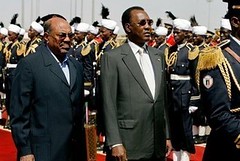
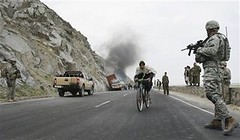
Author: Pan-African News Wire

  • The U.S. Supreme Court Wants to Kill Mumia Abu-Jamal

    The U.S. Supreme Court wants to kill Mumia Abu-Jamal

    Mumia is innocent: We must organize the Power of the People to stop his execution

    DEFEND BLACK HISTORY

    International Teach-In for Mumia Abu-Jamal

    Sat., Feb. 13
    12 noon to 5 p.m.
    Abiding Truth Ministries Church
    846 South 57th Street, Philadelphia
    (one block north from Baltimore Ave.)

    Activists from Philadelphia, across the U.S. and around the globe will take part in an important video streaming, video conferencing and live teach-in to take up the next stage in the struggle to free Mumia Abu-Jamal.

    Updates will be provided on the latest legal developments including the Jan. 19 U.S. Supreme Court decision that opens the way for the reinstatement of the death sentence. Information will be provided for those unfamiliar with this important case of the U.S.’s most prominent political prisoner and action proposals will be discussed including a global petition campaign calling on U.S. Attorney Eric Holder to open an investigation into civil rights violations in this case.

    Other proposals will discuss activities to reach out to and educate students and youth; and for events from April to July including teach-ins and protests.

    For more information call 215.476.8812 or
    215.724.1618 in Philadelphia or 212.330.8029 or
    212.633.6646 in New York
    www.freemumia.com, www.millions4mumia.org
    Email: [email protected]; [email protected]

  • The New American Imperialism in Africa

    The new American imperialism in Africa

    Michael Schmidt
    2010-02-04, Issue 468
    http://pambazuka.org/en/category/features/62008

    cc US ArmyMichael Schmidt reveals the alarming extent of American military expansion in Africa. This article was written four years ago, but still holds strong relevance today in the context of United States Africa Command (AFRICOM). Schmidt describes three avenues that the US is taking to increase its military foothold in Africa in pursuit of its ‘War on Terror’: ‘piggybacking’ off already strong French military presence, creating an unofficial ‘School of the Africas’ in the guise of the African Centre for Strategic Studies, and with its Africa Contingency Operations Training Assistance (ACOTA) programme ‘aimed at integrating African armed forces into US strategic (imperialist) objectives’. Schmidt places blame beyond the US, however, and uncovers the role that African countries, particularly South Africa, are playing in strengthening US military presence through ‘secret pacts’. In light of all this, Schmidt concludes with a warning: ‘It would be naïve to think that bourgeois democracy… will protect the working class, peasantry and poor from state terrorism.’

    AMERICA MUSCLES INTO ‘FRENCH TERRITORY’

    Former colonial power, France, has maintained the largest foreign military presence in Africa since most countries attained sovereignty in the 1950s and 1960s. While France reduced its armed presence on the continent by two thirds at the end of the last century, it continues to intervene in a muscular and controversial fashion. For example, under a 1961 ‘mutual defence’ pact, French forces were allowed to be permanently stationed in Ivory Coast and the 500-strong 43rd Marine Infantry Battalion is still based at Port Bouet next to the Abidjan airport.

    When the civil war erupted in Ivory Coast in September 2002, France added a ‘stabilisation force’, now numbering some 4,000 under Operation Licorne, which was augmented in 2003 by 1,500 Economic Community of West African States (ECOWAS) ‘peacekeepers’ drawn from Senegal, Ghana, Benin, Togo and Nigeria. In January 2006, the United Nations extended the mandate of Operation Licorne until December 2006.

    Piggybacking off the French military presence in Africa, however, are a series of new foreign military and policing initiatives by the United States and the European Union. It appears that the US has devised a new ‘Monroe Doctrine’ for Africa (the term has become a synonym for the doctrine of US interventions in what it saw as its Latin American ‘back yard’).

    Under the George W. Bush regime’s War on Terror doctrine, the US has designated a swathe of territory – curving across the globe from Colombia and Venezuela in South America, through Africa’s Maghreb, Sahara and Sahel regions, and into the Middle East and Central Asia – as the ‘arc of instability’, where both real and supposed terrorists may find refuge and training.

    In Africa, which falls under the US military’s European Command (EUCOM), the US has struck agreements with France to share its military bases. For example, there is now a US marine corps base in Djibouti at the French base of Camp Lemonier. More than 1,800 marines are stationed there, allegedly for ‘counter-terrorism’ operations in the Horn of Africa, the Middle East and East Africa, as well as for controlling the Red Sea shipping lanes.

    But the US presence involves more than piggybacking off French bases. In 2003, US intelligence operatives began training spies for four unnamed North African countries. These are believed to be Morocco and Egypt and perhaps also Algeria and Tunisia.

    It is also conducting training of the armed forces of countries such as Chad. In September 2005, Bush told the United Nations Security Council that the US would train 40,000 ‘African peace-keepers’ to ‘preserve justice and order in Africa’, over the following five years. The US Embassy in Pretoria said, at the time, that the US had already trained 20,000 ‘peace-keepers’ in 12 African countries in the use of ‘non-lethal equipment’.

    And now, while the US is downscaling and dismantling military bases in Germany and South Korea, it is relocating these military resources to Africa and the Middle East in order to ‘combat terrorism’ and ‘protect oil resources’.

    In Africa, new US bases are being built in Djibouti, Uganda, Senegal, and São Tomé & Príncipe. These ‘jumping-off points’ will station small, permanent forces, but with the ability to launch major regional military adventures, according to the US-based Associated Press. An existing US base at Entebbe in Uganda, under the one-party regime of US ally Yoweri Museveni, already ‘covers’ East Africa and the Great Lakes region. In Dakar, Senegal, the US is busy upgrading an airfield.

    SOUTH AFRICA SECRETLY JOINS THE ‘WAR ON TERROR’

    Governments with whom the US has concluded military pacts with include Gabon, Mauritania, Rwanda, Guinea and South Africa. The US also has a ‘second Guantanamo’ in the Indian Ocean, where alleged terror suspects who are kidnapped in Africa, the Middle East or Asia can be detained and interrogated without trial. This ‘second Guantanamo’ comprises of a detention camp, refuelling point and bomber base situated on the British-colonised Chagos Archipelago island of Diego Garcia, an island from which the indigenous inhabitants were forcibly removed to Mauritius.

    In South Africa’s case, while it is unlikely that there will ever be US bases established – the strength of South Africa’s own military, SANDF, makes this unnecessary – in 2005, the country quietly signed on to the US’s Africa Contingency Operations Training Assistance (ACOTA) programme, which is aimed at integrating African armed forces into US strategic (imperialist) objectives.

    South Africa, by signing on to ACOTA as the 13th African member, effectively joined the American War on Terror. ACOTA started life as a ‘humanitarian’ programme run by EUCOM out of Stuttgart, Germany, in 1996. After the 9/11 attacks, however, the Pentagon reorganised ACOTA and gave it more teeth.

    Today, ACOTA’s makeup is more obviously aggressive than defensive. According to journalist Pierre Abromovici – writing, in the July 2004 edition of Le Monde Diplomatique, about rumours that South Africa was preparing to sign ACOTA a full year before it did so – ‘ACOTA includes offensive training, particularly for regular infantry units and small units modelled on special forces… In Washington, the talk is no longer of non-lethal weapons… the emphasis is on “offensive” co-operation’.

    The real nature of ACOTA is perhaps indicated by the career of the man heading it up, Colonel Nestor Pino-Marina. He is, according to Abromovici, ‘a Cuban exile who took part in the 1961 failed US landing in the Bay of Pigs… He is also a former special forces officer who served in Vietnam and Laos. During the Reagan era he belonged to the Inter-American Defence Board, and, in the 1960s, he took part in clandestine operations against the Sandanistas. He was accused of involvement in drug-trafficking to fund arms sent to Central America’ to prop up pro-Washington right-wing dictatorships.

    Clearly, Pino-Marina is a fervent ‘anti-communist’ – whether that means opposing rebellious states or popular insurrections. He also sits on the executive of a strange outfit within the US military called the Cuban-American Military council, which aims at installing itself as the government of Cuba should the US ever achieve a forcible ‘regime-change’ there.

    The career of the US ambassador, Jendayi Fraser, who concluded the ACOTA pact with South Africa is also an indicator of US intentions. Fraser, Bush’s senior advisor on Africa, had no diplomatic experience. Instead, she once served as a politico-military planner with the joint chiefs of staff in the Department of Defence and as senior director for African affairs at the National Security Council. According to Fraser’s online biography, she ‘worked on African security issues with the State Department’s international military education training programmes’.

    IS THERE A MURDEROUS ‘SCHOOL OF THE AFRICAS’?

    The programmes that Fraser mentions include the ‘Next Generation of African Military Leaders’ course run by the shady African Centre for Strategic Studies based in Washington, which has ‘chapters’ in various African countries including South Africa. The Centre appears to be a sort of ‘School of the Africas’ similar to the infamous ‘School of the Americas’ based at Fort Benning in Georgia. In 2001, it was renamed the Western Hemisphere Institute for Security Cooperation (WHINSEC).

    Founded in 1946 in Panama, the School of the Americas has trained some 60,000 Latin American soldiers, including notorious neo-Nazi Bolivian dictator Hugo Banzer, infamous Panamanian dictator and drug czar Manuel Noriega, Argentine dictators Leopoldo Galtieri and Roberto Viola whose regime murdered 30,000 people between 1976 and 1983, numerous death-squad killers, and Efrain Vasquez and Ramirez Poveda who staged a failed US-backed coup in Venezuela in 2002.

    Over the decades, graduates of the School have murdered and tortured hundreds of thousands of people across Latin America, specifically targeting trade union leaders, grassroots activists, students, guerrilla units, and political opponents. The murder of Archbishop Oscar Romero of Nicaragua, in 1980, and the ‘El Mozote’ massacre of 767 villagers in El Salvador, in 1981, were committed by graduates of the School. And yet the School of the Americas Watch, an organisation trying to shut WHINSEC down, is on an FBI ‘anti-terrorism’ watch-list.

    So Africa should be concerned if the African Centre for Strategic Studies has similar objectives, even if the School of the Americas Watch cannot confirm these fears? There is more: we’ve all heard of the ‘Standby Force’ being devised by the African Union (AU), a coalition of Africa’s authoritarian neo-liberal regimes. But the AU has also set up, under the patronage of the Organisation for Security and Co-operation in Europe – which also covers North America, Russia and Central Asia – the African Centre for the Study and Research of Terrorism.

    The Centre is based in Algiers in Algeria, at the heart of a murderous regime that has itself ‘made disappear’ some 3,000 people between 1992 and 2003 (according to Amnesty International this is equivalent to the Pinochet dictatorship in Chile, but it is a fact ignored by the African left). The Centre’s director, Abdelhamid Boubazine told me that it would not only be a think-tank and trainer of ‘anti-terrorism’ judges, but that it would also have teeth and would provide training in ‘specific armed intervention’ to support the continent’s regimes.

    Anneli Botha, the senior researcher on terrorism at the Pretoria-based Institute for Security Studies, said though, that only ten per cent of terrorist attacks in Africa were on armed forces, and only six per cent were on state figures and institutions, though the latter were ‘focused’. She warned that a major cause of African terrorism was ‘a growing void between government and security forces on the one hand, and local communities on the other’. Caught in the grip of misery and poverty, many people are recruited into rebel armies even though few of these offer any sort of real solution.

    The Centre in Algiers operates under the AU’s ‘Algiers Convention on Terrorism’, which is notoriously vague on the definition of terrorism. This opens the door for a wide range of non-governmental, protest, grassroots, civic, and militant organisations to be targeted for elimination by the new counter-terrorism forces. It would be naïve to think that bourgeois democracy – which passed South Africa’s equally vaguely-defined Protection of Constitutional Democracy from Terrorism and Other Related Activities Act into law last year – will protect the working class, peasantry and poor from state terrorism.

    BROUGHT TO YOU BY PAMBAZUKA NEWS

    * Michael Schmidt is a Johannesburg-based journalist and political activist.
    * This article was first published in three years ago in ‘Zabalaza: a Journal of Southern African Revolutionary Anarchism’, No. 8, November 2006. Zabalaza is the English-language sister journal of the French-language Afrique Sans Châines.
    * Please send comments to [email protected] or comment online at Pambazuka News.

  • Putting Haiti Into Context

    Putting Haiti into context

    Andile Lungisa
    2010-02-04, Issue 468
    http://pambazuka.org/en/category/features/61979

    In the wake of the Haitian earthquake, ANC Youth League Deputy President Andile Lungisa calls for the disaster to be seen within its broader historical context. Discussing Haiti’s history as a nation long oppressed by external interests, Lungisa underlines the country’s new vulnerability to forces concerned solely for profit in the aftermath of its tragedy.

    A devastating earthquake, the worst in 200 years, struck Port-au-Prince on the 12 January, laying waste to the city and killed many thousands of people. The quake detonated more than 30 aftershocks throughout the night to the following morning.

    It toppled houses, hotels, hospitals and even the capital city’s main political buildings, including the presidential palace. The collapse of so many structures sent a giant cloud into the sky, which hovered over the city, raining dust down onto the wasteland below. An estimated 200,000 people have died in a metropolis of 2 million people, and those that survived are living in the streets, afraid to return inside any building that remains standing.

    The immediate suffering in Haiti is the result of a natural disaster of biblical proportion. It is also compounded by political disasters of the past two centuries, and the considerable responsibility for those disasters lies not only with the political penury of Haitian elites but also with Western, particularly US, policy-makers. The media coverage of the earthquake is marked by an almost complete separation of the disaster from the social and political history of Haiti.

    Haiti is seen as simply another ‘failed state’ to be pitied and in need of international intervention. Few people remember that Haiti has a glorious past.

    Journalists have noted that a slave revolt led to the founding of an independent Haiti in 1804 and made a passing reference on how France’s subsequent demand for ‘reparations’ (to compensate the French for their loss of property and slaves) crippled Haiti economically for more than a century. Some journalists have even pointed out that while it was a slave society, the United States backed France in that cruel policy and didn’t recognise Haiti’s independence until the Civil War.

    Occasional references also have been made to the 1915 US invasion under the ‘liberal’ Woodrow Wilson and an occupation that lasted until 1934, and support the US government gave to the two brutal Duvalier dictatorships (the infamous ‘Papa Doc’ and ‘Baby Doc’) that ravaged the country from 1957–86. Today there’s little discussion of how the problems of contemporary Haiti can be traced to those policies. It is thus important that a brief history of the resilient nation of Haiti is offered in order to contextualise the unfolding tragedy.

    Towards the end of the eighteenth century, Haiti, in those days Saint Domingue, was France’s richest colony. Haiti’s sugar plantations and Haiti’s African slaves provided the economic backbone and renaissance of France. After the fall of the Bastille, which ushered the institutional domination of capital, both Haiti’s white slave-owners and emancipated Haitian mulattoes sent representatives to the revolutionary convention in Paris. Haiti’s slave and plantation owners were relieved that the French monarchy and French commercial controls had collapsed, which opened up an interesting new market in the neighbouring United States. Haiti’s mulattoes were enthralled by French revolutionary principles. A Haitian mulatto leader, Lacombe, insisted that freedom, brotherhood and equality were principles which ought to be observed also in Haiti. He was immediately hanged by irate French slave-owners.

    Haiti’s popular majority, hundreds of thousands of African slaves, sent no representatives to revolutionary Paris. Instead they organised themselves, using the cover of voodoo sessions, which were tolerated by French plantation owners who thought their slaves were merely gathering to dance and worship their African gods. Haiti’s slaves were modernised proletariats brought together by their work on the big plantations. And they too heard the rumours from France and the signals of the revolution.

    The first Haitian slave rebellion took place in the month of August 1791. Twelve thousand slaves in the northern parts of Saint Domingue rose up, ransacked the plantations and hanged their oppressors on the nearest palm trees. And this is where Toussaint L’Ouverture, Haiti’s revolutionary leader, enters world history. He was a literate, black supervisor on a slave plantation where his French master seems to have been fairly tolerant and was protected by Toussaint against rebellious slaves.

    For a while Toussaint was seen as a benign slave collaborator, but he had realised that the slaves needed military organisation. He raised a black army and had the satisfaction of defeating two European invasions. First he defeated the troops sent out by revolutionary France to quell the slave rebellion. After that he defeated 100,000 British soldiers, dispatched by Prime Minister William Pitt ‘the younger’. The invaders were thoroughly beaten by Haiti’s African defenders and by yellow fever.

    In France, the Jacobins especially showed a great deal of sympathy for revolutionary Haiti, and in 1793 slavery was banned. However, after assuming power, the first consul, Napoléon Bonaparte, decided to reintroduce slavery and, as he put it, ‘rip the epaulettes off the shoulders of the Negroes’. Napoléon sent new invading forces. Haiti did survive as an independent nation but was under perpetual pressure from France, England, the United States and Spain. Toussaint L’Ouverture eventually died in a French dungeon.

    Even more glaring is the absence of a discussion of more recent Haiti–US relations, especially US support for the two coups (1991 and 2004) against a democratically elected president. Jean-Bertrand Aristide won a stunning victory in 1990 by articulating the aspirations of Haiti’s poorest citizens, and his populist economic programme irritated both Haitian elites and US policy-makers.

    The George H.W. Bush administration nominally condemned the 1991 military coup but gave tacit support to the generals. Subsequently, US President Bill Clinton eventually helped Aristide return to power in Haiti in 1994, but not until the Haitian leader had been forced to capitulate to business-friendly economic policies demanded by the United States.

    When Aristide won another election in 2000, the George W. Bush administration blocked crucial loans to his government and supported the violent reactionary forces attacking Aristide’s party. The sad conclusion to that policy came in 2004 when the US military effectively kidnapped Aristide and flew him out of the country.

    Aristide today is our guest in South Africa, blocked by the United States from returning to his country, where he still has many supporters and could help in the relief efforts.

    Exactly two weeks after the disaster, government ministers, international bankers and aid agencies gathered in Montreal, Canada, to discuss plans for ‘reconstructing’ earthquake-ravaged Haiti, a project that the theorist Naomi Klein has prudently termed ‘Disaster Capital’. At the heart of the proposal in Montreal is the re-colonisation of Haiti and the brutal exploitation of its people. Haiti is now being run by the US military which has deployed over 13,000 troops and unilaterally taken control of the country’s airport and port facilities.

    The Pentagon dominates the provision of relief which it has subordinated to the number one priority of deploying combat-equipped US soldiers and Marines, much to the detriment of injured and hungry Haitians waiting for life-saving medical supplies and food. Behind the talk of Haiti’s ‘reconstruction’, what is being discussed is a plan worked out in the months before the earthquake that is dictated by the profit interests of US banks and corporations, together with those of Haiti’s wealthy elite.

    Speaking to reporters en route from Washington to Montreal, US Secretary of State Hillary Clinton referred to this plan, ‘Disaster Capital’, while praising the work of her husband, former president Bill Clinton, in seeking to implement it in his position as United Nations envoy to Haiti. ‘He had just had a conference with 500 businesspeople’, she said. ‘They were signing contracts, they were making investments.’

    She continued: ‘So we have a plan. It is a legitimate plan. It was done in conjunction with other international donors, with the United Nations. And I don’t want to start from scratch, but we have to recognise the changed challenges we are now confronting.’

    The plan, worked up at the behest of the UN last year, is aimed at expanding the Haitian economy through the development of free-trade zones based on garment sweatshops in which Haitian workers would be paid near-starvation wages. The initiative is based on a report prepared for the UN last year by Oxford University economics professor Paul Collier.

    The report perversely cast Haiti’s poverty – the deepest in the Western hemisphere – as its number one asset in the global capitalist economy. ‘Due to its poverty and relatively unregulated labour market, Haiti has labour costs that are fully competitive with China, which is the global benchmark’, Collier wrote. This ‘asset’ is something that both Washington and Haiti’s parasitical ruling elite have jealously guarded.

    Former president Jean-Bertrand Aristide was overthrown twice – in 1991 and 2004 – in bloody coups orchestrated by the CIA in conjunction with Haitian factory owners, in large measure for proposing to raise the country’s minimum wage.

    BROUGHT TO YOU BY PAMBAZUKA NEWS

    * Andile Lungisa is the deputy president of the ANC Youth League and executive chairman of the National Youth Development Agency.
    * This article was originally published by ANC Today.
    * Please send comments to [email protected] or comment online at Pambazuka News.

  • Yemen Arrests 154 Nigerians, Sudanese Migrants

    Yemen arrests 154 Nigerian, Sudanese infiltrators

    09:41, February 11, 2010

    Yemeni coast-guard have arrested 154 African infiltrators from Nigeria and Sudan in the western province of al-Hodaidah, the Interior Ministry said on Wednesday.

    A total of 143 Nigerians, including 46 women and 25 children, along with 11 Sudanese were arrested in al-Hodaidah province, located near the Red Sea, said the ministry in a statement.

    “The African infiltrators were captured when they arrived in two boats in the city of al-Leahya in al-Hodaidah,” said the Yemeni coast-guard in the Red Sea was quoted by the Interior Ministry as saying.

    The ministry did not provide the date of arrest, but said it has seized the two smuggling boasts and sent the Africans to the security authorities for interrogation on charges of illegally entering Yemen.

    Meanwhile, the Defense Ministry said on Wednesday on its website that Yemeni border guards have seized 1,200 African infiltrators in the past two days after they illegally sneaked into western Yemeni coastal city of al-Leahya in al-Hodaidah.

    The report said the infiltrators were from different African nations, providing no further information.

    Last month, the Sanaa government launched security campaign on its wide-spreading coasts to prevent terrorists from infiltrating into the country.

    It also launched an arrest campaign to detain foreigners who are not registered as a refugee or who have no residence permits as well as those who violate the rules of residence.

    The campaign followed a threat by Somali extremists to supply their peers in the Yemen-based wing of al-Qaida with logistic support including arms and fighters.

    According to official statistics, Yemen, the poorest country in the Arab world, hosts 800,000 African migrants despite its faltered economy and security problems.

    The United Nations High Commissioner for Refugees (UNHCR) last month said more than 74,000 Africans, fleeing civil war, political instability, poverty and drought in Somalia, crossed the Gulf of Aden to reach Yemen in 2009, a 50 percent increase over the 50,000 arrivals in 2008.

    Source: Xinhua

  • Zuma to Shed Light on Government Top Priorities in Pivotal Address

    Zuma to shed light on govt top priorities in pivotal address

    February 10 2010 , 5:47:00

    President Jacob Zuma is expected to shed light on progress made in the realisation of government’s five key priorities during his State of the Nation Address tomorrow evening. Last year, he identified education, health, rural development, crime and job creation as his main priorities for the year.

    The other highlight will be celebrating the country’s achievements since President Nelson Mandela’s release. Symbolically, the address coincides with the anniversary of the release of Mandela from prison. Mandela served 27-years in prison on charges of sabotage and other crimes allegedly committed while leading the movement against apartheid. It is likely to be a core message of President Zuma’s address tomorrow evening. The president is likely to use Madiba’s legacy to call for the nation to unite.

    South Africa is still faced with challenges in the areas of health, crime, education, job creation and rural development. His response to the challenges facing the people that is much anticipated. Predictably, unemployment and crime are the biggest concerns for the ordinary people. They hope the president will give more details on how to deal with these challenges.

    Last year, he promised to create 500 000 job opportunities by December last year but, almost a million were lost.

    Zuma is also expected to use his address to make a call to the country to make the World Cup a success.

    For the first time in South African history, the president’s important address will take place in the evening. Presidential spokesperson Vincent Magwenya said that more people will be able to watch Zuma’s address in the evening, saying: “The motivation is to allow more South Africans, especially the workers, students and school children who do not have access to television sets while at work or at school to follow the proceedings.”

    For those on the move and need regular updates on the State of the Nation Address, call 082 155 and for more on the address and to watch the live stream, visit www.sabcnews.com.

  • Jamie Scott Update: Campaign Calls For Compassionate Release From Mississippi Prison

    Jamie Scott Update: National Campaign Calling for Compassionate Release

    Background info on the struggle to save the life of Jamie Scott, wrongfully convicted, unjustly imprisoned for 15 yrs and now suffering with complete kidney failure is at:
    http://www.freethescottsisters.blogspot.com

    We are in the midst of a campaign to obtain Compassionate Release for her and an update on the latest action requests are below. Please participate in this urgent activity, we are trying to save the life of this young woman, thank you for reading!

    PLEASE blast Governor Haley Barbour’s office! Jamie Scott was takenby ambulance to the hospital yesterday and returned to the prison thereafter and we’ve been told that she is very severely depressed. We have no official report on what was done to her there but believe that it could at the very least have included her having a dialysis treatment performed. We have some important organizing updates to share, so please forward and ACT!

    The Action Committee for Women in Prison just posted a BRAND NEW petition specific to getting compassionate release for Jamie Scott and we need to get as many people to sign on as quickly as possible, so please go to http://tinyurl.com/yfrj5g6 and SEND IT TO OTHERS.

    Peggy Plews of Mississippi Prison Watch did an outstanding appeal to the Mississippi Kidney Foundation at:

    http://mississippiprisonwatch.blogspot.com/2010/02/mississippi-kidney-foundation-appeal.html, which includes the following powerful statement:

    “It may well be that Jamie’s crisis is the catalyst that gets so much needed focus on the critically and terminally ill in prison; without her voice, countless others may suffer in invisibility. And her example of survival and resistance is an inspiration to other women living and dying there, too.” Check it out, she was very thorough!

    The Women Behind the Wall blogtalk radio program hosted by Mary Ellen and Gloria on 2/9 provided a lot of education and insight from those who could personally testify to being sick inside of those hellholes and the lack of caring offered by the corporations which dole out what passes for medical care, some of which has to come directly from the inmates’ own pockets!

    This program featured Mrs. Rasco and Shakeerah Abdul al-Sabuur, paralegal, and is archived at:
    http://www.blogtalkradio.com/4justicenow/2010/02/09/women-behindthe-wall?&utm_source=remail&utm_medium=listener

    The fantastic San Francisco Bay View continues to be our leading print resource and has posted a wonderful new piece today at the site: http://www.sfbayview.com/2010/compassionate-release-for-jamie-scott/

    We’ve added in a new link to the Govs’ assistant and ask that folks please CALL into the governor’s office for maximum effect, but additionally follow-up with e-mails, letters, faxes and anything possible. Please do something rather than nothing at all!

    Thank you so much, everyone!

    http://www.freethescottsisters.blogspot.com
    ———————

    BE DIRECT BUT PLEASE BE COURTEOUS — NO YELLING OR CURSING!
    IT WILL ONLY TAKE A FEW MINUTES, PLEASE PARTICIPATE!

    Governor Haley Barbour
    P.O. Box 139
    Jackson, Mississippi 39205
    1-877-405-0733 or 601-359-3150
    Fax: 601-359-3741
    (If you reach VM leave msgs, faxes, and please send letters)

    Dorothy Kuykendall
    Personal Assistant to Gov. Barbour
    (601) 359-3150
    [email protected]
    P. O Box 3150
    Jackson, MS 39205

    Christopher Epps, Commissioner of Prisons for the State of Mississippi
    601-359-5600
    [email protected]
    723 North President Street
    Jackson, MS 39202

    Emmitt Sparkman, Deputy Commissioner
    (601) 359-5610
    [email protected]

    Margaret Bingham, Superintendent of Central Mississippi Corrections Facility
    (601) 932-2880
    [email protected]
    FAX: (601) 664-0782
    P.O. Box 88550
    Pearl, Mississippi 39208

    Dr. Gloria Perry, Medical Department (601) 359-5155
    [email protected]

    Attorney General Eric Holder
    U.S. Department of Justice
    950 Pennsylvania Avenue, NW
    Washington, DC 20530-0001

    MAYOR OF PEARL, MISSISSIPPI (Where Jamie is incarcerated):
    Brad Rogers
    Phone Number (601) 932 3575
    Fax Number (601)932-3568

    Congressman Gregg Harper
    2507-A Old Brandon Road
    Pearl, MS 39208
    Phone: (601) 932 2410
    Fax: (601) 932 4647

    U.S. Senator Thad Cochran
    United States Senate
    Wash., D.C. 20510-2402
    JACKSON 601-965-4459
    Contact Form: http://cochran.senate.gov/contact.htm

    (FEEL FREE TO CONTACT ANY AND ALL MAJOR MEDIA YOU HAVE
    INFORMATION FOR, DON’T BE LIMITED BY THESE LISTINGS AT ALL!)

    MISSISSIPPI MEDIA:

    WLBT
    (601) 960-4426 newsroom
    (601) 355-7830 newsroom fax
    http://www.wlbt.com/Global/story.asp?S=241208&nav=menu119_8_8
    “Stribling, Wilson” , ( Asst News Director )

    WAPT TV
    calling 601-922-1607. To report news tips, call 601-922-1652.
    to submit news to the MGR, news anchor or anyone use this link
    http://www.wapt.com/contact/index.html

    WJTV
    Phone: (601) 372-6311
    Fax: (601) 372-8798
    http://www2.wjtv.com/jtv/online/site_information/contacts/

    FOX40
    601-922-1234
    http://www.my601.com/content/contactus/default.aspx

    GENERAL MEDIA:

    NBC TODAY SHOW: [email protected]
    NBC NIGHTLY NEWS: [email protected]
    Listing of NBC/MSNBC Show e-mails at http://www.msnbc.msn.com/id/10285339/

    NBC News
    30 Rockefeller Plaza
    New York, N.Y. 10112
    Phone: (212) 664-4444
    Fax: (212) 664-4426

    CBS FEEDBACK FORM: http://www.cbs.com/info/user_services/fb_global_form.php
    CBS NEWS
    524 W. 57 St., New York, NY 10019
    Phone: 212-975-4321
    Fax: 212-975-1893

    ABC NEWS CONTACT FORM: http://abcnews.go.com/Site/page?id=3271346&cat=Good%20Morning%20America
    ABC NEWS
    77 W. 66 St., New York, NY 10023
    Phone: 212-456-7777

    CNN NEWS TIP FORM: http://www.cnn.com/feedback/tips/newstips.html
    CNN
    One CNN Center, Box 105366, Atlanta, GA 30303-5366
    Phone: 404-827-1500
    Fax: 404-827-1784

    Inside Edition
    VIEWER COMMENTS
    PO Box 1323
    Radio City Station
    New York, NY 10101
    E-mail us at: [email protected]
    Call us at: (212) 817-5555

    Joe Madison: [email protected]

    Geraldo Rivera: [email protected]

    Oprah Contact Form: https://www.oprah.com/plugform.jsp?plugId=220

    USA Today
    7950 Jones Branch Dr., McLean, VA 22108
    Phone: 703-854-3400
    Fax: 703-854-2078

    Associated Press
    450 West 33rd St., New York, NY 10001
    Phone: 212-621-1500
    Fax: 212-621-7523
    General Questions and Comments: [email protected]

    Congressman Bennie Thompsom
    Washington, D.C. Office
    2432 Rayburn HOB
    Washington, D.C. 20515
    (202) 225-5876
    (202) 225-5898 (Fax)
    Jackson, Mississippi Office
    3607 Medgar Evers Blvd
    Jackson, MS 39213
    (601) 946-9003
    (601)-982-5337 (Fax)

    Congressman Alcee L. Hastings
    Washington Office
    2353 Rayburn Office Building
    Washington D.C. 20515
    Tel: (202) 225-1313
    Fax: (202) 225-1171

    Congressman Jeff Miller
    Washington D.C.
    2439 Rayburn House Office Building
    Washington DC 20515
    Phone: (202) 225-4136
    Fax: (202) 225-3414
    Toll Free Phone Number to District Office
    Pensacola, Florida
    Phone: 866-367-1614

  • Expanding the War to Yemen: The Pentagon’s War on Terror–Does It Make People in the U.S. Safer?

    Expanding the war to Yemen

    The Pentagon’s war on terror — does it make people in the U.S. safer?

    PART 3
    By Joyce Chediac
    Published Feb 7, 2010 7:28 PM

    Some 2,752 people were killed on Sept. 11, 2001, in the airplane attacks in the U.S. Their deaths have been marked and mourned. Today just the words “World Trade Center,” “9/11” and “al-Qaida” bring to mind attacks on civilians and fear of other such attacks.

    Washington has recently invoked these civilian deaths and a need to “protect American lives” to justify drone and cruise missile attacks in Yemen. A closer look, however, reveals that the U.S. government is using the 9/11 deaths as a pretext to kill civilians abroad. Pentagon attacks in Iraq, Afghanistan, Pakistan and now Yemen have killed tens of thousands of civilians.

    In Afghanistan, Pakistan and Yemen, U.S. drones target homes and neighborhoods. Every time the Pentagon or its clients announce that drone-launched cruise missiles killed a “terrorist leader,” the cruise missiles likely killed the entire family, any visiting relatives and any close neighbors of the alleged leader.

    Is the U.S. really hitting “al-Qaida operatives”?

    Neither the Obama administration nor the Pentagon expresses sympathy for these civilian deaths. In the name of eliminating “al-Qaida operatives,” the Pentagon is attacking whole communities.

    The U.S. media report that 30 Afghan civilians were killed the week of Jan. 11 alone. In both Afghanistan and Pakistan, cruise missiles have annihilated wedding parties. In 2009, the civilian toll in Afghanistan was the highest since the U.S. occupied that country in 2001.

    Investigative journalist Allan Nairn, interviewed Jan. 6 on WBAI Radio’s “Democracy Now!” explained that the U.S. had implemented the “El Salvador Option” in Iraq. This meant copying the death squads Washington set up in Central America in the 1980s under Gen. Stanley McCrystal’s direction. This killing of local leaders is flippantly called “man hunting,” said Nairn.

    The bombing of the CIA office in Khost, Afghanistan, on Dec. 30 revealed that the CIA there was involved in assassinating local leaders. Gen. McCrystal now runs the Afghanistan war.

    On Dec. 27, U.S. forces in Afghanistan’s Ghazi Khan Village dragged from their beds, handcuffed, then executed eight people they called “terrorists,” who turned out to be school children between the ages of 11 and 17. Their schoolmaster confirmed the youths’ identities and ages.

    Mass outrage over the massacre sparked protests, including one of school children in Kabul demanding that the U.S. get out. The Afghans charged the international occupation forces with valuing Afghan lives less than the lives of the occupation troops.

    In Yemen, a Dec. 17 attack which the pro-U.S. government claimed “killed 34 al-Qaida militants and foiled a terror plot,” really killed at least 49 civilians, including 23 children and 17 women, according to local officials. The regime also attacked a meeting planning a protest against the massacre. (Counterpunch, Jan. 15-17)

    After the Dec. 30 bombing of the CIA office in Afghanistan, the Pentagon drastically increased drone attacks on villages in Pakistan, surely killing more families and hitting more wedding parties.

    Killing civilians, it seems, was part of the Pentagon’s plan right from the beginning. According to Nairn, a feasibility study done by the Pentagon before the 2003 invasion of Iraq showed that of the 22 attacks planned the first day, approximately 30 civilians would be killed in each attack. The study referred to the civilian deaths as “bug splat.” This study was presented to Gen. Tommy Franks, who said to go ahead, do them all.

    Some 660 civilian deaths were anticipated in the first day of the Iraq war alone. This “bug splat” was a quarter of the 9/11 casualties, on the war’s first day.

    Occupation leads to suicide bombings

    How would you feel if your family was murdered, their deaths treated as bug splat? What would you do? Wouldn’t you be angry?

    Washington and the Pentagon know full well that their wars will fuel resistance. They have heard it from their own think tanks and academics. Robert Pates of the University of Chicago, a leading bourgeois expert on suicide bombings and a political conservative, called suicide bombings “a consequence of occupation.”

    The Rand Corporation, a major ruling-class think tank, said in a 2008 report, “U.S. policymakers should end the use of the phrase ‘war on terrorism’ since there is no battlefield solution to defeating al-Qaida.”

    If there is no “battlefield solution” to terrorism, who gains from the $1.05 trillion spent so far on the Iraq and Afghanistan wars? Who benefits from the $700 billion slated this year for the military, with $75 billion specifically earmarked for “the war on terrorism”?

    These U.S. wars are not about protecting people in the U.S. They are about getting new sources of profits for the oil companies and Wall Street corporations. U.S. oil companies want Iraqi oil, the huge untapped reserves in Yemen, and to run a pipeline through strategic Afghanistan from the vast oil wealth in the former Soviet Asian republics.

    Meanwhile, the mercenary company Blackwell, along with Bechtel, Halliburton and General Electric, to name a few, have reaped billions of dollars in profits from contracts in Iraq and Afghanistan.

    More than 5,000 U.S troops, sons and daughters of the working class, have died in Iraq and Afghanistan securing profits and strategic advantage for the corporations. Are they “bug splat” too?

    Do Pentagon actions make workers safer at home?

    Tens of millions of people in the U.S. are consumed with fear — fear of home foreclosures, of long-term unemployment and dwindling opportunities for themselves and their children. People are afraid to get sick because they have no health insurance, or the insurance they pay for might not cover their illness or medications.

    The banks finance the Pentagon’s military adventures abroad, and get their cut from corporate war profiteers. The banks gambled on real estate and left millions of working-class households in ruin. Now that the government has bailed them out, the same banks refuse to let workers renegotiate their mortgages, while they give themselves big fat bonuses.

    The jobs, homes, savings, health care and retirement funds that have been lost were not taken away by Osama Bin Laden, the Taliban, al-Qaida in Yemen, or by Iran, Syria, Hamas or Hezbollah. They are not our enemy.

    The greed of these banks and corporations has caused many, many times more death and misery than any so-called threat from al-Qaida.

    Articles copyright 1995-2010 Workers World. Verbatim copying and distribution of this entire article is permitted in any medium without royalty provided this notice is preserved.

    Workers World, 55 W. 17 St., NY, NY 10011
    Email: [email protected]
    Page printed from:
    http://www.workers.org/2010/world/yemen_0211/

  • African Singers to Raise Money for Haiti

    African singers to raise money for Haiti

    10 Feb 2010 15:52:16 GMT
    Source: Reuters

    DAKAR, Feb 10 – West and Central African singing stars will record a song in early March in the Senegalese capital Dakar to raise money for victims of last month’s earthquake in Haiti, the musical project’s leader said on Wednesday.

    More than 200,000 people were killed and a million left homeless when a magnitude 7.0 quake struck the poor Caribbean country on Jan. 12. Since then, a mass of international relief efforts have been launched.

    In the most recent African aid initiative, dozens of singers, among them internationally known names including Senegalese vocalists Youssou Ndour and Baba Maal, Ivorian reggae artist Alpha Blondy and Congolese musicians Lokua Kanza and Papa Wemba, will gather in Dakar from March 1-6 to record a song, all proceeds from which will go to Haitians.

    “We have seen many solidarity actions from other parts of the world, we too have to do our share,” singer and project coordinator Coumba Gawlo Seck told Senegalese television after a meeting with Senegal’s President Abdoulaye Wade.

    Mali and Guinea will also be represented musically, while Coumba Gawlo said a mega-concert in Dakar will be organised to raise more money for Haitians.

    Soon after the earthquake, Wade grabbed international headlines but surprised many in his own country by proposing the creation of a new African state to resettle homeless Haitians, comparing the idea to the 1948 birth of the state of Israel.

    (Reporting by Diadie Ba; Editing by Daniel Magnowski and Paul Casciato)

  • Storm Over Bailout of Greece, European Union’s Most Ailing Economy

    From The Times

    February 10, 2010

    Storm over bailout of Greece, EU’s most ailing economy

    Athens will be paralysed today by a 24-hour strike against a government trying to stave off bankruptcy ? as fellow members of the eurozone squabble over how best to solve Greece?s debt crisis

    David Charter in Brussels

    Angela Merkel tried to calm fevered speculation in financial markets yesterday that Germany was preparing to lead a bail-out of Greece amid a split in the EU on how to handle its most ailing member.

    The German Chancellor denied reports that her Finance Minister was conducting secret talks with Jean-Claude Trichet, head of the European Central Bank, and with other capitals on an EU rescue fund for Athens.

    Mrs Merkel has staunchly resisted suggestions that the EU must swallow its pride and turn to the Washington-based IMF for a solution to the growing economic turmoil in Greece, with fears that its troubles in international finance markets will trigger a domino effect, toppling other weak members of the eurozone such as Ireland, Portugal, Spain and Italy.

    But last night there were signs of a developing European split over calling in the International Monetary Fund, a move also strongly opposed by Brussels, with suggestions from Sweden’s Finance Minister and other officials that this might be better than the EU programme outlined last week.

    Mrs Merkel has repeatedly rejected the idea that the 16-nation eurozone would need to look to the IMF, which is already overseeing recovery efforts in Latvia and Hungary — both EU members outside the single currency. Her insistence that the eurozone can keep its own house in order led to market speculation yesterday that an EU bail-out was imminent.

    There were also reports yesterday that Wolfgang Schäuble, the German Finance Minister, was working bilaterally and at the European level on putting together a package to help Athens.

    A strong rally on Wall Street went into reverse when a spokesman for Mrs Merkel said flatly that this was “wrong”.

    The crisis in Greece that is putting the euro under its biggest strain in the ten-year history of the single currency has forced its way on to the agenda of an economic summit for the 27 EU leaders in Brussels tomorrow. It is the first extraordinary meeting called by the new EU President, Herman Van Rompuy, and was supposed to be a relaxed day of long-term thinking about job creation over ten years. Instead, the prospect of a Greek default triggering a wider crisis in other weak economies such as Portugal and Spain will hang over the leaders.

    The split emerged when Anders Borg, the Swedish Finance Minister, said that “the IMF has the technical knowledge” to resolve the Greek economic crisis, breaking the careful EU public consensus that the eurozone can cope. Mr Borg insisted that discussion of an IMF role in resolving Greece’s crisis should not be ruled out.

    An EU official added: “There have obviously been discussions going on at an EU level about what the options are. There is a feeling that the IMF could offer a better course of action. The IMF has precedents or doing this, it has a system with measures in place.”

  • Dressing Rich and Powerful

    Dressing rich and powerful

    10 February 2010
    Zenoyise Madikwa
    The Sowetan

    Designers played with the ankara fabric to make a statement in their designs during the Face of Africa competition on Saturday.

    I ATTENDED the Face of Africa contest in Lagos, Nigeria, on Saturday thinking that I was going to be the best-dressed in my little ensemble by a hot local designer.

    When I saw Nigerian ladies walking down the red carpet in their Ankara-inspired clothes, I wanted to run back to my hotel room to cover myself.

    In Nigeria any celebration is a chance to look good and clothes are a symbol of status and wealth.

    From head to toe Nigerian women make sure that they impress. The make-up is impeccable on their beautiful dark skins.

    There is not a single hair out of place and the nails are well done. The only turn-off about Naija women is their attitude.

    In their minds every woman is after their hot men. Maybe their fears are not far-fetched after all. Nigerian men seem to be a hit with South African women.

    There have been many reports about South African women , especially models, frequenting their country with their rich men.

    Back to fashion, according to top Nigerian designer Lisa Folawiyo of Jewel by Lisa, in Nigeria being fashionable is a priority for more than 70 percent of the Nigerian population.

    “Every female is not only trying to be fashionable but also to be a fashionista. Nigerian women love to dazzle. This is something that has been transferred from one generation to another.”

    Folawiyo adds that in recent years the Nigerian fashion scene has witnessed an astronomical upgrade that western fashion is fast losing its taste among many Nigerian women and many are choosing the ankara, which is one of the hottest trends in Nigeria today.

    This was evident in many Nigerian designs showcased at the M-Net Face of Africa ramp recently.

    Most Nigerian designers, including those that are based overseas, were inspired by the ankara, one way or the other.

    Formerly referred to as Dutch; this fabric acquired the name “Ankara” when the Turks made a cheaper version. Without a glamorous look, the fabric was regarded as indigenous.

    Fashion-savvy Nigerians have taken the fabric, improved it, and have represented it to the world.

    Folawiyo says the ankara is so versatile, easy to wear, and works wonderfully well with any essential accessory.

    It can be worn in combinations done tastefully and with a critical eye to its colourful nature.

    These days Ankara can be combined with satin, chiffon, linen, and even sometimes lace fabric.

    It has infiltrated the South African fashion scene as well. These day in South Africa the ankara has also become a symbol of class.

    Wealthy women usually show up in events such as the opening of Parliament and weddings dressed up in an ankara.

    Tomorrow any parliamentarians are likely to rock up in dresses made of this West African fabric.

    How to care for your ankara?

    It can either be hand or machine washed. Do not wash your the ankara in hot water, it will only fade away.

    As heat could cause your Ankara to easily fade and discolour, it is best to iron it inside out .

    The ankara is very durable and will stand the test of time. It will always look good but being wax, it will eventually begin to slightly fade.

    There is no need to soak your ankara in water for more than you need to, this might weaken its fibres.

    After washing allow to dry properly before storing.

    Also avoid washing your Ankara with detergents or acidic soaps; rather use quality bar soap.

    Avoid washing your ankara too often so as to prolong the lifespan.

    – Additional info http://www.fashionafrica.com

  • South African Authorities Crack Down on Balfour Protesters

    Cops crack down on Balfour protesters

    JOHANNESBURG, SOUTH AFRICA Feb 10 2010 08:16

    It was “very, very quiet” in the Siyathemba township in Balfour on Wednesday morning after violent protests earlier in the week, Mpumalanga police said.

    Sergeant Sam Tshabalala said the township calmed down at about 10pm on Tuesday.

    “It is calm in the township and we have members on the ground monitoring the situation,” said Tshabalala.

    The police arrested 12 South Africans, both male and female, for public violence on Tuesday night.

    “Some of them will also be linked to charges of malicious damage to state property after they damaged a police vehicle,” said Tshabalala.

    A foreign national was arrested for assault.

    “It is alleged that he and a group of other foreign nationals attacked members of the public, but we still have to investigate whether this could be related to the violence.”

    Tshabalala said there were no reports of injuries during the night.

    Twenty-two people were expected to appear in the Balfour Magistrate’s Court on Wednesday to face charges of public violence related to the protests.

    A municipal office was set alight in the township during the violence, which started on Sunday and continued into Monday.

    Police had opened a case of arson, but no one had yet been charged, Tshabalala said.

    About 15 foreigners who fled the violence went to the police station on Monday morning to ask to be accompanied back into the township to check on their shops and collect their belongings.

    President Jacob Zuma visited Balfour last year following a series of protests at Siyathemba by residents demanding the removal of all Mbombela municipal councillors. – Sapa

    Source: Mail & Guardian Online
    Web Address: http://www.mg.co.za/article/2010-02-10-cops-crack-down-on-balfour-protesters

  • African-American History & The Struggle For Socialism: A Public Forum in Detroit, Feb. 20, 5:00-8:00pm

    For Immediate Release

    Event: African-American History Month Program
    Date: Saturday, Feb. 20, 2010, 5:00-8:00pm
    Location: 5920 Second Avenue at Antoinette (WSU area)
    Sponsor: Workers World Party and the Harriet Tubman School
    Contact: 313.671.3715 or 887.4344
    E-mail: [email protected]
    Dinner: African-American Cuisine Served

    African American History & The Struggle for Socialism

    Even though it is hidden in the official accounts of U.S. history, African-Americans have played a pivotal role in the struggles against national oppression, capitalism and imperialism. During slavery Africans revolted and fled from bondage. Many fought in the civil war and afterwards for freedom and self-determination.

    African-American workers and youth have been on the ground level in the formation of trade unions and student organizations. Thousands joined left movements between World War I
    and the Great Depression. In the 1960s and 1970s, the Black Panther Party and the League of Revolutionary Black Workers advanced socialism as a political goal.

    Today African-Americans and women are on the frontlines of the struggle against the economic crisis for jobs, housing, health care and quality education. Join us on Feb. 20 for this groundbreaking discussion.

    Speakers Include:

    Debbie Johnson, Meeting Chair: Member of Workers World Detroit Branch

    Sandra Hines, Moratorium NOW! Coalition Organizer: Presents “A Tribute to Langston Hughes”

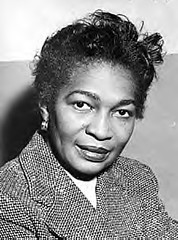
    Andrea Egypt, MECAWI/Moratorium NOW! Coalition Organizer: “Report on the Legacy of Claudia Jones and the Role of African-American Women in the Fight for Socialism”

    Kevin Carey, People’s Task Force: Report on “The Cold War, COINTELPRO & The Black Left”

    Abayomi Azikiwe, Editor, Pan-African News Wire: Report on “Socialism and the Right of Oppressed Nations to Self-Determination”

  • South African Unemployment Rate Remains Virtually Unchanged

    BuaNews (Tshwane)

    South Africa: Unemployment Rate Remains Virtually Unchanged

    9 February 2010

    Pretoria — South Africa’s unemployment rate in the fourth quarter of 2009 remained virtually unchanged at 24.3 percent, says Statistics South Africa (Stats SA).

    Stats SA’s Quarterly Labour Force survey showed that in the third quarter of 2009, 24.5 percent people were jobless.

    The number of people employed in the labour force increased by 61 000 between quarter three and four.

    The survey showed that though there was a slight improvement in job creation from the two quarters this did not necessarily translate to a big decrease in the number of unemployed people at 27 000. It said that rather there was a slight increase in the number of discouraged work seekers at 54 000.

    “This resulted in the unemployment rate remaining virtually unchanged between quarter three and four,” said the statistical body.

    On a year-on-year basis there was an annual decrease of 6.3 percent in employment and an increase of 292 000 in the number of unemployed people.

    There was also an increase of 947 000 in the number of persons who were not economically active of which 518 000 were discouraged work-seekers.

    Between the third and fourth quarter, 89 000 jobs were created across all industries with most of the job gains in the finance industry which accounted for 77 000 jobs. This was followed by the construction and trade industries.

    When coming to industries that lost the most jobs year-on-year trade accounting, manufacturing, private households and agriculture. “There was an overall decline of 870 000 in employment between quarter four 2008 and quarter four 2009,” said Stats SA, adding that job losses were experienced in all industries.

    In comparison to 2008 the number of unemployed persons increased by 292 000 in quarter four of which 227 000 were job losers.

  • South Africa: Violence Continues During Balfour Protests

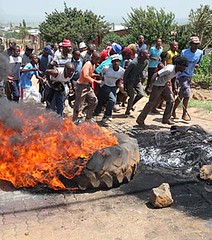
    Violence continues during Balfour protests

    JENNI O’GRADY | JOHANNESBURG, SOUTH AFRICA – Feb 09 2010 17:09

    The library in Balfour’s Siyathemba township went up in flames on Tuesday afternoon during a protest that appears to have shifted from labour recruitment demands to an insistence the local mayor resign.

    “They are burning the library down,” said police spokesperson Sergeant Sam Tshabalala on the third day of violence in the Mpumalanga township.

    Earlier, police fired rubber bullets when between 800 to 1 000 people became “irritated” during a meeting outside the Siyathemba community hall.

    Zakhele Maya, who says he is a community leader, told the South African Press Association he had been called to address a large crowd outside the hall, and was then told to go to the mayor’s office and ask him to resign.

    However, the mayor, Mabelane Tsotetsi, did not give an immediate answer.

    Maya said when he returned to the hall he was told people became “irritated” and started burning tyres and police fired rubber bullets.

    Tshabalala confirmed that rubber bullets were fired as people ran away and regrouped. Nobody was injured, he said.

    Earlier in the day, people had made pyres of poles that Eskom had planned to use in the area. On the previous two days, foreigners’ shops were looted and a municipal office burnt down.

    Mpumalanga’s minister of education, Reginah Mhaule, pleaded with local residents to allow schooling to continue unhindered. Pupils were preparing to rewrite some of their matric exams. The province got one of the lowest matric pass rates.

    “On Thursday 11 February 2010, the supplementary examinations for grade 12 learners will commence and my view is that every community should be obliged to ensure that school activities progress without any hassle,” Mhaule said in a statement.

    “I am making a humble call to the community of Balfour to allow teachers, learners and non-teaching staff to be in schools so that teaching and learning can progress unhindered.”

    Criminal elements

    Maya blamed “criminal elements” for the violence, saying they had actually helped the foreigners remove their merchandise to safety before criminals moved in.

    He complained the criminals were detracting from the real issues — that the local Burnstone Mine hire half its workforce in the local community.

    But Maya said the community had now changed strategy and decided they would for now focus on having the mayor removed.

    “People have lost confidence in him,” said Maya.

    “These are issues that resonate from the previous service delivery protests [of last year]. The mayor seems to not assist our people in dealing with the issues.”

    The National Union of Metalworkers of South Africa said a service delivery summit was needed to resolve the issues that communities such as Balfour were trying to raise.

    However, they condemned the targeting of foreigners.

    Twenty-two people were expected to appear in the Balfour Magistrate’s Court on Wednesday to face charges of public violence related to the protests. Police expect to make more arrests.

    The protests come two days before the State of the Nation address by President Jacob Zuma, who visited the area last year during similar protests. — Sapa

    Source: Mail & Guardian Online
    Web Address: http://www.mg.co.za/article/2010-02-09-violence-continues-during-balfour-protests

  • Imari Obadele, Who Fought For Reparations and Independence, Dies at 79

    Imari Obadele, Who Fought for Reparations, Dies at 79

    By DOUGLAS MARTIN

    Imari Obadele, a teacher and writer whose commitment to black empowerment fired a militant, sometimes violent effort to win reparations for descendants of slaves and to carve out, however quixotically, an African-American republic in the Deep South, died on Jan. 18 in Atlanta. He was 79.

    The cause was a stroke, said Johnita Scott, his former wife.

    Mr. Obadele (pronounced oh-ba-DEL-ee) was president of what he called the Republic of New Afrika, a country that existed as an idea. His provocative proposal was to have Alabama, Georgia, Louisiana, Mississippi and South Carolina — the heart of the old Confederacy — removed from the union and given over to black Americans.

    The demand drew the national news media’s attention. The New York Times called it “bizarre.”

    The proposal emerged in 1968, the year the Rev. Dr. Martin Luther King Jr. was assassinated. Black separatism was on the rise, with some advocates resurrecting 19th-century proposals for blacks to return to Africa.

    Mr. Obadele, who had despaired of integration into white society, demanded American land as payback for the centuries of abuse blacks had suffered. He also asked for billions of dollars and became a leader of the reparations movement.

    His organization saw itself as fighting a war of national liberation. It had a uniformed militia and engaged in gun battles with the police in Detroit and Jackson, Miss.; a police officer died in each.

    In the Jackson face-off — a raid on the group’s headquarters in 1971 — murder charges against Mr. Obadele were eventually dropped, thought eight members of his group were convicted. A year later, Mr. Obadele was convicted of conspiring to assault an F.B.I. officer and served more than five years of a 12-year sentence.

    Mr. Obadele and his supporters contended that they had become targets of the Federal Bureau of Investigation because of their political views, pointing to threats and raids by the police in the months before the Mississippi confrontation. Amnesty International in 1977 called Mr. Obadele a political prisoner, one of the first Americans so designated.

    The F.B.I. was clearly watching the group, as internal agency documents showed when they later became public. A 1968 agency memorandum urged that Mr. Obadele “be kept off the streets”; another called him one of America’s “most violence-prone black extremists.”

    In his critique of American race relations, Mr. Obadele, who had a doctorate in political science, argued that slaves should not have automatically been considered American citizens after their emancipation because they were offered no choice in the matter. If they had chosen not to become inferior members of a white society (the only possibility for them, as he saw it) or to move to another country, they should have been able to take land from the existing United States.

    Mr. Obadele also started the advocacy group National Coalition of Blacks for Reparations in America. Maulana Karenga, the black nationalist leader best known as the creator of Kwanzaa, the African-American celebration in December, wrote in 2008 in The Sentinel, a black newspaper in Los Angeles, that Mr. Obadele’s work for reparations was “essential.”

    Mr. Obadele’s views fueled a debate that had started during Reconstruction. In recent years, the issue has re-emerged among black intellectuals with the publication in 2000 of Randall Robinson’s book “The Debt: What America Owes to Blacks” and an effort by the Harvard law professor Charles J. Ogletree to assemble a top legal team to push for reparations.

    Mr. Obadele was born Richard Bullock Henry in Philadelphia on May 2, 1930, one of 12 children. He was an avid Boy Scout and as a young man helped his brother Milton start a civil rights organization that had W. E. B. Du Bois as a speaker. When Milton moved to Detroit, Richard followed.

    Richard worked there as a newspaper reporter and as a technical writer for the military. In 1963, he refused to let his son Freddy go to school and learn from textbooks he considered racist.

    Richard’s brother was a close friend of Malcolm X, and after Malcolm’s murder in 1965, Richard and Milton Henry helped form the Malcolm X Society to promote his views. Malcolm, in the face of continuing bloodshed in the civil rights struggle, had become increasingly frustrated with the philosophy of nonviolent resistance espoused by Dr. King and others. The Henry brothers began to embrace black separatism.
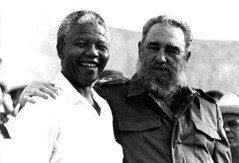
    In 1968, they and others formed the Republic of New Afrika and adopted African names; Milton became Gaidi Obadele. (Obadele is a Yoruba word meaning “the king arrives at home.”) At the group’s inaugural meeting in Detroit, about 200 delegates signed a declaration of independence and a “government in exile” was set up. Mr. Obadele was chosen information minister, and he published a handbook, “War in America.”

    A paramilitary unit, the Black Legion, to be clad in black uniforms with leopard-skin epaulettes, was formed.

    In March 1969, a gun battle erupted between police officers and the Black Legionnaires outside a Detroit church, leaving one officer dead. The militants were tried but not convicted in a trial that drew conflicting testimony about the confrontation.

    The Republic of New Afrika splintered the next year, with Milton, or Gaidi Obadele, saying he now rejected violence. Imari, who had now been elected president, led about 100 followers to Mississippi to build a black nation. After a deal to buy 18 acres from a farmer collapsed, the group established a headquarters in a house in Jackson.

    The local police and F.B.I. agents raided the house on Aug. 18, 1971. Some news reports said the purpose of the raid was to arrest a suspect in the Detroit killing. Others said the goal was to stop treasonous activities or to search for arms. Each side said the other fired first in a gun battle that left one officer dead.

    Though indicted in the killing, Mr. Obadele was found to have been 10 blocks away during the raid and charges were dropped. But in a related proceeding, he was convicted of conspiracy to assault a federal agent and was sent to prison.

    Mr. Obadele later earned a Ph.D. in political science from Temple University. He taught at several colleges, including Prairie View A&M University in Texas.

    He is survived by his daughters Marilyn Obadele and Vivian Gafford; his sons Imari II and Freddy Sterling Young; and numerous grandchildren and great-grandchildren.

    In 1983, Mr. Obadele was a defense witness in the trial of Cynthia Boston, a Republic of New Afrika member who was convicted in the holdup of a Brinks armored car in 1981. On the stand, he defended armed struggle.

    “We cannot tell somebody who is underground what to do,” he said. “If people feel that they must attack people who have been attacking and destroying and harming our people, then that is a decision they have to make.”

  • San Francisco Labor Council Resolution on the April 10 National March for Jobs

    San Francisco Labor Council Resolution – Adopted Feb. 8, 2010

    Commemorate the 75th anniversary of the WPA on April 10, 2010!

    We need the same kind of bold sweeping public jobs program today!

    Whereas, 75 years ago, on April 8, 1935, Congress passed legislation creating the largest public works program in U.S. history. The Works Progress Administration (WPA) created 8.5 million jobs during the Depression of the 1930s; and

    Whereas, organized labor and all working people and communities need to mark the 75th anniversary of the creation of the WPA by telling the government that today’s jobless crisis is as bad today as it was back then. We need the same kind of bold, sweeping jobs program that the people demanded in the 1930s; and

    Whereas, Martin Luther King Jr. dedicated the final months of his life to starting a movement for the right of all to a job or a guaranteed income – and we need that movement now more than ever; and

    Whereas, what we have now is at best a jobless recovery… an economy based on permanent high unemployment and low wages… a political and economic system that provides trillions of $ for Wall Street, and trillions of $ for war but nothing for large numbers of workers and the poor, who are facing joblessness, foreclosures, evictions, layoffs, low wages, hunger and homelessness; and

    Whereas, there are more than 20 million unemployed and underemployed people in the country today. We need a real WPA-type program that is big enough to ensure that those who need work get work — work that is socially useful and paying union wages and benefits – a real jobs program fully funded by the government; and

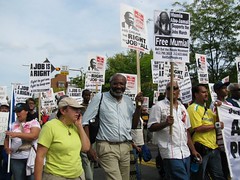
    Whereas, a national labor/community protest will take place on Saturday, April 10, 2010 in Washington, D.C., commemorating the 75th anniversary of the WPA and demanding enactment of a similar bold, sweeping public jobs program today; and

    Whereas, the issue of jobs is on the front burner: all it needs is a flame. The April 10th commemoration of the WPA’s 75th anniversary is consistent with the AFL-CIO’s 5-point Jobs Plan. April 10th would be a great stepping stone for a possible labor-led Solidarity Day III march on Washington in the fall of 2010, demanding that a real jobs program like the WPA be enacted today; therefore be it

    Resolved, that the San Francisco Labor Council endorse the April 10, 2010 national demonstration in Washington DC, commemorating the 75th anniversary of the WPA, part of the largest public works program in history, which created 8.5 million jobs during the Depression of the 1930s, and demanding enactment of a similar bold sweeping jobs program today;

    And be it further resolved, that copies of this resolution be sent to Bay Area labor councils, California Labor Federation, Change to Win, the AFL-CIO and key community allies, urging adoption.

    Resolution adopted by the San Francisco Labor Council, February 8, 2010, in San Francisco, California, by unanimous vote.

  • Chadian President Deby Urges Darfur Rebels in Sudan to Abandon Violence

    Chadian president urges rebels in Sudan’s Darfur to abandon violence

    Feb, 09, 2010 09:08 AM – Xinhua News Agency (China)

    KHARTOUM, Feb 09, 2010 (Xinhua via COMTEX) — Chadian President Idriss Deby Itno Tuesday urged rebels in the restive western Sudanese region of Darfur to abandon violence, saying that the peace talks currently underway in Doha, Qatar, were the ideal platform to resolving the Darfur conflicts.

    Addressing a gathering of Sudanese politicians and representatives of the Chadian community in Sudan, and with Sudanese President Omar al-Bashir standing beside him, the Chadian president said “the Darfur crisis can not be resolved through military ways, and I urged the armed men in Darfur to stop the hostilities.”

    The visiting Chadian leader also urged the rebel groups in eastern Chad to choose peace, saying that “It is no longer possible to reach power through gun, it can be achieved through voting boxes.”

    Deby asked the Sudanese government to exercise “sufficient flexibility” in the peace negotiations, saying that “the Doha track, which is supported by Chad, is the most suitable choice for realizing peace in the region.”

    He also said “those (Chadians) who live in Sudan should return to their homeland and I promise to provide them all opportunities. ”

    Meanwhile, the Chadian leader stressed his country’s desire to overcome differences with Sudan, saying “I have willingly come to Sudan, with my hands extended for peace. I came to transform the calmness in our relations into a comprehensive peace. I have no doubt that President al-Bashir feels the same.”

    Sudanese President Omar al-Bashir, for his part, said Sudan and Chad had put aside the differences and the two leaders decided to work together to achieve peace and development in their respective countries.

    “Today we affirm that we have folded the page of troubles. Our will make joint efforts to achieve peace and development and to provide services for our peoples,” he said.

    He also stressed the importance of coordination between the two countries’ leadership to overcome all difficulties, saying “there are enemies for peace in Sudan and Chad. These enemies may move again to undermine the two countries’ relations, therefore, we agreed to maintain direct contact between the two countries’ leadership to tackle any difference or problem.”

    The Chadian president arrived in Khartoum on Monday on an official tow-day visit, during which he and his Sudanese counterpart held closed-door talks in Khartoum and vowed to overcome differences between their countries and normalize bilateral ties to achieve security along their joint borders.

    Since the eruption of the Darfur conflicts in 2003, Sudan and Chad had been trading accusations that the other supported rebel groups and interfered in internal affairs, but last October the President Deby considered Khartoum’s offer to end hostilities and stop support for rebel movements based on both sides of the borders.

    Last month, the two countries inked a technical protocol on the establishment of the 3000-strong joint border force that will be led by a Sudanese commander during the first six months.

    As the April general elections are approaching in Sudan, an improvement of relations between Sudan and its western neighbor Chad could help ease tensions in Darfur and the re-election of the incumbent President al-Bashir.

    Sudan has ‘turned the page’ on Chad conflict: Beshir

    by Guillaume Lavallee

    KHARTOUM (AFP) – Sudanese President Omar al-Beshir said on Tuesday that Sudan had “completely turned the page” in its conflict with Chad and was ready to fully normalise relations with its neighbour.

    “I say to our people in Sudan and in Chad, we have completely turned the page on problems between us,” Beshir said, as Chadian President Idriss Deby Itno made his first visit to Sudan since 2004.

    “This visit has put an end to the problems between Chad and Sudan,” he further added during a joint news conference with Deby.

    “We have agreed to work together to achieve peace and stability,” he said.

    Deby said he was also willing to work for a new start with Sudan.

    “I have come with an open heart and my hand stretched out to write a new page in our relations,” Deby said.

    “I have no doubt that my brother Omar Hassan Ahmed al-Beshir has the same sentiments and will,” Deby told over a thousand people gathered in Khartoum.

    Chad and Sudan have had strained ties over the past five years, with Chad accusing Sudan of supporting rebels seeking to oust its government and Khartoum charging Ndjamena with backing ethnic minority rebels in western Darfur.

    In March 2008, the two states signed the Dakar agreement in the Senegalese capital, but it crumbled months later when a key Darfur rebel group, the Justice and Equality Movement, launched an unprecedented assault on Khartoum.

    This was followed by a surprise rebel attack on Ndjamena which came close to overthrowing Deby before government forces managed to rally and rout the insurgents.

    But in mid-January, Sudan and Chad agreed to deploy a joint force on their border, in order to end the presence of rebels on each other’s territory and halt their activities as part of normalisation efforts.

    “When we were told that President Deby was coming to Khartoum it was a surprise, but a pleasant surprise,” Beshir said.

    Beshir said joint projects would be set up in the border area between both countries in order to help those affected by the Darfur conflict.

    “A calm is not enough. Agreements and protocols alone cannot bring back confidence if politics are not included. It is time to outdo ourselves in order to seal this peace,” Deby said.

    “If I am with you today, it’s not purely for an accolade, I have come so that we can transform the current calm into definitive peace,” he said.

    The Sudanese leader has accepted an invitation to visit Ndjamena, but no date has yet been set, Sudanese officials said.

    In Jeddah, the Secretary General of the Organisation of the Islamic Conference, Ekmeleddin Ihsanoglu expressed “great satisfaction” with Deby’s visit.

    “The landmark visit to Sudan by President Deby reflects the genuine commitment of the two leaders to work together towards settling all the differences and strengthening bilateral cooperation between the two neighbouring countries, members of the OIC,” Ihsanoglu said.

  • NATO Warns Afghans Before Military Offensive

    Tuesday, February 09, 2010
    14:52 Mecca time, 11:52 GMT

    Nato warns Afghans before offensive

    Thousands of US Marines, Nato and Afghan troops are believed to be massed near the town of Marjah

    Afghan civilians have been warned to “keep their heads down” when US-led Nato forces launch a planned military offensive in southern Helmand province.

    Mark Sedwill, Nato’s senior civilian representative in Afghanistanm, admitted on Tuesday that fighting around the town of Marjah was likely to prompt an exodus from the area, but said that authorities were prepared to deal with it.

    The offensive in the area, which is currently under the control of Taliban fighters, is expected to be one of the largest since the Taliban were forced from government in 2001.

    Thousands of US Marines, Nato and Afghan troops are massed in the region, about 20km south of Lashkar Gah, for Operation Mushtarak which aims to drive Taliban out of the region, which notorious for its part in the drugs trade.

    Military leaders hope that the fact the offensive has been widely publicised will persuade Taliban fighters to lay down their arms before the fighting begins.

    Military phase

    “We very much hope that the military phase of this operation will go ahead swiftly and with as little incident as possible,” Sedwell told reporters in a briefing at Nato headquarters in Kabul.

    “The success of the operation will not be in the military phase.

    “It will be over the next weeks and months as the people … feel the benefits of better governance, of economic opportunities and of operating under the legitimate authorities of Afghanistan,” he said.

    Gulab Mangal, the regional governor, said a commission has been formed to handle the flow of displaced and any other fallout from the military action.

    “The commission is fully prepared. We have got tents. We’ve got food. We’ve got everything in place,” he said at the joint news conference with Sedwill on Tuesday.

    “So far we have had two waves of displaced people from the area – 72 and 92 families,” Mangal said.

    Up to 100,000 people are believed to live in the area.

    ‘Stay inside’

    Authorities have not advised people to leave the Marjah area but have warned them to stay inside and avoid road travel once the operation begins.

    “The message to the people of the area is of course keep your heads down, stay inside when the operation is going ahead,” Sedwell said.

    The military operation is the first phase of a plan to push out the anti-government fighters and return the area to civilian governance, Mangal said.

    “The main purpose is to have Afghan sovereignty in the area and expand the sovereignty of the republic of Afghanistan,” he said.

    “We have to clear the area of the opposition enemies in order to be able to stabilise the area.”

    Source: Agencies

  • Released Video Captures Extrajudicial Executions of Nigerians

    Tuesday, February 09, 2010
    18:37 Mecca time, 15:37 GMT

    Released Video Captures Extrajudicial Executions of Nigerians

    http://english.aljazeera.net/news/africa/2010/02/2010298114949112.html

    Nigerian police and military units carried out extrajudicial killings last year in the aftermath of clashes with members of a Muslim group in the north of the country, footage obtained by Al Jazeera appears to confirm.

    An estimated 1,000 people were killed as Nigerian government forces fought Boko Haram in Borno, Yobe, Kano and Bauchi states in July and August 2009.

    But the footage obtained by Al Jazeera shows that many of the deaths occurred once the fighting was over.

    Elements of the police and army staged a follow-up operation in which house-to-house searches were conducted and individuals were apparently selected at random and taken to a police station.

    ‘Shoot him in the chest’

    In the video, a number of unarmed men are seen being made to lie down in the road outside a building before they are shot.

    As one man is brought out to face death, one of the officers can be heard urging his colleague to “shoot him in the chest not the head – I want his hat”.

    As the executions continue another man is told: “Sit properly we want to take your picture.”

    The shootings continue as a crowd gathers further up the street in front of the police station.

    Voices can be heard saying: “No mercy, no mercy.”

    After the executions, the army officer who appears to have been in charge of the operation is seen to be handing over command to a senior police officer. Both men are clearly identified by the name tags on their chests.

    The family of Baba Fugu Mohammed, a respected community leader, told Al Jazeera that he was among those put to death outside the police station.

    “He was killed, he was killed, that’s what we believe. He was shot by the police,” one relative said.

    Fugu Mohammed was the father-in-law of Mohammed Yusuf, the Boko Haram leader whose group had battled the police, but the two had become estranged.

    His family said that he had come to help police restore order, but was shot.

    ‘Killings of the innocent’

    In the days following the clashes between the police and Boko Haram, the government, police and military repeatedly denied that civilians had been killed by their personnel.

    But Nigerian officials have since acknowledged that extrajudicial killings took place and an inquiry was set up to investigate the incident.

    “It was obvious [from] what we have seen and from the eye witnesses that the government police were doing the killings of the innocent,” Abubakar Umar Garda, a senator and a member of Nigeria’s ruling People’s Democratic Party party, told Al Jazeera.

    “The government is investigating the incident and as we go along the perpetrators will be put in front of the law and the law will take its course … the government acknowledged that this was a crime against humanity … you cannot shoot an unarmed civilian.”

    Fugu Mohammed’s family have given their story to the government commission set up to investigate the events that took place, but they are still waiting to receive an official explanation for the deaths.

    Senator Umar Garda could not confirm to Al Jazeera whether there had been any arrests relating to the killings and there have been few tangible signs of the inquiry bringing anyone to account.

    Boko Haram leader killed

    Aster Van Kregten, a Nigeria expert with rights group Amnesty International, told Al Jazeera that the group’s research suggested extrajudicial killings were widespread in Nigeria.

    “Our research shows that the Nigerian police are getting away with murder, they killed hundreds of people a year without any investigation – any investigation on whether the use of force was lawful or not,” she said.

    “What we saw on the footage happened seven month ago and we haven’t heard anything from the government whether they have arrested anyone and how far the investigation is going.”

    Among those killed in the aftermath of the clashes between Boko Haram and the police, was Boko Haram leader Mohammed Yusuf.

    In the Al Jazeera footage, he is seen wearing handcuffs and surrounded by heavily armed police officers.

    Nigerian police have said that Yusuf was killed while attempting to escape, but he died still wearing the handcuffs.

    In another video, which was made available shortly after last year’s fighting, Yusuf is shown inside the police station, his body covered with marks and bruises, as he is questioned about the organisation that he led.

    It is not known whether the injuries were caused during the fighting, arrest, or detention.

    ‘Extrajudicial killing’

    The New York-based Human Rights Watch described Yusuf’s death as “an extrajudicial killing”.

    “The extrajudicial killing of Mr Yusuf in police custody is a shocking example of the brazen contempt by the Nigerian police for the rule of law,” Eric Guttschuss, the organisation’s Nigeria researcher, said.

    Boko Haram, which means “Western education is prohibited” in the local Hausa dialect, has called for the nationwide enforcement of a strict interpretation of Islamic law, or sharia, even among non-Muslims.

    Last year’s clashes took place after suspected Boko Haram members, armed with machetes, knives, bows and arrows, and home-made explosives, attacked police buildings and officers.

    Nigeria’s 140 million people are nearly evenly divided between Christians, who dominate the south, and the primarily northern-based Muslims.

    Islamic law was implemented in 12 northern states after Nigeria returned to civilian rule in 1999 following years of military rule.

  • Former South African President Nelson Mandela: Profile of a Statesman

    Profile of a statesman

    Tue, 09 Feb 2010 08:26

    Nelson Mandela walked out of an apartheid prison 20 years ago on Thursday, beginning South Africa’s march to democracy and reconciliation that made him one of the world’s great statesmen.

    Now 91 years old and increasingly frail, he gives only occasional video addresses, most recently for the final draw of the World Cup, which he lobbied to bring to South Africa.

    When he does appear in public, he leans on his wife Graca Machel or on aides to walk.

    But in the popular consciousness, Mandela remains the towering figure who appeared on 11 February 1990, with arms outstretched on the balcony of Cape Town’s City Hall to greet the 50 000 people clamouring to see him after his 27-year imprisonment.

    “I greet you all in the name of peace, democracy and freedom for all,” he said then, in a speech broadcast across the globe.

    “Our struggle has reached a decisive moment,” he said. “We call on our people to seize this moment so that the process towards democracy is rapid and uninterrupted. We have waited too long for our freedom.”

    Four years later, the prisoner became president, setting South Africa on a course toward reconciliation by restoring dignity to the black majority and reassuring whites they had nothing to fear from change.

    “When he emerged from prison, people discovered that he was all the things they had hoped for and more,” said his fellow Nobel Prize winner, Archbishop Desmond Tutu.

    “He is by far the most admired and revered statesperson in the world and one of the greatest human beings to walk this earth.”

    Affectionately known as ‘Madiba’

    Rolihlahla Dalibhunga Mandela, affectionately known by his clan name “Madiba”, was born in Mvezo village in one of South Africa’s poorest regions, the Transkei. He is the great-grandson of a Tembu king.

    He was given his English name “Nelson” by a teacher at his school.

    An activist since his student days at Fort Hare University College in the southeast, Mandela opened South Africa’s first black law firm in Johannesburg in 1952, along with fellow activist Oliver Tambo.

    He became commander-in-chief of Umkhonto weSizwe (Spear of the Nation), the armed underground wing of the African National Congress, in 1961, and the following year underwent military training in Algeria and Ethiopia.

    After more than a year underground, Mandela was captured by police and sentenced in 1964 to life in prison during the Rivonia trial, where he delivered a speech that was to become the manifesto of the anti-apartheid movement.

    “During my lifetime, I have dedicated myself to this struggle of the African people. I have fought against white domination and I have fought against black domination. I have cherished the ideal of a democratic and free society…

    “It is an ideal for which I am prepared to die.”

    Mandela was jailed on Robben Island for 18 years before being transferred in 1982 to Pollsmoor prison in Cape Town and later to Victor Verster prison in nearby Paarl.

    As international sanctions mounted, hardline President PW Botha was replaced in 1989 by the more conciliatory FW De Klerk, who a year later ordered Mandela’s release. Both men were awarded the Nobel Peace Prize in 1993.

    Mandela embodied the hopes of his nation in April 1994 when he cast his ballot for the first time in his life.

    In office, he used his keen sense of the power of symbolism to further his drive for reconciliation, famously having tea with the widow of apartheid architect Hendrik Verwoerd, and donning the Springboks rugby jersey to congratulate the mainly white team’s victory in the 1995 Rugby World Cup.

    He served only one five-year term, but later devoted his energy to mediating conflicts, including the war in Burundi.

    In 1998, on his 80th birthday, Mandela, after having divorced Winnie Madikizela-Mandela, married Graca Machel, the widow of Mozambican president Samora Machel.

    In 2005, he announced his only surviving son had died of Aids and appealed for openness about the disease, one of the few African leaders to do so.