
Author: Matt Kelley

  • Film the Cops, Go to Jail

    Videos of police brutality have become fairly commonplace on YouTube, as mobile phones equipped with cameras have proliferated. But what if recording police activity was illegal? As it turns out, in some places, it already is.

    For an example of an agency responding to the advances in technology with exactly the wrong tone, look no further than the he Boston Police Department. Rather than embracing technology as a tool to help improve policing, the department is warping a 40-year-old wiretapping law in an attempt to prevent citizen watchdogs from filming raids, arrests, protests and other police activity.

    An excellent story in the Boston Globe last week from the New England Center for Investigative Reporting at Boston University explores the controversy in detail. The story is one of two people who were arrested after filming the cops on their cell phones — individuals whose arrests the department continues to stand by, on the ground that recording officers breaks a wiretapping law. “If an individual is inappropriately interfering with an arrest that could cause harm to an officer or another individual, an officer’s primary responsibility is to ensure the safety of the situation,” a spokesperson told the Globe.

    (more…)

  • Untested Rape Kits: Endangering the Public

    What can we expect in Los Angeles, now that officials have announced that 27 new crime lab positions aimed at eliminating the city’s backlog of untested evidence kits from sexual assaults won’t be filled?
    Well, for one and most obviously, it means further delays in critical tests in unsolved cases. And though a compromise proposal before the city council would outsource the tests to deplete the backlog, even with such outsourcing, what with overall volume, the city’s crime lab will likely end up back where it started — unable to meet demands and watching a new backlog expand.

    It’s not just rape victims that should be incensed by the delay, but the broader public — on behalf of such victims, yes, but also because this lapse means that public safety as a whole remains at risk. Having untested rape kits means that sexual assaults are going unsolved, leaving perpetrators free to commit further crimes. What’s more, untested evidence can allow innocent suspects to remain in jail and increase the chance of wrongful conviction.

    (more…)

  • Inside a Prison Hospice

    What does the end of life look like in prison?

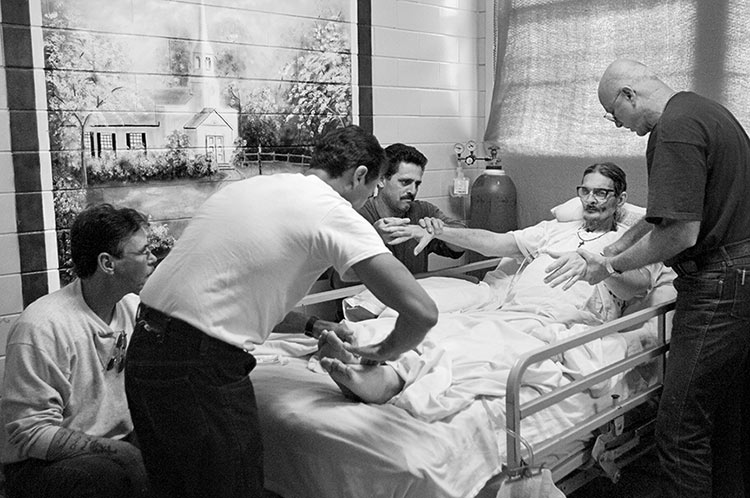
    Over the past three years, photographer Lori Waselchuk has visited the hospice at Louisiana’s Angola State Penitentiary to document the prison’s groundbreaking hospice program. Her images are an illustration of the system of cooperation and compassion between prisoners that can exist, and I’m glad they’re touring the world to open people up to that reality.

    Angola’s hospice, started more than a decade ago, is still one of only a few such programs in the nation. It is overseen by a nurse, but run mostly by prisoners who take care of one another. A quilting program helps the hospice raise money for basic needs.  And prisoner by prisoner, it’s helping change perspectives inside the system.

    At first, as Waselchuk told the Morning News, prison staff thought the hospice “was a scam; they thought these guys were going to abuse the system. It was all suspicion. ” But in the past 10 to 12 years, he says, the prisoners working there have “really convinced a lot of people,” and also taught many staff members “about compassion and that crime does not define the person.”

    “I wanted to make pictures,” she says, “that rose to how much I felt they could share.”

    To view Waselchuk’s moving images, you can check out the exhibition website here. As I’ve previously written, the documentary The Farm: 10 Down includes interviews about the hospice program and some footage of the program, and is also very much worth checking out.

    Photo Credit: Lori Waselchuk

  • Will Haiti’s Misery Be a Windfall for Private Prisons?

    While the world mobilizes to help Haiti dig out from last week’s devastating earthquake, private prison operator GEO Group could be preparing to profit from a “surge” of immigration detentions at a facility it operates in Guantanamo Bay.


    Some have speculated that Haiti’s misery will lead to an increase in Haitians attempting the dangerous 600-mile boat journey to Florida. If the U.S. experiences a spike in migrants trying to enter the country without documents, we’ll likely do what we do best: lock them up. And it’s likely that these detentions will be managed by GEO, the nation’s second-biggest private prison company, reports blogger Tom Barry at the Center for International Policy.

    GEO manages the Migrant Operations Center (MOC) at the U.S. military’s Guantanamo Bay Naval Station. The MOC has 130 beds, but GEO boasts that the prison “can house up to 500 detainees in a surge.” Planning to pack a facility to four-times capacity is certainly a red flag for potential abuse, but GEO usually charges the government a fixed rate per prisoner per day more bodies equals more dollars for GEO. The Obama administration, while planning to close the military detention facility at GITMO, has no plans to shutter MOC.

    In fact, as State Department spokesman P.J. Crowley recently told reporters, “Guantanamo is going to be an enormously valuable asset as we go through this.”

    FOX News reported on Friday that officials had not spotted any Haitian boats headed for the U.S. mainland since the earthquake, and Gen. Douglas Fraser says the U.S. is focused on relief efforts to improve the situation in Port-au-Prince. No official decision had been made on how to respond if Haitians did begin to seek U.S. shores in large numbers.

    If GEO’s position to profit from Haiti’s misery wasn’t ugly enough, however, it gets worse. Halliburton could get in on the deal, too.

    (more…)

  • Injustice Anywhere: MLK and Criminal Justice

    Today we mark the 81st birthday of Martin Luther King, Jr., and pause to consider a nation and world that has made great progress toward racial, economic and social justice in eight decades. But we still have a long way to go, and nowhere is that more evident than in our criminal justice policy.

    More than one in 100 Americans will spend tonight behind bars, and the vast majority of them are poor. The country is 75% white, but our prisons are 59% black or Latino. Fifty-five years after a young Martin Luther King, Jr., led the Montgomery bus boycott, something is still very, very wrong with social and racial justice in our country.

    In his famous Birmingham Jail letter of April 16, 1963, King wrote perhaps his second most-quoted line: “Injustice anywhere is a threat to justice everywhere.” These words, written behind bars, continue to inspire activists today in the fight for justice in our courts, our police stations and our jails.

    (more…)

  • Can the Feds Keep Sex Offenders Behind Bars?

    This week, controversy sparked as the U.S. Supreme Court heard oral arguments on whether the federal government can hold prisoners past the end of their sentence if they are considered “sexually dangerous.” Although the court seemed likely to allow the government to continue the process, Justice Antonin Scalia gave U.S. Solicitor General Elena Kagan an earful about the issue.



    Hard for me to say, but this is one of those rare days when I’m actually on board with Scalia here.

    More than 20 states have laws that permit keeping mentally ill or sexually violent prisoners behind bars, even after they’ve served their sentences. Such laws were sanctioned in a 1997 Supreme Court ruling, but whether or not the federal government shares that power is still up in the air. In 2006, Congress extended this policy to federal prisoners in the Adam Walsh Act, and now with the case U.S. v. Comstock, the Supreme Court is considering whether the policy oversteps its bounds with the law.

    In this particular case, the defendant, Graydon Comstock, was six days from finishing a 37-month sentence for child pornography when he was declared “sexually dangerous” by the attorney general and kept incarcerated. He and other similarly treated inmates have sued the government, arguing that Congress is seizing powers reserved only for the state.

    As Scalia has said, “This is a recipe for the federal government taking over everything.”

    By contrast, the government argues it has identified only 105 prisoners as “sexually dangerous”  — a tiny fraction among the 15,000 federal prisoners with a history of sexual violence or child molestation.

    The last problem we have in this country is too-short sentences, but in certain cases, if we need to hand down longer terms (with the possibility of parole) at trial, that practice would be far preferable to the practice of the federal government locking up these inmates indefinitely.

    To be sure, there are some prisoners in our country who pose a threat to our society and shouldn’t be released. But it’s the role of our court system — not Congress, not prosecutors — to sentence them and decide.

    More from SCOTUSblog, WSJ Law Blog and Reuters.

    Photo Credit: Rob Crawley

  • Help Fund Real Justice Reporting

    If you’ve ever been frustrated with sensationalized crime coverage in the U.S., good news is on the way. Today’s ever-changing media landscape is just the backdrop that’s needed to shake up the way reporters cover crime, courts and prison.

    Change.org readers have played a role in this revolution — for example, by funding a great ongoing reporting project at California public radio station KALW, digging into the day-to-day operation of Oakland’s busy court system.

    The series was funded through Spot.us, which is leading the way in developing crowdfunded journalism. Thanks to donations from readers and a matching grant from the Harnisch Foundation, KALW sent reporter Rina Palta into Oakland’s courts for two weeks in November to launch her own investigation into the system. She uncovered fascinating stories big and small, and opened up a key window into the daily grind and seldom-exposed recesses of our court system.

    The media tends to gravitate toward coverage of the more dramatic breakdowns in the criminal justice system, but what’s also needed is a look at the daily operations that might seem mundane — from court fees to jury selection. For an idea of what this looks like, check out Palta’s blogging here, and a radio segment about her experience here.

    (more…)

  • Changing Direction in the UK

    A new report from a key committee of the British Parliament finds that incarceration policy in the United Kingdom has swerved far off track and needs sweeping reform. It’s a refreshing message from the British government, and one that I hope resonates on this side of the Atlantic.

    The House of Commons Justice Committee Report, two years in the making, expresses serious concern that “the Government seems to accept the inevitability of a high and rising prison population and remains committed to building larger prisons” and calls for public investment in reentry, community supervision, alternative sentences and other rational reforms. Thanks for leading the way, UK.

    The report’s list of 98 conclusions and recommendations reads like a prison reform manifesto, and it would be wonderful to see even a third of these bullet points make their way into law. I also hope that the committee report can offer some lessons and guidance to Senator Jim Webb’s proposed criminal justice commission here in the USA. Well, first I hope that Webb’s commission actually happens (President Obama apparently supports the idea and Harry Reid, with all of the political capital he has left, says creating Webb’s commission is a top-ten priority in 2010).

    (more…)

  • Tortured into a False Confession, Freed Two Decades Later

    Michael Tillman was freed today in Chicago after 23 years in prison for a murder he didn’t commit. He is yet another victim of the reign of terror of former Chicago Detective Jon Burge, who orchestrated the torture of as many as 200 suspects while overseeing detectives on Chicago’s South Side in the 1990s.

    Tillman has said for two decades that he was tortured into admitting to a crime he didn’t commit. Even when another man was arrested and convicted for the murder, however, Tillman’s confession stood up in court and he remained imprisoned. He says Chicago detectives waterboarded him with 7-Up, punched him in the face and stomach until he vomited blood and put a plastic bag over his head, and that he gave them a false story to make them stop.

    Thanks to Burge and other corrupt detectives, Tillman suffered an unimaginable injustice and the family of the victim in this case has endured years of repeatedly seeing their relative’s murder reinvestigated. Nobody wins.

    (more…)

  • A Moratorium on Mongolia’s Death Penalty

    Citing his country’s dignity, Mongolia’s president called for a moratorium on the death penalty in a speech to Parliament today.

    “Mongolia is a dignified country … and our citizens are dignified people,” President Tsakhia Elbegdorj said in a speech to Mongolia’s parliament. “Therefore, I ask Mongolia to put behind us this death penalty which degrades our dignity to death.”

    The BBC reported that one person was executed in Mongolia in 2008 and nine people are believed to be on the country’s death row. Although abolishing the death penalty outright seems to be an uphill political battle for Elbegdorj, he has the power to commute sentences to life and to prevent any executions from taking place on his watch.

    (more…)

  • Sane Sentencing in School Zones

    With a week left in office, outgoing New Jersey Gov. Jon Corzine is leaving behind a string of smart criminal justice reforms. Late, I suppose, is better than never.

    Corzine signed a bill on Tuesday that gives discretion back to judges in drug cases for people convicted of certain drug crimes in school zones. It’s a sweeping change, and one that was a long time coming. Now if other states could only follow Jersey’s lead.

    Sentencing discretion is important in all types of cases, but it’s especially critical in these school-zone offenses, where studies have shown that broad-brush mandatory minimums completely fail to make schools safer or to prevent kids from buying drugs. The previous law included mandatory sentences of at least a year for marijuana offenses and three years for other drugs. With discretion, a judge can avoid a long sentence for a person caught with a small amount of a drug who happens to be 999 feet from a school. In many urban areas, as the great work of the Prison Policy Initiative has shown, almost everything is within 1,000 feet of a school.

    Meanwhile, a judge can still choose to hand down a harsh sentence when evidence shows that a drug dealer was actually targeting middle schoolers as his customers. That kind of activity needs to be prevented, but we don’t need mandatory minimums to stop it. In fact, they don’t work.

    (more…)

  • A Big Week for Marijuana Legalization

    The California Assembly’s public safety committee voted 4-3 yesterday in favor of a bill that would legalize marijuana and regulate it like alcohol. Although the bill likely won’t go anywhere (it will miss a deadline to reach the full floor for a vote), this is the first time a statewide committee has approved such a measure and it’s a sure sign that attitudes are  changing in California and across the country.

    The news came a day after New Jersey became the 14th state to approve marijuana for medicinal use. Gov. Jon Corzine says he’ll sign the bill into law before he leaves office this week.

    The momentum toward marijuana legalization continues to grow. On Monday, activists filed a petition in Washington state that will put full legalization on the ballot before voters in November.

    (more…)

  • Inside a Prison Riot

    It has been five months since violence erupted at California’s overcrowded men’s prison in Chino, but stories of abuses suffered by prisoners in the riot’s aftermath are now coming to light.

    After the long night of violence on August 8 when two housing blocks at the facility were burned and destroyed, some prisoners say they spent as long as four days straight in outdoor cages with no protection from the sun. Others say they are still waiting for health care services to treat injuries suffered during the riot.

    A woman whose relative was locked up at the time of the riot has launched a website called “In The Riot” to share the first-hand stories of prisoners who suffered mistreatment in the days and months following the riot.

    One prisoner writes: “It was hot in California in August and I received a severe sun burn because I lived in a dog kennel cage under the heat of the sun. The nights were freezing cold and I literally begged them to give me a blanket or some clothes, but they REFUSED. They also did not give me any medical attention for my stab wounds.”

    Another: “I was another one who was zip-tied for hours, placed in cages for 3 days with no clothes and no blankets, not given food for hours.”

    (more…)

  • Tearing Down Russia’s Prisons

    Reforms that took effect on Sunday could lead to a reduction of more than 10% in Russia’s prison population — currently at more than 1 million.

    Activists and observers say the conditions in Russia’s prisons are deplorable, and even President Dmitry Medvedev said in a live television interview that Russia’s “system of the execution of punishment has not changed for decades” and needs reform.

    Medvedev fired top prison officials and pushed for systemic changes after a prominent 37-year-old attorney died of heart failure in a detention facility in November, after complaining repeatedly that he was being denied access to health care.

    It’s a shame that it takes the death of a wealthy prisoner to get the establishment to take notice of unacceptable prison conditions, but that’s the way it is. The rules that took effect this week include alternatives to incarceration like house arrest for non-violent crimes.

    (more…)

  • Going the Other Way: South Dakota Could Shrink Sex Offender Registry

    I wrote last week about a misguided new law in Nebraska that has expanded the state’s sex offender registry by publishing the name and information of everyone convicted of a “ sexual offense” in the state — from relatively minor convictions like indecent exposure and statutory rape to serious crimes like sexual assault.

    A proposal in South Dakota could take that state in the other direction: removing people from the list after 10 years if they were convicted of less-serious offenses. An article in the Sioux Falls Argus Leader presents Tacy Chrispen’s son as an example of the desperate need for this kind of reform. He was a high school senior when he was convicted of statutory rape for having consensual sex with his 15-year-old girlfriend. Under current law, he’ll spend the rest of his life on the registry.

    Putting someone like him on the registry for life just isn’t helpful. Not only does it throw an undeserved wrench in his life, but it also dilutes any possible impact the registry might have on public safety.

    (more…)

  • Supreme Court Revisits Right to Confront Forensic Witnesses

    The U.S. Supreme Court will hear oral arguments this morning in a case that could challenge last term’s groundbreaking decision granting criminal defendants the right to call forensic analysts as witnesses.

    Seven months ago, the court ruled, in a 5-4 decision in Melendez-Diaz v. Massachusetts, that under the Confrontation Clause of the constitution, prosecutors can’t simply enter lab reports as evidence without giving defendants a right to cross-examine the analyst who conducted the tests. Since the decision came down, prosecutors have complained that the new rule puts an unmanageable burden on them — and 26 states join Virginia is today’s case, asking for a reversal of the decision in Melendez-Diaz.

    Today’s case, Briscoe  et. al. v. Virginia, could provide a window for a slim majority of the court to limit last term’s decision. The makeup of the court has changed — Justice Sonia Sotomayor, a former prosecutor, has replaced David Souter, a member of the majority in Melendez-Diaz.

    Melendez-Diaz protected a critical right for defendants in criminal cases, and it should be upheld. The case has had most its most immediate impact in drug cases, but it also ramifications in violent crimes. More than half of the wrongful convictions overturned through DNA testing to date were caused in part by faulty forensics. Without the right to challenge a forensic analyst, defendants are at a disadvantage when prosecutors throw flashy — but questionable — CSI antics into a trial.

    (more…)

  • China’s Draconian “Drug Treatment”

    A new report this week from Human Rights Watch peers into China’s Draconian and ineffective incarceration of people struggling with drug addiction.

    China has plenty of problems with its harsh, sprawling prison system, and its treatment of drug users is no exception. Police send drug users to mandatory “rehabilitiation centers” for a minimum stay of two years, without any trial or appeal. The conditions are deplorable, with no medical treatment for drug addiction at all, frequent beatings, inedible food and showers only once a month.

    Human Rights Watch reports that at any given time, more than half a million Chinese citizens are subject to this treatment, for infractions as small as a single positive drug test.

    (more…)

  • The School to Prison Pipeline Game

    Here’s a hypothetical:

    You’re in high school. You keep a cell phone on you for family emergencies even though you know it’s against the rules. You’re caught and threatened with suspension? What do you do?

    A new online game from the ACLU uses situations like this to show that the school-to-prison pipeline is more than a hypothetical. There’s a slippery slope that can — and does — lead from one institution to another.

    See for yourself. Play the game here.

    (more…)

  • The Lame Duck Governator Takes a Misguided Stab at Prison Reform

    After years of allowing California’s prisons to grow at an uncontrolled pace, Gov. Arnold Schwarzenegger used his final state of the state speech on Wednesday to call for a mandatory rebalancing of the state budget to focus on maintaining the state’s world-class universities and cutting back on prison spending.

    It sounds good, but is it all talk? He’s raising these issues too late to personally do much about it (he’ll be out of office a year from now), and he’s proposing mandatory budget levels unlikely to fly (at least 10% on higher education and no more than 7% on prisons). Even Schwarzenegger himself has argued against this kind of “autopilot budgeting” in the past.

    The trick to fixing a state criminal justice system isn’t only cutting dollars from the budgets, it’s how you cut. The details of the governor’s plan make this point for me. He wants to save money through privatization of facilities and health care services, the most nearsighted and ineffective approach possible.

    (more…)

  • Sexual Assaults Rampant in Juvenile Detention

    A report released today by the U.S. Bureau of Justice Statistics reveals that more than 12% of young people in juvenile detention facilities are sexually assaulted during their incarceration. The study points specifically to a serious problem with staff in these facilities: 80 percent of juvenile prisoners reporting abuse were abused by staff, and, surprisingly, 95 percent of those abused by staff were abused by female staffers.

    Writing today on the New York Review of Books blog, Just Detention International Executive Director Lovisa Stannow and writer David Kaiser point to these new statistics as a sign of the work to be done in preventing sexual assault in prison. Not only are these numbers shocking, they write, they’re also probably underreported, because prisoners are often hesitate to report assaults and because some facilities and juveniles were left out.

    Looking at the high numbers of staff assaults, Stannow and Kaiser write:

    Staff caught having sex with inmates often claim it’s consensual. But staff have enormous control over inmates’ lives. They can give them privileges, such as extra food or clothing or the opportunity to wash, and they can punish them: everything from beatings to solitary confinement to extended sentences. The notion of a truly consensual relationship in such circumstances is grotesque even when the inmate is not a child.

    (more…)